Skip to content
mannafest.faith

Voices and influences

John Calvin

1509 to 1564[1][2]

A French theologian, pastor and reformer of the church in Geneva during the Protestant Reformation.[2]

Reformed
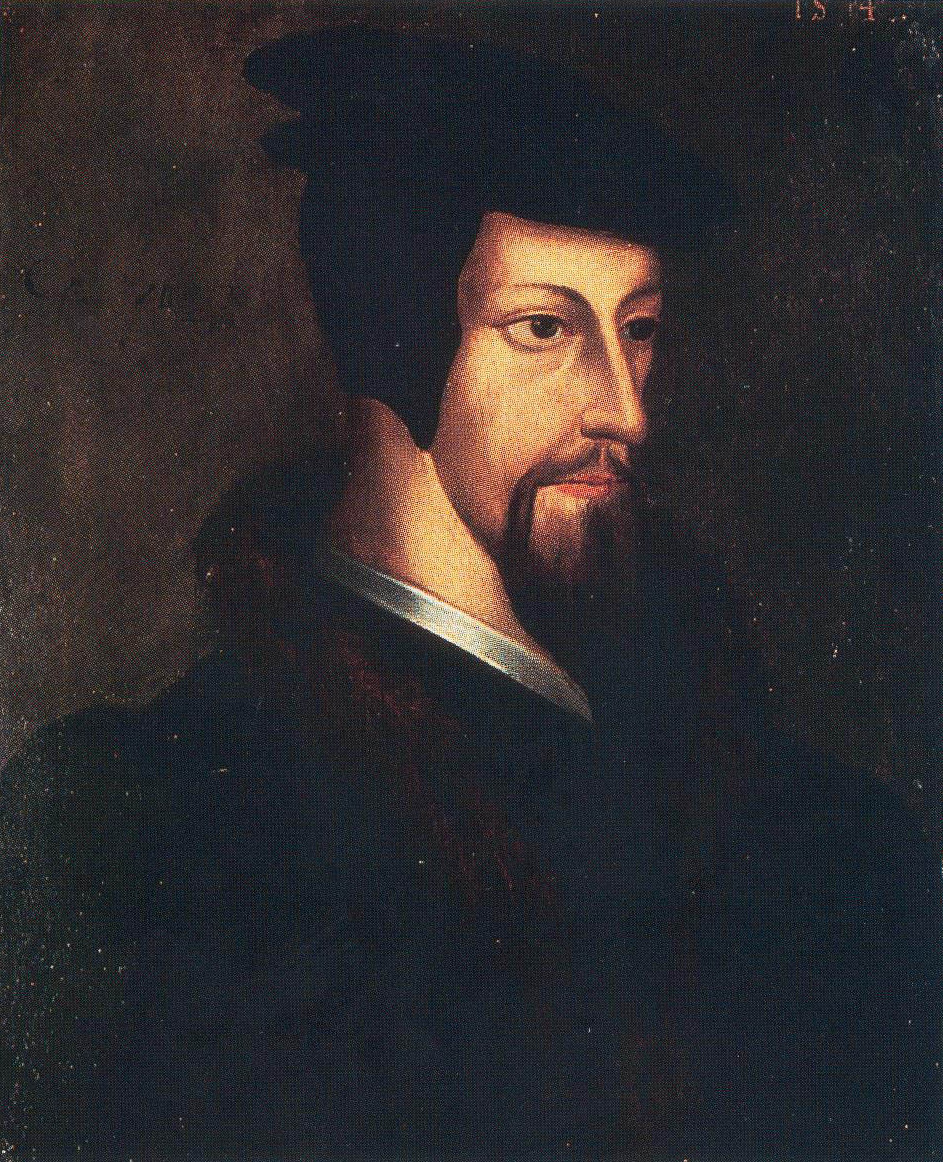
John Calvin as a young man, 16th century. Painting by Flemish school, Public domain, from Wikimedia Commons.

At a glance

Born
10 July 1509, Noyon, Picardy, as Jehan Cauvin[1][2]
Died
27 May 1564, Geneva, aged 54[1][2]
Family
Married Idelette de Bure in 1540; she died in 1549[2]
Tradition
Protestant; Wikipedia calls him the principal figure of the theology later named Calvinism[2]
Office
Moderator of the Company of Pastors of Geneva, 1541 to 1564[2]
Copyright
Public domain, in English translations that CCEL marks public domain, among them Henry Beveridge's Institutes, made in 1845 for the Calvin Translation Society, and William Pringle's Harmony of the Evangelists, which the Society brought out[3][4][5][6][7]

Life

He was the second of three sons who survived infancy, and his father, Gérard Cauvin, was the cathedral notary.[2] Drawn at first to the priesthood, he turned to law at Orléans and Bourges.[2] He broke from the Roman Catholic Church around 1530, and when violence against Protestants spread in France he fled to Basel.[2]

In March 1536 he published the first edition of the Institutes of the Christian Religion, a defence of his faith that he also meant as a first instruction in it.[2] That year William Farel recruited him to the Reformation in Geneva, but the city's council resisted their reforms and expelled them both.[2] At Martin Bucer's invitation he went to Strasbourg, where he led a church of French refugees, and in August 1540 he married Idelette.[2]

In 1541 he was invited back to lead the church of Geneva, and on 20 November the council passed his Ecclesiastical Ordinances, which set four orders of ministry: pastors, doctors, elders and deacons.[2] Their son Jacques, born prematurely on 28 July 1542, lived only briefly, and after Idelette's death he never married again.[2]

In a letter to Farel in 1546 he wrote that if Michael Servetus came to Geneva, as far as his authority went, he would not let him leave alive.[1][2] Servetus, a Spanish physician and theologian whose book rejected the Trinity, was arrested in Geneva in August 1553 on charges drawn up by Calvin's secretary.[1][2] After hearing the opinions of Zurich, Basel, Bern and Schaffhausen, the council condemned him as a heretic, refused Calvin's request that he be beheaded rather than burned, and had him burned alive at Champel on 27 October.[1][2] Wikipedia records that in May 1555, after his opponents took to the streets and their leaders fled, the plotters who remained in the city were found and executed with his approval.[2] Philip Schaff writes that Perrin fled with Vandel and Berthelier, that five of the fugitives were condemned to death, and that the sentence was carried out in effigy in June 1555.[1]

The school he had sought for the children of Geneva opened on 5 June 1559, and the last edition of the Institutes appeared that year.[2] He was buried the day after his death in an unmarked grave in the Cimetière des Rois.[2]

Emphasis in teaching

Knowing God and ourselves

He opened the Institutes by teaching that true wisdom consists almost entirely of the knowledge of God and the knowledge of ourselves, so bound together that it is hard to say which comes first.[3]

Seen in Institutes of the Christian Religion, book one, chapter one

The witness of the Spirit

He taught that our conviction of the truth of Scripture must rest on the secret testimony of the Spirit rather than on human reasons.[3]

Seen in Institutes of the Christian Religion, book one

Predestination

He defined predestination as the eternal decree by which God determined what he wished to happen with regard to every man, some to eternal life and others to eternal damnation.[3]

Seen in Institutes of the Christian Religion, book three

Accomplishments

  1. 1536Brought out the Institutes at Basel.[2]
  2. 1538Took up the pastorate of French refugees at Strasbourg.[2]
  3. 1541Saw Geneva adopt his church order.[2]
  4. 1559Finished the Institutes in four books of eighty chapters.[2]

Where to find his work

The Christian Classics Ethereal Library gives his Institutes and his commentaries free to read in public domain English.[3][7]

Books

  1. Institutes of the Christian Religion

    1536[3]

    This English text is Henry Beveridge's translation of 1845, made for the Calvin Translation Society.

    Read free at CCEL

  2. Tracts Relating to the Reformation

    Read free at the Internet Archive

Exposition commentary

  1. Commentaries on the First Book of Moses Called Genesis

    This edition is John King's translation from the Latin, compared with the French edition.[4]

    Read free at CCEL

  2. Commentary on the Book of Psalms

    Read free at CCEL

  3. Commentary on the Gospel according to John

    Read free at CCEL

  4. Commentaries on the Catholic Epistles

    This edition was translated and edited by John Owen, vicar of Thrussington.[7]

    Read free at CCEL

Quotations

“For, since he knew that he was invested by God with no common character, in being made the father of the fathers of the Church, he fulfilled, in the immediate prospect of death, the prophetic office, respecting the future state of the Church, which had been enjoined upon him.”

Commentaries, 1554

Genesis 48:1[8]

“For this purpose the disciples of Christ must be bold and courageous, that they may be always ready for martyrdom. Now confession of Christ, though it is regarded by the greater part of men as a trifling matter, is here represented to be a main part of divine worship, and a distinguished exercise of godliness.”

Mark 8:38[8]

“Accordingly, he employed the words Spirit and water to mean the same thing, and this ought not to be regarded as a harsh or forced interpretation”

Commentary on the Gospel according to John, volume 1, on John 3:5

John 3:5[9]

“We are taught, secondly, that it is the beginning of our life, when God, having been pacified by the death of his Son, receives us unto favor: for propitiation properly refers to the sacrifice of his death.”

Commentaries on the Catholic Epistles, on 1 John 4:10

1 John 4:10[10]

Sources

  1. 1Philip Schaff, History of the Christian Church, volume VIII, Modern Christianity: The Swiss Reformation, third edition, revised, Christian Classics Ethereal Library. ccel.org/ccel/schaff/hcc8 Opened 15 November 2026
  2. 2“John Calvin,” Wikipedia. en.wikipedia.org/wiki/John_Calvin Opened 15 November 2026
  3. 3John Calvin, Institutes of the Christian Religion, translated by Henry Beveridge (1845), Christian Classics Ethereal Library. ccel.org/ccel/calvin/institutes Opened 15 November 2026
  4. 4John Calvin, Commentaries on the First Book of Moses Called Genesis, volume two, translated by John King, Christian Classics Ethereal Library. ccel.org/ccel/calvin/calcom02 Opened 15 November 2026
  5. 5John Calvin, Commentary on a Harmony of the Evangelists, Matthew, Mark, and Luke, volume one, translated by William Pringle, Christian Classics Ethereal Library. ccel.org/ccel/calvin/calcom31 Opened 15 November 2026
  6. 6John Calvin, Commentary on John, volume one, Christian Classics Ethereal Library. ccel.org/ccel/calvin/calcom34 Opened 15 November 2026
  7. 7John Calvin, Commentaries on the Catholic Epistles, translated and edited by John Owen, Christian Classics Ethereal Library. ccel.org/ccel/calvin/calcom45 Opened 15 November 2026
  8. 8John Calvin, “Commentaries,” 1554.
  9. 9John Calvin, “Commentary on the Gospel according to John, volume 1, on John 3:5.” ccel.org/ccel/c/calvin/calcom34/cache/calcom34.txt
  10. 10John Calvin, “Commentaries on the Catholic Epistles, on 1 John 4:10.” ccel.org/ccel/calvin/calcom45/calcom45.v.v.iii.html

Every work cited on MannaFest is listed with its terms in the sources registry.

Keep Studying

Pages that name John Calvin430

Doctrines149

Show the next 6 titles

Passages and psalms49

Show the next 6 titles

Stories46

Show the next 6 titles