
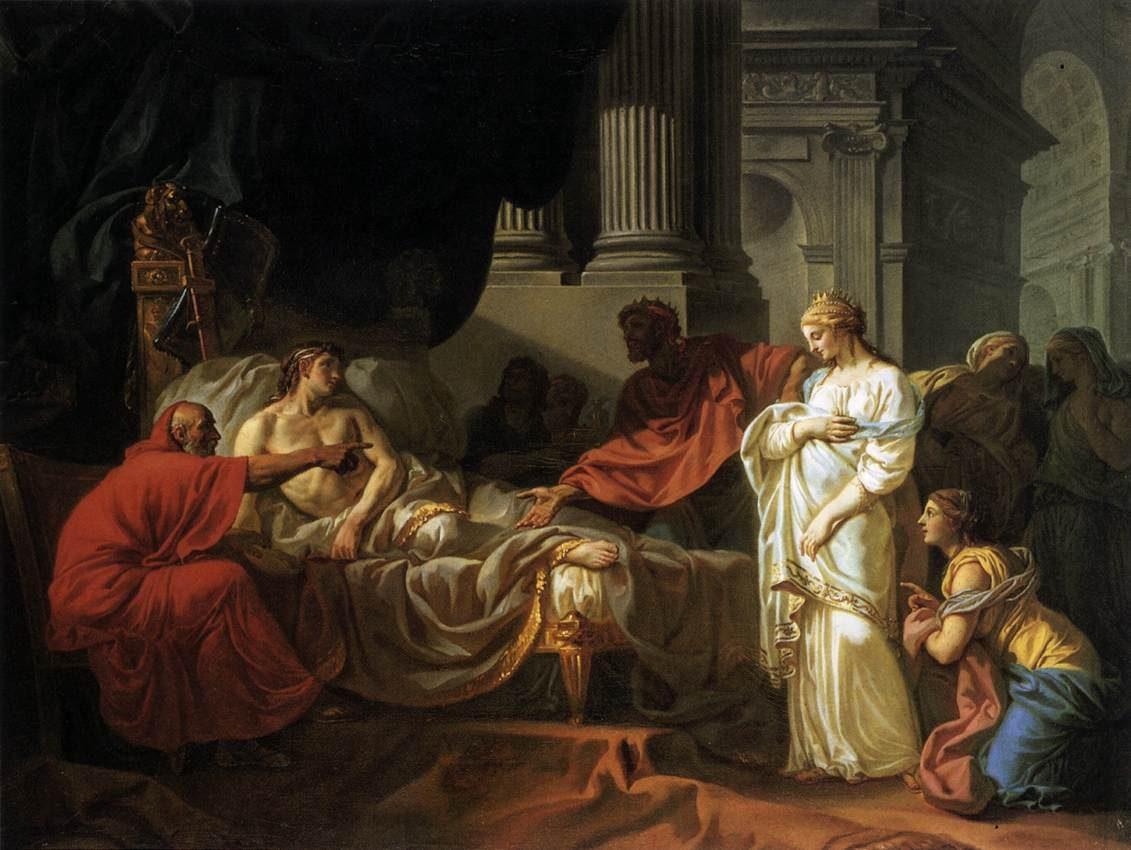
Jacques-Louis David, Antiochus and Stratonice, 1774. Public domain.
Daniel 11 · Group · Featured Study
The Kings of the North and the South
Two royal lines descended from Alexander's generals fought over Judea for more than a century.
The king of the South will grow strong, but one of his commanders will grow even stronger and will rule his own kingdom with great authority.
- Began
- After Alexander's death in 323 BC, when his generals divided his empire
The angel's account in Daniel 11 follows two royal lines through thirty-one verses before it reaches verse 36.
Summary
The kings of the South were the Ptolemies of Egypt, and the kings of the North were the Seleucids of Syria. Judea lay between the two kingdoms, and both claimed it.
- Three battles of the wars, Raphia, Paneas and Magnesia, stand behind verses 11 to 19.
- Antiochus IV is given fifteen verses, more than any other king.
- Readers part over whether verse 36 goes on with Antiochus or turns to a king at the end of the age.
Two Kings Named by Direction
The angel's account turns from Alexander's divided kingdom to two of its heirs.
The chapter calls each king by the side of Judea his land lay on. Adam Clarke names the king of the South as Ptolemy Lagus, who governed Egypt, and the commander who grew stronger as Seleucus Nicator, who held Syria, Babylon and Media to the north.
Eleven Kings on One Timeline
Eleven of the kings stand on the timeline, each against the verses the commentators give him.
The reigns of the two lines overlap from the first kings to Antiochus IV and Ptolemy VI.
To scale: 11 of 11 stops dated; a bar is a span; a mark that would lie on another stands in a lane under the axis.
- Ptolemy I Soter305 to 282 BCEgypt's lineDaniel 11:5
- Seleucus I Nicator305 to 281 BCSyria's line, the commander of the same verse
- Ptolemy III Euergetes246 to 221 BCEgypt's lineDaniel 11:7 to 9
- Seleucus II Callinicus246 to 225 BCSyria's lineDaniel 11:9
- Seleucus III Ceraunus225 to 223 BCSyria's lineDaniel 11:10
- Antiochus III the Great223 to 187 BCSyria's lineDaniel 11:10 to 19
- Ptolemy IV Philopator221 to 203 BCEgypt's lineDaniel 11:11 to 12
- Ptolemy V Epiphanes203 to 181 BCEgypt's lineDaniel 11:14 to 17
- Seleucus IV Philopator187 to 175 BCSyria's lineDaniel 11:20
- Ptolemy VI Philometor181 to 164 BCEgypt's lineDaniel 11:25 to 27
- Antiochus IV Epiphanes175 to 164 BCSyria's lineDaniel 11:21 to 35
Each bar runs from a king's first year to his last.
Ptolemy IV Philopator, Ptolemy V Epiphanes, Seleucus IV Philopator, Ptolemy VI Philometor, Antiochus IV Epiphanes
Six Turns of the War
The war turns six times between the royal marriage of verse 6 and the tax collector of verse 20.
A DAUGHTER SENT NORTH
Berenice, daughter of Ptolemy II, was married to Antiochus II, and she and her son were murdered.
HER BROTHER'S REVENGE
Ptolemy III invaded the north and carried its gods and vessels back to Egypt.
THE SONS OF THE NORTH
Seleucus III and Antiochus III raised armies against Ptolemy IV, who won a complete victory at Raphia on 22 June 217 BC.
THE BEAUTIFUL LAND TAKEN
Antiochus III beat the Egyptian army at Paneas in 200 BC and took Coele-Syria, with Judea.
A DAUGHTER GIVEN SOUTH
Antiochus III gave his daughter Cleopatra to Ptolemy V, who married her in 193 BC.
A COMMANDER ENDS HIS REPROACH
Rome defeated Antiochus III at Magnesia, and his son Seleucus IV sent Heliodorus for the temple's money.
The sons of the north, The Beautiful Land taken, A daughter given south, A commander ends his reproach
The King Given Fifteen Verses
These verses are matched to the career of Antiochus IV by commentators from Jerome to Barnes.
Theodoret of Cyrus names the despicable person of verse 21 as Antiochus Epiphanes, who came back from Rome and took the throne after his brother Seleucus. Adam Clarke takes the prince of the covenant in verse 22 to be the high priest Onias, whom Antiochus removed.
Jerome reports that Porphyry read verses 25 and 26 of Antiochus's campaign against his sister's son, Ptolemy VI. On verse 27 Jerome writes that Antiochus made peace with Ptolemy and ate at the same table with him while he plotted against him.
Albert Barnes and John Gill read the ships of Kittim in verse 30 as the Roman envoys led by Caius Popilius Laenas, who required Antiochus to give up his war on Egypt. Jerome writes that on his return Antiochus came against Judea and robbed the temple.
His war on the temple and on the faith of Judea, and the revolt it raised, are taught on two pages of their own.
The Land Between
The battles of verses 11 to 16 were fought on the road between Egypt and Syria.
The Seleucids and the Ptolemies fought six Syrian Wars in the third and second centuries BC. The prize was Coele-Syria, the corridor between Asia and Egypt.
The battle at Raphia, near modern Rafah, was one of the largest of the ancient world. The battle of Paneas was fought near the place later called Caesarea Philippi.
Ptolemy I won Egypt after Alexander died and later declared himself its ruler. The kingdom Seleucus founded in 312 BC lasted until Rome annexed it in 63 BC.
What the Chapter Leaves Unnamed
Two silences stand in Daniel 11's account of the kings.
No king of the North or the South is named, and every name given to them comes from the commentators and the histories.
Of the kingdoms that took Alexander's empire, the chapter follows two and passes over the rulers of Macedonia and Asia Minor. Theodoret of Cyrus gives the reason that no grief befell the Jews through them.
Refined Until the Time of the End
Daniel 11:33 to 35 turns from the kings to the wise who teach and fall.
Some of the wise will fall, so that they may be refined, purified, and made spotless until the time of the end, for it will still come at the appointed time.“Daniel gave the reason why God permitted them to be involved in such trials. What is the reason? ‘To purge them, to choose them and to make them white until the time of the end’ … so as to cleanse them and to show who among them was genuine and approved.”
John Chrysostom · Discourses Against Judaizing Christians 5:7.6 · on Daniel 11:35Patristic
A Voice on the Kings
John Calvin reads the angel's first words in Daniel 11 as a claim to hold the kings of Persia back.
John Calvin (1509 to 1564)
“And I, in the first year of Darius the Mede, stood up to strengthen and protect him.“I have not the slightest doubt of my present power to restrain these kings, lest they should pour forth their fury upon the people. The full meaning is this, the king of the Persians is nothing, and can do nothing except through me. I was God's servant in transferring the monarchy of the Medes and Chaldeans to the Persians, as well as that of the Babylonians to the Medes.”
John Calvin · Commentaries · on Daniel 11:1Reformed
Where Does the Chapter Turn?
Readers are divided over whether Daniel 11:36 to 45 still describes Antiochus IV.
Then the king will do as he pleases and will exalt and magnify himself above every god, and he will speak monstrous things against the God of gods. He will be successful until the time of wrath is completed, for what has been decreed must be accomplished.Antiochus to the end of the chapterAlbert Barnes; Theodoret of Cyrus
Barnes, in his Notes on Daniel, holds that the verse refers beyond question to Antiochus Epiphanes and was fulfilled in him. Theodoret, in his Commentary on Daniel, reads the success of verse 36 as Antiochus's own, lasting until God's wrath was spent.
“Antiochus will enjoy success, but not forever: ‘until his wrath has been spent,’ that is, until he kindles and draws out God's exceedingly great wrath. He calls the retribution God inflicts ‘his wrath,’ for the divine nature has no passion.”
Theodoret of Cyrus · Commentary on Daniel 11:36 · on Daniel 11:36Patristic
The objection: Barnes himself reports that most Christian interpreters hold that the account of Antiochus ends here, because some things said of this king could not be true of him.
A king at the end of the ageHippolytus of Rome; Jerome; John Gill
Hippolytus, in his Commentary on Daniel, holds that the prophet, having told what was already fulfilled, turns at verse 36 to the end of times. Barnes names Jerome, in his Commentary on Daniel, and John Gill, in his Exposition of the Old Testament, among those who read the rest of the chapter of the Antichrist.
The objection: Barnes answers that the narrative shows no change of person, and that the word king is nowhere used of the Antichrist.
Antiochus as a pattern of a later kingJohn Wesley; Jamieson, Fausset and Brown; Matthew Henry
Wesley, in his Explanatory Notes upon the Old Testament, holds that the verses refer first to Antiochus, an eminent type of the Antichrist, and apply to the later figure by accommodation. Jamieson, Fausset and Brown, in their Commentary of 1871, also call Antiochus a type of the Antichrist.
“And as it is usual with the prophets, when they foretel the prosperity of the Jewish church, to make use of such expressions as were applicable to the kingdom of Christ, and insensibly to slide into a prophecy of that, so, when they foretel the troubles of the church, they make use of such expressions as have a further reference to the kingdom of the antichrist, the rise and ruin of that.”
Matthew Henry · Commentary on the Whole Bible · on Daniel 11:36 to 37Puritan
The objection: Barnes holds that so sudden a passing to a figure centuries later, with no plain mark of it, is not the usual method of the prophets.
The People Who Know Their God
The kings of the chapter rise and fall, and the people it commends are those who hold to God under them.
With flattery he will corrupt those who violate the covenant, but the people who know their God will firmly resist him.The verse sets the faithful against the king who corrupts with flattery.
Jesus told His disciples to expect the same pressure, and gave them a promise for it.
But the one who perseveres to the end will be saved.Jesus spoke this in the discourse in which He spoke of the prophet Daniel.
Sources
Scripture is the Berean Standard Bible.
- Wikipedia, Ptolemaic dynasty, the list of rulers, and Ptolemaic Kingdom, the lead.
- Wikipedia, Seleucid dynasty, the table of rulers, and Seleucid Empire, the lead.
- Wikipedia, Battle of Raphia, Battle of Panium, Battle of Magnesia, Cleopatra I Syra, Syrian Wars and Berenice Syra, the lead of each.
- Jerome, Commentary on Daniel, on Daniel 11.
- Adam Clarke, Commentary on the Bible (1832), on Daniel 11 and 11:36.
- Albert Barnes, Notes, Explanatory and Practical, on Daniel 11.
- John Gill, Exposition of the Old Testament (1748 to 1763), on Daniel 11:30.
- Matthew Henry, Commentary on the Whole Bible (1710), on Daniel 11.
- Theodoret of Cyrus, Commentary on Daniel, on Daniel 11.
- Hippolytus of Rome, Commentary on Daniel 4.48.
- John Wesley, Explanatory Notes upon the Old Testament (1765), on Daniel 11:36.
- Jamieson, Fausset and Brown, Commentary Critical and Explanatory on the Whole Bible (1871), on Daniel 11:36.
- John Chrysostom, Discourses against Judaizing Christians 5.7.
- John Calvin, Commentaries on the Book of the Prophet Daniel, on Daniel 11:1.
Keep Studying
People and groups3
Places1