
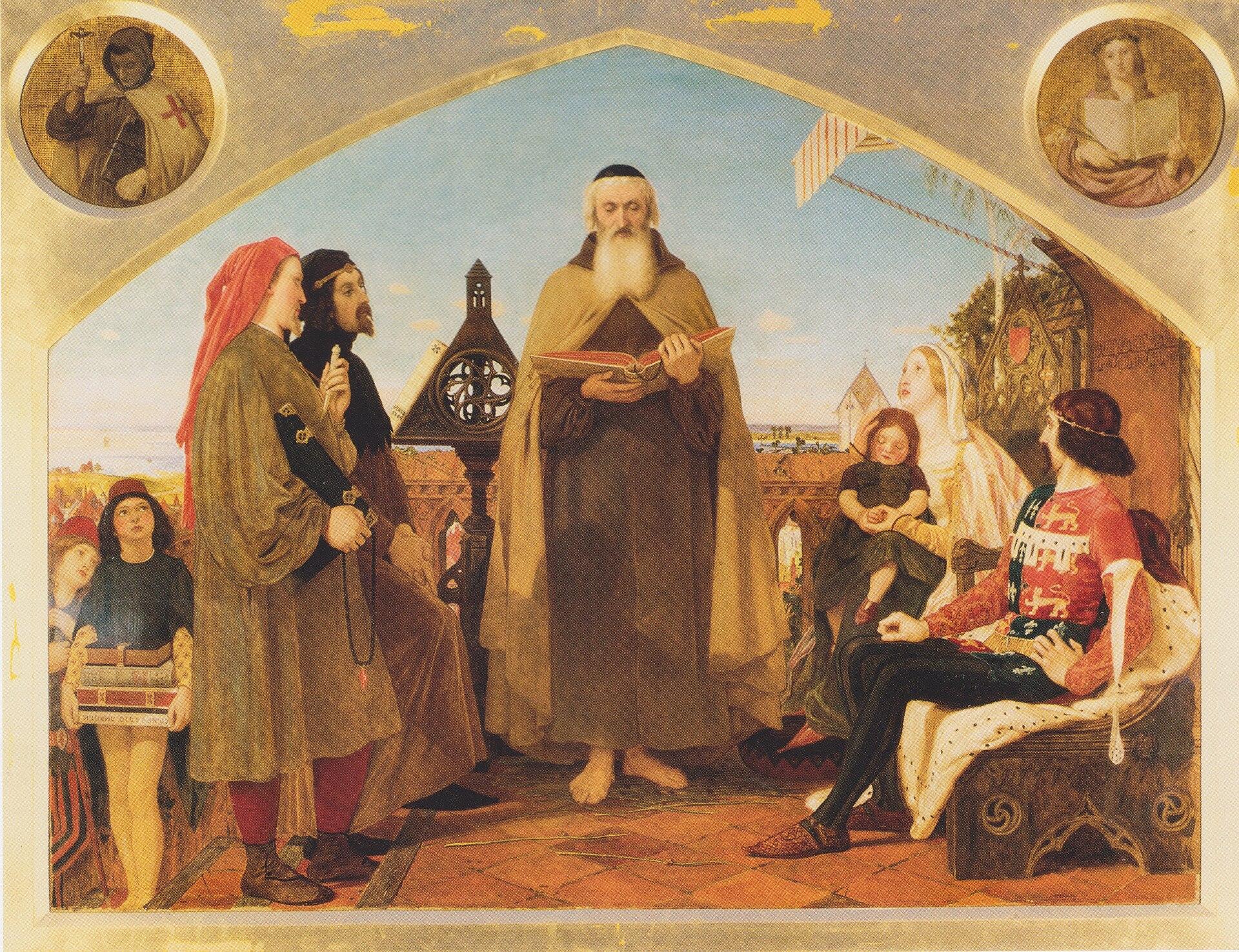
Ford Madox Brown, Wycliffe Reading His Translation, 1847 to 1861. Public domain.
Acts 2:8 · Subject · Featured Study
The History of the English Bible
Westcott traced the English Bible from the manuscripts of Wycliffe's day to the Revised Version.
How is it then that each of us hears them in his own native language?
A church council at Oxford in 1408 ruled that no one may translate a text of Scripture on his own authority.
Summary
Wycliffe's circle made an English Bible that was copied by hand. A line of printed versions began with Tyndale in the 1500s.
- A decree of 1408 let no one read a new English translation until his bishop approved it.
- Cochlaeus stopped the first printing of Tyndale's New Testament after ten sheets.
- The Geneva New Testament brought the verse numbers into English.
God's Wonders in Our Own Tongues
Luke sets the gift of tongues at Pentecost in a crowd drawn from many nations.
both Jews and converts to Judaism; Cretans and Arabs—we hear them declaring the wonders of God in our own tongues!”Translation into English carries on the work this verse describes.
Twelve Dates from Wycliffe to the Revised Version
Each row names an English version or a decree.
Eight English versions appeared in the 86 years from Tyndale's New Testament to the Authorised Version.
- About 1380The Wycliffite New Testament, in manuscript
- 1408The Constitutions of Oxford
- 1525Tyndale's New Testament
- 1535Coverdale's Bible
- 1537Matthew's Bible
- 1539The Great Bible
- 1557The Geneva New Testament
- 1560The whole Geneva Bible
- 1568The Bishops' Bible
- 1582The Rheims New Testament
- 1611The Authorised Version
- 1881The Revised New Testament
Two rows open their own pages, Tyndale's New Testament and the Authorised Version.
1557, 1560, 1568, 1582, 1611, 1881
The Wycliffite Bible
Westcott sets out the order in which Wycliffe's circle turned the books into English.
Westcott wrote that Wycliffe's translation of Revelation came first, then the Gospels with a commentary, then the rest of the New Testament.
A friend of Wycliffe, Nicholas de Hereford, appears to have begun the Old Testament. He was summoned to London in 1382 and broke off in the middle of Baruch.
Within a few years of Wycliffe's death, John Purvey began a full revision of the whole Bible.
Tyndale's Printed New Testament
William Tyndale took his finished translation to Cologne in 1525 to have it printed.
Tyndale moved to Worms, a safe retreat, and prepared two editions there. The small octavo edition without notes was finished first, ahead of the quarto with notes in its margins.
Westcott's list of Bibles names Erasmus and Luther as the sources behind that New Testament.
Coverdale, Matthew and the Great Bible
Three English Bibles followed one another within five years.
Miles Coverdale was allowed to finish what Tyndale had left incomplete. His Bible was finished in October.
John Rogers put together a composite Bible in 1537, either with a helper named Thomas Matthew or under that assumed name. It carried a dedication to Henry VIII.
The Great Bible was finished in April, and it carried no commentary.
Geneva, the Bishops, Rheims and 1611
Four more versions followed the Great Bible before the Revised Version.
The Geneva New Testament of 1557 was set in Roman type, with an opening letter by Calvin.
The whole Geneva Bible was finished in 1560 and dedicated to Queen Elizabeth. The Bishops' Bible followed in 1568, printed by R. Jugge with the queen's privilege.
The Rheims New Testament of 1582 was made at Allen's seminary, first set up at Douai and moved to Rheims in 1578. Westcott's list names the Vulgate and the Geneva version behind it.
Westcott lists the Authorised Version as made from the original texts, with the Bishops', Geneva and Rheims versions among its helps.
Who May Put Scripture into English?
A church council and a translator gave opposite answers a century apart.
Only a translation the bishop approvesThe Constitutions of Oxford, made under Archbishop Arundel in 1408, in Westcott's General View (1905)
The decree came from a convocation of the province of Canterbury.
The penalty for breaking it was the greater excommunication, that is, being cut off from the church.
Scripture for the boy at the ploughJohn Foxe, The Acts and Monuments, volume 5 (1838 edition), page 117
Foxe tells of a learned man who said to Tyndale that it was better to be without God's laws than the pope's.
Tyndale replied that if God spared his life, he would make a boy who drives the plough know more of the Scripture than that man did.
The Nineteenth Century
In the nineteenth century scholars revised the Authorised Version.
The Revised New Testament was published in May, and the Old Testament followed in May 1885.
The revisers also put out a new Greek text, which John William Burgon attacked in 1883.
Sources
Scripture is the Berean Standard Bible.
- B. F. Westcott, A General View of the History of the English Bible, 3rd edition revised by William Aldis Wright (New York: Macmillan, 1916 printing of the 1905 edition)
- F. H. A. Scrivener, A Plain Introduction to the Criticism of the New Testament, 4th edition, ed. Edward Miller, volume 1 (London: George Bell and Sons, 1894), chapter III.
- John William Burgon, The Revision Revised (1883), Article I.
- John Foxe, The Acts and Monuments, ed. George Townsend and Stephen Reed Cattley, volume 5 (London: Seeley and Burnside, 1838), page 117.
Keep Studying
Read it1
Studies1