
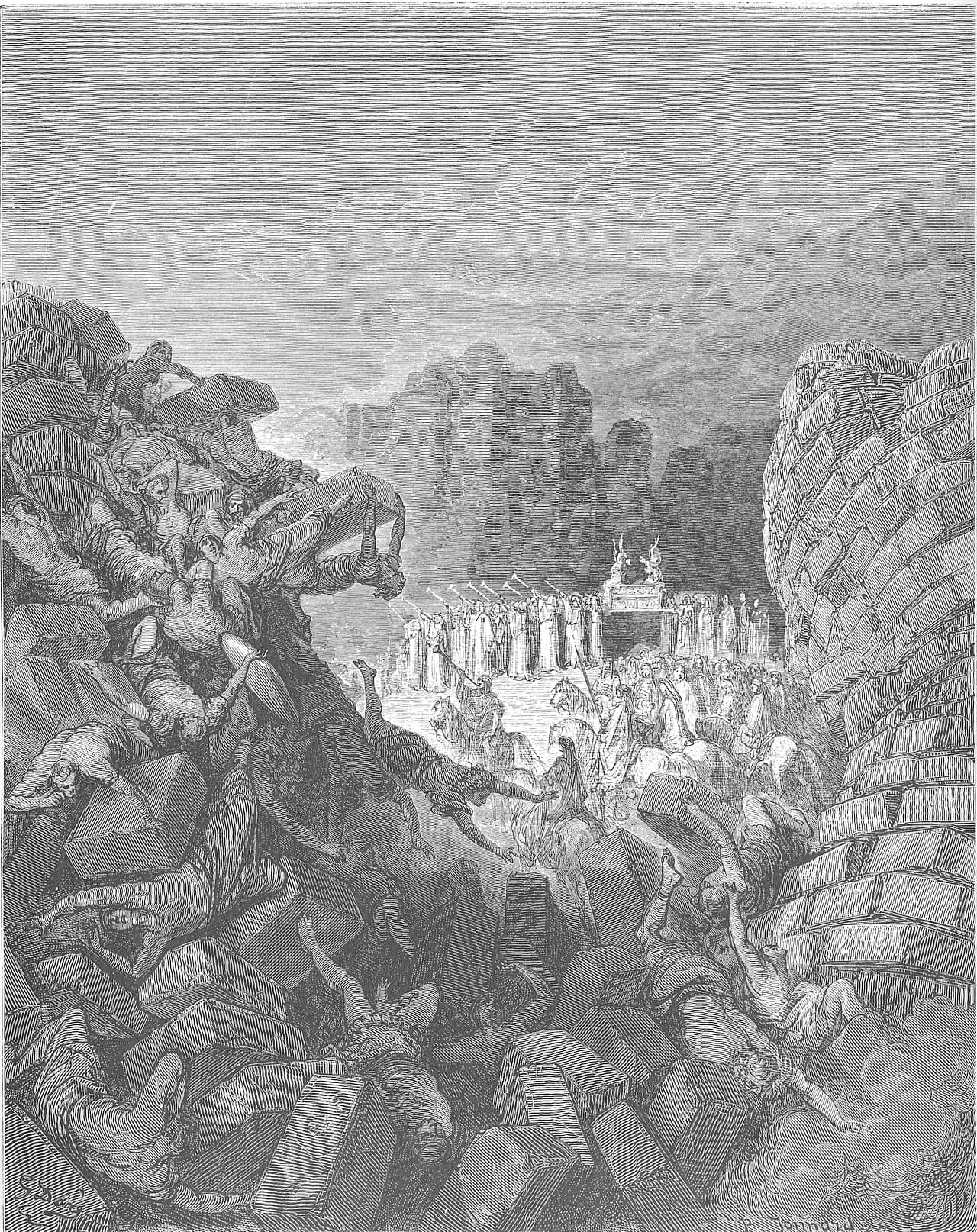
Gustave Doré, The Walls of Jericho Fall Down. Public domain.
Summary
God gave Jericho to Israel, and the city fell without a fight. Rahab's family lived, and Achan's died for taking what God had claimed.
- Jericho was afraid before Israel crossed the river.Joshua 2:9so that all who dwell in the land are melting in fear of you
- Nobody was to make a sound until Joshua gave the word.Joshua 6:10do not let one word come out of your mouth until the day I tell you…
- The whole city was given over to God. The order names one exception.Joshua 6:17Now the city and everything in it must be devoted to the LORD for destruction
- Joshua swore that whoever rebuilt Jericho would pay with his sons. Kings names the man who did.1 Kings 16:34At the cost of Abiram his firstborn he laid its foundation
The account, in the book's words
These verses carry the whole event in the order the book gives it.
Joshua 2
Two spies, and a woman who had already heard
Joshua 2:1Then Joshua son of Nun secretly sent two spies from Shittim, saying, “Go, inspect the land, especially Jericho.” So they went and entered the house of a prostitute named Rahab and stayed there.
Joshua 2:11When we heard this, our hearts melted and everyone’s courage failed because of you, for the LORD your God is God in the heavens above and on the earth below.
Joshua 5
A man with a drawn sword, outside the city
Joshua 5:13Now when Joshua was near Jericho, he looked up and saw a man standing in front of him with a drawn sword in His hand. Joshua approached Him and asked, “Are You for us or for our enemies?”
Joshua 5:14“Neither,” He replied. “I have now come as Commander of the LORD’s army.” Then Joshua fell facedown in reverence and asked Him, “What does my Lord have to say to His servant?”
Joshua 6
The shout, and the wall
Joshua 6:20So when the rams’ horns sounded, the people shouted. When they heard the blast of the horn, the people gave a great shout, and the wall collapsed. Then all the people charged straight into the city and captured it.
Joshua 6 to 7
The ban carried out, and the two households
Joshua 6:21At the edge of the sword they devoted to destruction everything in the city—man and woman, young and old, oxen, sheep, and donkeys.
Joshua 6:25And Joshua spared Rahab the prostitute, with her father’s household and all who belonged to her, because she hid the men Joshua had sent to spy out Jericho. So she has lived among the Israelites to this day.
Joshua 7:1The Israelites, however, acted unfaithfully regarding the things devoted to destruction. Achan son of Carmi, the son of Zabdi, the son of Zerah, of the tribe of Judah, took some of what was set apart. So the anger of the LORD burned against the Israelites.
How many laps, in what order
Israel walked around Jericho once a day for six days, seven times on the seventh, then shouted once.
Laps around Jericho, day by day
- Day 11
- Day 21
- Day 31
- Day 41
- Day 51
- Day 61
- Day 712345677 laps
- Then11 shout, and the wall fell
Each numbered block is one lap; the last mark is the shout.
The order of the column, front to back.
- 1The armed troops
- 2Priests with rams' hornsseven of them, sounding
- 3The ark of the LORDthe chest holding the covenant
- 4The rear guard
A seven-slot track for each of the seven days, drawn from one left edge. Israel walked one lap around Jericho on each of days one to six and seven laps on day seven, and a last mark stands for the shout after the seventh lap, when the wall fell.
The order
Joshua 6:3Do this for six days
The six days
Joshua 6:14So on the second day they marched around the city once and returned to the camp
The seventh day
Joshua 6:15they got up at dawn and marched around the city seven times in the same manner
The two verses it is read from
Joshua 6:9While the horns continued to sound, the armed troops marched ahead of the priests who blew the horns, and the rear guard followed the ark.
Joshua 6:13And the seven priests carrying seven rams’ horns kept marching ahead of the ark of the LORD and blowing the horns. The armed troops went in front of them and the rear guard followed the ark of the LORD, while the horns kept sounding.
Where, when in the book, and who is in it
- Where
- A mound in the Jordan valley called Tell es-Sultan today, beside a spring, about ten miles north of the Dead Sea.
- When in the book
- Israel's first campaign after the crossing of the Jordan, and the first city it took in the land.
- Who is in it
- Joshua, two spies, Rahab and her household, seven priests with rams' horns walking in front of the ark, and Achan of the tribe of Judah.
- How long it took
- Seven days of marching, from a camp pitched at Gilgal on the city's eastern border.
- The account
- Joshua 2 to 7, with the meeting outside the city at Joshua 5:13 to 15.
- Where the New Testament takes it up
- Hebrews on the wall and on Rahab, James on her works, Matthew on her family line.
Hebrews 11:30By faith the walls of Jericho fell
Hebrews 11:31did not perish with those who were disobedient
James 2:25was not even Rahab the prostitute justified by her actions when she welcomed the spies and…
Matthew 1:5Salmon was the father of Boaz by Rahab
Joshua 2
Why the city was already afraid
Rahab's words, the sign she hung, and Barnes
The fear came first. Jericho had heard what God did at the Red Sea and to the two kings east of the Jordan, and its courage was gone before the spies arrived.
The spies name one sign for her house, and she hangs it the moment they are gone.
Joshua 2:18you have tied this scarlet cord in the window through which you let us down
Albert Barnes sets her answer beside her neighbours' and names the difference.
It is noteworthy, too, that the same reports which work faith and conversion in the harlot, cause only terror and astonishment among her countrymen. (Compare Luk 8:37-39.)
Albert Barnes· Notes, Explanatory and Practical, on the Old and New Testaments (1832-1869)
We will be blameless of2:17 to 19
The oath carries three conditions and the men state each one: the scarlet line hung in the window, every relative gathered inside the house, and silence about the errand. His blood shall be upon his head is a legal formula rather than a threat, the same words David uses at 2 Samuel 1:16, and it puts the account on the man who walks out. Safety lies inside a marked house and nowhere outside it, which is the shape of the night in Exodus 12:22, where none was to go out at the door of his house until the morning, and Origen and Matthew Henry both read the two passages together.
Drawn from Matthew Henry, Commentary on the Whole Bible; John Gill, Exposition of the Old Testament.
Joshua 5:13 to 15
The man with the drawn sword
Joshua took his orders from someone else. He met a man with a drawn sword, asked whose side he was on, and was told neither. The first order he was given was the one God gave Moses at the burning bush.
Exodus 3:5“Do not come any closer,” God said. “Take off your sandals, for the place where you are standing is holy ground.”
The answer refuses the question and gives him a commander.
Joshua 5:14“I have now come as Commander of the LORD’s army
Origen, preaching through Joshua in the third century, reads the commander as the Lord Himself.
Therefore, Jesus [Joshua] recognized not only something from God but that which is God; for certainly he would not have worshiped unless he had recognized God.
The rest of the passage
For who else is chief of the army of the powers of God except our Lord Jesus Christ?
there stood a man over against him5:13 to 14
Joshua asks whose side the stranger is on and gets Nay for an answer, which refuses the question rather than choosing between its halves. The reply is as captain of the host of the LORD am I now come, and Joshua falls on his face and worships, and is not stopped. Commentators divide over who this is, with many of the older writers reading a Christophany from the worship accepted and the holy ground of the next verse, and others reading a created angel; Revelation 22:8-9, where an angel refuses worship twice, is the strongest text on the other side and belongs in the same breath.
Drawn from Matthew Henry, Commentary on the Whole Bible; Keil and Delitzsch, Biblical Commentary on the Old Testament: Joshua, Judges, Ruth.
Two readings, and no verdict
One reading: the Son of God, before He was born at Bethlehem.
Origen holds it in the third century and readers have held it since. Joshua worships him, he is not stopped, and the next verse calls the ground holy.
The other reading: an angel sent to command Israel's armies.
Scripture gives angels military titles without calling them God, and the Hebrew word for what Joshua did also covers the homage a man of rank receives. Revelation 22 is the text set against the first reading.
Revelation 22:9But he said to me, “Do not do that! I am a fellow servant with you and your brothers the prophets, and with those who keep the words of this book. Worship God!”
The book gives two facts and settles nothing: he names whose army he commands, and he takes what Joshua gives him.
The order given before the shout
What devoted means
God claimed the whole city before it fell. Devoted means given over to God for good. Here it meant the people were put to death and the silver, gold, bronze and iron went into His treasury. Older Bibles call it the ban, and the Hebrew word is cherem.
The book gives ground for it. God told Abraham the land would wait four generations, because the sin of the people in it was not yet full.
Joshua 6:17Now the city and everything in it must be devoted to the LORD for destruction. Only Rahab the prostitute and all those with her in her house will live, because she hid the spies we sent.
The metal was claimed before a lap was walked.
Joshua 6:19For all the silver and gold and all the articles of bronze and iron are holy…
What the land was waiting for.
Genesis 15:16for the iniquity of the Amorites is not yet complete
The book gives the reason her house was spared.
Joshua 6:25because she hid the men Joshua had sent to spy out Jericho
they burnt the city with6:24 to 25
She dwelleth in Israel even unto this day, which tells a reader the account was written while her family were still there and still known by name. Scripture calls her the harlot every time it names her, here and at Hebrews 11:31 and James 2:25, and Matthew 1:5 puts her in the line of Christ as the mother of Boaz. Hebrews 11:30 and 11:31 sit next to each other, the wall falling and the woman inside it living, which is this chapter in two sentences. The scarlet line of 2:18 is read as a figure of the blood by Henry, Gill and many after them, and the New Testament nowhere makes that link, so it carries their names rather than an apostle's.
Drawn from Matthew Henry, Commentary on the Whole Bible; John Gill, Exposition of the Old Testament.
The three Hebrew words
Three Hebrew words carry this story
Each word, as the lexicon files it
cherem: A thing given over to God for good, either destroyed or put in His treasury.
Hebrew · H2764Strong's entry: physical (as shutting in) a net (either literally or figuratively); usually a doomed object; abstractly extermination
What is handed to God and cannot be bought back.
38 times in the Old Testament · cherem, in full →
tiqvah: A cord; and, spelled the same way, hope.
Hebrew · H8615Strong's entry: literally a cord (as an attachment); figuratively, expectancy
The cord Rahab tied in her window. The same three letters spell the ordinary word for hope, and the lexicons file them as two words.
34 times in the Old Testament · tiqvah, in full →
chomah: The wall around a city.
Hebrew · H2346Strong's entry: a wall of protection
A city wall, the thing this whole account is looking at. Rahab's house was built into one.
133 times in the Old Testament · chomah, in full →
What Hebrews says about it
What brought the wall down
Hebrews, and Chrysostom on trumpets
Hebrews reads the same event, credits the fall to faith, and keeps the seven days in its one line about it.
Hebrews 11:30By faith the walls of Jericho fell, after the people had marched around them for seven days.
Jamieson, Fausset and Brown quote Chrysostom on what a trumpet can and cannot do.
The soundings of trumpets, though one were to sound for ten thousand years, cannot throw down walls, but faith can do all things [CHRYSOSTOM]. seven days--whereas sieges often lasted for years.
Jamieson, Fausset & Brown· Commentary Critical and Explanatory on the Whole Bible, 1871
Joshua 6 and 7
Two households
Two houses stand in consecutive chapters: one Canaanite family carried out alive, one Israelite family destroyed.
Joshua 6
Rahab believed, and her house lived
Joshua sends the same two men who swore the oath, and they bring out her whole family.
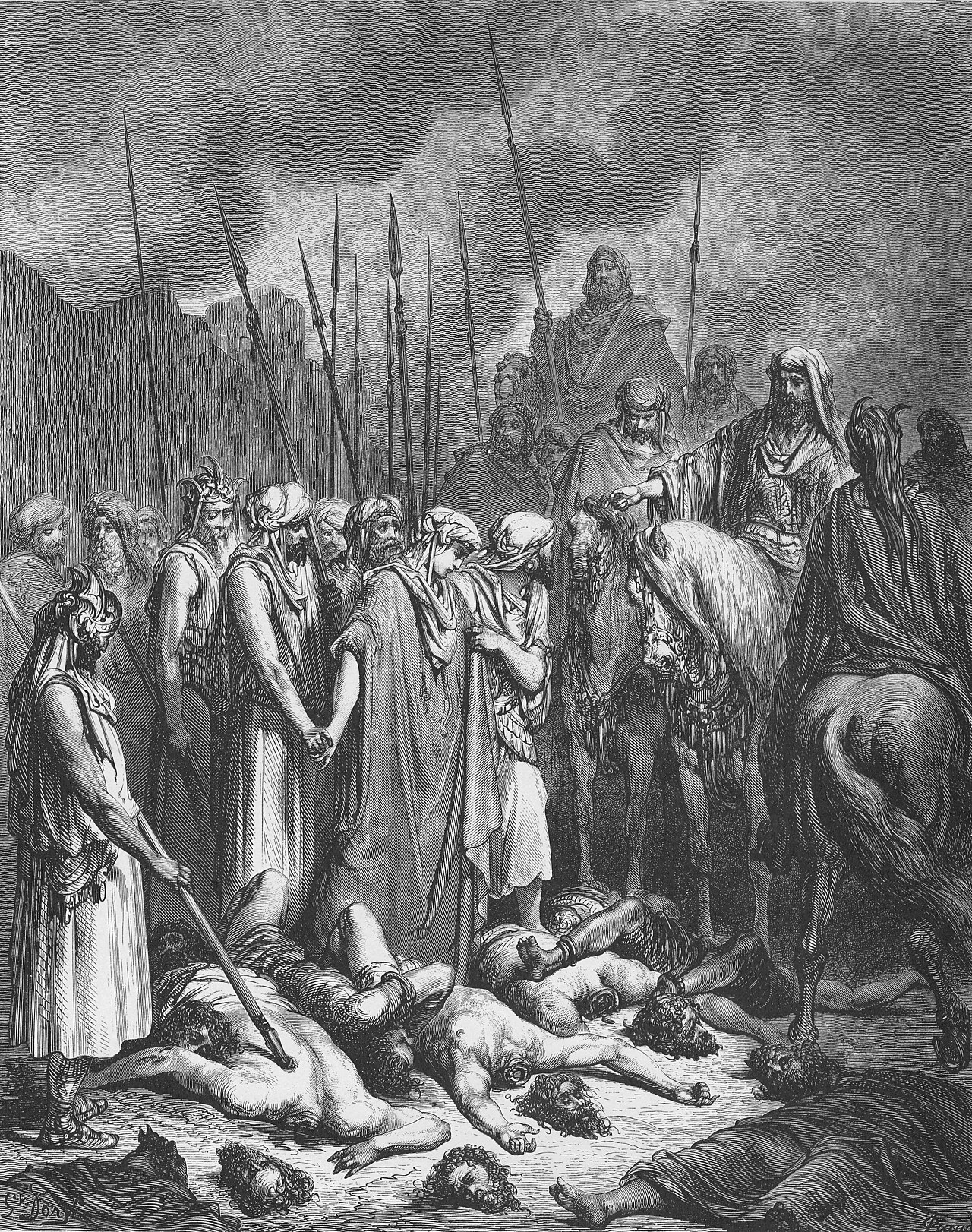
Charles Spurgeon, in 1872, says where her name is written.
The 11th chapter of Hebrews is a triumphal arch to the soldiers of faith and among the illustrious names inscribed there are the name of this harlot of Jericho.
Charles Spurgeon· The Metropolitan Tabernacle Pulpit, Sermon No. 1061: “Rahab” (lightly modernized text, CCEL edition), 1872
Joshua 7
Achan took, and his house died
Achan of Judah took what was devoted and buried it under his tent. Israel lost the next battle at Ai, and nobody knew why until the lot fell on him.
Ambrose of Milan points at this chapter for what money did to an army.
When the city of Jericho fell at the sound of the priests' trumpets and Joshua the son of Nun gained the victory, he knew that the valor of the people was weakened through love of money and desire for gold.
Ambrose of Milan· On the Duties of the Clergy 2.26.129, fourth century
Joshua 7:21When I saw among the spoils a beautiful cloak from Shinar, two hundred shekels of silver, and a bar of gold weighing fifty shekels, I coveted them and took them. They are hidden in the ground inside my tent, with the silver underneath.”
The book sets the two houses side by side and leaves them there.
The record of the kings
The oath over the ruin
The oath, the man who paid it, and Henry
Whoever rebuilt Jericho would lay its foundation at the cost of his firstborn and its gates at the cost of his youngest. Centuries later the record of the kings says a man of Bethel did it and lost two sons.
1 Kings 16:34In Ahab’s days, Hiel the Bethelite rebuilt Jericho. At the cost of Abiram his firstborn he laid its foundation, and at the cost of Segub his youngest he set up its gates, according to the word that the LORD had spoken through Joshua son of Nun.
The oath names the price twice, for the foundation and for the gates.
Joshua 6:26at the cost of his firstborn he will lay its foundations
Matthew Henry reads that verse and hears Achan in it.
It comes in as an instance of the height of impiety to which men had arrived, especially at Bethel, where one of the calves was, for of that city this daring sinner was.
Matthew Henry· Commentary on the Whole Bible, 1710
Henry on the builder of Jericho
Like Achan he meddled with the accursed thing, turned that to his own use which was devoted to God's honour.
Joshua adjured them at that6:26 to 27
The curse names a price in sons rather than a general warning, the firstborn at the foundation and the youngest at the gates. 1 Kings 16:34 discharges it by name in the days of Ahab, where Hiel the Bethelite builds Jericho, lays the foundation in Abiram his firstborn and sets up the gates in his youngest son Segub, according to the word of the Lord which he spake by Joshua the son of Nun. People live at the site long before that, at Judges 3:13 and 2 Samuel 10:5, so what the curse holds is the walling and gating of it. The chapter closes on the promise of 1:5 and 1:9 kept, the Lord was with Joshua.
Drawn from John Gill, Exposition of the Old Testament; Keil and Delitzsch, Biblical Commentary on the Old Testament: Joshua, Judges, Ruth.
Where the retelling drifts
The story is told often, and a few details have moved.
| What the retelling says | What the book says | In the book’s own words |
|---|---|---|
| What the retelling saysThey marched seven times a day for seven days. | What the book saysSix days were one lap each. The seventh was the only seven. | Joshua 6:4Then on the seventh day, march around the city seven times |
| What the retelling saysThe trumpets shook the wall down. | What the book saysThe horns sounded every day. The wall went down after the last shout. | Joshua 6:20and the wall collapsed |
| What the retelling saysJoshua worked out a clever siege. | What the book saysThe city was handed to him before a lap was walked. | Joshua 6:2I have delivered Jericho into your hand |
| What the retelling saysThe soldiers carried off the plunder. | What the book saysThe metal belonged to God, and the man who kept some was destroyed. | Joshua 6:19they must go into His treasury |
The ground it happened on
Four things fix the week in place.
The camp was outside the city
Israel pitched at Gilgal, east of the city.
Joshua 4:19On the tenth day of the first month the people went up from the Jordan and…
The river was in flood
The crossing came at harvest. Four days later Israel kept the Passover on the plain.
Joshua 3:15Now the Jordan overflows its banks throughout the harvest season
Rahab's house was in the wall
Her window looked outward, which is how the spies left after the gate was shut.
Joshua 2:15since the house where she lived was built into the wall of the city
The city was shut tight
Nobody was going in or out before the first lap.
Joshua 6:1Now Jericho was tightly shut up because of the Israelites
Jericho names more than one place
The mound where the wall fell is a tell, a hill made of one town built on the ruins of the last. This one is called Tell es-Sultan, and it stands beside the spring on the west side of the Jordan valley.
New Testament Jericho grew about two kilometres away on the Wadi Qelt, beside the Hasmonean and Herodian winter palaces that Ehud Netzer excavated from 1973. Modern Jericho is a fourth place, a living town beside the old mound.
So the Jericho Jesus walked through was the town near the palaces, and not the mound in this account.
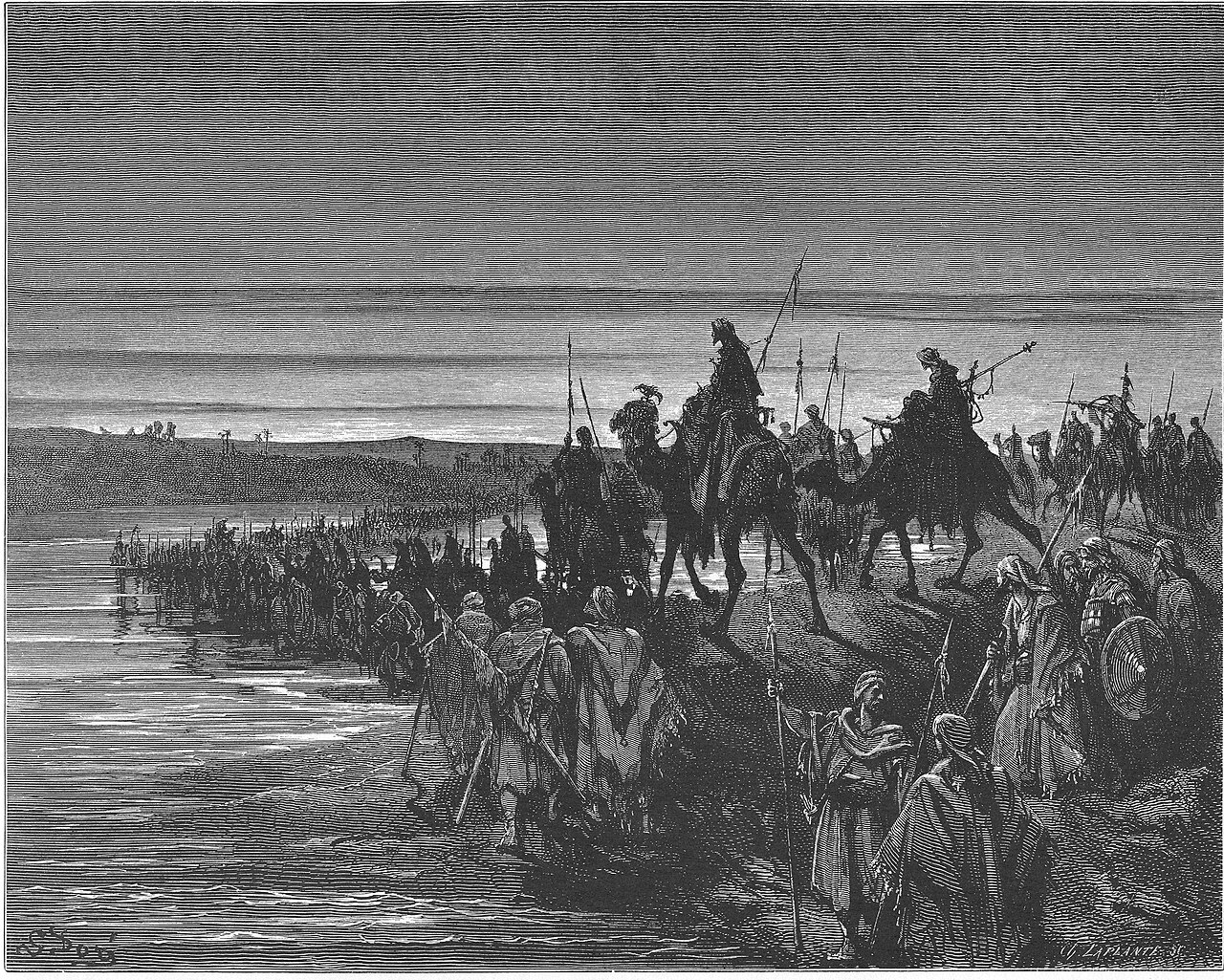
The mound at Tell es-Sultan
What the diggers found
What is agreed
The mound holds a burnt town, and four things about it are agreed. It was walled and it ended in fire. Mudbrick from its wall lies fallen outward at the foot of its stone base, and the grain jars were found full and charred.
Both excavators reported them: John Garstang in the 1930s, Kathleen Kenyon in the 1950s.
What is contested
The century of that burnt town is contested, and with it whether it is the city Joshua took or an older one. Kenyon read it as the Middle Bronze town, ending about a hundred and fifty years before the traditional date for Joshua.
Two later scholars argued the pottery without digging. The four positions open below.
Joshua 6:24Then the Israelites burned up the city and everything in it. However, they put the silver and gold and articles of bronze and iron into the treasury of the LORD’s house.
The four published positions
| Who, and when | The work | What they concluded | Where it stands |
|---|---|---|---|
| John Garstangdug 1930 to 1936 | The workThe Story of Jericho, 1940 | What they concludedReported a burned city with fallen walls, dated it to c. 1400 BC, and identified it with Joshua's Jericho. | Where it standsThe traditional reading. Its date comes from the 480 years the book of Kings counts between the exodus and Solomon's fourth year. |
| Kathleen Kenyondug 1952 to 1958 | The workDigging Up Jericho, 1957 | What they concludedDug again with finer method and read the burnt town as Middle Bronze, ending c. 1550 BC, with little of the later town left standing. | Where it standsThe majority position among excavators since. It rests on what her trenches did not contain, the imported Cypriot ware of the later period. That is an argument from silence about the ground she opened between 1952 and 1958. |
| Bryant G. Woodpublished 1990 | The workBiblical Archaeology Review 16:2 | What they concludedRe-read Kenyon's own pottery and argued for a destruction c. 1400 BC. His four grounds: a short action rather than a long siege, burned grain stores still full, mudbrick fallen outward at the base of the wall, and a fall at harvest. | Where it standsThe conservative minority reading. Three of his four grounds are the debris set beside the account; the date itself rests on his reading of the pottery. |
| Piotr Bienkowskipublished 1990 | The workBiblical Archaeology Review 16:5 | What they concludedAnswered Wood in the same journal later that year, holding to Kenyon's reading of the pottery. | Where it standsThe reply the field followed, which is why Kenyon's date is still the majority one. |
Wood's case rests in part on one radiocarbon sample read as 1410 BC, plus or minus 40 years (1990). Later work on the same burnt layer has moved that date back toward Kenyon's.
Wood's institution, Associates for Biblical Research, is a confessional body.
As of 2026 the burnt town is agreed and the century is not.
Read more at Jericho, the mound and its whole history, Every excavation of the tell..
Read more at How archaeology and the Bible are weighed, What a find can and cannot settle..
Where the book says nothing
Three questions the account leaves open
How the wall came down
The account gives the horns, the shout and the fall in one sentence and stops. It names no cause underneath that.
What Rahab told the king's men
Joshua 2 records what she said to the men the king sent and passes no judgment on it. Hebrews names her faith and James names her works, and neither raises the question.
Hebrews 11:31By faith the prostitute Rahab, because she welcomed the spies in peace, did not perish with those who were disobedient.
The year
No king of Egypt or Canaan is named and no year is given. The book dates the crossing to the tenth day of the first month.
Where it points, in Christ
Three things here are taken up later.
The outsider in the family line
Matthew names Rahab four generations above David, in the genealogy of the Messiah. A Canaanite woman of a city under the ban stands in the family of Christ.
Matthew 1:5Salmon was the father of Boaz by Rahab, Boaz the father of Obed by Ruth, Obed the father of Jesse,
The mark on the house
The spies went into the marked house and brought the household out alive. The earliest Christian reading of that cord is in 1 Clement, about AD 95.
The name the man carries
Joshua's name in Hebrew is Yehoshua, which the Greek writes as Iesous and English as Jesus. Hebrews argues from him to the rest he could not give.
Hebrews 4:8For if Joshua had given them rest, God would not have spoken later about another day.
Ambrose on the scarlet cord
Ambrose of Milan reads the scarlet cord as the sign of the blood that redeems.
A harlot saw this; and she who in the destruction of the city lost all hope of any means of safety, because her faith had conquered, bound a scarlet thread in her window, and thus uplifted a sign of her faith and the banner of the Lord's passion; so that the semblance of the mystic blood, which should redeem the world, might be in memory.
Ambrose of Milan· Exposition of the Christian Faith 5.10.127, fourth century
The rest of the passage: the sign outside the city, and the sign within
So, from outside the city, the name of Joshua was a sign of victory to those who fought. From within, the semblance of the Lord's passion was a sign of salvation to those in danger.
Read more at The Scarlet Thread, from Rahab's window across the canon, The sign of blood on a house, from Egypt to the cross..
Where it leads
Sources
Every work this page stands on, with its edition and year (17)
- Scripture
- Berean Standard Bible, public domain since 2023, from this site's verse store. The reader offers the King James and the American Standard on the same chapters.
- The Hebrew words
- The lexicon floor behind the three word cards: STEPBible's tagged lexical data from Tyndale House, Cambridge, released under CC BY 4.0, with Strong's numbers of 1890.
- The exposition notes on Joshua
- This site's published notes on Joshua 2 to 7, folded under the verses they cover, each carrying the two works it was drawn from.
- Albert Barnes, Notes, Explanatory and Practical, on the Old and New Testaments (1832 to 1869)
- On Joshua 2:11. Public domain, from this site's quote pool.
- Origen, Homilies on Joshua 6.2
- Preached in the third century. Public domain English translation, held in this site's quote pool with its link.
- Jamieson, Fausset and Brown, Commentary Critical and Explanatory on the Whole Bible (1871)
- On Hebrews 11:30, quoting John Chrysostom. Public domain.
- Charles Spurgeon, The Metropolitan Tabernacle Pulpit, Sermon 1061, Rahab (1872)
- On Hebrews 11:31. Public domain, CCEL edition, lightly modernized text.
- Ambrose of Milan, On the Duties of the Clergy 2.26.129
- On Achan and the love of money, fourth century. Public domain English translation.
- Ambrose of Milan, Exposition of the Christian Faith 5.10.127
- On the scarlet cord, fourth century. Public domain English translation.
- Matthew Henry, Commentary on the Whole Bible (1710)
- On 1 Kings 16:34. Public domain.
- Gustave Doré, La Sainte Bible (Tours: Alfred Mame et fils, 1866)
- Plates 44, 46 and 47. Public domain, licence verified per file and held on this site.
- John Garstang and J. B. E. Garstang, The Story of Jericho (1940)
- The excavator's own account of his six seasons, written for a general reader and cited for the position it argues. His season reports appeared in the Liverpool Annals of Archaeology and Anthropology from 1932.
- Kathleen M. Kenyon, Digging Up Jericho (London: Ernest Benn, 1957)
- The excavator's own account of her seasons, written for a general reader and cited for the position it argues. Her technical volumes, Excavations at Jericho, were published from 1960.
- Bryant G. Wood, Did the Israelites Conquer Jericho? A New Look at the Archaeological Evidence
- Biblical Archaeology Review 16:2 (March and April 1990), cited for its four grounds.
- Piotr Bienkowski, Jericho Was Destroyed in the Middle Bronze Age, Not the Late Bronze Age
- Biblical Archaeology Review 16:5 (September and October 1990), the reply that stands beside Wood's article.
- 1 Clement 12:7 to 12:8, about AD 95
- The earliest surviving Christian reading of the scarlet cord, carried in full on the Scarlet Thread study.
- This page
- Built 2026-09-05 from the research brief of 2026-08-20, and cut to the story kind's shape on 2026-09-06 after two outside reviews.
How this page is built
Every verse here is fetched from this site's verse store in the Berean Standard Bible and is never typed into the page.
Every quotation is fetched from the quote pool by row id, and the page slices the row's own bytes rather than retyping them.
The three Hebrew words are read from the lexicon floor by Strong's number, with their script, transliteration and counts.
The exposition notes are this site's published notes on Joshua, shown with the works each was drawn from.
The three plates are held on this site, licence verified per file, and shown whole at their own shape.
The dig positions carry the excavator, the years, the work and its year, in the order they were published.