
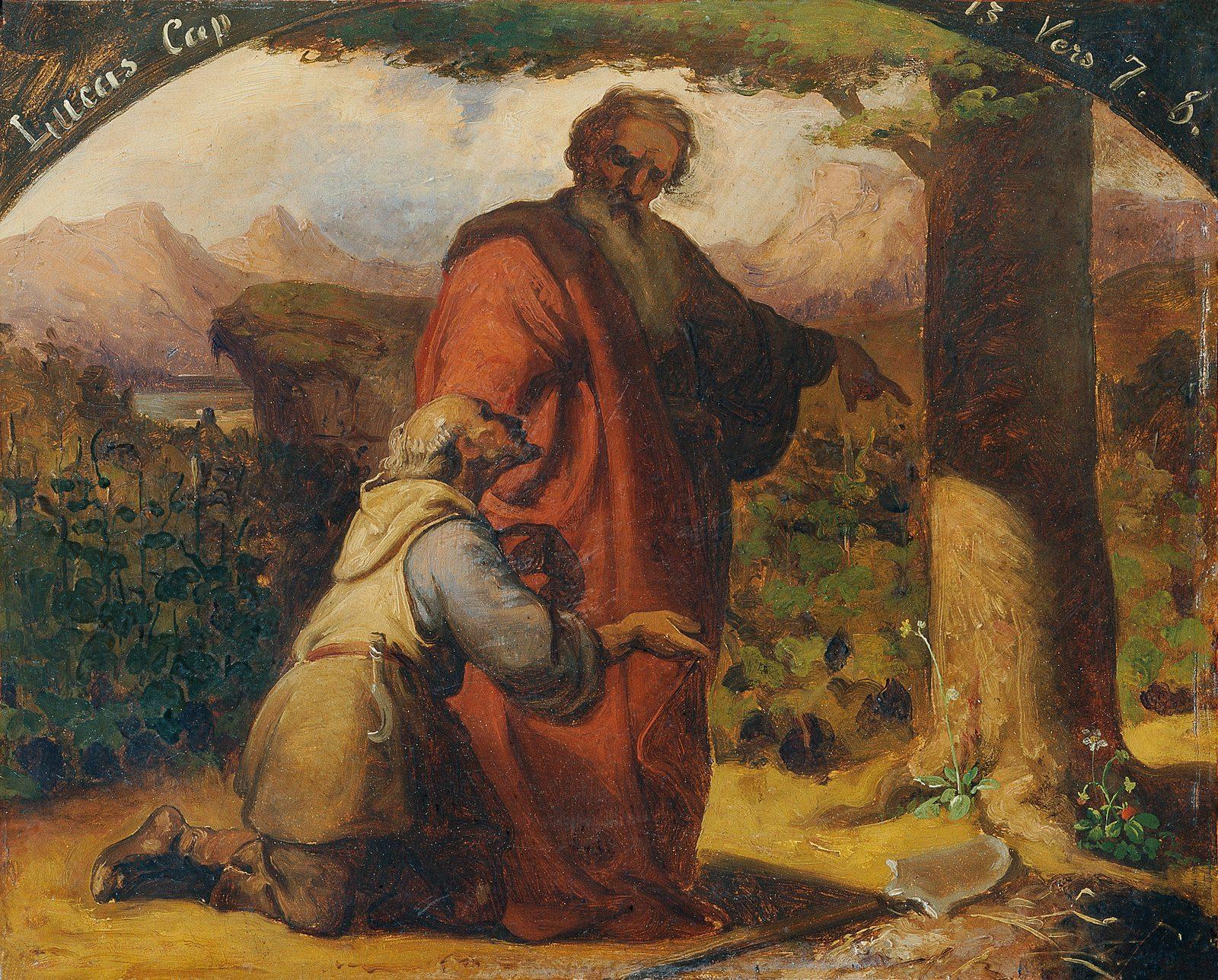
Carl Rahl, The Parable of the Barren Fig Tree, undated, Belvedere, Vienna. Public domain.
Deuteronomy 8 · Symbol · Featured Study
The Fig Tree
This symbol study follows the fig tree through the land, the prophets and the Gospels.
a land of wheat, barley, vines, fig trees, and pomegranates; a land of olive oil and honey;
- The word
- תְּאֵנָה (te'enah), H8384
- First appears
- Genesis 3:7 “…naked; so they sewed together fig leaves and…”
Proverbs 27:18 says that whoever tends a fig tree will eat its fruit.
Summary
The fig tree grows in the promised land, and Scripture uses it for peace, for the fruit God looks for and for judgment.
- Moses names fig trees among seven things in the good land.
- Isaiah had a lump of pressed figs prepared for Hezekiah's boil, and Hezekiah recovered.
- Nathanael's fig tree is the last fig tree the Gospels name.
The Fig in the Good Land
The fig appears in Eden, in the spies' load from Canaan and in Israel's complaint in the wilderness.
And the eyes of both of them were opened, and they knew that they were naked; so they sewed together fig leaves and made coverings for themselves.The coverings come straight after the eating of Genesis 3:6, so the fig enters Scripture at the fall.
When they came to the Valley of Eshcol, they cut down a branch with a single cluster of grapes, which they carried on a pole between two men. They also took some pomegranates and figs.This is the second verse to name the fig, and the first in the land of promise.
Why have you led us up out of Egypt to bring us to this wretched place? It is not a place of grain, figs, vines, or pomegranates—and there is no water to drink!”In Numbers 20:5 the fig first appears as something Israel lacks.
The Barren Fig Tree
Carl Rahl painted the owner and the keeper of the vineyard of the parable under the tree they speak of.
The painting sets the owner's order to cut the tree down beside the plea of the keeper of the vineyard.
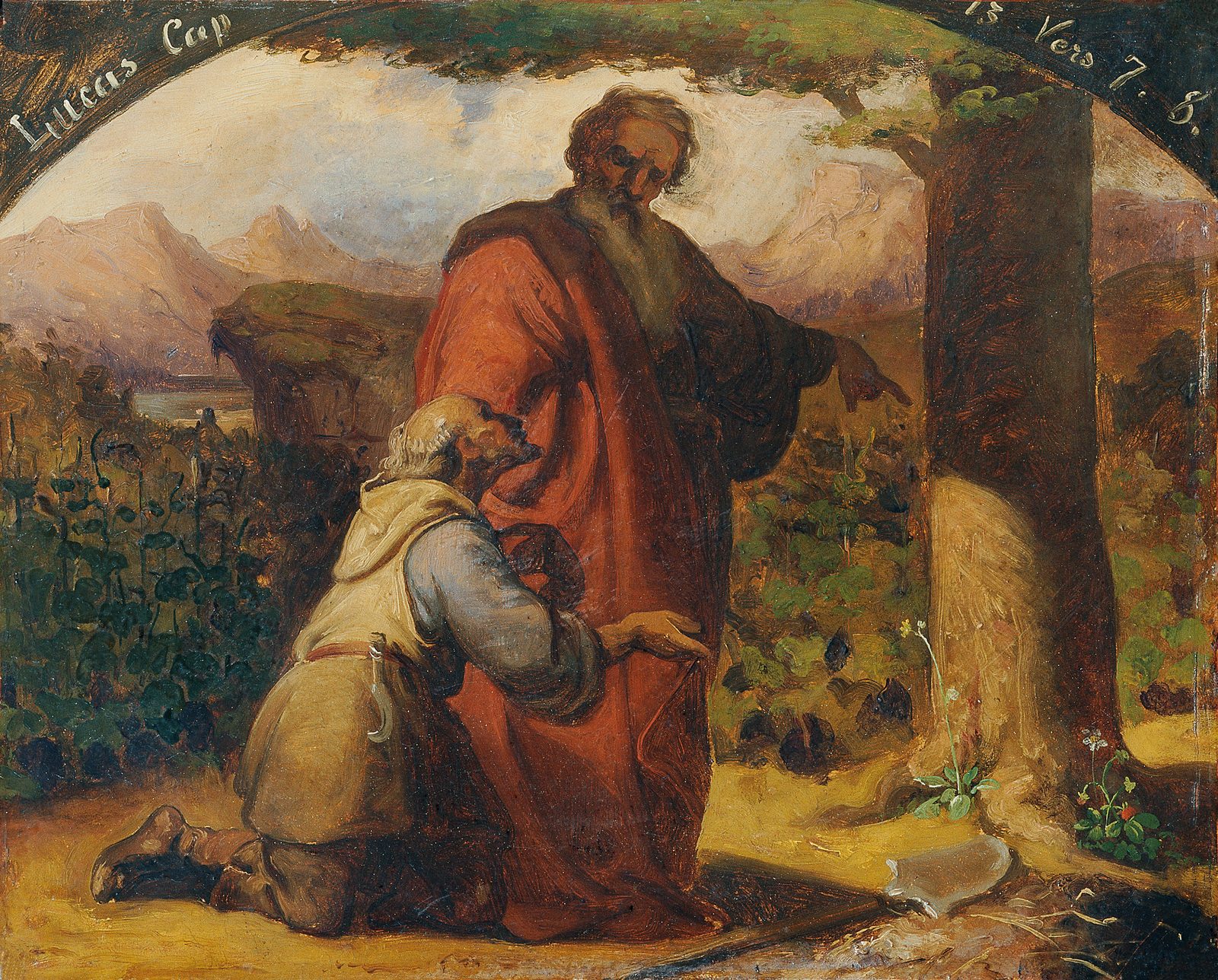
- The ownerA man in a red robe points at the tree that has borne no fruit.Luke 13:7
- The keeper of the vineyardAn old man in a work smock kneels at the owner's side and holds his robe.Luke 13:8
- The fig treeThe trunk stands at the right, with its leaves spread across the top of the arch.Luke 13:6
- The spadeA spade lies at the foot of the tree, ready to dig around it.Luke 13:8
- The vineyardRows of vines grow behind the keeper of the vineyard at the left.Luke 13:6
Carl Rahl, The Parable of the Barren Fig Tree, undated, Belvedere, Vienna. Public domain.
Each of the five parts answers to a verse of the parable, and the painter lettered its chapter and verses in the arch.
The Fig Tree Through Scripture
Te'enah, the fig tree or its fruit, stands in twenty books of the Old Testament. Syke, the fig tree, stands in six books of the New Testament.
Thirteen verses on the fig, in the order of the canon.
- Genesis 3They sewed together fig leaves, Genesis 3:7
- Judges 9To hold sway over the trees, Judges 9:11
- 1 Kings 4Each man under his own vine and his own fig tree, 1 Kings 4:25
- 2 Kings 20Prepare a poultice of figs, 2 Kings 20:7
- Jeremiah 24Two baskets of figs placed in front of the temple, Jeremiah 24:1
- Micah 4With no one to frighten him, Micah 4:4
- Nahum 3All your fortresses are fig trees, Nahum 3:12
- Habakkuk 3Though the fig tree does not bud, Habakkuk 3:17
- Matthew 21May you never bear fruit again, Matthew 21:19
- Matthew 24Learn this lesson from the fig tree, Matthew 24:32
- Luke 13For the past three years, Luke 13:7
- John 1I saw you under the fig tree, John 1:48
- Revelation 6Like unripe figs dropping from a tree, Revelation 6:13
Each stop opens its verse in the reader.
The fig tree stripped in judgmentJeremiah 8:13, Amos 4:9 and Joel
I will take away their harvest, declares the LORD. There will be no grapes on the vine, nor figs on the tree, and even the leaf will wither. Whatever I have given them will be lost to them.”Jeremiah's judgment reaches past the fruit to the leaf itself.
“I struck you with blight and mildew in your growing gardens and vineyards; the locust devoured your fig and olive trees, yet you did not return to Me,” declares the LORD.Amos counts the devoured fig trees among the warnings Israel did not heed.
Joel's withered fig tree, and the fig tree that yields its best again, are taught on The Years the Locusts Ate.
Nothing but Leaves
Mark sets the clearing of the temple courts between the curse and the withered tree.
Seeing in the distance a fig tree in leaf, He went to see if there was any fruit on it. But when He reached it, He found nothing on it except leaves, since it was not the season for figs.Mark alone adds that it was not the season for figs.
As they were walking back in the morning, they saw the fig tree withered from its roots.This verse closes the frame Mark opened the day before.
Te'enah, Syke and the Words Beside Them
Other words name the early fig, a cake of pressed figs and the unripe fig out of season.
te'enah
the fig (tree or fruit)
bikkurah
the early fig
bikkur
the first-fruits of the crop
debelah
a cake of pressed figs
syke
a fig-tree
sykon
a fig
olynthos
an unripe (because out of season) fig
The lexicon in full1 table
Seven words in this study's verses name the fig tree, its fruit or its first fruits.
| Word | Meaning | Uses |
|---|---|---|
| te'enah, H8384 | the fig (tree or fruit) | 39 |
| bikkurah, H1063 | the early fig | 4 |
| bikkur, H1061 | the first-fruits of the crop | 17 |
| debelah, H1690 | a cake of pressed figs | 5 |
| syke, G4808 | a fig-tree | 16 |
| sykon, G4810 | a fig | 4 |
| olynthos, G3653 | an unripe (because out of season) fig | 1 |
What Scripture Does Not Say
John 1:48 leaves one detail untold, and Luke 13:9 leaves another.
Fruit in Its Season
Hosea likens Israel's fathers to the first fruit of the fig tree, and Jeremiah likens the exiles to good figs.
I found Israel like grapes in the wilderness. I saw your fathers as the firstfruits of the fig tree in its first season. But they went to Baal-peor, and consecrated themselves to Shame; so they became as detestable as the thing they loved.Hosea looks back to Israel's beginning to measure how far the people fell.
“This is what the LORD, the God of Israel, says: ‘Like these good figs, so I regard as good the exiles from Judah, whom I have sent away from this place to the land of the Chaldeans. I will keep My eyes on them for good and will return them to this land. I will build them up and not tear them down; I will plant them and not uproot them.Jeremiah's vision turns on which people the LORD counts as the good figs.
The vine beside the fig tree is taught on The Vine and the Vineyard, and Jotham's fable on Abimelech and Jotham's Fable.
The peace of the vine and the fig treeZechariah 3:10, 2 Kings 18:31 and Adam Clarke
On that day, declares the LORD of Hosts, you will each invite your neighbor to sit under your own vine and fig tree.’”Zechariah gives the people who returned from exile the picture of 1 Kings 4:25.
Do not listen to Hezekiah, for this is what the king of Assyria says: Make peace with me and come out to me. Then every one of you will eat from his own vine and his own fig tree, and drink water from his own cistern,The Assyrian king's envoy offered Jerusalem the vine and the fig tree as the price of surrender.
Adam Clarke, in his Commentary on the Bible on Micah 4:4, calls sitting under the vine and the fig tree a proverbial expression of perfect peace, security and rural comfort.
Voices on the Fig Tree
Three teachers from the sixteenth century to the nineteenth wrote on the fig tree.
John Calvin (1509 to 1564)
John Calvin, in his Commentaries on the two baskets of Jeremiah 24, notes that Jeconiah was banished and deprived of his kingdom. Calvin observes that Jeconiah seemed to suffer the heavier punishment. The Jews left in Jerusalem, Calvin says, flattered themselves that God had dealt more kindly with them.
John Wesley (1703 to 1791)
John Wesley, in his Explanatory Notes upon the New Testament, says Christ spoke the lesson of the fig tree in spring. Wesley adds that the trees on the Mount of Olives were then budding.
Charles Spurgeon (1834 to 1892)
Charles Spurgeon, preaching on Mark 11:13 in 1864, called every other miracle of Jesus benevolent, save perhaps part of one. He said this one was an exception only in appearance.
Where Careful Readers Differ
Readers answer two questions about the fig tree in different ways.
Why Jesus looked for figs out of seasonAdam Clarke; Jamieson, Fausset and Brown
Adam Clarke, in his Commentary on the Bible, takes the season of Mark 11:13 as the season of gathering figs, which had not yet come. The objection is that Mark gives the season as the reason nothing was found.
Jamieson, Fausset and Brown, in their Commentary Critical and Explanatory, hold that no fruit would have been looked for but for the leaves, which had come early and out of nature. The objection is that Mark does not say the leaves came early.
What the lesson of the fig tree points toArno C. Gaebelein; John Gill and Adam Clarke
Arno C. Gaebelein, in The Gospel of Matthew: An Exposition of 1910, reads the fig tree of Matthew 24:32 as the picture of Israel. He sees it withered in Matthew 21 and holds that it will bud again, and he takes all the trees of Luke 21:29 as the nations. The objection is that Jesus names no nation in the lesson.
John Gill, in his Exposition of the New Testament, reads the fig tree of Luke 21:29 as that or any other tree. Adam Clarke reads the budding as a picture of the signs that the ruin of the Jewish state was near, as the budding of trees shows that summer is near. The objection, in Gaebelein's terms, is that the fig tree stands for Israel in Luke 13 and Matthew 21.
Books to Read Next
Both works are in the public domain, and each has a free copy to read.
Nothing But Leaves, Sermon 555
Charles Spurgeon · 1864
Spurgeon preached it at the Metropolitan Tabernacle in Newington.
Read at Spurgeon GemsThe Gospel of Matthew: An Exposition, volume 2
Arno C. Gaebelein · 1910
The second volume holds his notes on both fig tree passages of Matthew.
Read at the Internet ArchiveHave Faith in God
When Peter remembered the fig tree and spoke of it, Jesus answered with a call to faith.
“Have faith in God,” Jesus said to them.Mark gives this as the first word of the answer, before Jesus speaks of prayer.
Sources
Scripture is the Berean Standard Bible.
- James Strong, Exhaustive Concordance of the Bible, 1890, entries H8384, H1063, H1061, H1690, G4808, G4810 and G3653, with the verses each entry lists.
- Adam Clarke, Commentary on the Bible, 1832, on Mark 11:13.
- Adam Clarke, Commentary on the Bible, 1832, on Micah 4:4.
- Adam Clarke, Commentary on the Bible, 1832, on Matthew 24:32.
- Jamieson, Fausset and Brown, Commentary Critical and Explanatory on the Whole Bible, 1871, on Mark 11:13.
- John Wesley, Explanatory Notes upon the New Testament, 1755, on Luke 21:29.
- John Gill, Exposition of the New Testament, 1746 to 1748, on Luke 21:29.
- John Calvin, Commentaries on the Book of the Prophet Jeremiah and the Lamentations, translated by John Owen, volume 3, 1852, on Jeremiah 24:2.
- Charles Spurgeon, Nothing But Leaves, Metropolitan Tabernacle Pulpit, Sermon 555, 21 February 1864, on Mark 11:13.
- Arno C. Gaebelein, The Gospel of Matthew: An Exposition, volume 2, New York, 1910, pages 213 to 214.
Keep Studying
People and groups11
Show the next 5 titles
Places1