
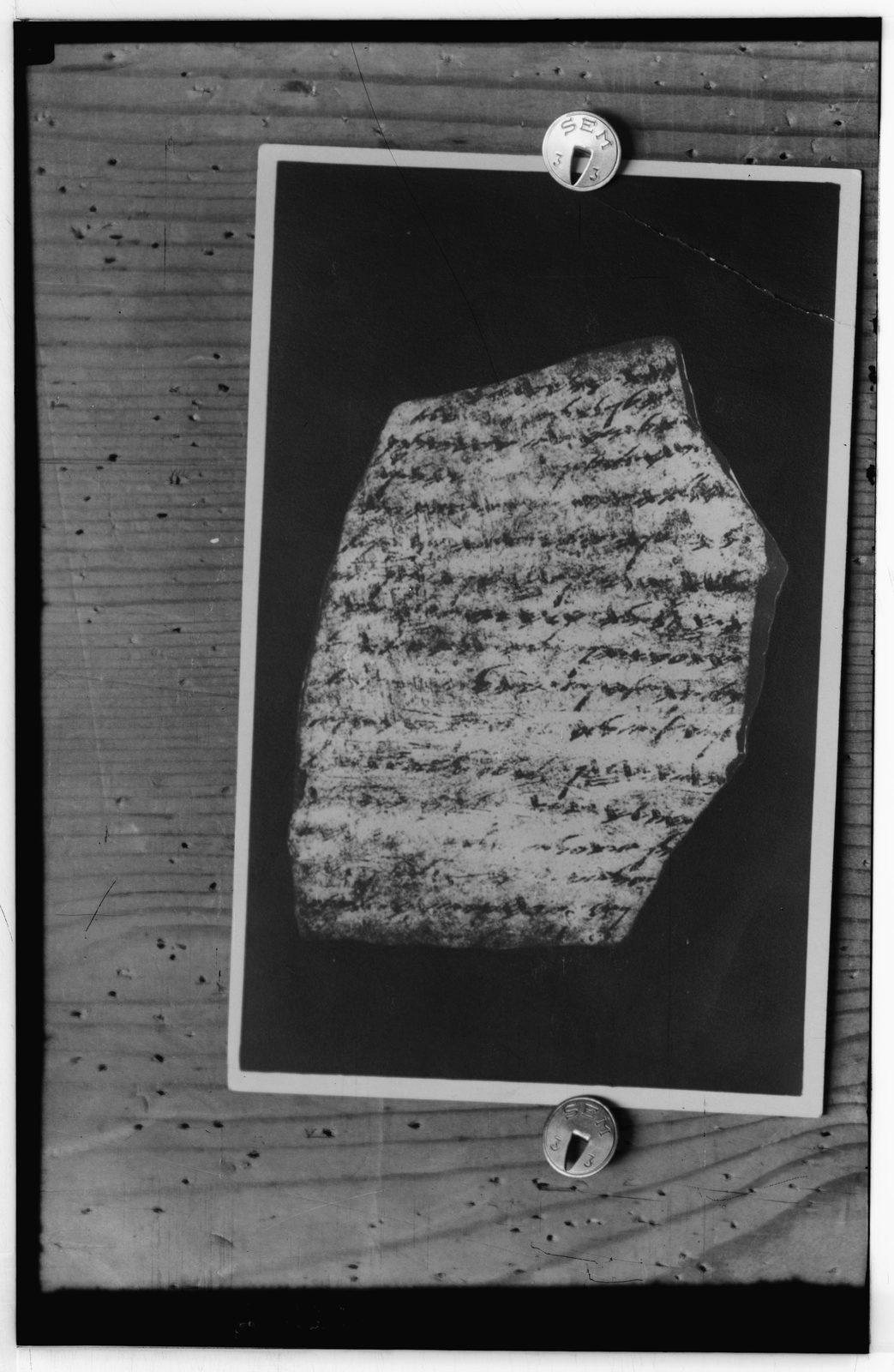
Unknown photographer, Lachish Letter 3, 1934 to 1939. Public domain.
Jeremiah 34:7 · Subject · Featured Study
The Lachish Letters and the Signal Fires
Letters written during Babylon's war on Judah were found at Lachish, one of the two towns Jeremiah 34:7 names.
An officer wrote that he was watching for the signals of Lachish, because he could not see Azekah.
as the army of the king of Babylon was fighting against Jerusalem and the remaining cities of Judah—against Lachish and Azekah. For these were the only fortified cities remaining in Judah.
as the army of the king of Babylon was fighting against Jerusalem and the remaining cities of Judah—against Lachish and Azekah. For these were the only fortified cities remaining in Judah.
- Book
- Jeremiah
- Hold in memory
- Jeremiah 34:7
Summary
The Lachish letters are short army letters. They were written in ink on pieces of broken pottery in the last years of the kingdom of Judah.
- Eighteen were found in 1935 and three more in 1938.
- Seventeen of them are held by the British Museum.
- Scholars read Letter 3 and Letter 4 in more than one way.
The Last Fortified Cities
Jeremiah spoke to King Zedekiah while Nebuchadnezzar's army was fighting against Jerusalem.
Three Letters Beside Jeremiah
W. F. Albright's translation, as the Bible Archaeology Report quotes it, gives each letter's words.
Three of the letters touch a place, a man and a phrase that the book of Jeremiah also records.
| Letter | What it says | What the verse beside it records |
|---|---|---|
| Letter 3 | The commander Coniah son of Elnathan has gone down to Egypt, and a letter came by way of the prophet. | The prophet Uriah fled to Egypt, and Elnathan son of Achbor went to bring him back. |
| Letter 4 | The writer watches for the signals of Lachish and cannot see Azekah. | Lachish and Azekah were the last fortified cities of Judah. |
| Letter 6 | Someone's words are liable to loosen the hands of the people. | The officials said Jeremiah was discouraging the warriors. |
Found at the Gate
Starkey's excavation found the letters, and H. Torczyner first published them.
Each letter is an ostracon, a piece of broken pottery used for writing. J. Naveh, in the Encyclopaedia Judaica, says the letters lay in a room beside the city gate.
Rehoboam built up both towns, and both were settled again after the exile.
| Town | What is recorded | In Scripture |
|---|---|---|
| Lachish | Built up by Rehoboam; Hezekiah sent his surrender to the king of Assyria there; settled again after the exile | 2 Chronicles 11:9; 2 Kings 18:14; Nehemiah 11:30 |
| Azekah | Joshua's pursuit reached it; built up by Rehoboam; dug by Bliss and Macalister in 1898 and 1899, and by the Lautenschläger Azekah Expedition since 2012 | Joshua 10:10; 2 Chronicles 11:9; Nehemiah 11:30 |
The Word for the Signal
Brown, Driver and Briggs give the Hebrew word two senses.
Their lexicon gives mas'eth as an uprising of smoke in Judges 20:38 and 40, and as a signal in Jeremiah 6:1.
“Run for cover, O sons of Benjamin; flee from Jerusalem! Sound the ram’s horn in Tekoa; send up a signal over Beth-haccherem, for disaster looms from the north, even great destruction.The Cambridge Bible notes that a related word was used in later Hebrew for the fire lit to announce the new moon.
John Calvin on the Arrest
Calvin wrote on Jeremiah's arrest after four officials heard his words.
John Calvin (1509 to 1564)
“The Prophet now shews that he was again dragged from the court of the prison to the inner part, which was dark, filthy, and like a grave. The cause of this he states: it was because four of the princes had heard his words.”
John Calvin · Commentaries · on Jeremiah 38:4Reformed
Two Questions Weighed
Scholars read Letter 4 and Letter 3 in more than one way.
Each letter has two readings, and each reading has its holders and its objection.
| Reading | Held by | Work | Objection |
|---|---|---|---|
| Letter 4: what the line on Azekah means | |||
| Azekah had already fallen | The Bible Archaeology Report, which calls it the standard reading | Letters from the Biblical World: The Lachish Letters (2025) | Begin argues that the writer's post had no line of sight to Azekah. |
| Azekah lay out of sight of the writer's post | Benny Begin; J. Naveh allows poor visibility | Beacons of Lachish; Lachish Ostraca, Encyclopaedia Judaica | The standard reading takes the line as news of Azekah's fall. |
| Letter 3: who the prophet was | |||
| Uriah son of Shemaiah, who fled to Egypt | H. Torczyner | Lachish I (1938) | Naveh calls the man only a certain prophet. |
| A prophet the letter does not name | J. Naveh | Lachish Ostraca, Encyclopaedia Judaica | Torczyner named him as Uriah. |
Books to Read Next
Two older commentaries cover Jeremiah 34 to 38.
Notes, Explanatory and Practical, on the Old and New Testaments
Albert Barnes · 1832 to 1869
Barnes comments on Jeremiah 34 to 38, with notes on Lachish and Azekah.
Read it free at BibleHubBiblical Commentary on the Old Testament: Jeremiah
Carl Friedrich Keil and Franz Delitzsch · 1857 to 1878
It takes Jeremiah 34 to 38 in order.
Read it free at BibleHubTwo Sides of One Siege
Jeremiah 34 and the Lachish letters come from the same war.
The prophet's word to the king and the officer's letters to his commander both come from Judah's last months.
And on the ninth day of the fourth month of Zedekiah’s eleventh year, the city was breached.Sources
Scripture is the Berean Standard Bible.
- J. Naveh, Lachish Ostraca, Encyclopaedia Judaica, cite-only.
- H. Torczyner and others, Lachish I: The Lachish Letters (1938), cite-only.
- The British Museum's holding of the letters, as cited by Wikipedia's article Lachish letters; O. Ilan, Image and Artifact: Treasures of the Rockefeller Museum (2000), for Letter 6.
- W. F. Albright, translation of the Lachish letters in J. B. Pritchard, ed., Ancient Near Eastern Texts (1950), p. 322, cite-only.
- Bible Archaeology Report, Letters from the Biblical World: The Lachish Letters (2025)
- Benny Begin, Beacons of Lachish, as reported in The Beacon of Lachish, Love of the Land.
- Brown, Driver and Briggs, Hebrew and English Lexicon, entry mas'eth (Strong's H4864)
- The Cambridge Bible for Schools and Colleges, on Jeremiah 6:1; public domain.
- Levantine Ceramics Project, Tel Azekah (2021), citing Stern (1993)
- Albert Barnes, Notes, Explanatory and Practical (1832 to 1869), on Jeremiah 34 to 38.
- Carl Friedrich Keil and Franz Delitzsch, Biblical Commentary on the Old Testament (1857 to 1878), Jeremiah; public domain.
- John Calvin, his commentary on Jeremiah 38.
Keep Studying
Read it4
Studies4
People and groups4
Doctrines1