
Galatians 1 · Acts 15 · Person · Featured Study
James the Brother of the Lord
What the Gospels, Acts, Paul's letters and Josephus record of him, and how the church has read the word brother.
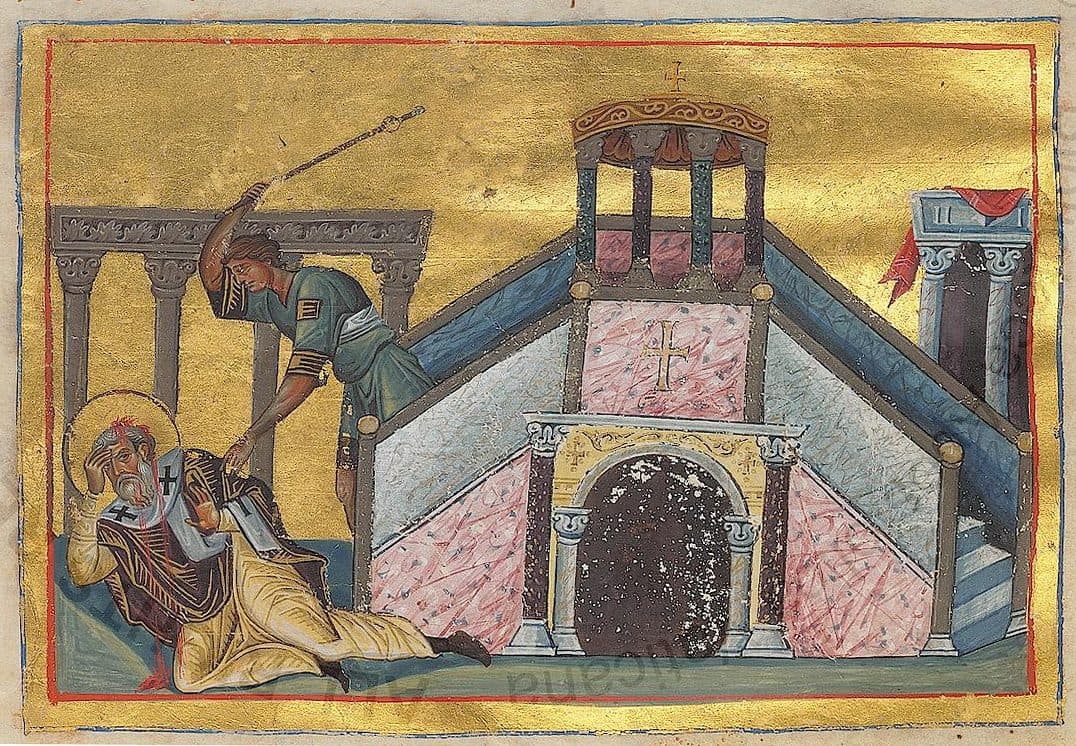
The martyrdom of James the brother of the Lord, miniature from the Menologion of Basil II, Constantinople, about 985, Vatican Library, Vat. gr. 1613. Public domain, via Wikimedia Commons.
THE ARTWORKA man raises a club over James, who lies fallen before the temple. The painter follows the account of his death that Eusebius preserves from Hegesippus.
James grew up in the family of Jesus at Nazareth and ended his life stoned in Jerusalem.
Summary
James was a brother of Jesus who came to faith after the resurrection and became the leader of the church in Jerusalem.
- Mark names him first of the four brothers of Jesus.
- The risen Christ appeared to him, as Paul records.
- Paul calls him one of the three pillars of the church.
- At the council in Acts 15 he gave the judgment on the Gentiles.
Where James Stands in Scripture
Mark 6:3, where Nazareth names him, and Paul's first word of him
Isn’t this the carpenter, the son of Mary and the brother of James, Joses, Judas, and Simon? Aren’t His sisters here with us as well?” And they took offense at Him.But I saw none of the other apostles except James, the Lord’s brother.The Life, Turn by Turn
Ten turns from Scripture and one from Josephus
- Named among the brothers of JesusNazareth, Mark 6:1 to 3
- The brothers do not believeGalilee, John 7:5
- The risen Christ appears to himnot named, 1 Corinthians 15:7
- Prays in the upper room with Mary and the apostlesJerusalem, Acts 1:14
- Paul sees him on his first visitJerusalem, Galatians 1:18 to 19
- Peter, freed from prison, sends him wordJerusalem, Acts 12:17
- Gives Paul the right hand of fellowshipJerusalem, Galatians 2:9
- Men come from him to the churchAntioch, Galatians 2:12
- Gives the judgment at the councilJerusalem, Acts 15:19
- Receives Paul's report with the eldersJerusalem, Acts 21:18
- Stoned on the order of AnanusJerusalem, in Josephus, Antiquities 20.9.1
Seven of the eleven turns take place in Jerusalem.
From the Risen Christ to the Jerusalem Elders
1 Corinthians, Galatians, Acts and the Gospel of the Hebrews
Three years after his call Paul stayed fifteen days with Peter in Jerusalem.
At Acts 12:17 Peter leaves for another place, and Acts next names James at the council, where he spoke last, after Peter, Barnabas and Paul.
The appearance to James1 Corinthians 15:5 to 8; the Gospel of the Hebrews
and that He appeared to Cephas and then to the Twelve. After that, He appeared to more than five hundred brothers at once, most of whom are still living, though some have fallen asleep. Then He appeared to James, then to all the apostles. And last of all He appeared to me also, as to one of untimely birth.“But the Lord, after he had given his grave clothes to the servant of the priest, appeared to James (for James had sworn that he would not eat bread from that hour in which he drank the cup of the Lord until he should see …”
Gospel of the Hebrews · De Viris Illustribus (On Illustrious Men), Section 2 · on Galatians 1:19Patristic
The judgment at the councilActs 15:13 to 21
‘After this I will return and rebuild the fallen tent of David. Its ruins I will rebuild, and I will restore it, so that the remnant of men may seek the Lord, and all the Gentiles who are called by My name, says the Lord who does these thingsAmos in the Berean text speaks of the remnant of Edom, and James speaks of the remnant of men.
It is my judgment, therefore, that we should not cause trouble for the Gentiles who are turning to God. Instead, we should write and tell them to abstain from food polluted by idols, from sexual immorality, from the meat of strangled animals, and from blood.Paul's last visitActs 21:17 to 26
When they heard this, they glorified God. Then they said to Paul, “You see, brother, how many thousands of Jews have believed, and all of them are zealous for the law.The thousands zealous for the law are the reason James and the elders gave for the vow that follows.
They asked Paul to join four men under a vow and pay their costs in the temple, and he did so the next day.
What the Texts Set Beside Him
Six details retellings often drop
THE FAMILY CAME TO TAKE HIM HOME
When crowds pressed on Jesus, His family went out to take custody of Him, saying He was out of His mind.
THE BROTHERS URGED HIM TO JUDEA
Before the Feast of Tabernacles the brothers told Jesus to go to Judea and show Himself to the world.
A REQUEST FOR THE POOR
The pillars asked Paul and Barnabas only to remember the poor.
THE BROTHERS TRAVELLED WITH WIVES
Paul says the Lord's brothers took believing wives with them on their travels.
A SERVANT BY HIS OWN TITLE
The letter of James opens with the title servant of God and of the Lord Jesus Christ and claims no kinship.
THE OTHER JAMES WAS ALREADY DEAD
Herod had James the brother of John put to death before Peter sent word to this James.
His Death in Jerusalem
Josephus, Hegesippus and Clement as Eusebius quotes them, and Jamieson, Fausset and Brown
Josephus, the Jewish historian, wrote that the governor Festus died in office and that Rome sent Albinus to replace him. In the gap the high priest Ananus, a Sadducee, called the Sanhedrin, charged James and some others with breaking the law, and had them stoned. Citizens who were careful of the law protested to King Agrippa and to Albinus, and Agrippa removed Ananus after three months as high priest.
Hegesippus, Clement and the name the JustEusebius, Church History 2.23 and 2.1; Jamieson, Fausset and Brown
Hegesippus, a Christian writer Eusebius places soon after the apostles, says James prayed in the temple so often that his knees grew hard like a camel's. He and Clement give one manner of death, and he adds that Vespasian's siege followed at once.
“James, the brother of the Lord, succeeded to the government of the Church in conjunction with the apostles. He has been called the Just by all from the time of our Saviour to the present day; for there were many that bore the name of …”
Hegesippus · Memoirs (Book V), as quoted in Church History (Book II), Chapter 23, Sections 4-18 · on Galatians 1:19Patristic
“He was called ‘the Just,’ from his strict adherence to the law, and so was especially popular among the Jewish party though he did not fall into their extremes; whereas Peter was somewhat estranged from them through his intercourse with the Gentile Christians.”
Jamieson, Fausset & Brown · Commentary Critical and Explanatory on the Whole Bible · on Galatians 2:9Reformed
“For they say that Peter and James and John after the ascension of our Saviour, as if also preferred by our Lord, strove not after honor, but chose James the Just bishop of Jerusalem... The Lord after his resurrection imparted knowledge to James the Just and to John and Peter, and they imparted it to the rest of the apostles, and the rest of the apostles to the seventy, of whom Barnabas was one. But there were two Jameses: one called the Just, who was thrown from the pinnacle of the temple and was beaten to death with a club by a fuller, and another who was beheaded.”
Clement of Alexandria · Hypotyposes books 6 and 7, quoted in Eusebius's Church History (Book II), Chapter 1, Sections 3-4 · on Galatians 1:19Patristic
The Family of James
Five ties named in the Gospels and Jude
| Person | Tie to James |
|---|---|
| Mary | The mother of Jesus. |
| Joseph | The carpenter, whom Nazareth took for the father of Jesus. |
| Joses and Simon | Two more brothers, named beside James and Judas. |
| Judas (Jude) | A brother, who calls himself a brother of James. |
| Sisters | Sisters of Jesus who lived at Nazareth, left unnamed. |
- Person
- Mary
- Tie to James
- The mother of Jesus.
- Person
- Joseph
- Tie to James
- The carpenter, whom Nazareth took for the father of Jesus.
- Person
- Joses and Simon
- Tie to James
- Two more brothers, named beside James and Judas.
- Person
- Judas (Jude)
- Tie to James
- A brother, who calls himself a brother of James.
- Person
- Sisters
- Tie to James
- Sisters of Jesus who lived at Nazareth, left unnamed.
The Places of His Life
Three cities the texts name in his life
about 200 km (124 miles)
- 1Nazareth, The hometown of Jesus and His brothers. Mark 6:1 to 3
- 2Jerusalem, The city of the council in Acts 15 and of his death. Acts 15:13 to 21
- 3Antioch, The church of Paul and Barnabas, where the dispute of Galatians 2 took place. Galatians 2:11
The coastline is simplified; each place stands at its place page's coordinates.
Each place opens its own page, in the order the texts reach it.
Questions the Life Raises
Two questions on his place among the apostles and his part at Antioch
Was James one of the Twelve?Matthew 10; Galatians 1; John Calvin
Scripture sets the brothers of Jesus apart from the Twelve, for Acts 1:13 to 14 names them after the eleven apostles, and John 7:5 records their unbelief after the Twelve were chosen.
John Calvin, in his Commentary on Galatians, read Galatians 1:19 as counting James among the apostles, and held that he was the son of Alphaeus and so one of the Twelve. Albert Barnes, in his Notes on the New Testament, also counts him an apostle.
These are the names of the twelve apostles: first Simon, called Peter, and his brother Andrew; James son of Zebedee, and his brother John; Philip and Bartholomew; Thomas and Matthew the tax collector; James son of Alphaeus, and Thaddaeus;Why did Peter draw back at Antioch?Galatians 2:11 to 13
For before certain men came from James, he used to eat with the Gentiles. But when they arrived, he began to draw back and separate himself, for fear of those in the circumcision group.What the Texts Leave Unsaid
Four silences in Scripture and one in Josephus
Scripture records the appearance to James and gives none of its words. It never calls him a bishop, never records his death, and never says what the men from James were sent to Antioch to do.
Origen and Eusebius quote Josephus as saying Jerusalem fell to avenge James. The sentence does not stand in the Antiquities as the Whiston translation gives it.
What His Life Shows
Two lessons from the brother who led the church in Jerusalem
Voices on James
Tertullian on the brothers' unbelief and John Chrysostom on the appearance
“But there is some ground for thinking that Christ's answer denies His mother and brethren for the present, as even Apelles might learn. ‘The Lord's brethren had not yet believed in Him.’ So is it contained in the Gospel which was published before Marcion's time; whilst there is at the same time a want of evidence of His mother's adherence to Him, although the Marthas and the other Marys were in constant attendance on Him.”
Tertullian · On the Flesh of Christ · on John 7:5Patristic
“‘After that, He was seen of James.’ I suppose, His brother. For the Lord is said to have Himself ordained him and made him Bishop in Jerusalem first. ‘Then to all the apostles.’ For there were also other apostles, as the seventy.”
John Chrysostom · Homily on 1 Corinthians 38 · on 1 Corinthians 15:7Patristic
What Brother Means, and Who Wrote the Letter
Four readings of brother and three on the letter's author
The site's lexicon glosses the Greek word adelphos as a brother, near or remote.
Sons of Mary and JosephHelvidius, as Jerome answers him about AD 383
Helvidius held that the brothers and sisters were children Mary bore after Jesus, and he cited Tertullian and Victorinus. Jerome, in Against Helvidius, answers him from the women at the cross in John 19:25.
My fellow prisoner Aristarchus sends you greetings, as does Mark the cousin of Barnabas. You have already received instructions about him: If he comes to you, welcome him.The New Testament uses anepsios, the word for cousin, only here, of Mark, so it never calls James a cousin of Jesus.
Sons of Joseph by an earlier wifeOrigen; Eusebius
Origen, in his Commentary on Matthew, reports that some held the brothers to be sons of Joseph by a wife before Mary. Eusebius, in Church History 2.1, says James was called the Lord's brother because he was known as a son of Joseph. Against this view, Jerome in Against Helvidius writes that it is nowhere written that Joseph had another wife.
Cousins of JesusJerome, Against Helvidius; John Calvin; John Wesley
Jerome held that the brothers were cousins, sons of Mary the wife of Clopas. John Calvin judged this the more probable reading, and John Wesley calls the brothers sons of the Virgin's sister.
“But other of the apostles I saw none, save James the brother (that is, the kinsman) of the Lord - Therefore when Barnabas is said to have ‘brought him into the apostles,’ Acts ix, 27, only St. Peter and St James are meant.”
John Wesley · Explanatory Notes upon the New Testament · on Galatians 1:19Evangelical
Against this view, Helvidius, as Jerome answers him, cited Matthew 13:55, which names the brothers with Mary and the carpenter as one household.
A title his character earnedJerome, Commentary on Galatians
Jerome, in his Commentary on Galatians, holds that James was called the Lord's brother at Galatians 1:19 as a title his character, faith and wisdom earned.
Eusebius, Jerome and Calvin on the authorEusebius; Jerome; John Calvin
Eusebius, in Church History 2.23, reports that James is said to be the author of the letter. He notes that it was disputed and that not many of the ancients mentioned it, yet it was read in very many churches. Jerome, in On Illustrious Men 2, reports that some said another man published it under his name. Calvin received the letter and declined to say which James wrote it.
Books to Read Next
Four early and Reformation works, all free to read
The Antiquities of the Jews, Book 20
Flavius Josephus, translated by William Whiston · the thirteenth year of Domitian
Book 20 covers twenty-two years of Judea, from the governor Fadus to Florus.
Read free at Project GutenbergChurch History, Book 2
Eusebius of Caesarea · fourth century
Eusebius carries the history of the church in Book 2 from the apostles to the reign of Nero.
Read free at New AdventOn Illustrious Men
Jerome · the fourteenth year of Theodosius
Jerome writes the lives of the Christian writers, and his second chapter, after Peter, gives the life of James.
Read free at New AdventCommentary on Galatians
John Calvin, translated by William Pringle · 1548
Calvin comments on the whole letter, chapter by chapter.
Read free at the Christian Classics Ethereal LibraryThe Brother Who Believed
His life asks the reader to serve the risen Christ in the church where he is placed.
Keep studying
Studies11
People8
Doctrines1