
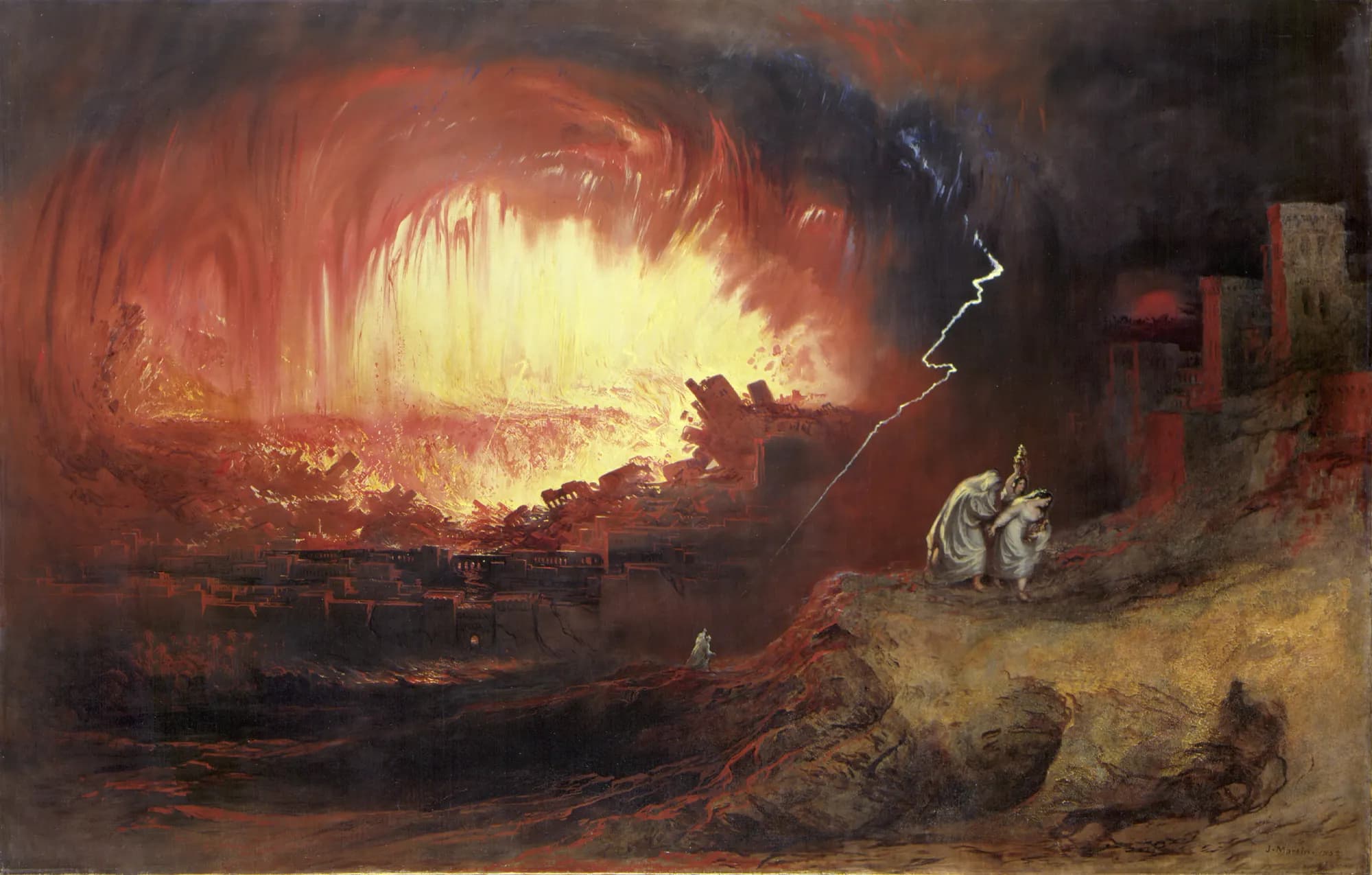
The Destruction of Sodom and Gomorrah, John Martin, 1852. Public domain.
Old Testament · Book 36 of 66
Zephaniah
Zephaniah records the words of a prophet in the days of King Josiah. He warns of the day of the LORD on Judah and the nations and closes with God rejoicing over his people with singing.
Zephaniah records the words of a prophet in the days of King Josiah. He warns of the day of the LORD on Judah and the nations and closes with God rejoicing over his people with singing.
What is Zephaniah about?
Zephaniah is the word of the LORD to a prophet of Judah in the days of King Josiah. It announces the day of the LORD, which sweeps the whole earth and falls first on Judah, where the LORD searches Jerusalem with lamps. The same day reaches the nations to the west, east, south and north. Between the two, the humble are told to seek the LORD before the day comes. Jerusalem is charged once more, and then a humble remnant is left in Zion and told to sing. The book ends with the LORD in her midst: “He will rejoice over you with singing” (3:17).
All 3 chapters
Every chapter of the book, in one grid. Each cell opens that chapter.
- The day of the LORD on JudahChapter 1
- The nations round aboutChapter 2
- The remnant that singsChapter 3
The colour is the movement of the book the chapter stands in, and every cell opens that chapter's Study level.
Who wrote it, where, when, for whom, and why?
The book opens as the word of the LORD that came to Zephaniah son of Cushi, and it traces his line through Gedaliah and Amariah to Hezekiah (1:1). It speaks in the LORD's own voice, marked again and again by declares the LORD (1:2, 1:3, 1:10, 2:9, 3:8). No other book of Scripture names Zephaniah the prophet. The priest Zephaniah son of Maaseiah in Jeremiah (Jeremiah 21:1) is another man.
This is the word of the LORD that came to Zephaniah son of Cushi, the son of Gedaliah, the son of Amariah, the son of Hezekiah, in the days of Josiah son of Amon king of Judah:
Zephaniah 1:1, Berean Standard Bible.
The book stands in Jerusalem. It names the Fish Gate, the Second District and the Hollow (1:10 and 11), the rooftops where the host of heaven is worshiped (1:5), and the LORD's holy mountain (3:11). Its judgments look out to Gaza, Ashkelon, Ashdod and Ekron on the coast, Moab and Ammon to the east, Cush to the south and Nineveh to the north (2:4 to 15).
The word came in the days of Josiah son of Amon king of Judah (1:1). Josiah reigned thirty-one years in Jerusalem, began to seek the God of David in his eighth year and to purge Judah in his twelfth (2 Chronicles 34:1 to 3), and in his eighteenth year the Book of the Law was found in the temple (2 Kings 22:3 and 8). Nineveh still stands in the book as a carefree city (2:13 to 15).
The book speaks to Judah and all who dwell in Jerusalem (1:4), to the shameful nation called to gather (2:1), and to all the humble of the earth who carry out the LORD's justice (2:3). Its last words are spoken to the Daughter of Zion (3:14).
The book gives its reason in the LORD's words. The people have turned back from following him and do not seek him (1:6), and some say in their hearts that he will do nothing, good or bad (1:12). He calls the humble to seek him before the day (2:3), and he promises to leave a meek and humble people who trust in his name (3:12) and to gather the scattered home (3:20).
Judah in these chapters still carries the worship of the reigns before Josiah: the remnant of Baal and its priests, the host of heaven on the rooftops, and oaths by Milcom (1:4 and 5). Its princes wear foreign apparel (1:8), and its merchants weigh out silver in the Hollow (1:11). Beyond its borders stand the Philistine cities, Moab and Ammon, Cush, and Assyria with Nineveh (2:4 to 15).
Sources. Zephaniah 1:1 to 6, 1:8, 1:10 to 12, 2:1, 2:3, 2:4 to 15, 2:9, 3:8, 3:11, 3:12, 3:14 and 3:20; 2 Kings 22:3 and 8; 2 Chronicles 34:1 to 3; Jeremiah 21:1. Every verse is read in the Berean Standard Bible.
How is Zephaniah arranged, and what is it for?
The three movements the book falls into, then what it teaches and what it was written to do.
- The day of the LORD on JudahChapter 1, 18 verses, the turn at 1:14
The earth swept, then Judah and Jerusalem searched with lamps, and the great day near.
- The nations round aboutChapter 2, 15 verses, the turn at 2:3
A call to seek the LORD before the day, then judgment west, east, south and north.
- The remnant that singsChapter 3, 20 verses, the turn at 3:17
Woe to the rebellious city, then pure lips for the peoples and the LORD singing in Zion.
The theme
The day of the LORD is near, and it falls first on his own people. Judah swears by the LORD and by Milcom and says he will do nothing, so he searches Jerusalem with lamps. The same day reaches the nations on every side and the whole earth. Through it runs one call, to seek the LORD in humility, and beyond it one promise: a humble remnant left in Zion, pure lips given to the peoples, and the LORD in the city's midst rejoicing over it with singing.
The purpose
Zephaniah was sent in the days of Josiah to tell Judah that the LORD it had written off would act, and soon. The book names the sins of the city street by street so that none could say the warning was vague. It calls the humble to seek the LORD while there is time, and it leaves them a promise to hold through the judgment: the LORD will gather them and bring them home.
The day of the LORD in widening circles
At the centre: “The LORD your God is among you” (3:17).
The stations (6)
- 1The whole earthZephaniah 1:2 to 3, 2 verses, The day of the LORD on JudahMan and beast, bird and fish swept from the face of the earth.
- 2Judah and JerusalemZephaniah 1:4 to 13, 10 verses, The day of the LORD on JudahBaal's priests, the rooftops, the princes, and the city searched with lamps.
- 3The whole earth againZephaniah 1:14 to 18, 5 verses, The day of the LORD on JudahThe great day near, and the whole earth consumed by the fire of his jealousy.
- 4The nations by compass pointZephaniah 2:4 to 15, 12 verses, The nations round aboutPhilistia west, Moab and Ammon east, Cush south, Assyria north.
- 5Jerusalem againZephaniah 3:1 to 8, 8 verses, The remnant that singsThe city of oppressors, with the LORD righteous within her.
- 6The singing at the centreZephaniah 3:9 to 20, 12 verses, The remnant that singsPure lips for the peoples, a humble remnant, and the LORD singing in Zion's midst.
The bar under each station is its length in verses, in the colour of its movement. The letters on the second band are the compass points of chapter 2.
The day of the LORD on Judah, Zephaniah 1
What the text says in these 18 verses, and the pages they open on.
The word comes to Zephaniah in the days of Josiah king of Judah (1:1). The LORD will sweep away everything from the face of the earth, man and beast, the birds and the fish, and the idols with their worshipers (1:2 and 3). Then the hand falls on Judah and Jerusalem: the remnant of Baal and its priests, those who bow on the rooftops to the host of heaven, those who swear by the LORD and by Milcom, and those who have stopped seeking him (1:4 to 6). The day is a sacrifice with guests consecrated, and the princes, the king's sons and those in foreign apparel will be punished (1:7 and 8). A cry goes up from the Fish Gate, the Second District and the Hollow, and the LORD searches Jerusalem with lamps for the men who say he will do nothing (1:10 to 12). At 1:14 the day itself is named: near, coming quickly, a day of wrath and darkness, of horn blast and battle cry, when silver and gold will not deliver and the whole earth is consumed by the fire of his jealousy (1:14 to 18).
The great Day of the LORD is near—near and coming quickly. Listen, the Day of the LORD! Then the cry of the mighty will be bitter.
- Study
Zephaniah 1the earth swept, Jerusalem searched, the day of wrath nearShow the summary and 6 pagesShow summary, 6 pagesHide the summary
Zephaniah traces his line back four generations to Hezekiah and prophesies under Josiah, and he opens at the scale of Genesis reversed: 'I will completely sweep away everything from the face of the earth … man and beast … the birds of the air, and the fish of the sea'. Then the sweep narrows to Judah: the remnant of Baal, the idol-priests, rooftop worshipers of the host of heaven, men who swear both by Jehovah and by Malcam. 'the Day of the LORD is near. Indeed, the LORD has prepared a sacrifice': the guests are the invaders. Jerusalem is searched with lamps for the complacent 'settled in complacency'. The great day is near: 'a day of wrath, a day of trouble and distress' (1:15).
- The LORD will sweep away man and beast, bird and fish, and cut off mankind from the face of the earth (1:2 and 3).
- Judah and Jerusalem are named: the remnant of Baal, the rooftop worship of the host of heaven, and those who swear by the LORD and by Milcom (1:4 and 5).
- Jerusalem is searched with lamps for the men who say the LORD will do nothing (1:12), and the great day is near (1:14).
On this chapter (6)
- The day of the LORD
The day the prophets announced, from Amos to Zephaniah.
- Josiah finds the book
The reform in the reign the book is dated to.
- Is the Hezekiah of 1:1 the king, and what does the four-generation line say of the prophet?
Answered under Where do readers disagree, lower on this page, with each reading and who holds it.
- When in Josiah's reign did Zephaniah prophesy, before or after the reform of 2 Kings 22 to 23?
Answered under Where do readers disagree, lower on this page, with each reading and who holds it.
- What is the day of the LORD in Zephaniah, and how did the church's hymn Dies irae take 1:15 up?
Answered under Where do readers disagree, lower on this page, with each reading and who holds it.
- Zephaniah 1:14
The verse on its own page, with the commentators on it by era.
Jerusalem searched by its quarters
“I will search Jerusalem with lamps” (1:12).
The quarters (4)
- 1The Fish GateZephaniah 1:10, a cryA gate of the north wall, named again in the rebuilding at Nehemiah 3:3.Probable: the area is known, the exact line is not.
- 2The Second DistrictZephaniah 1:10, a wailThe newer quarter where Huldah the prophetess lived (2 Kings 22:14).Probable: the area is known, the exact line is not.
- 3The hillsZephaniah 1:10, a loud crashingThe heights round the city; the verse speaks of the hills together.Proposed: one placement among several.
- 4The HollowZephaniah 1:11, the merchants silencedA low market quarter, often placed in the valley between the western and eastern hills.Proposed: one placement among several.
A solid ring is probable and a broken ring is proposed. T is the temple mount, the one fixed point.
Characters (6)
Who the text names. A name with a page carries its door.
- Zephaniah son of Cushi
The prophet, traced four generations to Hezekiah (1:1).
- Josiah
King of Judah in whose days the word came (1:1).
- Hezekiah
The last name in the prophet's line (1:1).
- The priests of Baal
The idolatrous and pagan priests whose names will be cut off (1:4).
Show the next 2
- The princes and the king's sons
Punished with all who dress in foreign apparel (1:8).
- The men settled in complacency
Those who say the LORD will do nothing, good or bad (1:12).
Places (4)
Where the chapter stands.
- Jerusalem
Searched with lamps on that day (1:12).
- The Fish Gate
Where a cry will go up (1:10).
- The Second District
Where a wail will rise (1:10).
- The Hollow
The merchants' quarter, told to wail (1:11).
Themes (3)
What the chapter raises, each on its own page where one stands.
- The day of the LORD
Near and coming quickly, a day of wrath (1:14 and 15).
- The search with lamps
No corner of the city is hidden on that day (1:12).
- Josiah finds the book
The reform in the reign Zephaniah names.
Where the New Testament uses these chapters (2)each marked as a quotation or an allusion, with the evidence
- Probable allusionZephaniah 1:14 to 18 at Revelation 6:17. Those who hide from the Lamb cry that the great day of their wrath has come, the words of Zephaniah's great day and day of wrath. The store's cross references join Revelation 6:17 to Zephaniah 1:14 to 18. John speaks of the great day of wrath, and Zephaniah 1:14 and 15 calls the same day the great day and a day of wrath.
- Probable allusionZephaniah 1:15 at Romans 2:5. Paul warns the hard heart that it stores up wrath for the day of wrath, when God's righteous judgment will be revealed. The store's cross references join Romans 2:5 to Zephaniah 1:15, and Matthew Henry, Commentary on the Whole Bible, on 1:15, sets Romans 2 beside the verse. Paul's day of wrath is the phrase of Zephaniah 1:15.
The nations round about, Zephaniah 2
What the text says in these 15 verses, and the pages they open on.
Chapter 2 opens with a call before the decree takes effect: gather together, O shameful nation (2:1 and 2). The humble of the earth are told to seek the LORD, to seek righteousness and humility, and perhaps they will be sheltered on the day of his anger (2:3). Then the judgment goes round the compass. To the west Gaza, Ashkelon, Ashdod and Ekron fall, and the coast becomes pasture for the remnant of Judah (2:4 to 7). To the east Moab and Ammon, who taunted God's people, will be like Sodom and Gomorrah, and the nations of every shore will bow to the LORD (2:8 to 11). To the south the Cushites are slain by his sword (2:12). To the north Assyria is destroyed and Nineveh, the carefree city that said there is none besides me, becomes a desert where herds lie down and the owls roost (2:13 to 15).
Seek the LORD, all you humble of the earth who carry out His justice. Seek righteousness; seek humility. Perhaps you will be sheltered on the day of the LORD’s anger.
- Study
Zephaniah 2seek the LORD, then Philistia, Moab and Ammon, Cush and NinevehShow the summary and 3 pagesShow summary, 3 pagesHide the summary
Before the storm, a door: 'Seek the LORD, all you humble of the earth … Seek righteousness; seek humility. Perhaps you will be sheltered on the day of the LORD’s anger' (2:3). Then judgment moves around the compass. West: Gaza forsaken, Ashkelon a desolation, Ashdod driven out at noonday, Ekron rooted up, the sea-coast left for the remnant of Judah. East: Moab and Ammon, who reproached and reviled his people, made like Sodom and Gomorrah, a possession of nettles and saltpits: 'This they shall have in return for their pride'. South: Ethiopia slain by the sword. North: Nineveh made dry as the wilderness, the joyous city that said in her heart, 'I am it, and there is none besides me'.
- The shameful nation is told to gather and to seek the LORD before the day comes (2:1 to 3).
- Gaza, Ashkelon, Ashdod and Ekron fall to the west, Moab and Ammon become like Sodom and Gomorrah to the east (2:4 to 11).
- The Cushites fall by the sword, and Nineveh becomes a dry desert where the owls roost (2:12 to 15).
On this chapter (3)
- The remnant
The few God spares, through the prophets.
- Who are the Cushites of 2:12 and 3:10?
Answered under Where do readers disagree, lower on this page, with each reading and who holds it.
- Zephaniah 2:3
The verse on its own page, with the commentators on it by era.
Four nations by compass point
- WestPhilistiaZephaniah 2:4 to 7, 4 verses
- The charge
- The seacoast of the Cherethites, the land of Canaan (2:5).
- The end
- No one left; the coast becomes pasture for the remnant of Judah (2:6 and 7).
- EastMoab and AmmonZephaniah 2:8 to 11, 4 verses
- The charge
- Taunting God's people and threatening their borders, out of pride (2:8 and 10).
- The end
- Like Sodom and Gomorrah, weeds and salt pits, plundered by the remnant (2:9).
- SouthCushZephaniah 2:12, 1 verse
- The charge
- Counted among the nations the LORD judges on that day (2:11 and 12).
- The end
- Slain by the LORD's sword (2:12).
- NorthAssyria and NinevehZephaniah 2:13 to 15, 3 verses
- The charge
- The carefree city that says there is none besides me (2:15).
- The end
- A desolation as dry as a desert, where herds lie down and owls roost (2:13 and 14).
Characters (4)
Who the text names. A name with a page carries its door.
- The humble of the earth
Those who carry out his justice, told to seek the LORD (2:3).
- The Philistines
The nation of the Cherethites on the seacoast (2:5).
- Moab and the Ammonites
Who taunted God's people and threatened their borders (2:8).
- The Cushites
Slain by the LORD's sword (2:12).
Places (6)
Where the chapter stands.
- Gaza
Abandoned (2:4).
- Ashkelon, Ashdod and Ekron
Left in ruins, driven out at noon, uprooted (2:4).
- Moab
To be like Sodom (2:9).
- Ammon
To be like Gomorrah (2:9).
Show the next 2
- Cush
The people to the south (2:12).
- Assyria and Nineveh
The north, made a desolation (2:13).
Themes (3)
What the chapter raises, each on its own page where one stands.
- Seeking the LORD in humility
Seek righteousness; seek humility (2:3).
- The remnant
The remnant of Judah takes the coast (2:7 and 9).
- The Twelve
The book of the twelve prophets Zephaniah stands in.
No New Testament passage quotes or names these chapters.
The remnant that sings, Zephaniah 3
What the text says in these 20 verses, and the pages they open on.
The woe turns back on Jerusalem, the city of oppressors that heeded no voice and did not draw near to her God (3:1 and 2). Her princes are roaring lions, her judges evening wolves, her prophets reckless and her priests profane, while the LORD within her is righteous and does no wrong (3:3 to 5). He cut off nations so she would fear him, and she did not (3:6 and 7), so the nations are gathered for his burning anger (3:8). Then the book turns: the LORD will restore pure lips to the peoples so that all call on his name, and worshipers will come from beyond the rivers of Cush (3:9 and 10). The proud are removed and a meek and humble people is left, who trust in his name and speak no lies (3:11 to 13). Zion is told to sing, because the LORD has taken away her punishment and is among her (3:14 and 15). He is mighty to save and will rejoice over her with singing (3:17), and he will gather the lame and the scattered and restore their captives before their eyes (3:18 to 20).
The LORD your God is among you; He is mighty to save. He will rejoice over you with gladness; He will quiet you with His love; He will rejoice over you with singing.”
- Study
Zephaniah 3the city charged, pure lips for the peoples, the LORD singingShow the summary and 4 pagesShow summary, 4 pagesHide the summary
The last city named is his own: 'Woe to the city of oppressors, rebellious and defiled!': she obeyed not the voice, received not correction, trusted not in Jehovah. Princes are roaring lions, judges evening wolves, prophets treacherous, priests profaning the sanctuary; and in the middle of it, 'The LORD within her is righteous … He applies His justice morning by morning'. God gathers the nations to pour out his indignation. Then turns the whole book: peoples given a pure language to call on his name with one consent, and an afflicted people left who take refuge in him. Zion is told to sing, for 'He will rejoice over you with singing' (3:17).
- Jerusalem's princes, judges, prophets and priests are charged, while the LORD within her is righteous (3:1 to 5).
- The LORD will restore pure lips to the peoples and leave a meek and humble people in the city (3:9 to 13).
- Zion is told to sing, for the LORD is in her midst and will rejoice over her with singing (3:14 to 17).
On this chapter (4)
- The singing God
The LORD who rejoices over his people with singing.
- The remnant
The few God spares, through the prophets.
- Is 3:9 to 20 Zephaniah's own or a later hope?
Answered under Where do readers disagree, lower on this page, with each reading and who holds it.
- Zephaniah 3:17
The verse on its own page, with the commentators on it by era.
Sing, for the LORD is among you
What Zion is told (5)
Characters (4)
Who the text names. A name with a page carries its door.
- The officials and judges
Roaring lions and evening wolves (3:3).
- The prophets and priests
Reckless and faithless, profaning the sanctuary (3:4).
- The meek and humble people
Left in the city to trust in the LORD's name (3:12).
- The Daughter of Zion
Told to sing and shout aloud (3:14).
Places (3)
Where the chapter stands.
- Jerusalem
The city of oppressors, and the city told not to fear (3:1 and 16).
- Zion
The LORD's holy mountain, where the LORD is in her midst (3:11 and 17).
- The rivers of Cush
From beyond them his worshipers bring an offering (3:10).
Themes (4)
What the chapter raises, each on its own page where one stands.
- The singing God
He will rejoice over you with singing (3:17).
- The remnant
The remnant of Israel who do no wrong (3:13).
- Worship
Pure lips to call on the name of the LORD (3:9).
- Why God is not finished with Israel
The scattered gathered and the captives restored (3:20).
Where the New Testament uses these chapters (3)each marked as a quotation or an allusion, with the evidence
- Probable allusionZephaniah 3:13 at Revelation 14:5. No lie was found in the mouths of those who follow the Lamb, as no lie is found in the mouth of Zephaniah's remnant. The store's cross references join the two verses. The remnant of 3:13 who speak no lies stand on Zion as the 144,000 of Revelation 14:1 do.
- Probable allusionZephaniah 3:14 to 16 at John 12:15. John joins Do not be afraid, Daughter of Zion to the king coming on a donkey's colt. The store's cross references join John 12:15 to Zephaniah 3:16 and 17. John quotes Zechariah 9:9 for the king on the colt, and the words do not be afraid, spoken to Zion, stand at Zephaniah 3:16.
- Later Christian readingZephaniah 3:9 at Romans 15:6. Paul prays that Jews and Gentiles glorify God with one mind and one voice, which readers have set beside the pure lips given to the peoples. The store's cross references join the two verses. Paul's prayer is for Jews and Gentiles praising God together (Romans 15:7 to 11).
- Author
- Zephaniah, son of Cushi, four generations from Hizkiah (Hezekiah), 1:1
- Date
- During Josiah's reign, c. 640–609 BC
- Audience
- Judah on the edge of reform and exile
Where do readers disagree?
One list: the readings with their holders, and what the evidence does not settle.
Is the Hezekiah of 1:1 the king, and what does the four-generation line say of the prophet?
- King Hezekiah, and the prophet of the royal house. Held by John Wesley, Explanatory Notes upon the Old Testament, on 1:1, who writes that Zephaniah is thought to have been the great-grandson of king Hezekiah, and by Albert Barnes, Notes on the Old Testament, on 1:1.
- Godly forebears, their standing unknown. Held by John Calvin in his Commentaries on the Twelve Minor Prophets, on 1:1.
- A line of prophets. Held by Jerome, reporting the tradition of the Hebrews in his Commentary on Zephaniah, on 1:1.
What the evidence does not settle: The verse gives Josiah the title king of Judah and Hezekiah his name alone, and the generations from Hezekiah to Zephaniah are one more than from Hezekiah to Josiah, the count a great-grandson of the king would have.
The argument in full
King Hezekiah, and the prophet of the royal house. No other prophet's line runs back four generations, and Barnes reads the length as naming the last man because he was someone remarkable. Matthew Henry, on 1:1, notes that the name is the very same as the king's.
Godly forebears, their standing unknown. The line may name men who excelled in piety, but that is uncertain, and what matters is that the prophet brings nothing of his own and delivers what he received from God.
A line of prophets. The Hebrews held that when a prophet's father or grandfather is named in a title, those men were prophets too.
When in Josiah's reign did Zephaniah prophesy, before or after the reform of 2 Kings 22 to 23?
Josiah finds the book→- Before the reform. Held by Adam Clarke, Commentary on the Bible, on 1:1.
- While the reform was under way. Held by Robert Jamieson, A. R. Fausset and David Brown, Commentary Critical and Explanatory on the Whole Bible, on 1:1 and 1:4.
What the evidence does not settle: The book dates itself only to the reign (1:1), and the practices it names were purged in stages from Josiah's twelfth year to his eighteenth (2 Chronicles 34:3; 2 Kings 23:4 to 14).
The argument in full
Before the reform. The disorders the book describes show that it came before the reformation of Josiah's eighteenth year, and Clarke places it about the beginning of the reign.
While the reform was under way. The remnant of Baal (1:4) is what Josiah could not yet root out in remote places, and the people clung to Amon's practices under a king who did all he could to reform them.
What is the day of the LORD in Zephaniah, and how did the church's hymn Dies irae take 1:15 up?
The Day of the LORD→- The fall of Jerusalem to Babylon. Held by Adam Clarke, Commentary on the Bible, on 1:14, who says the day began with the death of Josiah at Megiddo and ran to the destruction of Jerusalem by Nebuchadnezzar.
- A near day and a forerunner of the last. Held by Albert Barnes, Notes on the Old Testament, on 1:14 and 1:15.
- The last judgment sung. Held by Thomas of Celano, in Dies Irae, the medieval sequence attributed to him, whose first words are those of the Latin Vulgate of 1:15, dies irae, dies illa.
What the evidence does not settle: How far the book's whole earth (1:2, 1:18, 3:8) reaches past Judah's fall, since the same chapter names both Jerusalem's streets and the face of the earth.
The argument in full
The fall of Jerusalem to Babylon. The day of 1:14 to 16 falls on fortified cities and corner towers with horn blast and battle cry, which is the siege Judah suffered.
A near day and a forerunner of the last. Each day of the LORD in history is an earnest of the judgments to the end, and at 1:15 Barnes reads the day of wrath as the last judgment itself.
The last judgment sung. The hymn takes the prophet's day of wrath and sings it as the day the world is judged, and it stood in the church's requiem mass for centuries.
Who are the Cushites of 2:12 and 3:10?
- The Nile kingdom south of Egypt. Held by Robert Jamieson, A. R. Fausset and David Brown, Commentary Critical and Explanatory on the Whole Bible, on 2:12.
- A people of Arabia near Moab. Held by John Gill in his Exposition of the Old Testament, on 2:12.
- The farthest people, standing for the whole world. Held by Albert Barnes, Notes on the Old Testament, on 3:10.
What the evidence does not settle: Whether Cush names one people in both verses, since 2:12 speaks only of the sword against the Cushites and 3:10 calls those from beyond its rivers the LORD's scattered people.
The argument in full
The Nile kingdom south of Egypt. Ethiopia was Egypt's ally, and the sword of 2:12 fell when Nebuchadnezzar conquered Egypt (Jeremiah 46:2 to 9; Ezekiel 30:4).
A people of Arabia near Moab. The Cushites of 2:12 stand in a list of Israel's neighbours, so Gill reads them as the people of Arabia Chusea beside Moab and Ammon.
The farthest people, standing for the whole world. The farthest southern people the Jews knew stand as the type of the whole world beyond, so the offering from beyond the rivers of Cush reaches every nation.
Is 3:9 to 20 Zephaniah's own or a later hope?
The singing God→- Zephaniah's own, and a promise of the Gospel. Held by Matthew Henry, Commentary on the Whole Bible, on 3:9.
- A later hope added after the exile. Held by John Merlin Powis Smith, A Critical and Exegetical Commentary on Zephaniah, International Critical Commentary (1911).
- One book from one prophet. Held by O. Palmer Robertson, The Books of Nahum, Habakkuk, and Zephaniah, New International Commentary on the Old Testament (1990).
What the evidence does not settle: Whether a prophet in Josiah's reign could speak of gathering the scattered before Judah's exile, since the northern tribes were already scattered and the captives of 3:20 may be theirs.
The argument in full
Zephaniah's own, and a promise of the Gospel. The book's call to seek the LORD (2:3) and its remnant of Judah (2:7 and 9) already look past the judgment, so the promise completes what the book began.
A later hope added after the exile. The gathering of the scattered and the restored captives of 3:18 to 20 are read as the hope of Jews already in exile, so the verses are dated after the fall of Jerusalem.
One book from one prophet. The judgment on the whole earth and the pure lips of the peoples answer each other across the book, and nothing in the language requires a later hand.
The Text and the Spade
- The Broad Wall and the Second Quarter of Jerusalemexcavated 1969-1982 by Nahman Avigad in the Jewish Quarter
Zephaniah names Jerusalem by district: 'On that day, declares the LORD, a cry will go up from the Fish Gate, a wail from the Second District, and a loud crashing from the hills' (1:10), and then 'Wail, O dwellers of the Hollow, for all your merchants will be silenced' (1:11), the district the older English Bibles transliterate as Maktesh. Avigad uncovered a massive defensive wall of the late eighth century running through the western hill, showing that Jerusalem had expanded across it into a new district. That district is the second quarter the verse names, and Maktesh is generally placed in the traders' hollow below it. The oracle is walking through a city that can be mapped.
- The Ketef Hinnom silver amuletsfound 1979 by Gabriel Barkay; inscribed in the late 7th century BC
Two tiny rolled silver strips from a burial chamber outside Jerusalem, carrying the priestly blessing of Numbers 6 and the divine name. They are the oldest surviving fragments of a biblical text, and they come from Zephaniah's own generation. What they show is the picture the book assumes: the worship of the LORD alive in Jerusalem at the same moment as the Baal remnant, the rooftop cult, and the oath sworn by Milcom that 1:4-5 condemns.
- The destruction of Ashkelondestroyed 604 BC; excavated by the Leon Levy Expedition from 1985
Zephaniah 2:4 says 'Gaza will be abandoned, and Ashkelon left in ruins'. The excavators found a thick burned destruction layer sealing the Philistine city, with smashed storage jars, a wine press, and human remains left where the fire caught them. The Babylonian Chronicle records Nebuchadnezzar taking a city of Philistia in his first regnal year, and the two lines of evidence meet. The oracle was spoken in Josiah's reign and the layer is dated to within a few decades of it.
- Judean pillar figurines and the domestic cult8th to 7th century BC contexts across Judah and Jerusalem
Hundreds of small clay female figurines have come out of Judean houses of this period, most of them from ordinary domestic rooms rather than temples. What they are for is debated and no single reading has carried the field. Their bearing on this book is that they document exactly the kind of household religion the reform had trouble reaching, which is the setting of 1:5 with its worship on the roof and its oath sworn two ways at once.
The pages Zephaniah opens on
Studies14
Words7
Books beside it6
Sources for this page
The movements, the chapter entries, the figures and the Context are read off the text of Zephaniah. The works behind the readings under Where do readers disagree are Jerome, Commentary on Zephaniah; John Calvin, Commentaries on the Twelve Minor Prophets; Matthew Henry, Commentary on the Whole Bible (1710); John Gill, Exposition of the Old Testament (1748 to 1763); John Wesley, Explanatory Notes upon the Old Testament (1765); Adam Clarke, Commentary on the Bible (1832); Albert Barnes, Notes on the Old Testament, 1832 to 1869; Robert Jamieson, A. R. Fausset and David Brown, Commentary Critical and Explanatory on the Whole Bible (1871); the sequence Dies irae, attributed to Thomas of Celano; John Merlin Powis Smith, A Critical and Exegetical Commentary on Zephaniah (1911); and O. Palmer Robertson, The Books of Nahum, Habakkuk, and Zephaniah (1990). The New Testament pairs are those the store's cross references hold. Every verse quoted on this page is the Berean Standard Bible, read from the store.