

James Tissot, The Chaldees Destroy the Brazen Sea, 1896 to 1902. Public domain.
Genesis 11:28 to 31 · Place · Featured Study
Chaldea
Chaldea is the land at the head of the Persian Gulf where Ur of the Chaldeans stood.
The people of Abram's first home became the empire that ended the kingdom of Judah.
The LORD also told him, “I am the LORD, who brought you out of Ur of the Chaldeans to give you this land to possess.”
- Today
- Southern Iraq
- Region
- Southern Babylonia, at the head of the Persian Gulf
- Site
- 30.962, 46.104
- First named
- Genesis 11:28 “…land, in Ur of the Chaldeans.”
- Last named
- Acts 7:4 “…left the land of the Chaldeans and settled…”
The people of Abram's first home became the empire that ended the kingdom of Judah.
Summary
Chaldea is the Bible's name for southern Babylonia and for its people, the Chaldeans.
- The Hebrew word for its people is Kasdi, and the Aramaic form is Kasday.
- Stephen calls Abram's first country the land of the Chaldeans.
- Jeremiah 51:1 gives the name in a cipher, Leb-kamai.
The Land Abram Left
Genesis and Acts name Abram's first home by the people who lived there.
During his father Terah’s lifetime, Haran died in his native land, in Ur of the Chaldeans.The first mention of the Chaldeans in Scripture comes in the record of a death in Abram's family.
The LORD also told him, “I am the LORD, who brought you out of Ur of the Chaldeans to give you this land to possess.”The LORD Himself names the place He brought Abram out of.
So Abraham left the land of the Chaldeans and settled in Haran. After his father died, God brought him out of that place and into this land where you are now living.Stephen's speech carries the Genesis name into the New Testament.
Adam Clarke, in his Commentary on the Bible, notes that Chaldea sometimes means the whole of Babylonia and sometimes the one province toward the Arabian desert, with Babylon as its capital.
During his father Terah’s lifetime, Haran died in his native land, in Ur of the Chaldeans.The first mention of the Chaldeans in Scripture comes in the record of a death in Abram's family.
So Abraham left the land of the Chaldeans and settled in Haran. After his father died, God brought him out of that place and into this land where you are now living.Stephen's speech carries the Genesis name into the New Testament.
Adam Clarke, in his Commentary on the Bible, notes that Chaldea sometimes means the whole of Babylonia and sometimes the one province toward the Arabian desert, with Babylon as its capital.
Chaldea on Spruner's Plate
The title of Spruner's plate of 1865 names Babylonia among the lands it covers.
Chaldea lay along the lower Euphrates, from Babylon south to Ur near the head of the Gulf.
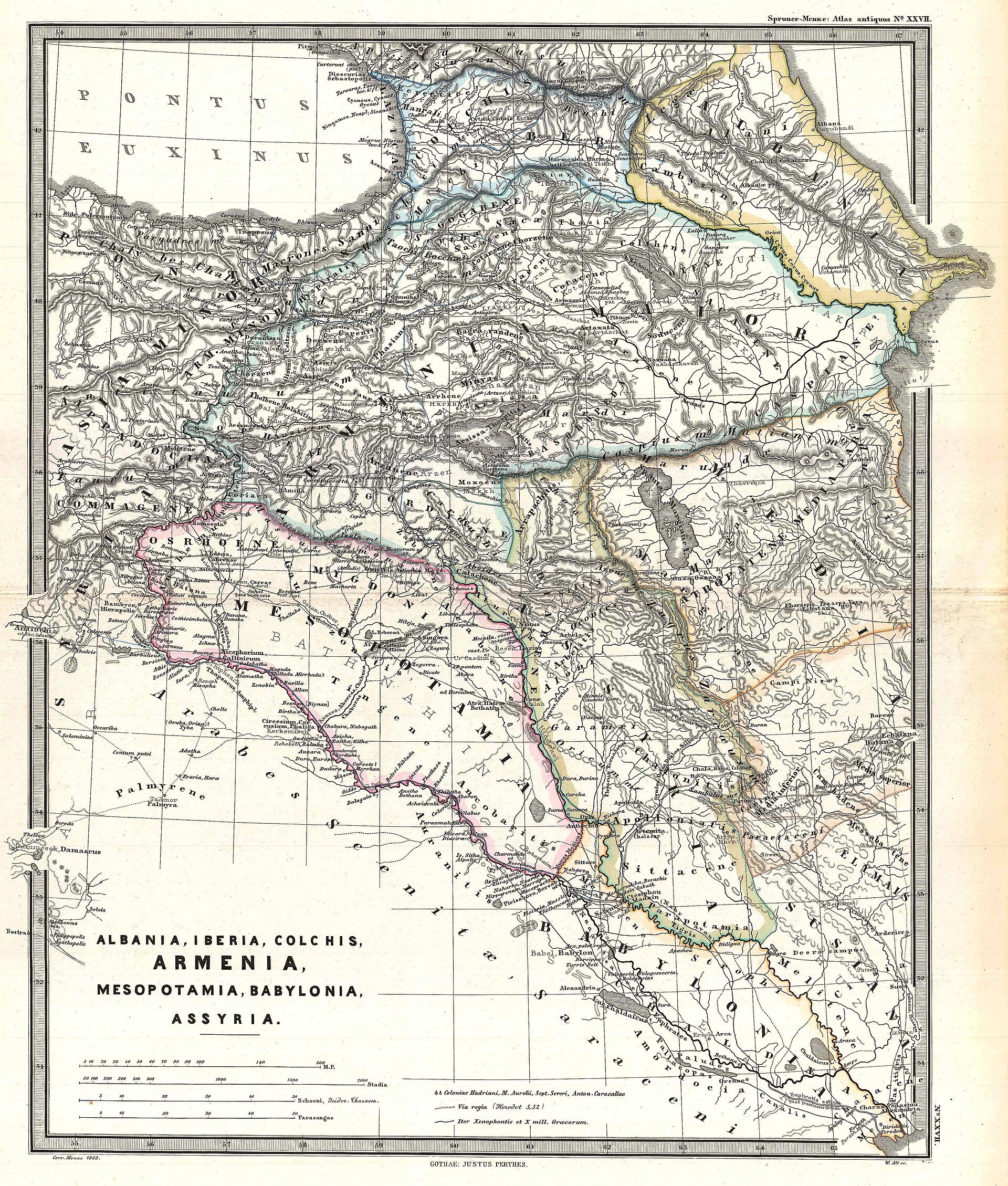
- Located: the site is known
- Probable: the River Kebar (OpenBible score 696 of 1,000)
- 1Babylon, Isaiah calls the city the glory of the pride of the Chaldeans Isaiah 13:19
- 2The River Kebar, The exiles of Judah lived beside it Ezekiel 1:1
- 3Erech, One of the first cities of Nimrod's kingdom in Shinar Genesis 10:10
- 4Ur, A city of some consequence in Chaldea in Abram's day Genesis 11:31
Base map: Albania, Iberia, Colchis, Armenia, Mesopotamia, Babylonia, Assyria, Karl von Spruner and Theodor Menke, Atlas Antiquus, plate XXVII (Gotha: Justus Perthes, 1865), public domain. Places with a place page stand at its coordinates and the others at the point cited for each, set on the plate by Haran and Babylon, as the plate prints them.
Four places of the land of the Chaldeans, with no line drawn; one ring carries OpenBible's identification score.
The Chaldeans in Scripture, in Order
Five moments in the Chaldeans' rule over Judah.
Daniel's schooling and Belshazzar's death mark the beginning and the end of that rule.
- Jehoiakim's third yearDaniel is taught the language and literature of the ChaldeansDaniel 1:4
- Jehoiakim's revoltChaldean raiders are sent against Judah2 Kings 24:2
- Zedekiah's eleventh yearThe Chaldean army breaks down the walls of Jerusalem2 Kings 25:10
- The same monthThe Chaldeans break up the bronze Sea and carry the bronze to Babylon2 Kings 25:13
- The night Babylon fellBelshazzar king of the Chaldeans is slainDaniel 5:30
Each row gives the moment and the verse that tells it.
Three Things the Name Means
Scripture uses the one name for raiders, for a land and for a class of wise men.
RAIDERS IN JOB'S DAY
Job's messenger reports that the Chaldeans formed three bands, raided the camels and put the servants to the sword.
A LAND WITH ITS OWN RIVER
Ezekiel received the word of the LORD in the land of the Chaldeans, by the River Kebar.
A CLASS OF THE KING'S WISE MEN
In Daniel 2:2 the name marks one class of the wise men Nebuchadnezzar summoned, and Jamieson, Fausset and Brown describe them as an order of priest-magicians.
Who the Chaldeans Were
The Chaldeans' history outside Scripture comes from the annals of their neighbours.
The Wikipedia article on Chaldea dates the first written record of the Chaldeans outside Scripture to 852 BC, in the annals of the Assyrian king Shalmaneser III. It places their tribes, among them Bit-Yakin, in the southeast of Babylonia on the shore of the Persian Gulf.
The same article reports that a dynasty later called Chaldean ruled Babylon from 626 to 539 BC, at the height of its power. Its last king, Nabonidus, and his son Belshazzar were of Assyrian descent.
For behold, I am raising up the Chaldeans—that ruthless and impetuous nation which marches through the breadth of the earth to seize dwellings not their own.The prophet is told that the coming invasion is the LORD's own work.
Leb-kamai, the name in cipherAlbert Barnes, on Jeremiah 51:1
This is what the LORD says: “Behold, I will stir up against Babylon and against the people of Leb-kamai the spirit of a destroyer.The Berean text keeps the cipher name in the oracle against Babylon.
Albert Barnes reads Leb-kamai as a cipher for Kasdim, the Chaldeans. He holds that Jeremiah need not have invented it to hide the meaning, and that such ciphers were used in the letters between the exiles in Babylon and their friends at home.
What Genesis Leaves Unsaid
Genesis uses the name only to place Ur.
Genesis names no Chaldean king, god or custom, and it does not say whether Terah's household were Chaldeans themselves or only lived among them.
Abraham's Seed in Chaldea
The exile came as a judgment, and Jeremiah set its length.
So He brought up against them the king of the Chaldeans, who put their young men to the sword in the sanctuary, sparing neither young men nor young women, neither elderly nor infirm. God gave them all into the hand of Nebuchadnezzar,This is the Chronicler's account of the fall that Kings tells in its chapter 25.
John Wesley, in his Explanatory Notes on 2 Chronicles 36:17, reads the exile as Abraham's seed carried back into the country from which God had called him.
But when seventy years are complete, I will punish the king of Babylon and that nation, the land of the Chaldeans, for their guilt, declares the LORD, and I will make it an everlasting desolation.Jeremiah gave this date in the first year of Nebuchadnezzar, long before the city fell.
The Voices on Chaldea
Clement, Calvin, Henry and Spurgeon each wrote on the Chaldeans and their city.
died 215 · Clement of Alexandria
Clement of Alexandria dates the fall of Jerusalem by the history of Berossus.
“In the twelfth year of king Zedekiah, seventy years before the dominance of the Persians, Nebuchadnezzar campaigned against the Phoenicians and Jews, as Berossus says in his ‘Researches on the Chaldeans.’ Juba, writing ‘On the Assyrians,’ admits that he took his account from Berossus, testifying to its accuracy. Nebuchadnezzar blinded Zedekiah and removed him to Babylon, deporting the whole people except a few who escaped to Egypt. The captivity lasted for seventy years. Jeremiah and Habakkuk continued to prophesy under Zedekiah, and in the fifth year of his reign Ezekiel was prophesying in Babylon.”
Clement of Alexandria · The Stromata Book 1 · on 2 Kings 25:26Patristic
1509 to 1564 · John Calvin
John Calvin reads Isaiah 47 as the end of Babylon's pride.
“The whole of this description tends to shew that there shall be a great change among the Babylonians, so that this city, which was formerly held in the highest honor, shall be sunk in the lowest disgrace, and subjected to outrages of every kind, and thus shall exhibit a striking display of the wrath of God.”
John Calvin · Commentaries · on Isaiah 47:2Reformed
1662 to 1714 · Matthew Henry
Matthew Henry observes what Nebuchadnezzar's school for Daniel left out.
“Nay, we do not find that he ordered them to be taught the religion of the Chaldeans, by which it appears That he was at this time no bigot; if men were skilful and faithful, and fit for his business, it was not material to him what religion they were of, provided they had but some religion.”
Matthew Henry · Commentary on the Whole Bible · on Daniel 1:4Puritan
1834 to 1892 · Charles Spurgeon
Charles Spurgeon draws from Jeremiah 51:50 a rule for exiles far from home.
“This message from the Lord was written by the Prophet Jeremiah to the Jews who were carried away to Babylon or even to more distant places. They were entreated not to forget the holy city where they had worshipped Jehovah in His Temple. Among all their thoughts, they were bidden to take care that the thought of Jerusalem should often come into their minds. This would keep them from settling down in the places to which they had been carried as captives.”
Charles Spurgeon · The Metropolitan Tabernacle Pulpit, Sermon No. 2648: “Sacred Memories” (lightly modernized text, CCEL edition) · on Jeremiah 51:50
Matthew Henry, Charles Spurgeon
Why Does Genesis Say Chaldeans?
Readers explain the name in Genesis two ways.
Some time later, Abraham was told, “Milcah has also borne sons to your brother Nahor: Uz the firstborn, his brother Buz, Kemuel (the father of Aram), Chesed, Hazo, Pildash, Jidlaph, and Bethuel.”Abraham hears this news of his brother's family after the binding of Isaac.
A later name for the landJohn Gill, 1748 to 1763
John Gill, on Genesis 22:22, allows that Genesis may call the Chaldees so by anticipation, by the name the land bore later.
The objection: the LORD uses the name in His own words to Abram in Genesis 15:7.
An old family nameJames Strong, 1890
Strong's dictionary glosses Kasdi as a descendant of Chesed.
The objection: Genesis 11:28 uses the name a generation before Chesed's birth is reported in Genesis 22.
The Call to Leave
The last word of the prophets to the Chaldeans' captives was a call to go home.
Leave Babylon! Flee from the Chaldeans! Declare it with a shout of joy, proclaim it, let it go out to the ends of the earth, saying, “The LORD has redeemed His servant Jacob!”The prophet speaks to the captives as if the day of release had already come.
Sources
Scripture is the Berean Standard Bible.
- James Strong, Exhaustive Concordance of the Bible (1890), Hebrew and Chaldee dictionaries, entries 3777, 3778 and 3779.
- Adam Clarke, Commentary on the Bible (1832), on Genesis 11:31.
- John Gill, Exposition of the Old Testament (1748 to 1763), on Genesis 22:22.
- Jamieson, Fausset and Brown, Commentary Critical and Explanatory on the Whole Bible (1871), on Daniel 2:2.
- Albert Barnes, Notes, Explanatory and Practical, on the Old and New Testaments, on Jeremiah 51:1.
- John Wesley, Explanatory Notes upon the Old Testament (1765), on 2 Chronicles 36:17.
- Clement of Alexandria, The Stromata, Book 1, on 2 Kings 25.
- John Calvin, Commentaries (1554), on Isaiah 47:2.
- Matthew Henry, Commentary on the Whole Bible (1710), on Daniel 1:4.
- Charles Spurgeon, The Metropolitan Tabernacle Pulpit, Sermon 2648, Sacred Memories (1899), on Jeremiah 51:50.
- Karl von Spruner and Theodor Menke, Atlas Antiquus, plate XXVII (Gotha: Justus Perthes, 1865), public domain.
- James Tissot, The Chaldees Destroy the Brazen Sea, about 1896 to 1902, the Jewish Museum, New York, public domain.
Keep Studying
Read it5
Studies5
Places4