
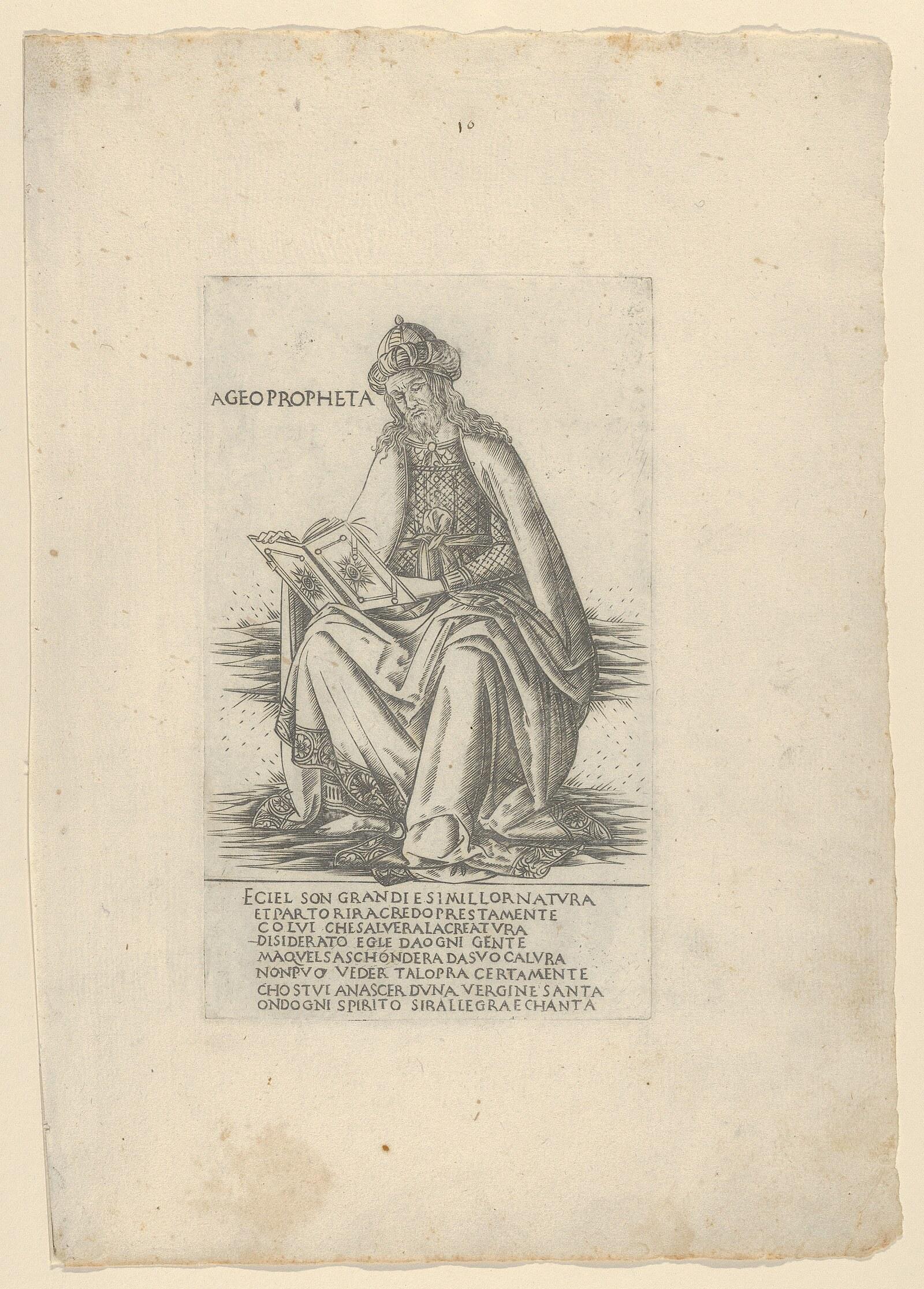
Francesco Rosselli or Baccio Baldini, The Prophet Haggai, 1480 to 1490. CC0.
Haggai 1:1 to 15 · Passage · Featured Study
Consider Carefully Your Ways: Haggai's First Message
Haggai's first message called the people of Jerusalem back to the work on the temple in 520 BC.
The LORD's house lay in ruins beside houses finished with paneled walls.
Now this is what the LORD of Hosts says: “Consider carefully your ways.
Now this is what the LORD of Hosts says: “Consider carefully your ways.
- The passage
- Haggai 1:1 to 15
- Book
- Haggai
- When
- the first day of the sixth month of Darius's second year, 520 BC (probable)
- Hold in memory
- Haggai 1:5
Summary
God sent Haggai to tell the people to build His house first. They obeyed, and the work began within the month.
- The people said the time had not come to build the house of the LORD.
- Haggai traced their poor harvests and lost wages to the ruined house.
- The leaders and the people obeyed, and the LORD said He was with them.
The Word of the Sixth Month
The first message answers what the people said about the time to build.
that this is what the LORD of Hosts says: “These people say, ‘The time has not yet come to rebuild the house of the LORD.’”The excuse belongs to these people, and the two leaders are not named in it.
“Is it a time for you yourselves to live in your paneled houses, while this house lies in ruins?”The LORD answers the excuse with a question about the houses they had already built.
The word came to Zerubbabel the governor and to Joshua the high priest. They led the people who had come back from Babylon. Adam Clarke notes that the Hebrews called the sixth month Elul.
Five Efforts and Their Losses
Haggai 1:6 sets five things the people did beside what each one came to.
Each effort in Haggai 1:6 ends in a loss that another verse of Scripture also names.
| What the people did | What it came to | The same loss in another verse |
|---|---|---|
| You have planted much | but harvested little | Deuteronomy 28:38, seed sown in the field and little gathered |
| You eat | but never have enough | Leviticus 26:26, bread eaten without being satisfied |
| You drink | but never have your fill | Micah 6:15, grapes trodden and the wine never drunk |
| You put on clothes | but never get warm | Deuteronomy 28:48, enemies served in nakedness |
| You earn wages | to put into a bag pierced through | Zechariah 8:10, the years before the work when no one received wages |
The Harvest That Came to Little
Haggai 1:9 to 11 names the dew withheld and the drought summoned.
You expected much, but behold, it amounted to little. And what you brought home, I blew away. Why? declares the LORD of Hosts. Because My house still lies in ruins, while each of you is busy with his own house.The word Why in this verse turns the list of losses into a charge against the people.
I have summoned a drought on the fields and on the mountains, on the grain, new wine, and oil, and on whatever the ground yields, on man and beast, and on all the labor of your hands.”The LORD names Himself as the one who summoned the drought, so the failed harvest is His act.
After the second call to consider, the LORD gives one command in Haggai 1:8. The people are to bring lumber from the hills and build the house, so that He may be glorified in it.
Haggai 2:16 to 17 looks back on the same years, when a heap of twenty measures of grain yielded ten. It adds the blight, the mildew and the hail.
The Work That Had Stopped
Ezra tells why the temple stood unfinished when Haggai spoke.
Thus the construction of the house of God in Jerusalem ceased, and it remained at a standstill until the second year of the reign of Darius king of Persia.Ezra dates the end of the halt to the same year of Darius in which Haggai spoke.
Then Zerubbabel son of Shealtiel and Jeshua son of Jozadak rose up and began to rebuild the house of God in Jerusalem. And the prophets of God were with them, helping them.Ezra calls the high priest Jeshua son of Jozadak, the man Haggai names Joshua son of Jehozadak.
Ezra 3:12 says that when the foundation was first laid, many of the older priests who had seen the first temple wept aloud. Haggai 2:3 asks the same generation how the house looked to them now.
Set Your Heart on Your Ways
Five Hebrew words carry the command and the charge of Haggai 1.
שׂוּם sum
584 uses in the canon
Sum means to set or to put, the verb of the command in Haggai 1:5.
לֵבָב levav
252 uses in the canon
Levav is the heart, the innermost part of a person.
דֶּרֶךְ derekh
707 uses in the canon
Derekh is a road, and so a person's course of life and conduct.
חָרֵב charev
10 uses in the canon
Charev means dry or ruined, the word for the house that lies in ruins.
חֹרֶב chorev
16 uses in the canon
Chorev is a drought, the word for what the LORD summoned on the fields.
The Berean renders the command as consider carefully your ways, and the Hebrew reads set your heart on your ways. Jamieson, Fausset and Brown, in their Commentary of 1871, give the same literal sense.
The ruined house and the drought share one sound in Hebrew. Jamieson, Fausset and Brown read the likeness as the punishment matching the sin.
Matthew Henry on the Paneled Houses
Matthew Henry, in his Commentary of 1710, set the people's excuse in the speech of his own day.
Matthew Henry (1662 to 1714)
“‘It is high time,’ says one, ‘that my house were wainscoted.’ ‘It is high time,’ says another, ‘that mine were painted.’ And God's house, all this time, lies waste, and nothing is done at it.”
Matthew Henry · Commentary on the Whole Bible · on Haggai 1:4Puritan
Why the People Said the Time Had Not Come
Three commentators give three reasons for the delay the people claimed in Haggai 1:2.
The seventy years were not yet completeAdam Clarke
Adam Clarke, in his Commentary on the Bible, held that the people thought the seventy years Jeremiah had spoken of were not yet over. He added that Archbishop Ussher had counted sixty-nine years from the last siege of Jerusalem to the year of Haggai's message.
The people had not yet recoveredMatthew Henry
Matthew Henry gave the people's reason as their own poverty. In his reading they said they had not yet recovered from the captivity or repaired their losses.
The hindrances were read as God's punishmentJamieson, Fausset and Brown, after John Calvin
Jamieson, Fausset and Brown, following Calvin, held that the people took the hindrances to the work as God punishing their haste. They added that the ban of Ezra 4 no longer stood under Darius, so the people had no real excuse.
I Am With You
The promise of Haggai 1:13 is two words in Hebrew, ani itekhem.
Haggai, the messenger of the LORD, delivered the message of the LORD to the people: “I am with you,” declares the LORD.Haggai speaks here as the messenger of the LORD, a title Albert Barnes notes only Haggai and Malachi give a prophet.
The LORD then stirred the spirits of the governor, the priest and the remnant. The promise returns in Haggai 2:4 with the command to be strong and work.
Sources
Scripture is the Berean Standard Bible.
- The Hebrew Bible with Strong's numbers, at Haggai 1:4, 1:5, 1:6, 1:9, 1:11 and 1:13.
- Matthew Henry, Adam Clarke, Albert Barnes and Jamieson, Fausset and Brown on Haggai 1:1 to 15.
- Matthew Henry, Commentary on the Whole Bible (1710), on Haggai 1:2 and 1:4.
- Adam Clarke, Commentary on the Bible (1832), on Haggai 1:1 and 1:2.
- Albert Barnes, Notes, Explanatory and Practical, on Haggai 1:13.
- Jamieson, Fausset and Brown, Commentary Critical and Explanatory on the Whole Bible (1871), on Haggai 1:2, 1:5 and 1:11.
Keep Studying
People and groups3
Go further3
Places1
Symbols1
Church history1
Values1