
2 Kings 23 to 25 · A Story
The Last Kings of Judah and the Fall of Jerusalem
Kings, Chronicles and Jeremiah each tell the end of the kingdom of Judah.
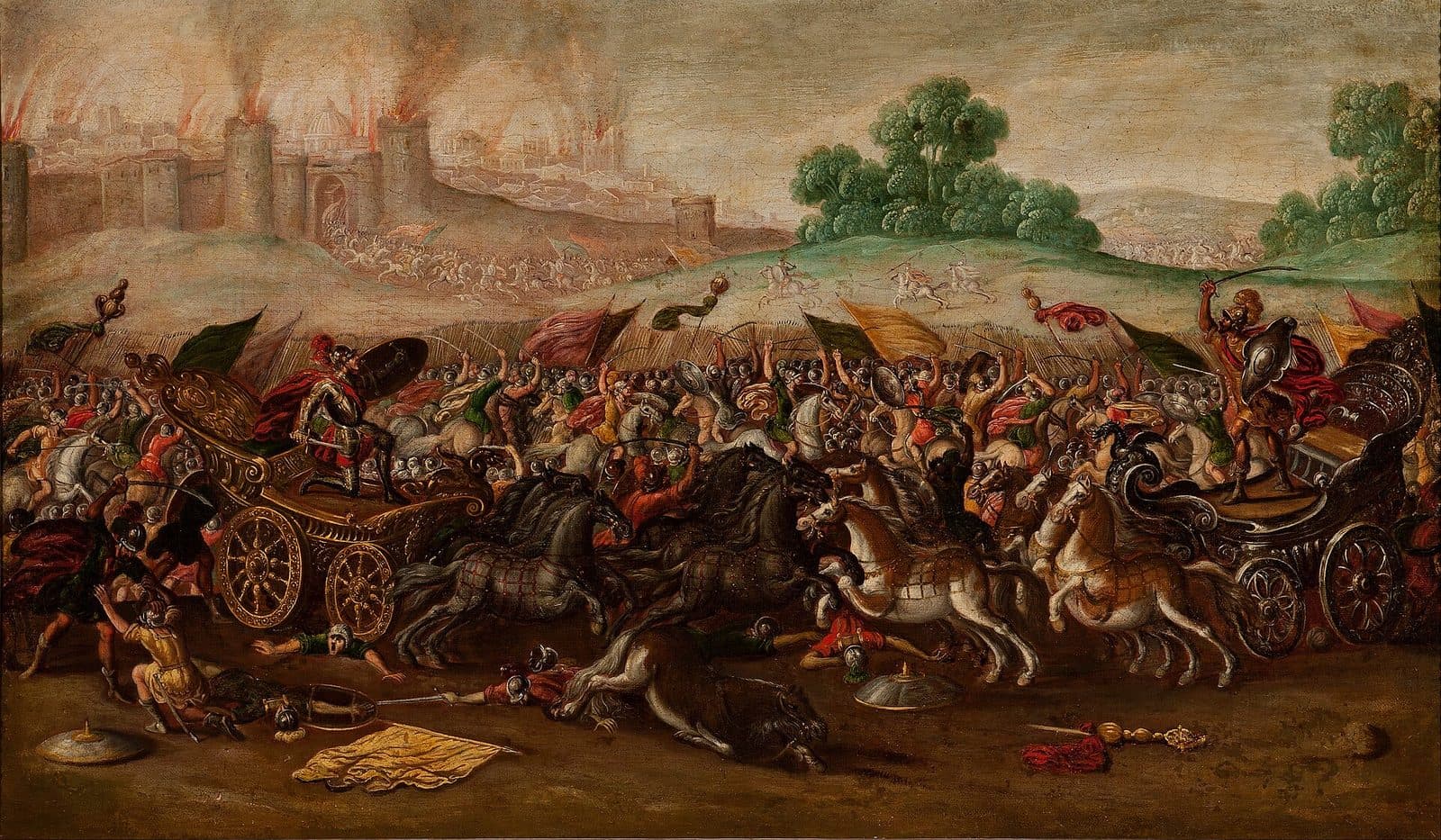
Circle of Juan de la Corte, The Burning of Jerusalem by Nebuchadnezzar's Army, between 1630 and 1660, oil on canvas. Public domain.
THE ARTWORKThe painter set the Babylonian army before a walled Jerusalem with fire rising from its towers, the burning of 2 Kings 25:9.
Within a generation of Josiah's reform the house of David lost its city, its temple and its throne, and the book of Kings closes with David's heir eating at the table of Babylon.
Summary
Judah fell to Babylon in two blows, the capture of Jerusalem under Jehoiachin and its burning eleven years later under Zedekiah.
- Four kings followed Josiah: Jehoahaz, Jehoiakim, Jehoiachin and Zedekiah, the last of them set up by Nebuchadnezzar.
- Jeremiah told Zedekiah to surrender and save the city, and Zedekiah would not.
- A Babylonian tablet dates the first capture to 15 or 16 March 597 BC.
The Account in the Text
Eight verses of 2 Kings 23 to 25 mark each turn from Josiah's son to the burned city.
Then Pharaoh Neco made Eliakim son of Josiah king in place of his father Josiah, and he changed Eliakim’s name to Jehoiakim. But Neco took Jehoahaz and carried him off to Egypt, where he died.After Megiddo the throne of Judah was in the gift of Egypt.
During Jehoiakim’s reign, Nebuchadnezzar king of Babylon invaded. So Jehoiakim became his vassal for three years, until he turned and rebelled against Nebuchadnezzar.Here Nebuchadnezzar first appears in the book of Kings.
Jehoiachin king of Judah, his mother, his servants, his commanders, and his officials all surrendered to the king of Babylon. So in the eighth year of his reign, the king of Babylon took him captive.Then the king of Babylon made Mattaniah, Jehoiachin’s uncle, king in his place and changed his name to Zedekiah.Zedekiah was the last son of David to reign in Jerusalem.
So in the ninth year of Zedekiah’s reign, on the tenth day of the tenth month, Nebuchadnezzar king of Babylon marched against Jerusalem with his entire army. They encamped outside the city and built a siege wall all around it.Zechariah 8:19 names a fast of the tenth month, the month this siege began.
And they slaughtered the sons of Zedekiah before his eyes. Then they put out his eyes, bound him with bronze shackles, and took him to Babylon.Jeremiah 39:6 and Jeremiah 52:10 add that the officials of Judah were killed with his sons.
He burned down the house of the LORD, the royal palace, and all the houses of Jerusalem—every significant building.The house Solomon dedicated in 1 Kings 8 ends here.
On the twenty-seventh day of the twelfth month of the thirty-seventh year of the exile of Judah’s King Jehoiachin, in the year Evil-merodach became king of Babylon, he released King Jehoiachin of Judah from prison.Wiseman reckons the thirty-seventh year of the exile as about 561 BC, the first year of Evil-merodach.
Five Rulers in Order
Each row gives a ruler, his rule and how it ended.
- Jehoahazthree months, taken to Egypt by Pharaoh Neco, 2 Kings 23:31
- Jehoiakimeleven years, a vassal of Babylon who rebelled, 2 Kings 23:36
- Jehoiachinthree months, surrendered and taken to Babylon, 2 Kings 24:8
- Zedekiaheleven years, blinded and taken to Babylon, 2 Kings 24:18
- Gedaliahgovernor at Mizpah, killed by Ishmael son of Nethaniah, 2 Kings 25:25
Of the four kings, only Jehoiakim died while he reigned, 2 Kings 24:6 says.
From Josiah's Death to the Fire
Kings carries the story, and Chronicles and Ezekiel add to its last siege.
Josiah went out to meet Pharaoh Neco, and Neco killed him at Megiddo. The people made his son Jehoahaz king, and Neco put him in chains at Riblah. Jehoiakim taxed the land to pay the silver and gold Egypt demanded.
In Jehoiakim's days the LORD sent raiders from Babylon, Aram, Moab and Ammon against Judah.
Jehoiachin was eighteen when he followed his father, and in his days the Babylonian army laid siege to the city. Nebuchadnezzar carried off the treasures of the temple and the palace, cut up the gold that Solomon had made, and took the king and the leading men to Babylon.
Zedekiah and the last siege2 Kings 24:17 to 25:7; 2 Chronicles 36:12 and 13; Ezekiel 24:1 and 2
Zedekiah rebelled against Babylon in his turn. Chronicles adds that he did not humble himself before Jeremiah and that he broke the oath Nebuchadnezzar had made him swear by God.
On the day the last siege began, Ezekiel in Babylon was told to write the date down. By the ninth day of the fourth month of the eleventh year the city had no food, the wall was breached, and the soldiers fled by night toward the Arabah.
The Babylonians caught Zedekiah in the plains of Jericho and brought him to Nebuchadnezzar at Riblah. There the king of Babylon passed sentence on him.
The fire, the governor and the release2 Kings 25:8 to 30
A month after the wall was breached, Nebuzaradan, the captain of the guard, came to the city, and the army broke down its walls. He took the rest of the people into exile and left the poorest to work the vineyards and fields. The chief priest Seraiah and the leading men left in the city were put to death at Riblah.
Nebuchadnezzar appointed Gedaliah over those who remained, and he governed from Mizpah. In the seventh month Ishmael, a man of the royal family, killed him, and the people fled to Egypt for fear of the Babylonians.
Once freed, Jehoiachin had his throne set above the other captive kings and a daily portion for life.
Where Kings and Jeremiah Differ
Three of the numbers in Jeremiah 52 differ from 2 Kings.
The day the temple burned2 Kings 25:8, Jeremiah 52:12, Taanit 29a, Josephus
Kings says Nebuzaradan came on the seventh day of the fifth month. Jeremiah says the tenth day. The Talmud reads the two together: the enemy entered on the seventh, set the fire on the ninth near nightfall, and the house burned through the tenth. That is why the fast for the first temple is kept on the ninth of Av. Josephus, in the Antiquities of the Jews, gives a third date, the first day of the fifth month.
How many were taken into exile2 Kings 24:14 and 16, Jeremiah 52:28 to 30
Kings counts ten thousand captives taken with Jehoiachin, seven thousand fighting men and a thousand craftsmen among them. Jeremiah lists 3,023 Jews in Nebuchadnezzar's seventh year, 832 in his eighteenth and 745 in his twenty-third, 4,600 in all. Kings dates the surrender to the eighth year of the king of Babylon, and Jeremiah's first list to his seventh.
The day Jehoiachin was released2 Kings 25:27, Jeremiah 52:31, Wesley, Rashi
Kings gives the twenty-seventh day of the twelfth month and Jeremiah the twenty-fifth. Rashi, in his commentary on 2 Kings 25:27, takes the twenty-fifth as the day Nebuchadnezzar died, and the twenty-seventh as the day his son freed the captive king.
“Seven and twentieth - Or, on the twenty fifth day, as it is, Jer. lii, 31. For then the decree was made, which was executed upon the twenty seventh day.”
John Wesley · Explanatory Notes upon the Old Testament · on 2 Kings 25:27Evangelical
The Record Outside the Bible
Texts from Babylon and from Judah bear on the dates and the captives of the account.
THE BABYLONIAN CHRONICLE
A chronicle tablet in the British Museum, BM 21946, dates the capture to Nebuchadnezzar's seventh year. On the second of Adar he seized the city of Judah, took its king and set up a king of his own choice. Wiseman reckons that day as 15 or 16 March 597 BC.
THE RATION TABLETS
Tablets dug up in Babylon list oil given out to captives of the royal household, and among them the sons of the king of Judah. They date from the tenth to the thirty-fifth year of Nebuchadnezzar.
A LETTER FROM LACHISH
An officer's letter on a potsherd from Lachish says he is watching for the signals of Lachish because Azekah can no longer be seen.
THE YEAR OF THE FIRE
Wiseman, in his edition of the chronicles, dates the last siege from 588 BC and the burning of the city in 586 BC. The chronicle tablets break off before that year, so the date is reckoned from the regnal years of Kings.
Jeremiah's Word to Zedekiah
Jeremiah was a prisoner each time the king sent for him.
Zedekiah sent for Jeremiah in secret and asked whether there was a word from the LORD, and Jeremiah told him he would be handed over to the king of Babylon. Jeremiah offered him one way out: surrender to the Babylonian officers, and the city would not be burned and his household would live. Zedekiah did not go out.
Jeremiah had said Zedekiah would see the king of Babylon face to face. Ezekiel had said he would be brought to Babylon and would not see it.
The promise that he would die in peaceJeremiah 34:4 and 5; Jamieson, Fausset and Brown
Jeremiah also told Zedekiah he would not die by the sword but would be mourned as the kings before him were.
“The honors here mentioned were denied to Jehoiakim (Jer 22:18). Ah, lord!--The Hebrews in their chronology (Seder Olam) mention the wailing used over him, ‘Alas! King Zedekiah is dead, drinking the dregs (that is, paying the penalty for the sins) of former ages.’”
Jamieson, Fausset & Brown · Commentary Critical and Explanatory on the Whole Bible · on Jeremiah 34:5Reformed
Josephus, Antiquities of the Jews, book 10Antiquities 10.7.2 and 10.8.2
Josephus writes that Zedekiah set the two prophets against each other and believed neither, and that both words came true when he met Nebuchadnezzar at Riblah and was blinded before he reached Babylon.
What the Text Leaves Unsaid
Three questions the accounts leave open, each named where the text stops.
Jeremiah says Zedekiah was kept in custody in Babylon until the day he died, and gives neither the year nor the place. Kings lists the bronze, the gold and the silver the guard carried off, and names no ark among them.
Kings gives no word of what Jehoiachin thought or prayed when he was freed.
Why the City Fell and What Was Left
The reasons are given in prose, and the grief and the hope in poetry.
Kings gives the cause in its own voice: the LORD removed Judah from his presence because of the sins of Manasseh and the innocent blood that filled Jerusalem. Chronicles adds that God sent his messengers again and again because he had compassion on his people, and they mocked them until there was no remedy.
Chronicles reads the empty land as its Sabbath rest, kept for seventy years as Jeremiah had said, and it closes with the decree of Cyrus to build the house again. Matthew writes Jehoiachin's name as Jeconiah and places him and his son Shealtiel in the line of Jesus after the exile to Babylon.
How lonely lies the city, once so full of people! She who was great among the nations has become a widow. The princess of the provinces has become a slave.The first of the five poems of Lamentations opens with this line.
Because of the loving devotion of the LORD we are not consumed, for His mercies never fail. They are new every morning; great is Your faithfulness!These lines stand in the third poem, the middle of the five.
Three Voices on the Last Kings
Voices from the sixteenth, eighteenth and nineteenth centuries, earliest first.
John CalvinCommentaries on Jeremiah, Jeremiah 39:2
“But the Prophet here reminds us that it was a false confidence; for though God spared him for a time and suspended his judgment, he yet at length punished the impiety of his revolt, to which was also added ingratitude, as it has been before stated.”
John Calvin · Commentaries · on Jeremiah 39:2Reformed
John WesleyExplanatory Notes upon the Old Testament (1765), 2 Kings 25:7
“Slew, &c. - Tho' they were but children, that this spectacle, the last he was to behold, might leave a remaining impression of grief and horror upon his spirit. And in slaying his sons they in effect declared, that the kingdom was no more, and that he nor any of his breed were fit to be trusted: therefore not fit to live.”
John Wesley · Explanatory Notes upon the Old Testament · on 2 Kings 25:7Evangelical
Charles SpurgeonSermon 2178 (1890), Jeremiah 38:5
“But, if we cannot trust in men, we think that surely we may trust in princes. If honor were banished from all the rest of the world, it ought to find a home in the breasts of kings! Great men, noble men, men of renown, men of high standing—may we not trust in them? Brethren, ‘It is better to trust in the Lord than to put confidence in princes,’ for princes are but men, and sometimes hardly that. Princes are not always the truest of men—they are seldom the best of men to trust. Many have had to say at the end of life what Wolsey is represented as saying to Sir William Kingston, ‘Had I but served my God with half the zeal I served my king, He would not in my age have left me naked to my enemies.’ If ‘uneasy lies the head that wears the crown,’ certainly uneasy is the heart which rests on the wearer of a diadem! Trust in God and you have trusted in the true King, ‘the King immortal, invisible.’ Trust in the Christ of God and you have trusted in the only Prince who can never falter, fail, or forget. I think that is clearly a lesson of the text. We all know someone who, to us, is as a prince—let us not rest too much on a wealthy uncle, or a generous friend, or a capable patron—but let our trust be in the Lord, alone. Had Jeremiah been trusting in Zedekiah, he would have been sorrowfully deceived. Yet this is not the lesson that I am going to teach at this time. Zedekiah was a gentleman of a sort wonderfully common nowadays. A good-natured, easy man. His nobles could get anything they liked from him. He would not act amiss of his own self, but he would follow the lead of others, wherever that might lead him. He had a great respect for the Prophet—he liked to visit him and know what message he had received from God. He did not wish to have it known that he consulted him, but still he liked to steal away in private and have a talk with the man of God.”
Charles Spurgeon · The Metropolitan Tabernacle Pulpit, Sermon No. 2178: “Zedekiah—or, the Man Who Cannot Say, "No"” (lightly modernized text, CCEL edition) · on Jeremiah 38:5
Is the Sentence on Jeconiah Kept or Lifted?
Jeremiah 22:30 bars Jeconiah's descendants from the throne of David.
The sentence stands on the royal lineJohn Wesley, Explanatory Notes (1765); Matthew Henry, Commentary on the Whole Bible (1710) · Protestant commentary
Matthew Henry reads the verse as the end of David's line as a royal line, while children were still born to Jeconiah. On this reading Zerubbabel, Jeconiah's grandson, was governor of Judah and never king.
“Childless - He is said to be childless, either because all his children died before their father; or because he had no child that sat upon the throne, or ever had any ruler's place in Judah.”
John Wesley · Explanatory Notes upon the Old Testament · on Jeremiah 22:30Evangelical
The sentence was lifted after the exileRabbi Yohanan in the Babylonian Talmud, Sanhedrin 37b · Rabbinic
Rabbi Yohanan says exile atones for every sin, and he proves it from Jeconiah, whose sons are listed after the exile though Jeremiah wrote him childless.
“As surely as I live,” declares the LORD, “even if you, Coniah son of Jehoiakim king of Judah, were a signet ring on My right hand, I would pull you off.Coniah is a short form of the name Jehoiachin.
On that day, declares the LORD of Hosts, I will take you, My servant, Zerubbabel son of Shealtiel, declares the LORD, and I will make you like My signet ring, for I have chosen you, declares the LORD of Hosts.”Read beside Jeremiah 22:24, this verse is the ground for holding the sentence lifted.
Books on the Fall of Jerusalem
The Antiquities of the Jews, book 10
Flavius Josephus, translated by William Whiston · about AD 94
Josephus retells the reigns of the last kings and the siege of Jerusalem in his own words.
Read it free at Project GutenbergCommentaries on the Book of the Prophet Jeremiah and the Lamentations
John Calvin · 1563
Calvin reads the siege chapter by chapter as a pastor of a church under threat.
Read it free at CCELChronicles of Chaldaean Kings (626 to 556 BC) in the British Museum
D. J. Wiseman · 1956
Wiseman sets out the chronicle tablets in transliteration and English translation, with notes on their dates.
In print: find it wherever books are sold.
The Fire and the Throne
The promise to David outlived the fire.
The throne Zedekiah lost is given to Jesus, the son of David, whose kingdom will never end.
Keep studying
Read it1
Studies11
People8
Symbols1