
Debate · Featured Study
Hell and the Final State of the Lost
Eight passages from Isaiah to Revelation, and the five positions Christians have taken on the final state of the lost.
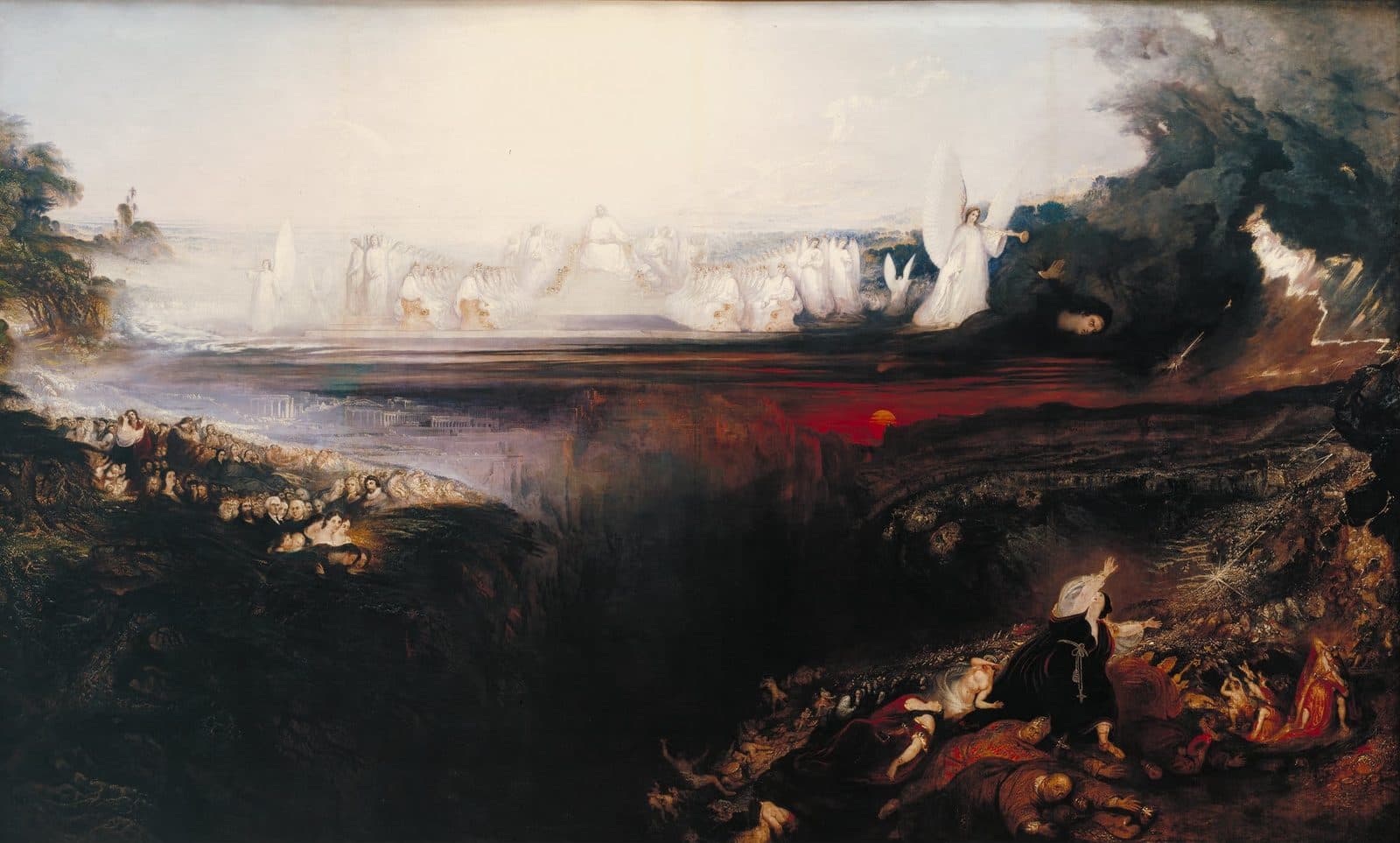
John Martin, The Last Judgement, 1853. Public domain, via Wikimedia Commons.
THE ARTWORKMartin painted the judgment as a divide: the saved in light above a chasm and the lost falling into fire below it. The painting shows the end that every position tries to describe.
Jesus used one word, eternal, for both the life of the righteous and the punishment of the wicked in a single sentence.
Summary
Scripture speaks of the end of those who reject God in fire, darkness, destruction and separation from the Lord. Christians who read the same verses have held five positions on what that end is.
- Eight passages carry the question, from Isaiah 66 to Revelation 20.
- Gehenna, Hades and the lake of fire are three different words, and only two of them name the final state.
- Most Christians in most centuries have held that the punishment is conscious and without end.
- Conditional immortality, universal restoration, separation from God and the dehumanization view each have serious holders.
- Each position stands with its strongest case and the strongest objection to it.
The Passages in Order
Eight texts from Isaiah to Revelation stand in order, each read as every position reads it.
Isaiah ends with the worshippers of the new heavens and new earth going out to see the corpses of those who rebelled against God.
“As they go forth, they will see the corpses of the men who have rebelled against Me; for their worm will never die, their fire will never be quenched, and they will be a horror to all mankind.”The undying worm and the unquenched fire, which Jesus quotes in Mark 9.
Daniel sees the dead wake from the dust, some to everlasting life and some to everlasting contempt.
And many who sleep in the dust of the earth will awake, some to everlasting life, but others to shame and everlasting contempt.One word, everlasting, stands over both ends.
In Matthew 25 the King sends those on His left into the eternal fire prepared for the devil and his angels.
Then He will say to those on His left, ‘Depart from Me, you who are cursed, into the eternal fire prepared for the devil and his angels.The fire was prepared for the devil, and the lost are sent into it.
And they will go away into eternal punishment, but the righteous into eternal life.”Eternal punishment and eternal life stand in one sentence.
In Mark 9 Jesus warns that it is better to lose a hand, a foot or an eye than to be thrown into hell. He names the place with Isaiah's last words.
If your hand causes you to sin, cut it off. It is better for you to enter life crippled than to have two hands and go into hell, into the unquenchable fire.Hell here is the Greek word gehenna, and the fire is called unquenchable.
where ‘their worm never dies, and the fire is never quenched.’These are the worm and the fire of Isaiah 66:24.
In Luke 16 the rich man dies and is in torment in Hades. He can see Abraham and Lazarus, he speaks, and he remembers his life.
In Hades, where he was in torment, he looked up and saw Abraham from afar, with Lazarus by his side. So he cried out, ‘Father Abraham, have mercy on me and send Lazarus to dip the tip of his finger in water and cool my tongue. For I am in agony in this fire.’The rich man feels torment and thirst, sees and speaks, before any resurrection.
And besides all this, a great chasm has been fixed between us and you, so that even those who wish cannot cross from here to you, nor can anyone cross from there to us.’A great chasm is fixed, and no one crosses it.
In 2 Thessalonians Paul says that those who do not know God and do not obey the gospel will suffer eternal destruction, separated from the presence of the Lord.
They will suffer the penalty of eternal destruction, separated from the presence of the Lord and the glory of His might,Destruction and separation stand in one verse.
In Revelation 14 the third angel warns that whoever worships the beast will be tormented in fire and sulfur in the presence of the Lamb.
he too will drink the wine of God’s anger, poured undiluted into the cup of His wrath. And he will be tormented in fire and sulfur in the presence of the holy angels and of the Lamb. And the smoke of their torment rises forever and ever. Day and night there is no rest for those who worship the beast and its image, or for anyone who receives the mark of its name.”No rest day or night, and smoke that rises forever and ever.
In Revelation 20 the devil, the beast and the false prophet are thrown into the lake of fire. Then Death and Hades are thrown in, and so is anyone not written in the Book of Life.
And the devil who had deceived them was thrown into the lake of fire and sulfur, into which the beast and the false prophet had already been thrown. There they will be tormented day and night forever and ever.Tormented day and night forever and ever.
Then Death and Hades were thrown into the lake of fire. This is the second death—the lake of fire. And if anyone was found whose name was not written in the Book of Life, he was thrown into the lake of fire.The lake of fire is called the second death.
The Five Positions Side by Side
The table gives each position with its holders and the text it leans on.
| Position | Holders | The text it leans on |
|---|---|---|
| Eternal conscious punishment | Augustine, Aquinas, Calvin, Wesley, Spurgeon | Matthew 25:46, one word eternal for punishment and life |
| Separation from God | Adam Clarke, C. S. Lewis | 2 Thessalonians 1:9, separated from the presence of the Lord |
| Conditional immortality | Edward Fudge, John Stott, John Wenham, Richard Bauckham | Matthew 10:28, God can destroy both soul and body |
| Universal restoration | Origen, George MacDonald, David Bentley Hart | 1 Corinthians 15:28, that God may be all in all |
| The dehumanization view | C. S. Lewis, N. T. Wright, Robert Golding | Matthew 25:41, the fire prepared for the devil, cited by Lewis |
- Position
- Eternal conscious punishment
- Holders
- Augustine, Aquinas, Calvin, Wesley, Spurgeon
- The text it leans on
- Matthew 25:46, one word eternal for punishment and life
- Position
- Separation from God
- Holders
- Adam Clarke, C. S. Lewis
- The text it leans on
- 2 Thessalonians 1:9, separated from the presence of the Lord
- Position
- Conditional immortality
- Holders
- Edward Fudge, John Stott, John Wenham, Richard Bauckham
- The text it leans on
- Matthew 10:28, God can destroy both soul and body
- Position
- Universal restoration
- Holders
- Origen, George MacDonald, David Bentley Hart
- The text it leans on
- 1 Corinthians 15:28, that God may be all in all
- Position
- The dehumanization view
- Holders
- C. S. Lewis, N. T. Wright, Robert Golding
- The text it leans on
- Matthew 25:41, the fire prepared for the devil, cited by Lewis
Gehenna, Hades and the Lake of Fire
English Bibles have often rendered three different words as hell.
Gehenna is the valley of Hinnom, south of Jerusalem. Jerome writes that an idol stood in that valley and a grove there was consecrated to it.
Jamieson, Fausset and Brown read Isaiah's last verse as a picture drawn from bodies left unburied in that valley. Adam Clarke notes that Jesus applies the same words to the punishment of the wicked in Gehenna.
For their worm shall not die - These words of the prophet are applied by our blessed Savior, Mar 9:44, to express the everlasting punishment of the wicked in Gehenna, or in hell.
Adam Clarke · Commentary on the Bible · on Isaiah 66:24Evangelical
Hades is the place of the dead before the judgment. The rich man is in Hades, and Jamieson, Fausset and Brown note that it is not the final place of the lost.
The lake of fire is the final place. Revelation throws Hades itself into it and calls it the second death.
The Question Through the Centuries
Each position is dated from Origen to the present.
| When | What was written | The position it states |
|---|---|---|
| Third century | Origen teaches a restoration of all; his view is later condemned. | Universal restoration |
| Fifth century | Augustine writes of the eternal fire in The City of God, book 21. | Eternal conscious punishment |
| Died 1107 | Theophylact of Ohrid answers the Origenists from Paul. | Eternal conscious punishment |
| 1755 | John Wesley's Explanatory Notes upon the New Testament. | Eternal conscious punishment |
| 1940 and 1945 | C. S. Lewis, The Problem of Pain and The Great Divorce. | The dehumanization view |
| 2008 | N. T. Wright, Surprised by Hope. | The dehumanization view |
| 2018 | Randal Rauser, Depersonalizing the Damned. | The objection to the dehumanization view |
- When
- Third century
- What was written
- Origen teaches a restoration of all; his view is later condemned.
- The position it states
- Universal restoration
- When
- Fifth century
- What was written
- Augustine writes of the eternal fire in The City of God, book 21.
- The position it states
- Eternal conscious punishment
- When
- Died 1107
- What was written
- Theophylact of Ohrid answers the Origenists from Paul.
- The position it states
- Eternal conscious punishment
- When
- 1755
- What was written
- John Wesley's Explanatory Notes upon the New Testament.
- The position it states
- Eternal conscious punishment
- When
- 1940 and 1945
- What was written
- C. S. Lewis, The Problem of Pain and The Great Divorce.
- The position it states
- The dehumanization view
- When
- 2008
- What was written
- N. T. Wright, Surprised by Hope.
- The position it states
- The dehumanization view
- When
- 2018
- What was written
- Randal Rauser, Depersonalizing the Damned.
- The position it states
- The objection to the dehumanization view
What the Texts Leave Unsaid
Every position has to answer these questions without a verse.
No passage says how a fire made for spirits acts on a body, and none says where the lake of fire is. Augustine asked how material fire could punish demons who have no bodies.
No passage states in so many words whether the lost go on existing without end. Every position draws that answer from the words eternal, destruction, death and torment, and weighs them differently.
The Judge Is the Son
Every passage on the final state points to the Son as Judge.
The New Testament places the final judgment in the hands of Jesus. The Father has given all judgment to the Son, and in Matthew 25 the Son of Man sits on His throne and separates the nations.
Furthermore, the Father judges no one, but has assigned all judgment to the Son,All judgment is given to the Son.
When the Son of Man comes in His glory, and all the angels with Him, He will sit on His glorious throne. All the nations will be gathered before Him, and He will separate the people one from another, as a shepherd separates the sheep from the goats.The Son of Man on His throne, separating the nations.
Voices Across the Centuries
Gregory of Nyssa, Jerome and John Wesley are each quoted on the texts the positions read.
Gregory of Nyssa, in On the Soul and the Resurrection, reads the chasm of Luke 16 as the choices a person makes in this life.
What then, I asked, are the fire and the gulf and the other features in the picture? Are they not that which they are said to be? I think, she replied, that the Gospel signifies by means of each of them certain doctrines with regard to our question of the soul. For when the patriarch first says to the Rich Man, "Thou in thy lifetime receivedst thy good things," and in the same way speaks of the Poor Man, that he, namely, has done his duty in bearing his share of life's evil things, and then, after that, adds with regard to the gulf that it is a barrier between them, he evidently by such expressions intimates a very important truth.… This, in my opinion, is the "gulf"; which is not made by the parting of the earth, but by those decisions in this life which result in a separation into opposite characters. The man who has once chosen pleasure in this life, and has not cured his inconsiderateness by repentance, places the land of the good beyond his own reach; for he has dug against himself the yawning impassable abyss of a necessity that nothing can break through.
Gregory of Nyssa · On the Soul and the Resurrection · on Luke 16:25-26Patristic
Jerome, on the last verse of Matthew 25, tells the reader to note that the punishments are eternal.
Let the thoughtful reader observe that punishments are eternal, and that that continuing life has thenceforward no fear of fall.
Jerome · Catena Aurea by Aquinas · on Matthew 25:46Patristic
John Wesley, in his Explanatory Notes upon the New Testament, argues from the same verse that the punishment and the reward last equally long.
And these shall go away into everlasting punishment, but the righteous into life everlasting - Either therefore the punishment is strictly eternal, or the reward is not: the very same expression being applied to the former as to the latter. The Judge will speak first to the righteous, in the audience of the wicked.
John Wesley · Explanatory Notes upon the New Testament · on Matthew 25:46Evangelical
Each Position with Its Case
Each position is given its strongest case and the strongest objection to it.
Eternal conscious punishment
Those who finally reject God exist forever in conscious separation from Him under His just judgment. Its holders point to Matthew 25:46, where one adjective governs both the punishment and the life.
They add Revelation 20:10, where the devil, the beast and the false prophet are tormented day and night forever and ever. They also cite Jesus' words about Judas, that it would be better for him if he had not been born.
The Son of Man will go just as it is written about Him, but woe to that man by whom He is betrayed. It would be better for him if he had not been born.”A remark its holders say loses its force if the lost simply cease to exist.
The objection: Scripture's own words for the end of the wicked are destruction, perishing and the second death. This position has to read them as ruin rather than an end.
Separation from God
This position reads the heart of the punishment as loss: the lost are shut out from the presence of the Lord. Adam Clarke, on Paul's words eternal destruction, denies that they mean annihilation and calls the punishment banishment from the presence of the Lord. Lewis writes that the doors of hell are locked on the inside.
The objection: Revelation 14:10 sets the torment in the presence of the holy angels and of the Lamb, so separation cannot be the whole of it.
Conditional immortality
Immortality is God's gift to the redeemed and not a property of every soul. The unrepentant are judged, suffer justly, and are finally destroyed.
Its holders read destroy in Matthew 10:28 in its plain sense. They note that God alone is immortal, and that Jude calls the fire that fell on Sodom eternal, though those cities are not burning now.
He alone is immortal and dwells in unapproachable light. No one has ever seen Him, nor can anyone see Him. To Him be honor and eternal dominion! Amen.God alone is immortal.
In like manner, Sodom and Gomorrah and the cities around them, who indulged in sexual immorality and pursued strange flesh, are on display as an example of those who sustain the punishment of eternal fire.The punishment of eternal fire, on cities long since gone.
The objection: Matthew 25:46 would need eternal to mean one thing for the punishment and another for the life. Revelation 20:10's torment day and night forever and ever is hard to read as a single moment of ending.
Universal restoration
God's love and Christ's atonement finally succeed with everyone. Judgment is real and may be long, but it corrects rather than only punishes, and in the end every creature is reconciled to God.
And when all things have been subjected to Him, then the Son Himself will be made subject to Him who put all things under Him, so that God may be all in all.The text its holders read as God finally all in all.
The objection: Theophylact of Ohrid answered the Origenists of his day from 2 Thessalonians 1:9, where Paul calls the punishment eternal. Tertullian had already written that no restoration is promised to the fallen angels. In Luke 16:26 a great chasm is fixed that no one can cross.
So then, where are the Origenists, who fabulously teach about the finality of punishments? This, that is punishment, Paul called eternal. In what way then can the eternal be temporal according to you? Here the apostle shows the ease with which this will be accomplished. …
Theophylact of Ohrid · Commentary on 2 Thessalonians · on 2 Thessalonians 1:9Patristic
The dehumanization view
Chris Date names this view and files it with the variations of eternal punishment: the lost grow less and less human, cease to bear the image of God, and remain consciously separated from Him.
Lewis pictures a grumbler who becomes nothing but the grumble. In The Problem of Pain he writes that what is cast into hell is no longer a man.
N. T. Wright calls the end beings that once were human but now are not, and says his view is neither annihilation nor eternal conscious torment.
The objection: Randal Rauser argues that no doctrine of hell should depersonalize the damned, and that if no person remains, the view slides into annihilation.
This site's tradition holds eternal conscious punishment and says so on its doctrine of last things. It gives conditional immortality its full case and names universal restoration and declines it. The site ranks this question tier A, one where Scripture allows more than one reading, so each position stands at its strongest with no verdict given.
Fear the One Who Can Destroy
Every position agrees on what Jesus asked of His hearers. He told them to fear God more than death, and to give up a hand or an eye rather than lose life.
Do not be afraid of those who kill the body but cannot kill the soul. Instead, fear the One who can destroy both soul and body in hell.The warning every reading keeps.
The Judge who gives that warning also gives a promise. Whoever hears His word and believes has eternal life and will not come under judgment.
Truly, truly, I tell you, whoever hears My word and believes Him who sent Me has eternal life and will not come under judgment. Indeed, he has crossed over from death to life.The one who believes has already crossed over from death to life.
Keep studying
Studies5
Doctrines6
Go further1