
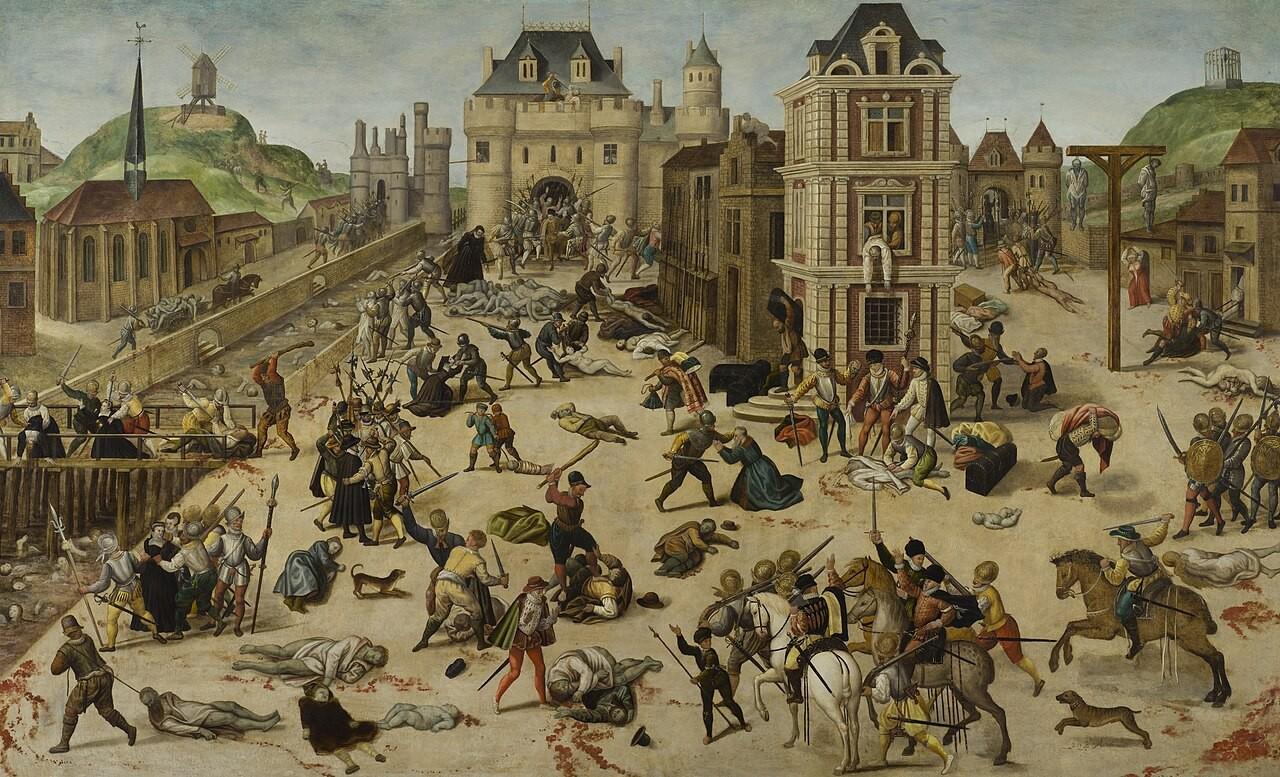
François Dubois, The Saint Bartholomew's Day Massacre, 1572 to 1584. Public domain.
1572 to 1787 · The churches · Featured Study
The Huguenots
The Reformed Christians of France kept their faith through massacre, the loss of their rights and exile until Louis XVI granted toleration.
At half past one in the morning on Saint Bartholomew's Day the bell of Saint Germain l'Auxerrois sounded. Then the killing of the Protestants of Paris began.
God arises. His enemies are scattered, and those who hate Him flee His presence.
Summary
The Huguenots were the Protestants of France. The law protected their worship for only eighty-seven years.
- The massacre spread from the capital to the provinces within a week.
- Henry IV gave them the right to worship by the Edict of Nantes.
- Louis XIV took that right away, and tens of thousands fled abroad.
- Those who stayed met in secret, in what they called the Desert.
The Texts They Sang and Lived
The texts come from Psalm 68, Hebrews 11 and Matthew 10.
The Huguenots sang the psalms in the French verse of Clément Marot, so that their neighbours called them the psalm-singers. Smiles tells of a company of Camisards who came down into a chestnut wood singing the sixty-eighth psalm before a fight.
After the revocation the Reformed of France worshipped in caves, valleys, woods and old quarries, and they called the place of their meetings the Desert.
They were stoned, they were sawed in two, they were put to death by the sword. They went around in sheepskins and goatskins, destitute, oppressed, and mistreated. The world was not worthy of them. They wandered in deserts and mountains, and hid in caves and holes in the ground.The Huguenots' meetings in caves and quarries answer to this list of the faithful.
Many thousands crossed the borders of France rather than give up their faith. Jesus had told His disciples to flee from a town that persecuted them.
When they persecute you in one town, flee to the next. Truly I tell you, you will not reach all the towns of Israel before the Son of Man comes.Jesus' word to His disciples about flight from persecution, which the refugees lived out.
Two Centuries on One Line
Each event stands on the year its source gives.
The Huguenots won liberty of worship, lost it, and regained toleration a century later.
- The massacre begins in Paris with the death of Admiral Coligny24 August 1572
- The killing reaches Meaux, Troyes, Orleans, Bourges and Lyons25 to 30 August 1572
- Henry IV promulgates the Edict of Nantes1598
- Louis XIV signs the revocation of the Edict18 October 1685
- Claude Brousson is hanged at Montpellier1698
- Antoine Court holds the first synod of the Desert in a quarry near NimesAugust 1715
- Rabaut Saint Etienne claims the rights of the Protestants, and the Edict of Tolerance follows1787
A timeline of seven events. The Edict of Nantes stood for eighty-seven years. The Church in the Desert then met in secret for about seventy-five years before the Edict of Tolerance.
The Massacre of Saint Bartholomew's Day
The killing began in Paris that night, and the counts of the dead in Paris differ tenfold.
The Huguenot nobles had come to Paris for the wedding of Henry of Navarre to the sister of Charles IX. On 22 August a shot wounded Gaspard de Coligny, the admiral and the leader of the Huguenots, but did not kill him.
When the bell rang two days later, Coligny was the first to be killed. Henry of Navarre and the prince of Condé saved their lives by abjuring their faith.
From Paris the killing spread to the provinces through the last week of August. At Rouen the governor refused to carry out the king's warrant but did not prevent the slaughter. At Dijon, Limoges, Blois and Nantes it was prevented.
The counts of the dead differ tenfold for Paris and fivefold for France.
| Who counted | For where | The count |
|---|---|---|
| La Popelinière | Paris | 1,000 |
| The Tuscan ambassador | Paris | 3,000 |
| Brantôme | Paris | Nearly 4,000 bodies thrown into the Seine |
| Davila | Paris | 10,000 |
| De Thou and La Popelinière | France | 20,000 |
| Jean de Serres and the Mémoires de l'estat de France | France | 30,000 |
| Péréfixe | France | 100,000 |
The Edict, the Revocation and the Refuge
Henry IV gave liberty, Louis XIV took it away, and other lands took in the refugees.
By the Edict of Nantes the Huguenots, after sixty years of persecution, were allowed comparative liberty of conscience and freedom of worship. Pope Clement VIII wrote in protest.
“a decree which gave liberty of conscience to all was the most accursed that had ever been made.”
Clement VIII · His protest against the Edict of Nantes, as Samuel Smiles reports it in The Huguenots: Their Settlements, Churches, and Industries in England and Ireland, chapter 3, page 76Roman Catholic
The revocation was published four days after the king signed it. Smiles writes that the Revocation was the king's own act. Yet the Catholic Church of France and the great body of the French people approved it.
No count of the emigrants was taken. Charles Butler, a Roman Catholic writer, put those who left at 50,000. Capefigue, who worked from the population tables of the time, put them at 230,000.
The refugees went to Switzerland, Prussia, Holland, Denmark, England, Ireland, America and the Cape of Good Hope. At the beginning of the eighteenth century London alone held no fewer than thirty-five French Protestant churches.
The Church in the Desert
Three pastors and the prisoners of the tower at Aigues-Mortes kept the hidden church alive.
Claude Brousson1647 to 1698
A lawyer of Nimes who became a pastor of the Desert, he was hanged at Montpellier. Smiles counts seventeen pastors publicly executed between 1686 and 1698.
Antoine Court1696 to 1760
Born in the Vivarais, he called nine people to the first synod of the Desert in an empty quarry near Nimes in the month Louis XIV died.
Paul Rabauteighteenth century
A pastor at Nimes, he was looked upon as the leader of the hidden church after Court left France for Lausanne, and he held his people back from armed resistance.
The women of the Tour de Constanceeighteenth century
Huguenot women were sent for life to the tower at Aigues-Mortes, and fourteen were still held there when a royal visitor came to release them.
Antoine Court (1696 to 1760), Paul Rabaut (eighteenth century), The women of the Tour de Constance (eighteenth century)
An officer who went with the Prince de Beauvau to the tower described the release of its last prisoners.
“They fell at our feet, bathed in tears, and speechless, until, emboldened by our expressions of sympathy, they recounted to us their sufferings. Alas! all their crime consisted in having been attached to the same religion as Henry IV. The youngest of these martyrs was more than fifty years old. She was but eight when first imprisoned for having accompanied her mother to hear a religious service, and her punishment had continued until now!”
An officer in the suite of the Prince de Beauvau · His account of the release of the women of the Tour de Constance, from Froissard, Nismes et ses Environs, as Samuel Smiles gives it in The Huguenots in France after the Revocation of the Edict of Nantes, chapter 13, End of the Persecutionsnot recorded
What the Record Leaves Open
Three things the sources cannot settle
Baird wrote that no figures can be relied upon for the number put to death in the massacre.
The hour at which the court resolved on the massacre is disputed, and the dispatches of the time are read both ways.
Smiles wrote that no two writers agree on the number of French citizens driven out by the Revocation. The counts he weighed differ more than fourfold.
A Faith Kept in Hiding
What the Huguenots show of a church without buildings, pastors or the protection of law
For about seventy-five years the Reformed of France had no legal church, and many of their pastors died on the gallows. They met by night in the Desert and sang the psalms, and the church outlived the law that declared it suppressed.
Peter told the scattered believers of Asia Minor not to be surprised at the fiery trial among them.
Beloved, do not be surprised at the fiery trial that has come upon you, as though something strange were happening to you. But rejoice that you share in the sufferings of Christ, so that you may be overjoyed at the revelation of His glory.Peter's word to believers who suffered for the name of Christ.
How the Key Verse Was Taught
Basil of Caesarea and Jerome read the verse on those who wandered in deserts.
Basil of Caesarea (died 379)
LETTER 42
Basil of Caesarea, writing in the fourth century, set the life of the desert beside the teachers and prophets of Hebrews 11.
“Here is the narrow and close way that leads to life. Here are the teachers and prophets, ‘wandering in deserts, mountains, caves and holes in the earth.’ Here are the apostles and evangelists … living as citizens of the desert.”
on Hebrews 11:38Patristic
Jerome (died 420)
ON LAZARUS AND DIVES 86
Jerome, preaching on Lazarus and the rich man, set the prophets in their goatskins and caves beside the poor man at the gate.
“Moses and the prophets went about in goatskins, wandering in their caves and in holes in the ground. They were poor men just like Lazarus, and they suffered calamities and endured hunger.”
on Hebrews 11:37 to 38Patristic
In Their Own Words
The admiral, a young preacher and a pastor of the Desert speak through Baird and Smiles.
Gaspard de Coligny (died 1572)
Henry M. Baird, History of the Rise of the Huguenots, volume 2 (London: Hodder and Stoughton, 1880), chapter 18
The admiral's last order
“For a long time have I kept myself in readiness for death. As for you, save yourselves, if you can. It were in vain for you to attempt to save my life. I commend my soul to the mercy of God.”
French Reformed
About this saying1 paragraph
When his house was forced on the morning of the massacre in 1572, Coligny answered the man who brought the news. Baird took the account from one who was in the room, most likely the ensign Cornaton.
Fulcran Rey (died 1686)
Samuel Smiles, The Huguenots in France (London: George Routledge and Sons, 1903), chapter 2
At the gallows of Beaucaire
“Courage, courage! the end of my journey is at hand. I see before me the ladder which leads to heaven.”
French Reformed
About this saying1 paragraph
Fulcran Rey, a young preacher of Nismes, cried out when he came in sight of the gallows at Beaucaire in 1686.
Claude Brousson (1647 to 1698)
Samuel Smiles, The Huguenots in France (London: George Routledge and Sons, 1903), chapter 3
Brousson's answer to his friends
“When God permits his servants to die for the Gospel, they preach louder from the grave than they did during life.”
French Reformed
About this saying1 paragraph
Between 1686 and 1689 Claude Brousson, an exile at Lausanne, resolved to go back to France. When his friends told him he would be taken and hanged, he answered them.
When the Massacre Was Resolved Upon
Two readings of how the massacre came about, each with its holders
Readers divide over whether the court had long planned the killing of the Huguenots or resolved on it after the failed shot at Coligny. Baird quotes the dispatch of the papal nuncio, written in cipher to Rome.
“Madame the regent, having come to be at variance with him [the admiral], and having decided upon this step a few days before, caused him to be fired upon. This was without the knowledge of the king, but with the participation of the Duke of Anjou, the Duchess of Nemours, and her son, the Duke of Guise. If the admiral had died at once, no others would have been slain.”
Antonio Maria Salviati · His dispatch in cipher to the cardinal secretary of state, in Henry M. Baird's English, in History of the Rise of the Huguenots of France, volume 2, chapter 18, Was the Massacre long premeditated?, page 435Roman Catholic
Planned long beforeThe Protestant writers of the time; Michel de la Huguerye's memoirs as first read
Baird records that the opinion became almost universal among the Protestants, and current among Roman Catholics too, that the butchery had long been contemplated and that Charles IX knew of it. The memoirs of Michel de la Huguerye, printed in 1877, tell of a warning given about Martinmas 1570 that the king meant to cleanse his whole state in a single day.
The objection, from Baird: La Huguerye's warnings were at most rumours. The nuncio would have known of any scheme, and he wrote that the step was taken a few days before.
Resolved after the failed shotSalviati; Henry M. Baird, 1880; James Westfall Thompson, 1909
On this reading the massacre was resolved in the night after the attempt on Coligny failed. Thompson wrote in 1909 that it was not plotted years before or even many days before, and that if Coligny had been killed by the first shot the massacre probably would not have happened.
The objection: at the conference of Bayonne in 1565 the killing of the Protestant leaders was urged on the French court, and to many this pointed to an older design. Thompson finds no positive connection between Bayonne and the massacre.
Books to Read Next
Four works from 1867 to 1909
The Huguenots: Their Settlements, Churches, and Industries in England and Ireland
Samuel Smiles · 1867
Smiles follows the refugees to London, Canterbury, Norwich and the towns of Ireland.
History of the Rise of the Huguenots of France
Henry M. Baird · 1880
In his second volume Baird recounts the wars and the massacre down to the death of Charles IX in 1574.
The Huguenots in France after the Revocation of the Edict of Nantes
Samuel Smiles · 1903
Smiles tells of those who stayed: the Camisards, the galley slaves and the Church in the Desert.
The Wars of Religion in France 1559-1576
James Westfall Thompson · 1909
Thompson tells the wars from 1559 to 1576 from the dispatches of the ambassadors at the French court.
What the Huguenots Hand On
The Huguenots ask the reader whether faith is worth exile, the galleys or the loss of every legal right. Many of them answered yes, and their churches in the Desert and in the lands of refuge carried the Reformed faith on.
Jesus told His disciples that those persecuted because of righteousness are blessed, for theirs is the kingdom of heaven.
Sources
Scripture is the Berean Standard Bible.
- Henry M. Baird, History of the Rise of the Huguenots of France, volume 2, London: Hodder and Stoughton, 1880.
- James Westfall Thompson, The Wars of Religion in France 1559-1576, Chicago: The University of Chicago Press, 1909.
- Samuel Smiles, The Huguenots: Their Settlements, Churches, and Industries in England and Ireland, London: John Murray, 1867.
- Samuel Smiles, The Huguenots in France after the Revocation of the Edict of Nantes, London: George Routledge and Sons, 1903 printing.
- Jerome, On Lazarus and Dives.
- Basil of Caesarea, Letter 42.
Keep Studying
Trials of life1
People and groups3
Church history2