
The Gospels, Acts and 1 and 2 Peter · Person · Featured Study
Peter
The life of Simon Peter from the nets of Galilee to the council at Jerusalem, and the two letters that carry his name.
The man who denied Jesus three times beside a charcoal fire was asked three times beside another whether he loved Him.
- The name means
- Peter is the Greek for rock, and Cephas is the Aramaic Kepha for the same, as John 1:42 explains; he was born Simon son of John
- Died
- under Nero at Rome, in the mid 60s AD, by the tradition of Tertullian and Eusebius (probable)
- Family
- father: John, also called Jonah; brother: Andrew; wife: unnamed in Scripture; mother-in-law: unnamed in Scripture
- Places
- Bethsaida, Capernaum, Sea of Galilee, Jerusalem, Lydda, Joppa, Caesarea, Antioch
- First named
- Matthew 4:18
- Last named
- 2 Peter 1:1
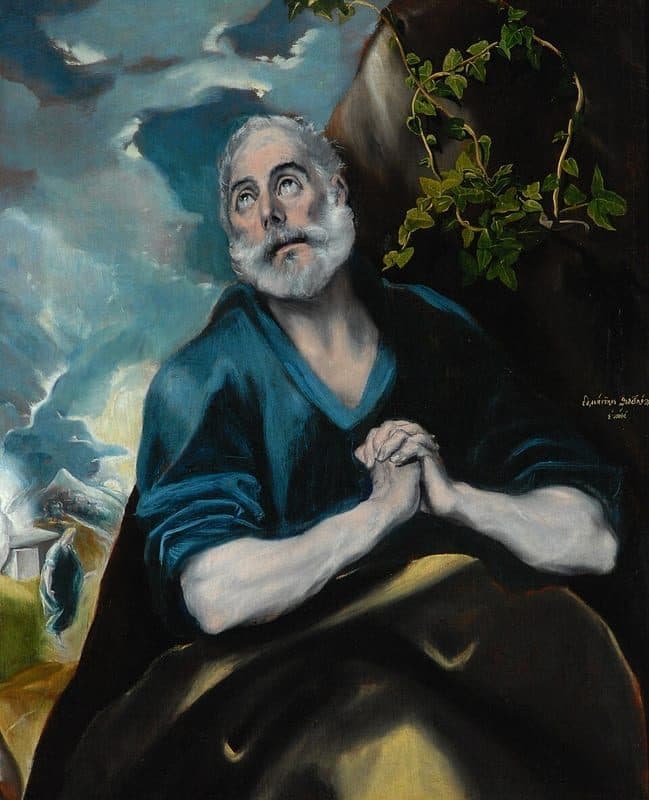
El Greco, The Tears of Saint Peter, between 1580 and 1589. Public domain, via Wikimedia Commons.
THE ARTWORKEl Greco painted Peter weeping with his eyes on heaven, and placed the empty tomb small in the distance behind him.
Summary
Simon son of John was a fisherman of Galilee whom Jesus named Cephas, Peter, the rock, and who led the Twelve and then the church in Jerusalem.
- His brother Andrew brought him to Jesus, and he left his nets to follow Him.
- Asked who Jesus was, he confessed Him as the Christ, the Son of the living God.
- He denied Jesus on the night of the arrest, and after the resurrection Jesus charged him to feed His sheep.
- At Pentecost he preached the risen Jesus to the crowds in Jerusalem.
- At Caesarea he ordered the household of Cornelius to be baptized, the first Gentiles Acts records receiving the Spirit.
Where Peter Stands in Scripture
His naming in John, his witness in 2 Peter and what Scripture calls him
Andrew brought him to Jesus, who looked at him and said, “You are Simon son of John. You will be called Cephas” (which is translated as Peter).Jesus names Simon at their first meeting, before he has done anything.
For we did not follow cleverly devised fables when we made known to you the power and coming of our Lord Jesus Christ, but we were eyewitnesses of His majesty.In his last letter Peter rests his preaching on what he saw.
The Life, Turn by Turn
Fifteen turns from the call to the council at Jerusalem
- Andrew brings him to Jesus, who names him CephasBeyond the Jordan, John 1:41
- Leaves his nets after the great catchLake of Gennesaret, Luke 5:11
- Walks on the water and sinksSea of Galilee, Matthew 14:29
- Confesses the Christ and is rebukedCaesarea Philippi, Matthew 16:16
- Sees the transfigurationA high mountain, Matthew 17:1
- Refuses, then asks for, the washingThe upper room in Jerusalem, John 13:8
- Denies Jesus three timesJerusalem, Luke 22:57
- Runs to the tombJerusalem, Luke 24:12
- Is restored by three questionsSea of Tiberias, John 21:17
- Preaches at PentecostJerusalem, Acts 2:14
- Rebukes Ananias and SapphiraJerusalem, Acts 5:3
- Raises TabithaJoppa, Acts 9:40
- Orders the baptism of Cornelius's householdCaesarea, Acts 10:48
- Is led out of Herod's prison by an angelJerusalem, Acts 12:7
- Speaks at the council for salvation by graceJerusalem, Acts 15:11
Seven of the fifteen turns take place in Jerusalem.
The Two Fires and the Other Turns of His Life
Luke 22 and John 21 read together, with six other turns of his life
At the supper Peter promised to go with Jesus to prison and to death, and Jesus warned him that he would fall that same night.
That night Peter followed the arrested Jesus at a distance and sat down among the servants at a fire in the high priest's courtyard. A servant girl said he had been with Jesus, and he denied it. A little later another man said the same, and about an hour after that a third insisted that he too was a Galilean.
Matthew records that at the third denial he began to curse and swear, and that a rooster crowed immediately.
And the Lord turned and looked at Peter. Then Peter remembered the word that the Lord had spoken to him: “Before the rooster crows today, you will deny Me three times.” And he went outside and wept bitterly.Only Luke records the look.
After the resurrection Peter went fishing on the Sea of Tiberias, John's name for the Sea of Galilee, with six other disciples and caught nothing all night. At dawn Jesus called to them from the shore. When the disciple whom Jesus loved said it was the Lord, Peter put on his outer garment and jumped into the sea.
On the shore Jesus had made a charcoal fire. The Greek word for it, anthrakia, stands only twice in the New Testament, here and at John 18:18.
After breakfast Jesus asked him three times whether he loved Him, and met each answer with a charge to feed or shepherd His flock. Then He told Peter how he would die, and said to him, Follow Me.
Jesus asked a third time, “Simon son of John, do you love Me?” Peter was deeply hurt that Jesus had asked him a third time, “Do you love Me?” “Lord, You know all things,” he replied. “You know I love You.” Jesus said to him, “Feed My sheep.The restoration ends in a charge, so Peter is given work as well as pardon.
The call by the lakeJohn 1, Luke 5, Mark 1
Andrew heard John the Baptist point to Jesus, followed Him, and then went first to find his brother Simon. Some time later Jesus taught the crowd from Simon's boat by the Lake of Gennesaret, Luke's name for the Sea of Galilee. Then He told Simon to let down his nets in deep water after a night of catching nothing.
When Simon Peter saw this, he fell at Jesus’ knees. “Go away from me, Lord,” he said, “for I am a sinful man.”Peter's first answer to the power of Jesus is to ask Him to go away.
Jesus answered him, Do not be afraid, and told him that from then on he would catch men. They brought their boats ashore and left everything to follow Him.
The waterMatthew 14
In the fourth watch of the night the disciples saw Jesus walking on the sea and cried out in fear. Peter alone asked to be commanded to come to Him on the water.
But when he saw the strength of the wind, he was afraid, and beginning to sink, cried out, “Lord, save me!” Immediately Jesus reached out His hand and took hold of Peter. “You of little faith,” He said, “why did you doubt?”Jesus rescues Peter before He rebukes his doubt, so the rebuke comes to a man already safe.
“I am going to talk about the characteristics of this prayer in the hope that there may be many who have never yet prayed aright, who may make this their own prayer, tonight, so that from many a person here present this cry may silently go up, ‘Lord, save me.’ Where did Peter pray this prayer? It was not in a place set apart for public worship, or in his usual place for private prayer. He prayed this prayer just as he was sinking in the water! He was in great peril, so he cried out, ‘Lord, save me.’”
Charles Spurgeon · The Metropolitan Tabernacle Pulpit, Sermon No. 3186: “Peter's Shortest Prayer” (lightly modernized text, CCEL edition) · on Matthew 14:30
Caesarea PhilippiMatthew 16
Near Caesarea Philippi Jesus asked the Twelve who they said He was, and Peter answered for them. Jesus called him blessed and promised him the keys of the kingdom of heaven.
Simon Peter answered, “You are the Christ, the Son of the living God.”Jesus says in the next verse that the Father revealed this answer to Peter.
From that time Jesus began to show them that He must suffer, be killed and be raised on the third day. Peter took Him aside to rebuke Him.
But Jesus turned and said to Peter, “Get behind Me, Satan! You are a stumbling block to Me. For you do not have in mind the things of God, but the things of men.”The rebuke follows the blessing within one conversation.
Pentecost and the rulersActs 2 to 5
Seven weeks after the courtyard, Peter stood up with the Eleven in Jerusalem and explained the outpouring of the Spirit from the prophet Joel. He told them that Jesus was delivered up by God's set plan and foreknowledge. He ended by calling them to repent and be baptized, and about three thousand were baptized that day.
Therefore let all Israel know with certainty that God has made this Jesus, whom you crucified, both Lord and Christ!”Peter draws this conclusion from Joel and the Psalms.
After he healed a man lame from birth at the temple gate, the priests, the captain of the temple guard and the Sadducees seized him and John, and the next day the rulers questioned them.
Salvation exists in no one else, for there is no other name under heaven given to men by which we must be saved.”Peter gives the rulers his answer, filled with the Holy Spirit.
The house of CorneliusActs 10 and 11
At Joppa Peter lodged with a tanner named Simon. On the roof at the sixth hour he saw a sheet let down from heaven full of animals. When a voice told him to kill and eat, he answered that he had never eaten anything impure. The voice told him not to call impure what God had made clean, and this happened three times.
Messengers from Cornelius, a Roman centurion at Caesarea, arrived at that moment. In Cornelius's house Peter said that God had shown him to call no man impure or unclean.
Then Peter began to speak: “I now truly understand that God does not show favoritism, but welcomes those from every nation who fear Him and do what is right.Peter moves from whom he may visit to whom God accepts.
While he was still speaking, the Holy Spirit fell on all who heard, and they spoke in tongues. Peter ordered that they be baptized, and when the believers in Jerusalem objected, he told them God had given the Gentiles the same gift He gave the apostles.
He reminded them that the Lord had said John baptized with water, but they would be baptized with the Holy Spirit.
“This passage is crucial for several reasons. Firstly, it demonstrates that the experience of speaking in tongues is not limited to the Jewish believers of Pentecost but extends to Gentiles as well.”
Charlie Shamp · Speaking in Tongues: The Definitive Evidence of the Baptism of the Holy Spirit · on Acts 10:44 to 46Charismatic
The council at Jerusalem and AntiochActs 15 and Galatians 2
Peter's last words in Acts come at the council in Jerusalem, where he argued that God had made no distinction between Jewish and Gentile believers.
On the contrary, we believe it is through the grace of the Lord Jesus that we are saved, just as they are.”The council had met over whether Gentile believers must be circumcised, and Peter answers from the way Jewish believers are saved.
Later at Antioch Peter stopped eating with Gentile believers when men came from James, and Paul opposed him to his face.
Six Details the Accounts Record
From the Gospels and Acts
A SWORD IN THE GARDEN
At the arrest Peter drew a sword and cut off the right ear of Malchus, the high priest's servant.
A COIN FOR TWO
Jesus paid the temple tax for Himself and Peter with a coin from a fish's mouth.
ASLEEP IN THE GARDEN
In Gethsemane Jesus asked Simon by name whether he could not keep watch for one hour.
INTO THE TOMB FIRST
The other disciple reached the tomb first, but Peter was the first to enter it.
NAMED IN THE MESSAGE AT THE TOMB
The young man at the tomb told the women to tell His disciples and Peter that Jesus was going ahead of them into Galilee.
A SHADOW IN THE STREET
People laid the sick in the streets so that Peter's shadow might fall on them as he passed.
The Fishing Town on the Lake
Capernaum and the fishing trade of the Sea of Galilee
Capernaum was the fishing town on the north shore of the Sea of Galilee where Jesus made His base. Its fishermen worked through the night, casting nets from the shore and letting them down from boats, and they washed and mended the nets by day.
The Family and Companions of Peter
Six ties, each with its verse
| Person | Tie to Peter | Verse |
|---|---|---|
| John, also called Jonah | His father, named when Jesus calls him Simon son of Jonah. | Matthew 16:17 |
| Andrew | His brother, a fisherman with him on the Sea of Galilee. | Mark 1:16 |
| His wife | A believing wife who travelled with him, as Paul says the apostles' wives did. | 1 Corinthians 9:5 |
| His wife's mother | Healed of a fever by Jesus, after which she served them. | Mark 1:31 |
| James and John | His partners in the fishing trade, the sons of Zebedee. | Luke 5:10 |
| Mark | The one he calls my son when he sends greetings from Babylon. | 1 Peter 5:13 |
- Person
- John, also called Jonah
- Tie to Peter
- His father, named when Jesus calls him Simon son of Jonah.
- Verse
- Matthew 16:17
- Person
- Andrew
- Tie to Peter
- His brother, a fisherman with him on the Sea of Galilee.
- Verse
- Mark 1:16
- Person
- His wife
- Tie to Peter
- A believing wife who travelled with him, as Paul says the apostles' wives did.
- Verse
- 1 Corinthians 9:5
- Person
- His wife's mother
- Tie to Peter
- Healed of a fever by Jesus, after which she served them.
- Verse
- Mark 1:31
- Person
- James and John
- Tie to Peter
- His partners in the fishing trade, the sons of Zebedee.
- Verse
- Luke 5:10
- Person
- Mark
- Tie to Peter
- The one he calls my son when he sends greetings from Babylon.
- Verse
- 1 Peter 5:13
The Places of His Life
Eight places, from his home town to the Gentile church at Antioch
- Located: the gazetteer fixes one site
- Placed: the point stands for an area, or is rounded
about 200 km (124 miles)
- 1Bethsaida, The town of Andrew and Peter, and of Philip. John 1:44
- 2Capernaum, Jesus went from the synagogue to the home of Simon and Andrew. Mark 1:29
- 3Sea of Galilee, Jesus called Peter and Andrew there to follow Him. Matthew 4:18
- 4Jerusalem, Peter stood up among the hundred and twenty believers. Acts 1:15
- 5Lydda, Peter healed Aeneas, who had been bedridden for eight years. Acts 9:34
- 6Joppa, Peter raised Tabitha and saw the sheet let down from heaven. Acts 10:11
- 7Caesarea, The Spirit fell on the household of Cornelius while Peter spoke. Acts 10:44
- 8Antioch, Paul opposed Peter for withdrawing from the Gentile table. Galatians 2:11
Not located: Bethsaida, Lydda.
The coastline is simplified; each place stands at its place page's coordinates.
In Acts his travels run from Jerusalem to the coast at Joppa and Caesarea.
Questions the Life Raises
Four questions answered from Scripture, three of them also from writers who read it
Did Peter fall away when he denied Jesus?Luke 22:31 to 32
Jesus prayed that Peter's faith would not fail, and before the denial He spoke of Peter's return as certain. His word for that return, epistrepho, means to turn back.
Simon, Simon, Satan has asked to sift each of you like wheat. But I have prayed for you, Simon, that your faith will not fail. And when you have turned back, strengthen your brothers.”The prayer answers Satan's request, and the task it gives is for after the fall.
Was going back to fishing a lapse?John Calvin, Commentary on the Gospel of John
John 21:3 records the fishing trip without comment.
“Meanwhile, they do what they were accustomed to do, and what belonged to men in private life. It is true that Paul, in the midst of his employment as a preacher, gained the support of his life by his own hands, but it was for a different reason; for his time was so arranged, that the labors of his hands did not withdraw him from teaching.”
John Calvin · Commentaries · on John 21:3Reformed
Do the two Greek words for love matter?Augustine, Tractates on John
In John 21:15 and 16 Jesus asks with the verb agapao and Peter answers with phileo, and in the third question Jesus uses Peter's word. Augustine, in his Tractates on John in the early fifth century, held that the two verbs mean the same thing here.
How did Peter die?1 Clement 5; Tertullian, Scorpiace; Eusebius, Church History 3.1
Jesus told Peter that when he was old he would stretch out his hands and be led where he did not want to go. John adds that this showed the kind of death by which he would glorify God. Peter wrote in his second letter that the laying aside of his tent was near, as the Lord Jesus Christ had shown him.
“But not to dwell upon ancient examples, let us come to the most recent spiritual heroes. Let us take the noble examples furnished in our own generation. Through envy and jealousy the greatest and most righteous pillars [of the church] have been persecuted and put to death. Let us set before our eyes the illustrious apostles. Peter, through unrighteous envy, endured not one or two, but numerous labours; and when he had at length suffered martyrdom, departed to the place of glory due to him.”
Clement of Rome · Clement's First Letter to the Corinthians, Chapter 5 · on John 21:18 to 19Patristic
Tertullian names the city and the emperor, and Eusebius in his Church History adds the manner of the crucifixion.
“We read the lives of the Caesars: At Rome Nero was the first who stained with blood the rising faith. Then is Peter girt by another, when he is made fast to the cross.”
Tertullian · Scorpiace · on John 21:18Patristic
“Peter appears to have preached in Pontus, Galatia, Bithynia, Cappadocia, and Asia to the Jews of the dispersion. And at last, having come to Rome, he was crucified head-downwards; for he had requested that he might suffer in this way.”
Eusebius of Caesarea · Church History (Book III), Chapter 1 · on John 21:18 to 19Patristic
What the Text Leaves Unsaid
His meeting with the risen Lord, his later travels and his children
Where Peter Points
The intercession, the shepherd, the living stone and the mission to the circumcised
The prayer of Luke 22:32 shows in one scene what Hebrews 7:25 teaches of Christ, who always lives to intercede for those who draw near to God through Him.
The man told to shepherd the sheep later wrote to the elders of five provinces as a fellow elder.
And when the Chief Shepherd appears, you will receive the crown of glory that will never fade away.Peter places every elder under Christ, who will reward them.
The living stone, the titles of Israel and the mission to the circumcised1 Peter 2 and Galatians 2
His first letter takes up the building Jesus promised in Matthew 16:18.
As you come to Him, the living stone, rejected by men but chosen and precious in God’s sight, you also, like living stones, are being built into a spiritual house to be a holy priesthood, offering spiritual sacrifices acceptable to God through Jesus Christ.Every believer, Peter among them, is a stone laid on Christ.
He then gives the scattered believers the titles of Israel from Exodus 19:6 and Isaiah 43:20, a chosen people, a royal priesthood and a holy nation. The letter adds that those who once were not a people are now the people of God.
For the One who was at work in Peter’s apostleship to the circumcised was also at work in my apostleship to the Gentiles.Paul gives both missions to one God.
How the Church Has Read Him
Augustine and Ambrose on the night and the morning
“When fear overwhelmed him, as the Lord had predicted, he three times denies the one for whom he promised to die. As it says, ‘The Lord looked at him and he, for his part, wept bitterly.’ Remembrance of his denial was necessarily bitter, so that the grace of redemption might be even more sweet. If Christ had not left him to himself, he would not have denied. If Christ had not looked at him, he would not have wept. God hates people relying presumptuously on their own powers. Like a doctor, he lances this swollen tumor in those whom he loves. By lancing it, of course, he inflicts pain, but he also ensures health later. When he rises again, the Lord entrusts his sheep to Peter, to that one who denied him. Peter denied him because he relied on himself, but later Peter would feed his flock as a pastor, because he loved him. After all, why does he ask him three times about his love, if not to prick his conscience about his threefold denial?”
Augustine of Hippo · SERMON 285.3 · on Luke 22:61Patristic
Ambrose on the three questionsExposition of the Christian Faith
“It is Peter, chosen by the Lord himself to feed his flock, who merits three times to hear the words ‘Feed my little lambs; feed my lambs; feed my sheep.’ And so, by feeding well the flock of Christ with the food of faith, he effaced the sin of his former fall. For this reason he is admonished three times to feed the flock. He is asked three times whether he loves the Lord in order that he may confess him three times whom he had denied three times before his crucifixion.”
Ambrose of Milan · Exposition of the Christian Faith 5, PROLOGUE 2 · on John 21:15Patristic
What the Rock and the Keys Give Him
Three readings of Matthew 16:18, and two of Antioch
The rock is PeterTertullian, On Modesty; Cyprian, On the Unity of the Church
Tertullian, in On Modesty, reads the promise as a gift conferred on Peter himself. Cyprian, in On the Unity of the Church, holds that all the apostles were equal in honour and power and that the unity of the church begins from one. The objection from the other readings is that Matthew 18:18 gives the binding and loosing to all the disciples.
The rock is the confessionJohn Chrysostom, Homily on Matthew 54; Matthew Henry, Commentary
Chrysostom, preaching on Matthew, reads the rock as the faith of Peter's confession, and Matthew Henry in his Commentary of 1710 calls the confession the great truth on which Christ builds His church. The objection is that in Aramaic one word, Kepha, stands in both halves of the sentence.
The rock is ChristAugustine, Retractations; John Wesley, Explanatory Notes
Augustine in his Retractations gave this as his later reading and left the reader to choose. The objection is that the rock of the sentence follows directly on the words You are Peter.
“There is a wonderful beauty and energy in these expressions, which describe Christ as a spiritual foundation, solid, firm, durable; and believers as a building erected upon it, in preference to that temple which the Jews accounted their highest glory. And St. Peter speaking of him thus, shows he did not judge himself, but Christ, to be the rock on which the church was built.”
John Wesley · Explanatory Notes upon the New Testament · on 1 Peter 2:4Evangelical
Antioch as an arranged lessonJohn Chrysostom, Homily on Galatians 2; John of Damascus, Commentary
Chrysostom and John of Damascus read the rebuke at Antioch as agreed between Peter and Paul for the sake of those watching. The objection rests on the word Paul uses for the withdrawal in Galatians 2:13.
The other Jews joined him in his hypocrisy, so that by their hypocrisy even Barnabas was led astray.The rebuke in the next verse was made in front of everyone, which both readings accept.
Antioch as a real faultTertullian, Against Marcion 5; John Wesley, Explanatory Notes
Tertullian and Wesley read the rebuke as a correction of Peter's real fear of the circumcision party. The objection is that Peter and Paul had just given each other the right hand of fellowship at Jerusalem. Peter later calls him our beloved brother Paul.
Books to Read Next
Four works from about 400 to 1869
Tractates on the Gospel of John
Augustine of Hippo · early fifth century
Augustine preaches through the Gospel of John to its last chapter.
Homilies on Acts
John Chrysostom · about 400
Chrysostom follows Peter through Pentecost, the council and the house of Cornelius.
Commentary on the Gospel of John
John Calvin · 1554
Calvin reads the restoration by the lake and the charge to feed the flock.
Expository Thoughts on the Gospels: John
J. C. Ryle · 1869
Ryle reads John 21 as practical lessons for believers.
Follow Me
His last word in his letters asks the reader to grow in the grace and knowledge of our Lord and Savior Jesus Christ.
The life calls the reader to come back to Christ after failure as Peter did, to answer His question with love, and to follow Him.
Keep studying
Read it4
Studies9
Places7
Show the next 1 title
Doctrines8
Peoples and groups1