
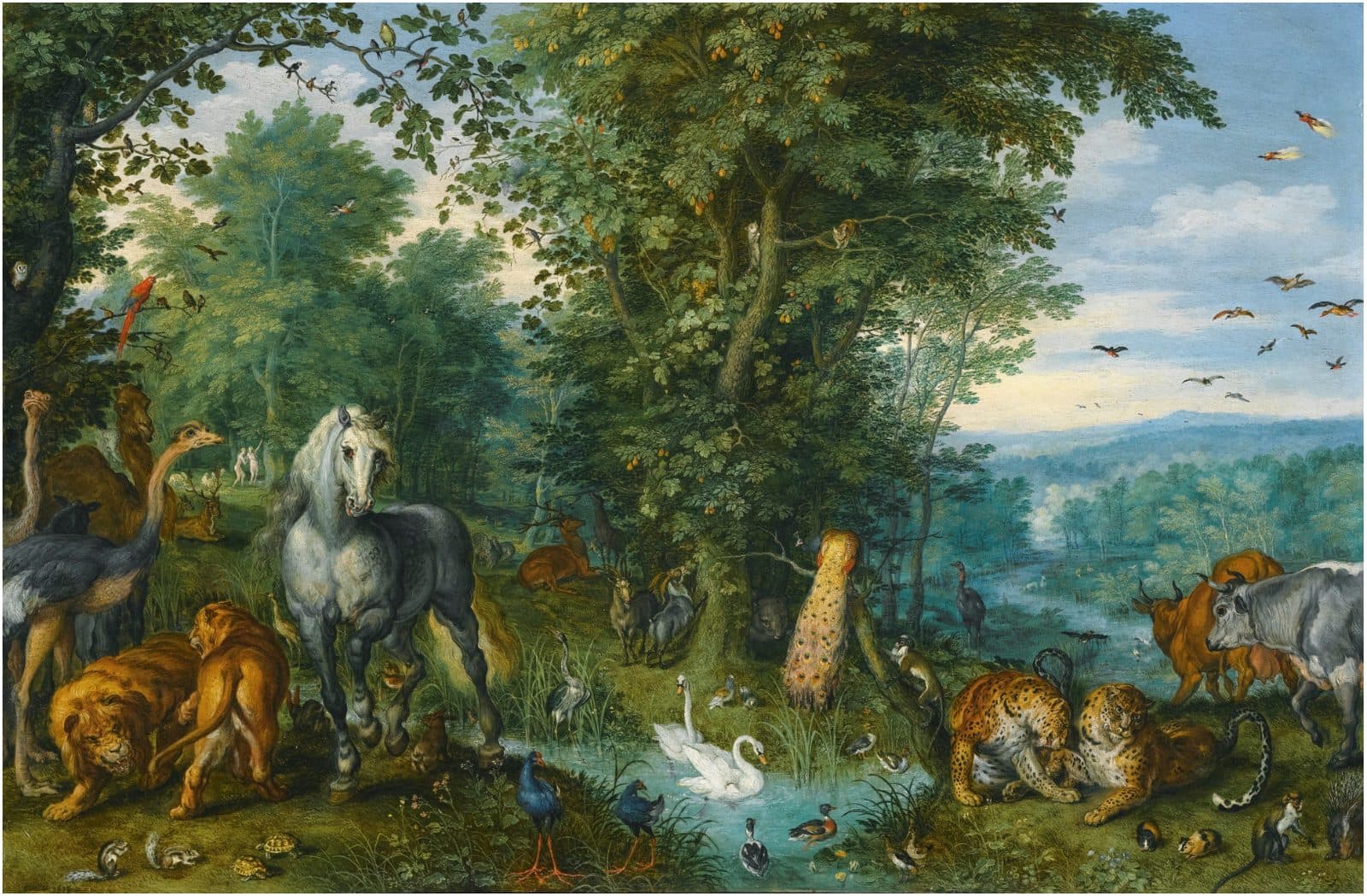
The Garden of Eden with the Fall of Man. Jan Brueghel the Elder, 1613. Wikimedia Commons. Public domain.
Old Testament · Book 1 of 66
Genesis
Genesis records the creation of the world, the fall, the flood and God's covenant with Abraham. It follows Abraham's family through Isaac, Jacob and Joseph and ends with Joseph's death in Egypt.
Genesis records the creation of the world, the fall, the flood and God's covenant with Abraham. It follows Abraham's family through Isaac, Jacob and Joseph and ends with Joseph's death in Egypt.
What is Genesis about?
Genesis opens on a world spoken into being and called very good, and it closes on a coffin in Egypt. Between those two points a man and a woman take the fruit they were told to leave, their children fill the earth with violence, and a flood washes it away. The story then narrows to one family. God calls Abram out of Ur and swears him a land and a people, and the promise passes to Isaac, to Jacob and to Jacob's twelve sons. It ends with that family fed in Egypt and the promise still unkept.
All 50 chapters
Every chapter of the book, in one grid. Each cell opens that chapter.
- The worldGenesis 1 to 11
- AbrahamGenesis 12 to 25
- JacobGenesis 26 to 36
- JosephGenesis 37 to 50
The colour is the cycle of the story the chapter stands in, and every cell opens that chapter's Study level.
Who wrote it, where, when, for whom, and why?
Genesis does not name its writer. The rest of the Law says that Moses wrote at the LORD's command (Exodus 17:14, 24:4 and 34:27; Numbers 33:2), and that he wrote the words of the law in a book from beginning to end (Deuteronomy 31:9 and 24). Joshua builds the altar by the Book of the Law of Moses (Joshua 8:31). Jesus calls it the Book of Moses (Mark 12:26), opens the Scriptures beginning with Moses (Luke 24:27 and 44), and says that Moses wrote about him.
If you had believed Moses, you would believe Me, because he wrote about Me.
John 5:46, Berean Standard Bible.
The book narrows from the whole earth to one household. Abram's family leaves Ur of the Chaldeans for Canaan by way of Haran (Genesis 11:31 and 12:5), and Jacob's family goes down to Egypt, seventy in all (46:27), where Joseph dies (50:26). Scripture keeps its own count of the years after them: four hundred years of affliction foretold to Abram (15:13), 430 years in Egypt (Exodus 12:40), and 480 years from the exodus to Solomon's temple (1 Kings 6:1). Counted back from Solomon, the patriarchs lived about two thousand years before Christ.
Moses gave the law he wrote to the priests and the elders, to be read in the hearing of all Israel (Deuteronomy 31:9 to 11). Its first hearers were the people the LORD had brought out of Egypt.
the book was written by moses to the jews in the exodus and its purpose was to teach them about YHWH, not explain every little detail and be a perfect account, or else there would have been much more included
Genesis stands in the ancient Near East of walled towns, tent dwelling herdsmen and great river empires at either end of the Fertile Crescent. Its neighbours told their own accounts of a creation, a garden and a flood, and what the resemblances prove is argued under the Hard Questions below. The patriarchs live as resident strangers among Canaanite city states, buy burial ground by contract, and move between Mesopotamia, Canaan and Egypt along roads the period's own records describe.
the Watchers view: that the “sons of God” are fallen angelic beings whose union with human women produced the Nephilim, the reading of the earliest Jewish interpreters (1 Enoch, Jubilees) and a strand of the church fathers, and defended in modern scholarship (Michael Heiser, The Unseen Realm, 2015). The Sethite reading (the godly line of Seth intermarrying with Cainite women) is held by many others, including much of the Reformation and post-Reformation tradition.
Sources. Genesis 11:31, 12:5, 15:13, 46:27 and 50:26; Exodus 12:40, 17:14, 24:4 and 34:27; Numbers 33:2; Deuteronomy 31:9 to 11 and 31:24; Joshua 8:31; 1 Kings 6:1; Mark 12:26; Luke 24:27 and 44; John 5:46. Every verse is read in the Berean Standard Bible.
How is Genesis arranged, and what is it for?
The outline the text prints over itself, then what the book teaches and what it was written to do.
The eleven records of Genesisthe outline the book prints over itself
Genesis prints the sentence these are the generations of, in Hebrew toledot, 11 times over 10fathers, Esau's twice, and opens a new record at each. That is what the divisions of the book follow. The rows below are the eleven, in the order the text prints them.
- 1 of 11Genesis 2:4The generations of the heavens and the earth. Genesis 2:4 to 4:26. The garden, the command, the serpent, the first promise of a deliverer, and the first murder.
- 2 of 11Genesis 5:1The generations of Adam. Genesis 5:1 to 6:8. Ten generations from Adam to Noah, the refrain of death through the list, and the wickedness that fills the earth.
- 3 of 11Genesis 6:9The generations of Noah. Genesis 6:9 to 9:29. The ark, the flood, the LORD remembering Noah, the altar, and the covenant sealed with the bow in the cloud.
- 4 of 11Genesis 10:1The generations of the sons of Noah. Genesis 10:1 to 11:9. The seventy nations spread out by their families and tongues, then gathered again at Babel and scattered.
- 5 of 11Genesis 11:10The generations of Shem. Genesis 11:10 to 11:26. Ten generations from Shem to Abram, narrowing the line the promise runs in.
- 6 of 11Genesis 11:27The generations of Terah. Genesis 11:27 to 25:11. The call out of Haran, the covenant cut between the pieces, the sign of circumcision, Ishmael, Isaac, and the binding on Moriah.
- 7 of 11Genesis 25:12The generations of Ishmael. Genesis 25:12 to 25:18. The twelve princes of Ishmael, the branch God blesses and then sets aside from the line of promise.
- 8 of 11Genesis 25:19The generations of Isaac. Genesis 25:19 to 35:29. The twins struggling, the birthright sold, the blessing taken, Bethel, Laban, Peniel, and the renaming of Jacob as Israel.
- 9 of 11Genesis 36:1The generations of Esau. Genesis 36:1 to 37:1. The chiefs and kings of Edom, the second branch honoured in a list and then set aside.
- 10 of 11Genesis 36:9The generations of Esau. Genesis the same record, reopened. The chiefs of Esau by their clans, closing the branch before the record returns to Jacob.
- 11 of 11Genesis 37:2The generations of Jacob. Genesis 37:2 to 50:26. The pit, Egypt, the prison, the dreams, the famine, the brothers bowing, the blessing of the twelve, and the coffin.
The four colours on the chapter grid are a second division, held beside the headings rather than against them: the primeval history, Genesis 1 to 11; the abraham cycle, Genesis 12 to 25; isaac and jacob, Genesis 26 to 36; the joseph cycle, Genesis 37 to 50. It follows where the story stands rather than where the text prints a heading, which is why the grid and the rows above cut the book in different places. The four-movement division, one primeval section and three patriarchal cycles, is the ordinary division of modern commentary on Genesis. Gordon J. Wenham sets the book out this way in Genesis 1-15 and Genesis 16-50 (Word Biblical Commentary, 1987 and 1994), as does Bruce K. Waltke in Genesis: A Commentary (2001).
The theme
Genesis teaches that one God made everything there is, that he made it good, and that the ruin in it came from the creature and not from the Maker. It teaches that God answers that ruin by promise rather than by starting again, binding himself by oath to one man and to his line. It teaches that the promise is carried by the son God chooses rather than by the son the family would have chosen, which is why the book keeps setting an elder brother aside.
The purpose
Genesis was written to tell one people who their God is and what he had already sworn to their fathers, so that the rest of the story has a ground to stand on. It names the world as his work, the ruin as the creature's doing, and the promise as his answer to it, and it leaves the family in Egypt with the promise still unkept, which is the point Exodus takes up.
The world, Genesis 1 to 11
What the text says in these 11 chapters, and the pages they open on.
God speaks a world into being in six days and calls it very good, and he makes the man and the woman in his own image to rule it for him. They take the fruit they were told to leave, and the sentence God passes on the serpent carries the first promise of a deliverer. Their first son kills his brother, the line of Cain builds a city, and the earth fills with violence until God washes it away and keeps one family alive in an ark. The nations spread from Noah's three sons, and at Babel they build a tower to make a name for themselves and are scattered from it by a confusion of speech. The eleven chapters stand over the whole earth, and the last of them narrows the record to one household in Ur.
So God created man in His own image; in the image of God He created him; male and female He created them.
- Study
Genesis 1the six days and the image of GodShow the summary and 5 pagesShow summary, 5 pagesHide the summary
Genesis 1 tells how God made everything by speaking, in the order of a week. Its last act is man, made in God's image and given the world to rule.
- God is named Elohim, a plural form of the word carrying a singular verb.
- God creates from nothing at the start; after that he separates, produces and fills what he has already made.
- The sun and the moon are called the greater and the lesser light, not by the names the nations gave their gods.
- The first blessing in the Bible is spoken over fish and birds before it is spoken over a man.
- Six times God calls a piece of the work good. At the end he calls the whole of it very good.
On this chapter (5)
- The creation week
The six days of Genesis 1 day by day, with the readings of the days and who holds each.
- The Edenic covenant
The charge God gave the first man and woman, and the one command set over it.
- Were the six days literal, and how old is the earth?
Answered under Where do readers disagree, lower on this page, with each reading and who holds it.
- Are there two creation accounts?
Answered under Where do readers disagree, lower on this page, with each reading and who holds it.
- Genesis 1:1
The verse on its own page, with the commentators on it by era.
- Study
Genesis 2the seventh day, the garden and the first marriageShow the summary and 1 pageShow summary, 1 pageHide the summary
The seventh-day rest, then the garden. The creation account narrows from cosmos to Eden: a river in four heads, trees for food, the tree of life at the centre and the tree of knowledge forbidden. Adam is put in the garden to dress and keep it. Vocation precedes the fall. The animals are named; none is a fit helper. Then the woman, built from the man's side. Bone of his bone, flesh of his flesh. And marriage is instituted before any sin. Henry notes the sacredness of this first institution; Calvin emphasises that companionship was God's design, not a concession.
On this chapter (1)
- Genesis 2:1
The verse on its own page, with the commentators on it by era.
- Genesis 2:1
- Study
Genesis 3the serpent, the sentence and the first promiseShow the summary and 5 pagesShow summary, 5 pagesHide the summary
The serpent questions God's word to the woman, and she and the man eat from the tree God had forbidden. God judges the serpent, the woman and the man, promises that the woman's offspring will defeat the serpent, and sends the two out of the garden.
- Their eyes are opened, they know they are naked, and they hide from God among the trees.
- The man blames the woman, and the woman blames the serpent.
- God makes garments of skin for the man and his wife before they leave.
- Cherubim and a flaming sword guard the way to the tree of life.
On this chapter (5)
- The fall
The temptation, the three sentences, and how the promise of 3:15 has been read.
- The seed promise
The promised offspring traced from the sentence on the serpent to the sceptre of Judah.
- Eden
The garden the first man and woman leave, and the places Scripture names it again.
- The garment and the robe
What a garment stands for in Scripture, and the garments of Genesis among them.
- Genesis 3:15
The verse on its own page, with the commentators on it by era.
- Study
Genesis 4the offerings, the first murder, and men calling on the LORDShow the summary and 1 pageShow summary, 1 pageHide the summary
The first children and the first murder. Cain and Abel each bring an offering; Abel's is accepted, Cain's is not. ‘If you do what is right, will you not be accepted?’ The warning goes unheeded; Cain rises up and kills his brother in the field. ‘Where is your brother Abel?’ answers ‘Where are you?’ of the previous chapter. Cain is marked but not destroyed. Divine restraint even in judgment. Lamech's seven-fold boast signals the spread of violence; Seth is born as a replacement, and the chapter closes: ‘At that time men began to call upon the name of the LORD’. Two lines now run in parallel through the world.
On this chapter (1)
- Genesis 4:1
The verse on its own page, with the commentators on it by era.
- Genesis 4:1
- Study
Genesis 5a line of deaths, and one man who walked with GodShow the summary and 1 pageShow summary, 1 pageHide the summary
The toledoth of Adam. Ten generations from Adam to Noah. The refrain ‘and he died’ strikes like a bell across the chapter: Eden's sentence is made visible in nine generations. Two exceptions break the pattern. Enoch ‘walked with God, and he was not, for God took him’. Henry calls this the sweetest note in the whole genealogy. And Lamech names his son Noah (‘rest’) with a prophecy of comfort from the ground the LORD has cursed. The genealogy is not filler; it is the narrowing of the line of promise through Seth toward the one who will find grace in the eyes of the LORD.
On this chapter (1)
- Genesis 5:1
The verse on its own page, with the commentators on it by era.
- Genesis 5:1
- Study
Genesis 6the sons of God and the building of the arkShow the summary and 6 pagesShow summary, 6 pagesHide the summary
The sons of God take wives from the daughters of men, the Nephilim are on the earth, and the LORD limits man's days to a hundred and twenty years. God sees the earth filled with violence and resolves to destroy it, but Noah finds favor with him and is told to build an ark.
- The LORD regrets that he has made man, and his heart is grieved.
- Noah is called righteous and blameless in his generation, and he walks with God.
- God gives the ark's measures: three hundred cubits long, fifty wide and thirty high, with three decks and a door in the side.
- God promises to establish his covenant with Noah, and Noah does everything God commands him.
On this chapter (6)
- The Watchers and the Nephilim
The sons of God of Genesis 6 and the readings the church and the synagogue have given them.
- The Nephilim and the giants
The Nephilim of 6:4 and the giants of the later books, with both readings of the sons of God.
- The giants of 1 Enoch
How 1 Enoch expands Genesis 6:4 into an account of the Watchers' giant offspring.
- Noah's ark
The vessel itself, its measurements and what the account says was carried in it.
- Who are the sons of God in chapter 6?
Answered under Where do readers disagree, lower on this page, with each reading and who holds it.
- Genesis 6:8
The verse on its own page, with the commentators on it by era.
- Study
Genesis 7the family and animals shut in, and the waters over the earthShow the summary and 1 pageShow summary, 1 pageHide the summary
The flood comes. Noah and his family and the animals enter the ark; the LORD shuts them in. The fountains of the great deep are broken up, the windows of heaven opened; forty days and forty nights of rain. Every living thing that moved upon the earth dies. Only those in the ark remain alive. Henry finds the chapter almost unbearable to read; Calvin marks the double source of the waters (below and above) as an undoing of the second day's separation. The chapter's refrain is ‘as God had commanded him’. Noah's obedience in the face of a world that has forgotten obedience.
On this chapter (1)
- Genesis 7:1
The verse on its own page, with the commentators on it by era.
- Genesis 7:1
- Study
Genesis 8the ark at rest on Ararat, the dove, and Noah's altarShow the summary and 1 pageShow summary, 1 pageHide the summary
The waters recede, and God remembers Noah. The ark rests on the mountains of Ararat; the raven goes forth, then the dove thrice. The third time returning not. Noah opens the ark and finds the earth dry. His first act on dry ground is to build an altar and offer clean animals; ‘the LORD smelled a sweet savour’. Judgment is answered by a covenantal resolve: ‘I will not again curse the ground any more for man's sake’. Clarke emphasises Noah's priestly posture; JFB reads the altar as the pattern for all later worship. A saved man's first word is praise.
On this chapter (1)
- Genesis 8:1
The verse on its own page, with the commentators on it by era.
- Genesis 8:1
- Study
Genesis 9the covenant with Noah and the bow in the cloudShow the summary and 4 pagesShow summary, 4 pagesHide the summary
God blesses Noah and his sons, gives them every living creature for food except meat with its lifeblood, and requires a life for a life because man is made in God's image. He makes a covenant with every living creature never again to destroy the earth by a flood, and sets the rainbow in the cloud as its sign.
- The covenant is made with Noah, with his descendants and with every animal that came out of the ark.
- Noah plants a vineyard, becomes drunk and lies uncovered in his tent.
- Ham sees his father and tells his brothers, and Shem and Japheth cover Noah without looking at him.
- Noah curses Canaan, the son of Ham, and blesses Shem and Japheth.
- Noah lives three hundred and fifty years after the flood and dies at nine hundred and fifty.
On this chapter (4)
- The Noahic covenant
The covenant made after the flood with Noah and every living creature, and the bow set as its sign.
- The flood
The waters, the ark, the covenant after it and the questions the account raises.
- The covenants
The covenants God makes in Scripture, read in order.
- Genesis 9:13
The verse on its own page, with the commentators on it by era.
- Study
Genesis 10the peoples from Noah's sons, and Nimrod's kingdomShow the summary and 1 pageShow summary, 1 pageHide the summary
The table of nations. Seventy peoples descend from the three sons of Noah. Japheth's maritime fringe, Ham's southern kingdoms (including Nimrod's tower-builder empire), Shem's central east. The chapter is not merely geography; it is the covenantal setting for the call of Abram that is coming. Henry notes that every human being alive traces through this table; Calvin emphasises the unity of the human race. Nimrod is named twice (‘a mighty hunter before the LORD’) and the founding of Babel is flagged. The chapter sets up the Babel narrative as its theological interpretation.
On this chapter (1)
- Genesis 10:1
The verse on its own page, with the commentators on it by era.
- Genesis 10:1
- Study
Genesis 11Babel, and the line that runs to AbramShow the summary and 5 pagesShow summary, 5 pagesHide the summary
The whole earth has one language, and people settling in Shinar build a city and a tower to make a name for themselves. The LORD confuses their language and scatters them, and the chapter then traces the line of Shem down to Terah and his son Abram.
- The place is called Babel, because there the LORD confused the language of the whole earth.
- The line from Shem to Abram is given with each father's age, and the lifespans grow shorter as it goes.
- Sarai, Abram's wife, is barren and has no child.
- Terah sets out from Ur of the Chaldeans for Canaan with Abram, Sarai and Lot, settles in Haran and dies there.
On this chapter (5)
- The tower of Babel
The building, the scattering and the confusion of speech, set beside the gathering at Pentecost.
- The table of nations
The seventy names of Genesis 10 and the peoples the book attaches to them.
- The city
What a city stands for in Scripture, and who builds the first ones.
- Babylon
The city of Babel followed through Scripture to the Babylon of Revelation.
- Genesis 11:9
The verse on its own page, with the commentators on it by era.
Days one to three make three spaces, and days four to six fill the same three in the same order
Days one to three: the spaces made
Days four to six: what fills them
- Day 1 is filled on day 4.
- Day 2 is filled on day 5.
- Day 3 is filled on day 6.
Day 7: the day set apart
God finishes his work, rests, and blesses the seventh day and sets it apart.
Characters (8)
Who the text follows in these chapters. A name with a page carries its door.
- Adam
The first man, made from the ground and set in the garden to work it and keep it.
- Eve
The first woman, made from the man's side, and the mother of all the living.
- Cain
Adam's firstborn, a farmer, who killed his brother over an offering and was sent out a wanderer.
- Abel
Adam's second son, a keeper of sheep, whose offering God accepted and whose blood the New Testament still names.
Show the next 4
- Enoch
Seventh from Adam, who walked with God and was taken without dying.
- Noah
The man God found righteous in his generation, who built the ark and came out to a covenant and a bow.
- Seth
The son given in Abel's place, through whom the line to Noah runs.
- Shem
Noah's son, the father of the line the book follows to Abram.
Places (3)
Where the chapters stand, each with the page that holds it.
Themes (9)
What these chapters raise, each carried further on its own page.
- The image of God
What it means that God made the man and the woman in his own likeness, and what the rest of Scripture builds on it.
- The creation week
The six days and the seventh, read as the account itself sets them out.
- The fall
The eating, the sentence and the promise of the seed that would crush the serpent's head.
- The Watchers and the Nephilim
The sons of God of Genesis 6 and the readings the church and the synagogue have given them.
Show the next 5
- The flood
The waters, the ark, the covenant after it and the questions the account raises.
- Noah's ark
The vessel itself, its measurements and what the account says was carried in it.
- Adam to Noah
The ten fathers of Genesis 5, their years and what the list is doing.
- The table of nations
The seventy names of Genesis 10 and the peoples the book attaches to them.
- The tower of Babel
The building, the scattering and the confusion of speech.
Where the New Testament uses these chapters (7)each marked as a quotation or an allusion, with the evidence
- Explicit quotationGenesis 1:27 and 2:24 at Matthew 19:4-5 and Mark 10:6-8. Jesus answers a question about divorce by reading the two verses together as one word on marriage. The words of both verses are reproduced and introduced with a formula of citation, have you not read.
- Explicit quotationGenesis 2:24 at Ephesians 5:31 and 1 Corinthians 6:16. Paul quotes the verse for the union of husband and wife, and again for what union with a body means. The verse is reproduced word for word in both places, with a citation formula at Ephesians 5:31.
- Explicit quotationGenesis 2:7 at 1 Corinthians 15:45. The first man became a living being, quoted to set the last Adam beside the first. The clause is reproduced and marked as written.
- Probable allusionGenesis 1:3 at 2 Corinthians 4:6. God who said let light shine out of darkness, set beside the light given in the face of Christ. The language of the first day is carried without a citation formula and without reproducing the verse.
- Probable allusionGenesis 3:15 at Romans 16:20. The God of peace will soon crush Satan under your feet. The picture of the crushed serpent is carried, with the foot moved from the seed to the church.
- Probable allusionGenesis 3:1-6 at 2 Corinthians 11:3 and 1 Timothy 2:14. The serpent's deceiving of Eve, used for the danger to a church and in the argument about Adam and the woman. The scene is named and summarised rather than quoted.
- Probable allusionGenesis 2:9 and 3:22-24 at Revelation 2:7 and 22:1-2. The tree of life and the river return at the end of the canon, with the way to the tree open again. The furniture of the garden is reused without quotation, and the curse is named as gone at 22:3.
Abraham, Genesis 12 to 25
What the text says in these 14 chapters, and the pages they open on.
God calls Abram out of Haran and swears him a land, a people and a blessing that reaches every family on the earth. Abram believes him, and God counts that belief as righteousness and cuts a covenant by passing alone between the pieces of the sacrifice. The promise waits twenty five years while Abram takes Hagar at Sarai's word and fathers Ishmael, and it is kept when Sarah bears Isaac in her old age. God then asks for the son back on a mountain in Moriah, and provides a ram in the boy's place. Abraham buys a field at Machpelah to bury Sarah, the first piece of the land he ever owns, sends for a wife for Isaac, and is buried in the same cave.
Abram believed the LORD, and it was credited to him as righteousness.
- Study
Genesis 12the call out of Haran and the threefold promiseShow the summary and 3 pagesShow summary, 3 pagesHide the summary
The LORD tells Abram to leave his country and his father's house for a land he will show him, and promises to make him a great nation and to bless all the families of the earth through him. Abram goes and builds altars in Canaan, and then goes down to Egypt in a famine, where he passes Sarai off as his sister.
- Abram is seventy-five years old when he leaves Haran with Sarai, Lot and all they own.
- At Shechem the LORD appears to Abram and promises the land to his offspring.
- Pharaoh takes Sarai into his palace, and the LORD strikes his household with plagues until he sends Abram away.
On this chapter (3)
- The Abrahamic covenant
What God swore, on what terms, and how the oath is repeated and deepened across the book.
- The altar
The altars of Scripture, among them the ones Abram builds as he moves through the land.
- Genesis 12:1
The verse on its own page, with the commentators on it by era.
- Study
Genesis 13Lot chooses the plain, the promise repeatedShow the summary and 1 pageShow summary, 1 pageHide the summary
Abram returns from Egypt (‘very rich in cattle, in silver, and in gold’) to his altar between Bethel and Ai. Strife between his herdsmen and Lot's forces a parting. Abram yields first choice to the younger kinsman; Lot picks the well-watered plain of Jordan, pitching his tent toward Sodom. The LORD repeats the promise. Land and seed uncountable as the dust of the earth. Abram moves to the oaks of Mamre and builds another altar. Henry notes the difference between the man of faith and the man of sight: Abram takes what God gives; Lot chooses what the eye prefers.
On this chapter (1)
- Genesis 13:1
The verse on its own page, with the commentators on it by era.
- Genesis 13:1
- Study
Genesis 14the war of the kings and Melchizedek's blessingShow the summary and 4 pagesShow summary, 4 pagesHide the summary
Four kings from the east defeat the five kings of the plain, plunder Sodom and Gomorrah and carry off Lot. Abram pursues them with three hundred and eighteen trained men, rescues Lot and the goods, and on his return is met by Melchizedek, king of Salem and priest of God Most High.
- Melchizedek brings out bread and wine and blesses Abram by God Most High, Creator of heaven and earth.
- Abram gives Melchizedek a tenth of everything.
- Abram keeps nothing from the king of Sodom, so that no one can say the king made him rich.
- This is the first chapter of the Bible to call Abram a Hebrew.
On this chapter (4)
- Melchizedek
The priest king of Salem and the order Hebrews builds on him.
- Hebrews 7, the Study
The chapter of Hebrews that builds its argument on Melchizedek, verse by verse.
- Names of God
The names Scripture gives God, God Most High and God Almighty among them.
- Genesis 14:18
The verse on its own page, with the commentators on it by era.
- Study
Genesis 15the covenant cut between the piecesShow the summary and 5 pagesShow summary, 5 pagesHide the summary
The word of the LORD comes to Abram in a vision, and when Abram asks about an heir, God shows him the stars and promises him offspring as many as they are. Abram believes the LORD, who credits it to him as righteousness, and God makes a covenant with him over the divided animals.
- God tells Abram that his descendants will be strangers and slaves in another land for four hundred years and will come out with great possessions.
- After a deep sleep falls on Abram, a smoking firepot and a flaming torch pass between the pieces.
- The land is promised to his offspring from the river of Egypt to the Euphrates.
On this chapter (5)
- The Abrahamic covenant
What God swore, on what terms, and how the oath is repeated and deepened across the book.
- Justification by faith
Being declared righteous, walked in five stages from the charge to the peace that follows.
- Imputation
The word reckon or credit followed through seven texts from Genesis 15 to James.
- Faith and works
Paul and James read side by side on the same Abraham.
- Genesis 15:6
The verse on its own page, with the commentators on it by era.
- Study
Genesis 16the maid's flight and the God who seesShow the summary and 1 pageShow summary, 1 pageHide the summary
Hagar and Ishmael. Sarai, still childless, gives her Egyptian maid to Abram; Hagar conceives and despises her mistress; Sarai afflicts her, and she flees. The angel of the LORD finds her at a fountain in the wilderness, sends her back with a promise. Ishmael will be a great nation, a wild man. Hagar names the LORD ‘You are the God who sees me’. The chapter shows the fruit of trying to help God's promise along. Henry: patience would have waited; unbelief invented a short-cut and bequeathed a long quarrel. Yet even here the covenant God speaks kindly to a fleeing handmaid.
On this chapter (1)
- Genesis 16:1
The verse on its own page, with the commentators on it by era.
- Genesis 16:1
- Study
Genesis 17the sign of circumcision and the new namesShow the summary and 5 pagesShow summary, 5 pagesHide the summary
When Abram is ninety-nine, God appears to him as God Almighty, confirms his covenant, and renames him Abraham, the father of many nations. God gives circumcision as the sign of the covenant, renames Sarai as Sarah, and promises that she will bear a son, Isaac, within a year.
- Every male in Abraham's household is to be circumcised on the eighth day, the servants included.
- Abraham laughs at the thought of a son at a hundred and asks that Ishmael might live before God.
- God promises Ishmael twelve princes and a great nation, and establishes his covenant with Isaac.
- Abraham, Ishmael at thirteen and every male of the household are circumcised that same day.
On this chapter (5)
- The Abrahamic covenant
What God swore, on what terms, and how the oath is repeated and deepened across the book.
- Circumcision of the heart
The sign in the flesh and the circumcision of the heart the Law and the Prophets call for.
- The covenants
The covenants God makes in Scripture, read in order.
- Names of God
The names Scripture gives God, God Most High and God Almighty among them.
- Genesis 17:1
The verse on its own page, with the commentators on it by era.
- Study
Genesis 18the three visitors and the plea for SodomShow the summary and 2 pagesShow summary, 2 pagesHide the summary
Three men come to Abraham's tent at Mamre, he serves them a meal, and the LORD promises that Sarah will have a son by that time next year. Sarah laughs, and as the men set out for Sodom, Abraham pleads with the LORD for the city down to ten righteous people.
- Sarah denies that she laughed, and the LORD says that she did.
- The LORD tells Abraham what he is about to do to Sodom, because he has chosen him to lead his household in righteousness and justice.
- Abraham asks whether the Judge of all the earth will do what is right, and brings the number from fifty down to ten.
On this chapter (2)
- Sodom and Gomorrah
Abraham's plea for the city and the judgment that follows, told in six beats.
- Genesis 18:25
The verse on its own page, with the commentators on it by era.
- Study
Genesis 19the angels in the city, the fire, and the pillar of saltShow the summary and 1 pageShow summary, 1 pageHide the summary
Sodom destroyed. Two angels reach the city; Lot hosts them; the men of Sodom press the door. Lot's compromised household barely escapes as the angels drag them out. Fire and brimstone fall from the LORD out of heaven. Lot's wife looks back and becomes a pillar of salt; Lot flees to Zoar, then to a cave. The chapter's dreadful coda is the daughters' incestuous conception of Moab and Ammon. A warning across the rest of the Old Testament. Henry notes that Lot is saved, but ‘yet so as by fire’. A man of faith whose compromises cost him nearly everything.
On this chapter (1)
- Genesis 19:1
The verse on its own page, with the commentators on it by era.
- Genesis 19:1
- Study
Genesis 20the sister ruse again, and the king's dreamShow the summary and 1 pageShow summary, 1 pageHide the summary
Abraham and Abimelech. Once again Abraham calls Sarah his sister; Abimelech of Gerar takes her. God comes to Abimelech in a dream by night: ‘You are as good as dead because of the woman you have taken’. Abimelech, protesting his integrity, is believed. His household was kept from sin by divine restraint. Sarah is restored with gifts; Abraham prays and heals the household's barrenness. The episode replays Genesis 12 with worse excuse: Abraham now has the covenant behind him and still reaches for the old evasion. Gill notes the mercy of God who protects the promise in spite of the patriarch's weakness.
On this chapter (1)
- Genesis 20:1
The verse on its own page, with the commentators on it by era.
- Genesis 20:1
- Study
Genesis 21the promised son, and Ishmael sent awayShow the summary and 1 pageShow summary, 1 pageHide the summary
Isaac born. ‘Now the LORD attended to Sarah as He had said, and the LORD did for Sarah what He had promised.’ The child of promise comes at the appointed time; Sarah's laughter turns from doubt to joy. Ishmael mocks at the weaning feast; Sarah demands his expulsion, and Abraham is grieved. God confirms the decision: ‘through Isaac your offspring will be reckoned’. But Ishmael will also be a nation. Hagar and the boy are dismissed; God meets her in the wilderness and opens her eyes to a well. The chapter closes with Abraham's peace-covenant with Abimelech at Beersheba. Paul allegorises this chapter in Galatians 4. Two sons, two covenants, two cities.
On this chapter (1)
- Genesis 21:1
The verse on its own page, with the commentators on it by era.
- Genesis 21:1
- Study
Genesis 22the binding on Moriah and the ram providedShow the summary and 6 pagesShow summary, 6 pagesHide the summary
God tests Abraham by telling him to offer Isaac as a burnt offering on a mountain in the land of Moriah. Abraham goes, binds his son on the altar and takes the knife, the angel of the LORD stops him, and a ram caught in a thicket is offered in Isaac's place.
- On the way Isaac asks where the lamb is, and Abraham answers that God will provide it.
- Abraham names the place The LORD Will Provide.
- Because Abraham did not withhold his only son, God swears by himself to bless him, multiply his offspring and bless all nations through it.
- The chapter closes with news of the children of Nahor, among them Rebekah.
On this chapter (6)
- The binding of Isaac
The demand on Moriah, the ram provided, and how the passage has been read.
- The lamb
The lamb followed from Moriah to the throne of Revelation.
- The Lamb of God
The title given to Jesus, and the lambs of Scripture behind it.
- Faith and works
Paul and James read side by side on the same Abraham.
- The hall of faith
Hebrews 11, which counts the patriarchs' acts as faith.
- Genesis 22:14
The verse on its own page, with the commentators on it by era.
- Study
Genesis 23Sarah's death and the cave bought for her burialShow the summary and 1 pageShow summary, 1 pageHide the summary
Sarah's death at Kirjath-arba (Hebron). Abraham rises from mourning to buy a burying-place from the sons of Heth. The transaction is stately, formal, dignified. A page-long bargain for the cave of Machpelah, the field that contained it, and all its trees. Four hundred shekels of silver in current merchant weight. The chapter is the first real estate transaction in Scripture: a pilgrim in the land of promise takes formal possession of only a grave. Henry reads it as a promise in seed: the whole land will one day be his; now, a foothold for the bones. Sarah is buried in the cave.
On this chapter (1)
- Genesis 23:1
The verse on its own page, with the commentators on it by era.
- Genesis 23:1
- Study
Genesis 24the servant's prayer and Rebekah's consentShow the summary and 1 pageShow summary, 1 pageHide the summary
A wife for Isaac. The eldest servant of Abraham's house is sent back to Mesopotamia with ten camels and gifts and a solemn oath. His prayer at the well of Nahor (‘O LORD God of my master Abraham, send me good speed this day’) is answered before he has done speaking: Rebekah comes out, and at his quiet test she waters the camels. Her family receives the servant; Laban and Bethuel acknowledge the hand of the LORD; Rebekah consents to go at once. Isaac is meditating in the field at evening; he sees her, she veils herself, and he is comforted after his mother's death.
On this chapter (1)
- Genesis 24:1
The verse on its own page, with the commentators on it by era.
- Genesis 24:1
- Study
Genesis 25the twins born, and the birthright soldShow the summary and 1 pageShow summary, 1 pageHide the summary
Abraham's second marriage to Keturah; his death at 175 and his burial beside Sarah by Isaac and Ishmael. The toledoth of Ishmael closes that line; the toledoth of Isaac opens the next: Rebekah's twins, the two nations struggling in the womb, ‘the elder shall serve the younger’. Esau is born red and hairy; Jacob comes holding the heel. The chapter ends with Esau's single sentence of theology (‘behold, I am at the point to die; and what profit shall this birthright do to me?’) and the bowl of red pottage. Hebrews 12:16 reads this moment as the profane trade that bars Esau from the promise.
On this chapter (1)
- Genesis 25:1
The verse on its own page, with the commentators on it by era.
- Genesis 25:1
- Genesis 3:15the seed of the woman
- Genesis 12:3all the families of the earth blessed in Abram
- Genesis 22:18in your seed, spoken after the binding
- Genesis 49:10the sceptre not departing from Judah
Abraham leaves Ur and Haran and lives as a stranger through the whole land, from Shechem in the north to Beersheba in the south
The long road, stations 1, 2, 3 and 6
The land, stations 3 to 12
The stations, in order (12)
- 1Ur of the Chaldeans Genesis 11:31proposed
- 2Haran Genesis 11:32 and 12:4known
- 3Shechem, the oak of Moreh Genesis 12:6known
- 4Bethel, the hill country east of it Genesis 12:8known
- 5The Negev Genesis 12:9probable
- 6Egypt Genesis 12:10probable
- 7Bethel again, by way of the Negev Genesis 13:1 to 3known
- 8Hebron, the oaks of Mamre Genesis 13:18known
- 9Gerar Genesis 20:1probable
- 10Beersheba Genesis 21:31 to 33known
- 11The land of Moriah Genesis 22:2proposed
- 12Hebron, where Sarah dies Genesis 23:2known
- A filled dot is a known site, one the atlas locates.
- A ring is a probable site, a region or a common identification.
- A dashed ring is a proposed site, one candidate among several.
- An arrow gives the order of travel, and a dot with two numbers is a place he comes to twice.
Characters (7)
Who the text follows in these chapters. A name with a page carries its door.
- Abraham
Called out of Ur and Haran, sworn a land and a people, and named the father of all who believe.
- Sarah
Abraham's wife, who laughed at the promise of a son and bore Isaac at ninety.
- Lot
Abraham's nephew, who chose the plain of the Jordan and was pulled out of Sodom before it burned.
- Hagar
Sarai's Egyptian servant, given to Abram, met by the angel of the LORD in the wilderness twice.
Show the next 3
- Ishmael
Abram's first son, blessed and made a great nation, and set outside the line of the promise.
- Isaac
The son of the promise, carried up Moriah and given back, and the father of Esau and Jacob.
- Melchizedek
King of Salem and priest of God Most High, who met Abram with bread and wine and blessed him.
Places (9)
Where the chapters stand, each with the page that holds it.
- Ur
The city of the Chaldeans the family leaves at the end of Genesis 11.
- Haran
The town the family settles in on the way, and the place the call comes.
- Canaan
The land God swears to Abram and his offspring, which Abram lives in as a stranger.
- Mamre
The oaks near Hebron where Abraham pitched his tent and where the three visitors came.
Show the next 5
- Sodom
The city of the plain Lot settled in, judged with fire from the LORD.
- Gomorrah
The city judged with Sodom, named with it through the rest of Scripture.
- Moriah
The land Abraham was sent to with Isaac, and the mountain where the ram was provided.
- Machpelah
The field and cave Abraham bought from Ephron, the burial place of the patriarchs.
- Beersheba
The well and the oath in the south, where Abraham and Isaac both settled.
Themes (6)
What these chapters raise, each carried further on its own page.
- The seed promise
One thread from the sentence on the serpent to the sceptre of Judah, drawn in the strip below.
- The Abrahamic covenant
What God swore, on what terms, and how the oath is repeated and deepened across the book.
- Faith
What Genesis 15:6 means by believing, and how the New Testament reads it.
- The binding of Isaac
The demand on Moriah, the ram provided, and how the passage has been read.
Show the next 2
- Melchizedek
The priest king of Salem and the order Hebrews builds on him.
- Circumcision
The sign of the covenant given in Genesis 17 and what the sign carries.
Where the New Testament uses these chapters (5)each marked as a quotation or an allusion, with the evidence
- Explicit quotationGenesis 15:6 at Romans 4:3, Galatians 3:6 and James 2:23. Abraham believed God and it was credited to him as righteousness, the verse the New Testament argues justification from. Three writers reproduce the verse, two of them with the formula the Scripture says.
- Explicit quotationGenesis 12:3 and 22:18 at Galatians 3:8 and Acts 3:25. The promise that all nations would be blessed in Abraham's offspring, read as the gospel announced in advance. Paul names the promise as Scripture preaching beforehand, and Peter quotes it to the crowd in Solomon's Colonnade.
- Explicit quotationGenesis 18:10 and 25:23 at Romans 9:9 and 9:12. The promise of Isaac's birth and the word about the twins, quoted to argue that the promise runs by God's choice. Both verses are reproduced inside Paul's argument, each introduced as what was said.
- Explicit quotationGenesis 21:10 at Galatians 4:30. Sarah's demand that the slave woman and her son be sent away, quoted for the two covenants. The verse is reproduced with the formula what does the Scripture say.
- Explicit quotationGenesis 14:17-20 at Hebrews 7:1-10. Melchizedek meeting Abram, quoted and then argued from at length for a priesthood outside Levi's line. The passage is reproduced in pieces across the argument, each piece carrying its own comment.
Jacob, Genesis 26 to 36
What the text says in these 11 chapters, and the pages they open on.
Isaac keeps his father's wells and his father's promise, and his twin sons divide between them before they are born. Jacob buys the birthright for a bowl of stew and steals the blessing with his mother's help, and runs for his life to Paddan-aram. On the way God stands over him at Bethel with a ladder set on the earth and swears him the same promise his grandfather was given. He works twenty years for Laban, is given Leah in Rachel's place, and leaves with two wives, two servants, eleven sons and a daughter. On the way home he wrestles a man until daybreak at the ford of the Jabbok, is given the name Israel and a limp, and meets Esau, who runs to him and weeps on his neck.
Look, I am with you, and I will watch over you wherever you go, and I will bring you back to this land. For I will not leave you until I have done what I have promised you.”
- Study
Genesis 26famine, the covenant renewed, and peace at BeershebaShow the summary and 1 pageShow summary, 1 pageHide the summary
Isaac in Gerar. Famine drives him south; the LORD renews the covenant directly to him. ‘Stay in this land as a foreigner, and I will be with you and bless you.’ Isaac replays his father's deception. Rebekah as sister. And is rebuked by Abimelech. He sows and reaps a hundredfold. The Philistines stop up the wells; Isaac re-digs them and moves on, naming quarrels and roominess in the land. At Beersheba the LORD appears again; Isaac builds an altar; Abimelech comes to covenant with him. The chapter is the quietest of the patriarchal biographies. Isaac as the son who inherits, not the son who ventures.
On this chapter (1)
- Genesis 26:1
The verse on its own page, with the commentators on it by era.
- Genesis 26:1
- Study
Genesis 27the stolen blessing and the flight from EsauShow the summary and 2 pagesShow summary, 2 pagesHide the summary
Isaac, old and blind, sends Esau to hunt game so that he may bless him before he dies. Rebekah dresses Jacob in Esau's clothes and goatskins, Jacob receives the blessing, and Esau vows to kill him once their father is dead.
- Isaac doubts because the voice is Jacob's, and blesses him because the hands feel like Esau's.
- Esau weeps and pleads for a blessing, and Isaac tells him he will live by the sword and serve his brother.
- Rebekah sends Jacob to her brother Laban in Haran until Esau's anger cools.
On this chapter (2)
- Jacob have I loved
The choice of Jacob over Esau, followed from the word before their birth to Romans 9.
- Genesis 27:36
The verse on its own page, with the commentators on it by era.
- Study
Genesis 28Bethel, the ladder, and the promise spoken to Jacob himselfShow the summary and 3 pagesShow summary, 3 pagesHide the summary
Isaac blesses Jacob again and sends him to Paddan-aram to take a wife from Laban's daughters. On the road Jacob dreams of a stairway reaching to heaven with the angels of God going up and down it, and the LORD standing above it gives him the promise made to Abraham.
- The LORD promises to be with Jacob, to keep him wherever he goes and to bring him back to the land.
- Jacob sets up the stone he slept on as a pillar, pours oil on it and names the place Bethel, the house of God.
- Jacob vows that if God keeps him and brings him home, the LORD will be his God and he will give him a tenth.
- Esau sees that Canaanite wives displease his father and marries a daughter of Ishmael.
On this chapter (3)
- Jacob's ladder
The stairway set on the earth at Bethel and how the New Testament takes it up.
- The stone
What a stone stands for in Scripture, Jacob's pillar at Bethel among them.
- Genesis 28:12
The verse on its own page, with the commentators on it by era.
- Study
Genesis 29Laban, Leah and RachelShow the summary and 3 pagesShow summary, 3 pagesHide the summary
Jacob comes to a well near Haran, meets Rachel and waters her father's flock, and Laban takes him into his house. Jacob works seven years for Rachel, Laban gives him Leah on the wedding night, and Jacob works seven more years for Rachel.
- The seven years seem to Jacob like only a few days because of his love for Rachel.
- Laban says it is the custom there to give the firstborn daughter in marriage before the younger.
- The LORD sees that Leah is unloved and opens her womb, while Rachel is barren.
- Leah bears Reuben, Simeon, Levi and Judah.
On this chapter (3)
- Rachel and Leah
The two sisters Jacob married and the household of Genesis 29 to 35.
- Type-scenes
The story patterns Scripture uses more than once, the meeting at a well among them.
- Genesis 29:20
The verse on its own page, with the commentators on it by era.
- Study
Genesis 30the sisters' rivalry, Rachel's son, and Laban's wagesShow the summary and 1 pageShow summary, 1 pageHide the summary
The family of Jacob filled out. Rachel gives Bilhah; Leah gives Zilpah; mandrakes are traded; six more sons are born and the daughter Dinah. Joseph closes the chapter as Rachel's first and long-awaited son. Jacob then bargains with Laban over wages. The speckled and spotted and brown among the flock. By means Calvin calls weak but by God's providence, Jacob's flocks increase greatly. The chapter is a study in domestic pain made to serve a larger purpose: twelve sons, from four mothers, forming the tribes of Israel. Jealousy and faithlessness braid together with covenant continuation under a patient providence.
On this chapter (1)
- Genesis 30:1
The verse on its own page, with the commentators on it by era.
- Genesis 30:1
- Study
Genesis 31the teraphim, Laban's pursuit, the covenant at MizpahShow the summary and 1 pageShow summary, 1 pageHide the summary
Jacob flees from Laban. The LORD tells him to return to the land of his fathers; he gathers his wives, children, and flocks and slips away without farewell. Rachel steals her father's teraphim. Laban pursues and overtakes at Mount Gilead; a dream from God has already warned him to speak only good or ill. They quarrel; Jacob defends his twenty years of service. A covenant is cut at Mizpah: ‘May the LORD keep watch between you and me when we are absent from each other’. Often quoted as benediction, originally a boundary oath. Laban goes home; Jacob turns toward the land.
On this chapter (1)
- Genesis 31:1
The verse on its own page, with the commentators on it by era.
- Genesis 31:1
- Study
Genesis 32the night at Peniel and the name IsraelShow the summary and 2 pagesShow summary, 2 pagesHide the summary
Jacob sends messengers and gifts ahead to Esau, hears that he is coming with four hundred men, and prays for deliverance. Alone at the ford of the Jabbok, he wrestles with a man until daybreak, is given the name Israel, and leaves limping.
- Jacob divides his people and flocks into two camps, so that one might escape if Esau attacks.
- In his prayer Jacob says he is unworthy of all the kindness God has shown him.
- The man touches the socket of Jacob's hip, and Jacob holds on until the man blesses him.
- Jacob names the place Peniel, because he has seen God face to face and his life was spared.
On this chapter (2)
- Jacob wrestles the angel
The night at the Jabbok, what the text says and leaves unsaid, and who the man has been taken to be.
- Genesis 32:28
The verse on its own page, with the commentators on it by era.
- Study
Genesis 33the brother's embrace, and an altar at ShechemShow the summary and 1 pageShow summary, 1 pageHide the summary
Reconciliation with Esau. Jacob lifts his eyes; Esau is coming. He bows seven times to the ground. Esau runs and embraces him; they weep together. Esau refuses the gift at first but receives it. He offers an escort; Jacob declines for the children's sake and travels at the pace of the flocks. They part in peace. Jacob settles at Succoth, then at Shechem, buys a parcel of field, erects an altar. El-elohe-Israel, ‘God, the God of Israel’. After twenty years of absence and a night of wrestling, the patriarch's first act in the land is worship. Calvin: strife finds its end at the feet of the LORD.
On this chapter (1)
- Genesis 33:1
The verse on its own page, with the commentators on it by era.
- Genesis 33:1
- Study
Genesis 34the defilement, and the city put to the swordShow the summary and 1 pageShow summary, 1 pageHide the summary
The defilement of Dinah. Shechem the prince takes her; afterwards he asks to marry her. Jacob hears and holds his peace; the sons come in from the field in grief and fury. They propose circumcision as a condition; the men of the city agree. On the third day, in their weakness, Simeon and Levi put the city to the sword; the rest of the brothers plunder. Jacob rebukes them: ‘You have brought trouble upon me by making me a stench to the Canaanites and Perizzites, the people of this land’. The chapter's violence hangs over the family until Jacob's death-bed blessings return to it in chapter 49. Henry notes how the patriarch's silence allowed his sons' savagery.
On this chapter (1)
- Genesis 34:1
The verse on its own page, with the commentators on it by era.
- Genesis 34:1
- Study
Genesis 35the return to Bethel and the death of RachelShow the summary and 3 pagesShow summary, 3 pagesHide the summary
God sends Jacob back to Bethel, and Jacob has his household put away their foreign gods before they go. At Bethel God confirms the name Israel and the promise of nations and land, and on the road to Ephrath Rachel dies giving birth to Benjamin.
- Jacob buries the foreign gods under the oak near Shechem.
- Deborah, Rebekah's nurse, dies and is buried below Bethel.
- Reuben sleeps with Bilhah, his father's concubine, and Israel hears of it.
- The twelve sons of Jacob are listed, and Isaac dies at a hundred and eighty and is buried by Esau and Jacob.
On this chapter (3)
- The twelve tribes
The twelve sons of Jacob and the tribes the rest of Scripture counts from them.
- Rachel and Leah
The two sisters Jacob married and the household of Genesis 29 to 35.
- Genesis 35:10
The verse on its own page, with the commentators on it by era.
- Study
Genesis 36Esau's line, the move to Seir, and the chiefs and kings thereShow the summary and 1 pageShow summary, 1 pageHide the summary
The toledoth of Esau. The set-aside line named and dismissed so the narrative can follow Jacob. Esau's wives, his sons, his departure from Canaan to Seir ‘for their riches were more than that they might dwell together’, and the succession of the dukes of Edom. Eight kings before any king reigned over the children of Israel (36:31). The chapter is a long genealogy with a purpose: Edom becomes a rival, then an adversary, then the object of prophetic oracles (Obadiah, Malachi). Henry: God keeps account of nations as well as men; even the excluded brother is named.
On this chapter (1)
- Genesis 36:1
The verse on its own page, with the commentators on it by era.
- Genesis 36:1
The promise runs from Abraham through Isaac and Jacob to 12 sons, and at each fork one brother is set aside
The forks (4)
- Isaac, Sarah's son, carries the line, and God promises Ishmael, Hagar's son, a nation of his own. Genesis 21:12 to 13
- Rebekah bears twins, and the word God gives before their birth sets the younger over the elder. Genesis 25:23 to 26
- Isaac's blessing goes to Jacob, and Esau is set aside from it. Genesis 27:28 to 29
- Jacob's twelve sons are born to four mothers, the last of them Benjamin at Rachel's death on the road (35:18). Genesis 35:22 to 26
The 12 sons by their mothers
Leah (6)
Reuben, Simeon, Levi, Judah, Issachar, Zebulun
Rachel (2)
Joseph, Benjamin
Bilhah, Rachel's servant (2)
Dan, Naphtali
Zilpah, Leah's servant (2)
Gad, Asher
Characters (6)
Who the text follows in these chapters. A name with a page carries its door.
- Jacob
The younger twin, who took the birthright and the blessing and was renamed Israel at the Jabbok.
- Esau
The elder twin, a hunter, who sold his birthright for a meal and forgave his brother twenty years later.
- Rachel
The wife Jacob worked fourteen years for, the mother of Joseph and Benjamin, who died on the road to Ephrath.
- Leah
The elder sister given to Jacob in Rachel's place, the mother of six of the tribes, including Judah.
Show the next 2
- Laban
Rebekah's brother, Jacob's uncle and father in law, who changed his wages ten times.
- Dinah
Jacob's daughter by Leah, whose violation at Shechem brought her brothers' revenge on the city.
Places (5)
Where the chapters stand, each with the page that holds it.
- Bethel
The place Jacob slept on a stone and saw the ladder, and the place he returned to build an altar.
- Paddan-aram
The country of Laban, where Jacob worked twenty years and where his sons were born.
- Peniel
The ford of the Jabbok where Jacob wrestled until daybreak and named the place the face of God.
- Shechem
The city Jacob bought a field at, and where Dinah was violated and her brothers took revenge.
Show the next 1
- Hebron
Where Isaac was living when Jacob came home, and where the patriarchs are buried.
Themes (4)
What these chapters raise, each carried further on its own page.
- Jacob's ladder
The stairway set on the earth at Bethel and how the New Testament takes it up.
- The twelve tribes
The twelve sons born in these chapters and the tribes the rest of Scripture counts from them.
- The birthright and the blessing
What each one was, what each one carried, and why the book keeps setting the elder brother aside.
- The name Israel
The name given at the Jabbok, what it means and what it is given to.
Where the New Testament uses these chapters (1)each marked as a quotation or an allusion, with the evidence
- Probable allusionGenesis 28:12 at John 1:51. Jesus tells Nathanael he will see the angels of God ascending and descending on the Son of Man. Jacob's dream is carried whole as a picture, with Jesus standing where the ladder stood.
Joseph, Genesis 37 to 50
What the text says in these 14 chapters, and the pages they open on.
Jacob's favourite son dreams that his family will bow to him, and his brothers sell him to a caravan going down to Egypt. He is bought by Potiphar, accused by Potiphar's wife and put in prison, and he reads the dreams of two men there and then of Pharaoh himself. Pharaoh sets him over Egypt, and the famine he predicted brings his brothers to him for grain without knowing his face. Joseph tests them, finds Judah willing to be taken in Benjamin's place, and tells them who he is. Jacob comes down to Goshen with seventy people, blesses Joseph's two sons and then all twelve of his own, and dies. The book ends with Joseph forgiving his brothers, telling them God meant it for good, and leaving his bones to be carried up when God visits them.
As for you, what you intended against me for evil, God intended for good, in order to accomplish a day like this—to preserve the lives of many people.
- Study
Genesis 37the dreams, the robe and the pitShow the summary and 3 pagesShow summary, 3 pagesHide the summary
Jacob loves Joseph more than his other sons and gives him a robe, and Joseph's two dreams of his family bowing to him make his brothers hate him. When Joseph comes to them at Dothan, they throw him into a pit and sell him to traders bound for Egypt.
- Reuben talks the brothers out of killing Joseph, meaning to rescue him and bring him back to his father.
- Judah proposes selling him, and he is sold for twenty shekels of silver.
- The brothers dip the robe in goat's blood, and Jacob mourns Joseph as killed by a wild animal.
- In Egypt Joseph is sold to Potiphar, an officer of Pharaoh and captain of the guard.
On this chapter (3)
- Joseph
Six moments in Joseph's life set beside their match in Christ, and his words on providence at 50:20.
- The garment and the robe
What a garment stands for in Scripture, and the garments of Genesis among them.
- Genesis 37:28
The verse on its own page, with the commentators on it by era.
- Study
Genesis 38Judah and Tamar, and the birth of PerezShow the summary and 3 pagesShow summary, 3 pagesHide the summary
Judah leaves his brothers, marries a Canaanite woman, and gives his firstborn Er a wife named Tamar. When Er and then Onan die and Judah holds back his third son, Tamar veils herself by the road, conceives by Judah, and proves it by the seal, cord and staff he left with her.
- Judah says that Tamar is more righteous than he is, because he did not give her to his son Shelah.
- Tamar bears twins, Perez and Zerah, and the midwife ties a scarlet thread on Zerah's hand.
- Perez is an ancestor of David, and Matthew names Tamar in the genealogy of Jesus.
On this chapter (3)
- The Root of David, the Lion of Judah
The title of Jesus drawn from the line of Judah, the line Perez carries.
- The twelve tribes
The twelve sons of Jacob and the tribes the rest of Scripture counts from them.
- Genesis 38:26
The verse on its own page, with the commentators on it by era.
- Study
Genesis 39Potiphar's house and the prisonShow the summary and 3 pagesShow summary, 3 pagesHide the summary
Potiphar buys Joseph, the LORD is with him, and Potiphar puts him in charge of all his house. Potiphar's wife tries day after day to seduce him, and when he flees and leaves his cloak in her hand, she accuses him and he is put in the king's prison.
- The LORD blesses the Egyptian's house for Joseph's sake.
- Joseph asks how he could do such a great evil and sin against God.
- In prison the LORD shows Joseph kindness, and the warden puts him over all the prisoners.
On this chapter (3)
- Joseph
Six moments in Joseph's life set beside their match in Christ, and his words on providence at 50:20.
- The garment and the robe
What a garment stands for in Scripture, and the garments of Genesis among them.
- Genesis 39:2
The verse on its own page, with the commentators on it by era.
- Study
Genesis 40the cupbearer's and the baker's dreams in prisonShow the summary and 2 pagesShow summary, 2 pagesHide the summary
Pharaoh's chief cupbearer and chief baker are put in the prison where Joseph is held, and each has a dream on the same night. Joseph says that interpretations belong to God, reads both dreams, and three days later the cupbearer is restored and the baker is hanged, as Joseph said.
- The cupbearer dreams of a vine with three branches, and the baker of three baskets of bread that birds eat.
- Joseph asks the cupbearer to mention him to Pharaoh.
- The restoration and the hanging fall on Pharaoh's birthday.
- The cupbearer forgets Joseph.
On this chapter (2)
- Joseph
Six moments in Joseph's life set beside their match in Christ, and his words on providence at 50:20.
- Genesis 40:8
The verse on its own page, with the commentators on it by era.
- Study
Genesis 41Pharaoh's dreams and the rise over EgyptShow the summary and 3 pagesShow summary, 3 pagesHide the summary
Pharaoh dreams of seven thin cows eating seven fat ones and seven thin heads of grain swallowing seven full ones, and no one in Egypt can interpret them. The cupbearer remembers Joseph, who tells Pharaoh that God is showing him seven years of plenty and seven of famine, and Pharaoh sets Joseph over all Egypt.
- Joseph advises storing a fifth of the harvest in the good years.
- Pharaoh gives Joseph his signet ring, a gold chain, the name Zaphenath-paneah and a wife, Asenath.
- Joseph is thirty years old when he enters Pharaoh's service.
- His sons Manasseh and Ephraim are born before the famine, and the whole earth comes to Egypt to buy grain.
On this chapter (3)
- Joseph
Six moments in Joseph's life set beside their match in Christ, and his words on providence at 50:20.
- The sevens of Scripture
The seven years of plenty and of famine among the sevens Scripture counts.
- Genesis 41:38
The verse on its own page, with the commentators on it by era.
- Study
Genesis 42the brothers bow, and Simeon heldShow the summary and 1 pageShow summary, 1 pageHide the summary
The brothers' first trip to Egypt. Famine drives them down; they bow before Joseph without recognising him. He speaks roughly; accuses them of being spies; holds Simeon; sends the others home with their money in their sacks and the demand that Benjamin be brought. The brothers, terrified at home, confess: ‘we are verily guilty concerning our brother … therefore is this distress come upon us’. Reuben remembers his earlier protest. Jacob refuses to let Benjamin go: ‘all these things are against me’. Henry reads the chapter as the slow work of repentance. Guilt that has waited twenty years finally finds words. Providence is working through fear to bring them to confession.
On this chapter (1)
- Genesis 42:1
The verse on its own page, with the commentators on it by era.
- Genesis 42:1
- Study
Genesis 43the youngest brought, and the seating by ageShow the summary and 1 pageShow summary, 1 pageHide the summary
The second trip. The famine continues; Jacob at last consents to send Benjamin when Judah pledges himself personally. The brothers bring double money, a gift, and the boy. Joseph sees Benjamin and is overcome; he goes aside to weep, then composes himself. The meal is served according to their birth order. Impossible coincidence. And Benjamin's portion is five times the others'. The brothers drink and are merry with him, still not knowing. Calvin notes how Joseph's weeping betrays what his composure hides; the path to reconciliation now runs straight, but not yet. The test is not finished.
On this chapter (1)
- Genesis 43:1
The verse on its own page, with the commentators on it by era.
- Genesis 43:1
- Study
Genesis 44the cup in the sack and Judah's pleaShow the summary and 2 pagesShow summary, 2 pagesHide the summary
Joseph has his silver cup hidden in Benjamin's sack, sends his steward after the brothers, and the cup is found with Benjamin. The brothers return to Joseph, and Judah offers to stay as a slave in Benjamin's place so that the boy can go home to his father.
- The steward searches from the oldest to the youngest, and the brothers tear their clothes when the cup is found.
- Judah says that God has exposed their guilt.
- Judah tells Joseph that their father's life is bound up in the boy's life, and that losing him would kill their father.
On this chapter (2)
- Joseph
Six moments in Joseph's life set beside their match in Christ, and his words on providence at 50:20.
- Genesis 44:33
The verse on its own page, with the commentators on it by era.
- Study
Genesis 45the brother made known, the wagons sentShow the summary and 1 pageShow summary, 1 pageHide the summary
‘I am Joseph! Is my father still alive?’ The Egyptians are sent out; the brothers stand terrified; Joseph weeps aloud. The theology of providence is preached from the throne: ‘do not be distressed or angry with yourselves … it was to save lives that God sent me before you’. He sends them back with wagons and provisions and this one instruction: ‘Do not quarrel on the way’. Pharaoh ratifies it: bring your father and your households; the good of all the land of Egypt is yours. Jacob's spirit revives when he sees the wagons. Calvin: the chapter is a theological sermon in narrative form. God meant for good what man meant for evil.
On this chapter (1)
- Genesis 45:1
The verse on its own page, with the commentators on it by era.
- Genesis 45:1
- Study
Genesis 46the vision at Beersheba, and the reunionShow the summary and 1 pageShow summary, 1 pageHide the summary
Israel goes down into Egypt. At Beersheba God speaks to Jacob in visions of the night: ‘Do not be afraid … I will make you into a great nation there. I will go down with you to Egypt, and I will surely bring you back’. The seventy souls of the house of Jacob are numbered. Judah is sent ahead to prepare. Joseph falls on his father's neck and weeps a good while. The shepherd household is settled in Goshen, apart from the Egyptians, because every shepherd is an abomination to them. The separation preserves the identity of Israel through four centuries in the land of their sojourn.
On this chapter (1)
- Genesis 46:1
The verse on its own page, with the commentators on it by era.
- Genesis 46:1
- Study
Genesis 47the land sold to Pharaoh for grainShow the summary and 1 pageShow summary, 1 pageHide the summary
Jacob before Pharaoh: ‘few and evil have the days of the years of my life been’. The land of Goshen is given; Joseph's family is settled. Meanwhile, famine deepens; Joseph buys all the money, then all the livestock, then all the land, then the persons of the Egyptians for Pharaoh in exchange for grain; he gives them seed and imposes a fifth part to the king. The priests' lands are exempt. Israel multiplies in Goshen. Jacob, sensing his end, makes Joseph swear to bury him in Canaan, not Egypt. Henry notes Joseph's economic policy; Calvin notes Jacob's faith. A pilgrim who will not have his bones settle in Egypt.
On this chapter (1)
- Genesis 47:1
The verse on its own page, with the commentators on it by era.
- Genesis 47:1
- Study
Genesis 48the grandsons blessed with crossed handsShow the summary and 1 pageShow summary, 1 pageHide the summary
Jacob blesses Ephraim and Manasseh. Joseph brings his sons; the old man gathers strength and sits up on the bed. ‘I never expected to see your face again … but now God has let me see your children as well.’ Joseph places Manasseh at his right hand and Ephraim at his left; Jacob crosses his hands, putting the right on the younger. Joseph protests; Jacob knows what he does: ‘his younger brother shall be greater than he’. Two tribes are carved out of Joseph. Hebrews 11:21 cites this chapter as the triumph of dying faith: ‘Jacob, when he was dying, blessed each of Joseph’s sons and worshiped as he leaned on the top of his staff’.
On this chapter (1)
- Genesis 48:1
The verse on its own page, with the commentators on it by era.
- Genesis 48:1
- Study
Genesis 49the dying father's word over each sonShow the summary and 1 pageShow summary, 1 pageHide the summary
Jacob's prophetic blessings upon his twelve sons. Reuben. Unstable as water, shall not excel. Simeon and Levi. Their anger cursed, scattered in Israel. Judah: ‘The scepter will not depart from Judah, nor the staff from between his feet, until Shiloh comes and the allegiance of the nations is his’. Zebulun, Issachar, Dan, Gad, Asher, Naphtali. Each receiving a terse, image-rich oracle. Joseph: ‘a fruitful vine by a spring, whose branches scale the wall’. Benjamin (‘a ravenous wolf’. The messianic line now runs publicly through Judah. Calvin called this chapter ‘the testament of Jacob’) prophecy spoken with dying breath.
On this chapter (1)
- Genesis 49:1
The verse on its own page, with the commentators on it by era.
- Genesis 49:1
- Study
Genesis 50you meant evil, God meant good, and the coffin in EgyptShow the summary and 4 pagesShow summary, 4 pagesHide the summary
Joseph and his brothers carry Jacob up to Canaan and bury him in the cave at Machpelah after a great mourning. Afterward the brothers fear his revenge, and Joseph weeps and tells them that God used what they did to save many lives.
- The Egyptians mourn Jacob for seventy days.
- Joseph promises to provide for his brothers and their children.
- Joseph dies at a hundred and ten and makes the sons of Israel swear to carry his bones up when God comes to their aid.
- He is embalmed and placed in a coffin in Egypt.
On this chapter (4)
- Joseph
Six moments in Joseph's life set beside their match in Christ, and his words on providence at 50:20.
- Forgiveness
What Joseph says to his brothers twice, and what the book means by it.
- The hall of faith
Hebrews 11, which counts the patriarchs' acts as faith.
- Genesis 50:20
The verse on its own page, with the commentators on it by era.
God states the promise 8 times to the three fathers, and it goes down into Egypt with Jacob's family
| The statement | Land | SeedOffspring | Nations blessed |
|---|---|---|---|
| To Abram, Genesis 12:1 to 3 | yes | yes | yes |
| To Abram, Genesis 13:14 to 17 | yes | yes | no |
| To Abram, Genesis 15:5 to 21 | yes | yes | no |
| To Abraham, Genesis 17:4 to 8 | yes | yes | no |
| To Abraham, Genesis 22:16 to 18 | no | yes | yes |
| To Isaac, Genesis 26:3 to 4 | yes | yes | yes |
| To Jacob, Genesis 28:13 to 15 | yes | yes | yes |
| To Jacob, Genesis 35:11 to 12 | yes | yes | no |
| To Jacob, going down to Egypt, Genesis 46:3 to 4carried into Egypt | yes | yes | no |
| Jacob over Joseph's sons, Genesis 48:15 to 16carried into Egypt | no | yes | no |
Characters (5)
Who the text follows in these chapters. A name with a page carries its door.
- Joseph
Jacob's eleventh son, sold into Egypt by his brothers and set over it by Pharaoh.
- Judah
Leah's fourth son, who proposed the sale and later offered himself in Benjamin's place, and who carries the sceptre in Jacob's blessing.
- Benjamin
Rachel's second son, born at her death, the brother the last test of the family turns on.
- Tamar
Judah's daughter in law, who took her right by a deception and bore Perez, an ancestor of David.
Show the next 1
- Potiphar
The officer of Pharaoh who bought Joseph and later put him in the king's prison.
Places (3)
Where the chapters stand, each with the page that holds it.
Themes (4)
What these chapters raise, each carried further on its own page.
- Forgiveness
What Joseph says to his brothers twice, and what the book means by it.
- Providence
The reading of Genesis 50:20 that the whole cycle is built to carry.
- Dreams and their reading
The six dreams of this cycle, who reads them and on what authority.
- The blessing of Judah
The sceptre that does not depart, and how the New Testament takes it up.
Where the New Testament uses these chapters (1)each marked as a quotation or an allusion, with the evidence
- Probable allusionGenesis 49:9-10 at Revelation 5:5. The Lion of the tribe of Judah has triumphed. Jacob's blessing supplies both the lion and the tribe, without a citation formula.
- Author
- Moses, by traditional attribution; the book is the first of the Pentateuch
- Date
- Composed c. 15th–13th century BC; draws on older patriarchal sources (the toledoth framework is internal)
- Audience
- The wilderness generation of Israel, given the foundation-story for the covenant they are entering
Where do readers disagree?
One list: each question's readings and who holds them.
Who wrote Genesis, and when?
- Moses wrote it, for the generation that came out of Egypt. The Torah's own claims (Exodus 17:14, 24:4 and 34:27), Jesus at Mark 12:26 and John 5:46, the Talmud at Bava Batra 14b, and Kenneth A. Kitchen, On the Reliability of the Old Testament (2003)
- Compiled from several sources long after Moses. Julius Wellhausen, Prolegomena to the History of Israel (1878), and the critical tradition after him
What the evidence does not settle: Who gave the book its present form and when, since Genesis does not name its writer.
The argument in full
Genesis does not name its writer, and the rest of the Law names Moses as the one who wrote at the LORD's command. Two readings answer who gave the book its present form and when. The argument on both sides is set out in the introduction to Gordon J. Wenham, Genesis 1-15, Word Biblical Commentary (1987).
Moses wrote it, for the generation that came out of Egypt. The Law names Moses as its writer and Jesus names him too. Kitchen reads the customs of the patriarchal stories as fitting the second millennium before Christ. On this reading the book was written in the fifteenth or the thirteenth century before Christ, with the exodus.
Compiled from several sources long after Moses. The change between the divine names, the stories told twice and the shifts of style are read as seams between written sources. On this reading the last of them was joined in the sixth or the fifth century before Christ.
His purpose sentence under Context above names Moses as the writer.
Were the six days literal, and how old is the earth?
Creation Week, argued in full→- Six literal twenty-four-hour days, a young earth. The plain reading of the 'there was evening, and there was morning' language in each day, the young-earth creationist tradition (Answers in Genesis, the Institute for Creation Research), and the majority of church history before modern geology; held by John F. Ashton, In Six Days (1999)
- The days read figuratively, or the earth is ancient. Day-age and framework readings held by evangelical scholars including Hugh Ross, Navigating Genesis (2014), and John Walton, and the old-earth dating held across mainstream geology and cosmology
What the evidence does not settle: Whether the evening and morning of each day are meant as a scientific chronology or as the shape of an ordinary week.
The argument in full
Genesis 1 reads in ordinary evening-and-morning days, and readers have long divided over whether that language is meant as a strict scientific chronology or as the ordinary shape of a week given to a people who needed to know who made the world, not how old it is. This site does not stamp a position on the question.
His purpose sentence for the whole book stands under Context above.
Who did Cain marry?
Cain and Abel, argued in full→Genesis names Cain's wife without naming her origin (4:17).
What the evidence does not settle: Why a marriage inside the first family was permitted then and forbidden later, which Genesis does not say.
The argument in full
The text's own arithmetic answers the question inside the family: Adam and Eve had 'sons and daughters' beyond the short list Genesis records by name (5:4), so Cain married his own sister or niece, before any later law against close-kin marriage existed to forbid it. Genesis itself says nothing about why such a marriage was permitted then and forbidden later, and the site states no reason the text does not give.
Are there two creation accounts?
Creation Week, argued in full→- One connected account, summary then close-up. The traditional reading, and evangelical commentators including Gleason Archer, A Survey of Old Testament Introduction (1964), and Kenneth Mathews
- Two originally separate, incompatible sources. The documentary hypothesis's division of chapter 1 to the Priestly source and chapter 2 to the Yahwist source, held by Gerhard von Rad, Genesis: A Commentary (1972)
What the evidence does not settle: Whether chapter 2 retells the sixth day in close-up or comes from a second source.
The argument in full
Genesis 1:1-2:3 and 2:4-25 are sometimes read as two separate, conflicting creation stories. Read as one connected account, they work together rather than against each other: chapter 1 gives the six-day sequence of the whole created order from the widest angle, ending with humanity as its climax; chapter 2 narrows to the sixth day alone and tells the same creation of man and woman from ground level, in the detail the wide shot had no room for. Hebrew narrative regularly moves from a summary to a close-up this way; the pattern is not unique to Genesis.
How did people live so long before the flood?
- The numbers are literal years, sustained by conditions before the flood changed the earth's environment. The young-earth tradition and most conservative commentators taking the numbers at face value, including Matthew Henry, Commentary on the Whole Bible (1710)
- The numbers carry symbolic or scribal significance in ancient Mesopotamian number convention. Readers noting that extended reigns and lifespans were a customary ancient Near Eastern way of marking a figure's importance, without claiming ordinary biological longevity; held by Carol A. Hill, 'Making Sense of the Numbers of Genesis', Perspectives on Science and Christian Faith 55 (2003)
What the evidence does not settle: Whether the ages of chapter 5 are counted as ordinary years or carry the meaning an ancient king list gave its numbers.
The argument in full
Genesis 5's genealogy from Adam to Noah lists lifespans in the nine hundreds, Methuselah's 969 years the longest recorded anywhere in Scripture (5:27). Two readings account for the numbers differently.
How far did the flood reach?
The Flood, argued in full→- A worldwide flood, covering the whole earth. The traditional reading, following the text's own repeated totalizing language, held by Robert Jamieson, Commentary Critical and Explanatory on the Whole Bible (1871)
- A catastrophic but geographically limited flood, covering the whole of Noah's known world. Evangelicals reading 'all the earth' as the Mesopotamian basin Noah knew, in light of the absence of matching worldwide geological evidence; held by Hugh Ross, Navigating Genesis (2014)
What the evidence does not settle: Whether the whole earth of chapter 7 means the globe or the world Noah knew.
The argument in full
Genesis 7 describes the waters in sweeping terms, all the high mountains under the whole heaven covered, and every living thing on the face of the ground destroyed (7:19-23). Readers have long divided over how literally geographic that sweep is meant. This site presents the widely-held global reading under the same purpose framing given above: Genesis was written to teach Israel who YHWH is, not to settle the exact geography of a judgment its own text describes at full strength.
What do the Mesopotamian flood stories mean for Genesis?
The Flood, argued in full→- All three accounts remember one real flood, each telling it in its own theology. Conservative commentators including Kenneth A. Kitchen, On the Reliability of the Old Testament, and Alexander Heidel, The Gilgamesh Epic and Old Testament Parallels (1946)
- Genesis is written against the Babylonian accounts, answering them rather than sharing a memory with them. Gordon J. Wenham, Genesis 1-15 (1987), and John H. Walton, Ancient Near Eastern Thought and the Old Testament (2006)
- Genesis draws on the Mesopotamian tradition as a literary source. The critical reading after Hermann Gunkel, Genesis (1901), and much of the commentary that follows him
What the evidence does not settle: Whether the shape the three flood stories share comes from one memory, from an answer to Babylon, or from a borrowed source.
The argument in full
The Atrahasis Epic and the eleventh tablet of Gilgamesh, in copies surviving from about 1800 to 1200 BC, tell of a flood sent by the gods, a hero warned in advance to build a boat, animals brought aboard and birds sent out to find dry land. Genesis 6 to 9 tells a flood with the same shape and a different theology: one God who judges human wickedness and remembers his covenant, against gods who send the flood because human noise disturbs their sleep. What the shared shape shows is argued, and the readings below are the arguments, not a settled answer.
What are the toledot headings, and do they mark sources?
- Superscriptions: each heading opens the section that follows it. The ordinary reading of modern commentary, set out by Gordon J. Wenham in Genesis 1-15 (Word Biblical Commentary, 1987), and the division nearly every English Bible's section headings follow
- Colophons: each heading closes the section before it, as on a clay tablet. P. J. Wiseman, New Discoveries in Babylonia about Genesis (1936), developed by R. K. Harrison in Introduction to the Old Testament (1969); the reading depends on the Mesopotamian tablet colophon as its parallel
- Seams of a source: the headings belong to one of the compiled sources. The source-critical tradition following Julius Wellhausen, Prolegomena to the History of Israel (1878), which assigns the toledot formula to the Priestly source and reads the headings as that source's own framework rather than the whole book's
What the evidence does not settle: Which side of each heading its material stands on, and whether any heading marks a joined source.
The argument in full
Genesis prints the formula 'this is the account of' eleven times, over ten named subjects, and the page is ordered by it. What the formula is doing is argued three ways. The first two differ over which side of the heading the material it names stands on, and the third is the claim that the headings are seams where an older written source was joined. The evidence inside the text is that every heading names a father rather than the section's own subject, and that Genesis 5:1 calls what follows it a written record, 'the book of the generations of Adam'. The page takes the headings as the divisions the book prints over itself, which is what all three readings agree they are, and does not rest the structure on any claim about sources.
Who are the sons of God in chapter 6?
Watchers and Nephilim, argued in full→- The Watchers reading: fallen angelic beings intermarrying with human women. The ancient Jewish reading preserved in 1 Enoch, reflected in Jude 6 and 2 Peter 2:4, held by Michael Heiser, The Unseen Realm (2015), and held as this site's own tradition
- The Sethite reading: the godly line of Seth intermarrying with the ungodly line of Cain. Augustine and much of the medieval and Reformation church, including John Calvin, Commentary on Genesis (1554)
What the evidence does not settle: Whether the sons of God of chapter 6 are angelic beings or men of the line of Seth.
The argument in full
Genesis 6:1-4 names 'sons of God' who took human wives, and their offspring, the Nephilim. Two readings have stood in the church's history.
The pages Genesis opens on
Studies298
- The Creation Week, Genesis 1
- The Fall and the Protoevangelium, Genesis 3
- The Watchers and the Nephilim, Genesis 6
- The Flood, Genesis 6 to 9
- The Tower of Babel, Genesis 11
- The Abrahamic Covenant, Genesis 12, 15 and 17
Show the next 6 titles
- The Binding of Isaac, Genesis 22
- Jacob's Ladder, Genesis 28
- Joseph, Genesis 37 to 50
- The Seed Promise
- Adam to Noah
- The Table of Nations
Show the next 6 titles
Show the next 6 titles
Show the next 6 titles
Show the next 6 titles
- Edom, the nation of Esau
- Egypt's Famine Years and the Land of Pharaoh
- Ephraim and Manasseh, the two tribes of Joseph
- Esau
- The Euphrates
- Eve: The Mother of All Living
Show the next 6 titles
Show the next 6 titles
Show the next 6 titles
- Joseph and the Tale of Two Brothers
- Judah, the Brother Who Stood Surety
- Jude, the Study Guide
- Laban
- Levirate Marriage
- Lot
Show the next 6 titles
Show the next 6 titles
- Noah
- Noah's Ark as a Type
- Paran
- Abraham and Sarah: The Twenty-Five Years
- Rachel's Tomb on the Bethlehem Road
- Rebekah
Show the next 6 titles
Show the next 6 titles
Show the next 6 titles
- The Calendar of the Flood
- The Call of Abraham
- The City
- The Dove
- The Dynastic-Ruler Reading of the Sons of God
- The Gap Reading at Genesis 1:2
Show the next 6 titles
- The Garden
- The Harvest
- The Image of God
- The Judge
- The Kingdom and Culture: Dominion, Transformation and Separation
- The Land of Israel
Show the next 6 titles
Show the next 6 titles
- The Seventy Who Went Down and the Seventy-Five of Acts
- The Sheep and the Flock
- The Silver Cup and Joseph's Claim to Divine
- The Sun
- The teraphim
- The Threshing Floor
Show the next 6 titles
- The toledot formula of Genesis
- The Tree
- The Tree of Life
- The Two Lines of Cain and Seth
- The wife and sister scenes
- The Younger Set Before the Elder
Show the next 6 titles
Show the next 6 titles
- Who Wrote the Pentateuch
- Wind and Breath
- Work and Vocation
- The Word / Logos
- Trees: Eden, Cross, New Jerusalem
- The Covenants
Show the next 6 titles
- Mazzaroth
- The Potter and the Clay: Jeremiah 18-19
- Second Adam
- The Scarlet Thread
- The Great Commission: Matthew 28:18-20
- Melchizedek: the King-Priest of Salem
Show the next 6 titles
- The Armor of God
- Put That on Mine Account: Imputation
- Faith and Works: James and Paul on the Same Abraham
- Lamb of God
- Root of David / Lion of Judah
- The Bible and the Ancient Near East
Show the next 6 titles
- The Designer's Fingerprint
- The Numbers of Scripture
- Darkness
- The Edenic Covenant
- Gematria and Its Limits
- The Words Tov and Agathosyne
Show the next 6 titles
- Heaven
- How to Study the Bible
- Marriage and the Household
- Render Unto Caesar
- The Body and Sexual Ethics in Scripture
- The Heavens
Show the next 6 titles
- Light
- The Sanctity of Human Life
- The Sea
- The Spirit in the Old Testament
- The Three Forbidden Mixtures
- Who the Holy Spirit Is
Show the next 6 titles
- All Scripture Is God-Breathed
- Cush in Scripture
- Diligence
- Divorce: What Jesus Said
- The New Jerusalem
- The Words Erek Appayim and Makrothymia
Show the next 6 titles
- Sabbath Rest
- Whose Money Is It
- Sunday and the Sabbath
- The Name
- The Sabbath in Jewish Practice
- The Seven Days of a Jewish Wedding
Show the next 6 titles
- The Sevens of Scripture
- The Shema
- Wordplay: the Puns of the Prophets
- Angelology
- Bread
- You Shall Not Covet
Show the next 6 titles
- David and Goliath
- Fire
- God Dwelling with His People, from Eden to the New Jerusalem
- The Words Shama and Hypakoe
- Satan
- The Names of Satan
Show the next 6 titles
- Satan Across the Testaments
- The Canaanite Conquest
- The Cherubim
- The Face
- The Garment and the Robe
- The Groaning Creation
Show the next 6 titles
Show the next 6 titles
- Cain and Abel
- The Hall of Faith
- Hebel: the word the Berean text renders futility
- Parallelism: the Bible's Rhyme of Thoughts
- Seventy Times Seven
- The Door & the Gate
Show the next 6 titles
- The Shepherd
- Enoch, the Man Who Walked with God
- To Act Justly, to Love Mercy, and to Walk Humbly
- The Genealogies
- 1 Enoch: The Book Jude Quotes
- The Giants of 1 Enoch
Show the next 6 titles
- Mount Hermon: the Oath
- Caleb and the Twelve Spies
- Head Coverings
- The Words Tom and Tamim
- The Nephilim and the Giants
- The Heart
Show the next 6 titles
- The Days of Noah
- Chiasmus: the Bible's Mirror Writing
- Clean and Unclean
- The Altar
- The Mountain
- God and the Nations, from Abraham to the New Jerusalem
Show the next 6 titles
- Shiphrah and Puah, the Hebrew Midwives
- The Blood
- The blood rule after the cross
- The Death Penalty in the Law of Moses
- The Vine & the Vineyard
- Achan
Show the next 6 titles
- Gog and Magog
- Jonah: History or Parable?
- The nations left in the land
- The Philistines
- Babylon
- Babylon the Great
Show the next 6 titles
- Gerizim and Ebal: the blessing and the curse
- Type-Scenes: the Stories Scripture Tells Twice
- Why God Is Not Finished With Israel
- Hebron
- Abraham's Three Visitors
- Amalek and the Standing War
Show the next 6 titles
- The High-Priestly Line
- The Tithe
- Caleb
- Fear Not: How Often Scripture Says It
- The Words Emunah and Pistis
- Hope Against Hope
Show the next 6 titles
- Justification by Faith: the Verdict of the Cross
- The Mosaic Covenant
- The Words Shalom and Eirene
- The Covenant of Phinehas
- Sihon and Og
- The Covenant of the Pieces
Show the next 6 titles
- The Mixed Multitude and the Foreigner
- The Name of the LORD Given at the Bush
- The rules of war
- The Solas of the Reformation
- The Stars
- Christophany
Show the next 6 titles
- Hagar and Sarah: the Allegory
- Brit milah: circumcision on the eighth day
- Circumcision of the Heart
- Cut Off from Among His People
- Infant Baptism and Believers' Baptism
- The sign of circumcision
Show the next 6 titles
- Abraham's Intercession for Sodom
- Hospitality in Israel and the Early Church
- The Words Mishpat and Tsedaqah
- Be It Unto Me: The Annunciation, Luke 1
- The Words Chesed and Chrestotes
- Ruth
Show the next 6 titles
- The Anchor of the Soul
- Jesus: Titles & Roles
- The Words Agape, Philia, Chesed and Ahavah
- Molech and Topheth
- Providence
- The Lamb
Show the next 6 titles
- The Words Philoxenia and Ger
- Money, Law and Power
- Mourning and Burial in Israel
- Weights, Measures, and Money in Scripture
- The Bride & the Jewish Wedding
- Rachel and Leah
Show the next 6 titles
- The Yoke
- The Stone
- The Angel Who Redeemed: the Goel of Genesis 48:16
- The Farmer's Creed
- Jacob Wrestles the Angel
- The Woman at the Well: John 4
Show the next 6 titles
Places19
Books beside it1
Sources for this page
The painting in the band is The Garden of Eden with the Fall of Man. Jan Brueghel the Elder, 1613. Wikimedia Commons. Public domain. The toledot headings are read off the text of Genesis at the eleven verses named under The shape. The works consulted are Gordon J. Wenham, Genesis 1-15, Word Biblical Commentary (1987); Bruce K. Waltke, Genesis: A Commentary (2001); Julius Wellhausen, Prolegomena to the History of Israel (1878); Kenneth A. Kitchen, On the Reliability of the Old Testament (2003); John F. Ashton, In Six Days (1999); Hugh Ross, Navigating Genesis (2014); Gleason Archer, A Survey of Old Testament Introduction (1964); Gerhard von Rad, Genesis: A Commentary (1972); Matthew Henry, Commentary on the Whole Bible (1710); Robert Jamieson, Commentary Critical and Explanatory on the Whole Bible (1871); Michael Heiser, The Unseen Realm (2015); John Calvin, Commentary on Genesis (1554); Carol A. Hill, 'Making Sense of the Numbers of Genesis', Perspectives on Science and Christian Faith 55 (2003); Rashi on Genesis; the Targums of Onkelos, Pseudo-Jonathan and Neofiti; Genesis Rabbah; and the Talmud at Bava Batra 14b. Every verse quoted on this page is the Berean Standard Bible, read from the store rather than retyped.