

Jesus Christ · On Discipleship
Take Up Your Cross
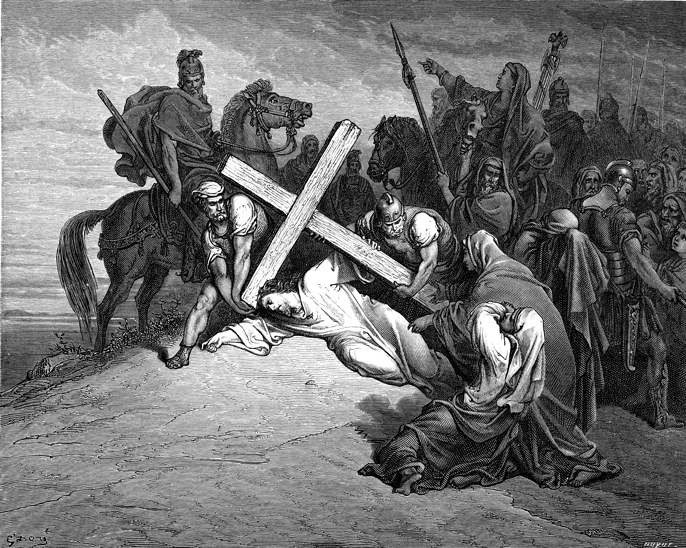
Right after Peter’s confession that Jesus is the Christ, and right after Jesus’s first plain word that He must suffer and die (which Peter rebukes Him for), Jesus turns and answers the rebuke by handing the cross to every disciple in the crowd. Not a symbol yet. A cross, in that world, was a condemned man’s one-way walk under Roman occupation. Jesus tells people who have never been sentenced to pick one up anyway, on purpose, before anyone forces it on them.
El Greco, Christ Carrying the Cross, c. 1580. Public domain.
Summary
This page reads the saying in Matthew, Mark, and Luke side by side, explains what carrying a cross actually meant in that world, and traces the same command into Paul's own letters.
- Matthew, Mark, and Luke are set in three columns to show what each Gospel adds
- A cross was a condemned man's own walk to execution: Jesus hands it to people who haven't been sentenced
- Luke alone adds 'daily,' turning a single crisis decision into an ordinary, repeated posture
- The exchange question, a soul for the whole world, is treated as a trade with no answer that makes sense
- Paul lives inside the same command in Galatians 2:20 and Romans 12:1
The Text
Matthew 16:24-26
Then Jesus told His disciples, “If anyone wants to come after Me, he must deny himself and take up his cross and follow Me.Deny yourself, take up your cross, follow: three commands, one summons.
For whoever wants to save his life will lose it, but whoever loses his life for My sake will find it. What will it profit a man if he gains the whole world, yet forfeits his soul? Or what can a man give in exchange for his soul?The exchange logic: no rate makes trading a soul for the whole world sane.
Jesus speaks these words right after Peter’s confession, “Thou art the Christ” (16:16), and right after His own first plain word that He must go to Jerusalem, suffer, and be killed (16:21), which Peter takes Him aside and rebukes Him for (16:22). The cross-saying is Jesus’s answer to that rebuke. A suffering, dying Messiah is hard news for Peter; what follows is harder news still for everyone who wants to follow Him.
The Three Calls
Matthew, Mark, and Luke keep the same sentence: read them side by side
WHO WAS LISTENING
His disciples
“Then Jesus told His disciples…”
THE CALL
- 1deny himself
- 2take up his cross
- 3follow Me
at Caesarea Philippi: moments after Peter's confession, and Peter's protest
WHO WAS LISTENING
the crowd, with His disciples
“Then Jesus called the crowd to Him along with His disciples…”
THE CALL
- 1deny himself
- 2take up his cross
- 3follow Me
Mark widens the room: this call was never for the Twelve alone
WHO WAS LISTENING
all of them
“Then Jesus said to all of them…”
THE CALL
- 1deny himself
- 2take up his crossDAILY
- 3follow Me
Luke adds the one word that moves the cross from a moment to a manner of life
What He Is Saying
a cross before it was jewelry
A cross today is a piece of jewelry or a shape on a steeple. In Jesus’s world it was neither. Crucifixion was a specific, deliberately public and prolonged Roman method of execution, reserved chiefly for slaves, pirates, rebels, and the lowest-status criminals. The condemned man customarily carried the crossbeam himself through the streets to the execution site, the very picture “take up his cross” puts in front of His hearers: a man already sentenced, hauling the instrument of his own death past a jeering crowd, on a walk with no way back. Jesus’s first-century Jewish audience, living under Roman occupation, did not need this explained to them the way a reader today does. He is telling people who have not been arrested or sentenced to pick up that walk voluntarily, before any soldier ever requires it of them.
Three Gospels, one command: what each addsMatthew, Mark, Luke
Matthew and Mark both put the saying to “his disciples”, but Mark is explicit that Jesus “called the people unto him with his disciples also” (Mark 8:34), widening the audience from the Twelve to the whole crowd. Mark also extends the saying with a sharper warning: whoever is ashamed of Jesus “in this adulterous and sinful generation,” of him the Son of Man will be ashamed when He comes in His Father’s glory.
Luke's one added word: dailykath' hēmeran
Luke alone adds a word: “let him deny himself, and take up his cross daily, and follow me” (Luke 9:23). The Greek is kath’ hēmeran, not a single crisis decision but a repeated, everyday posture. Matthew and Mark’s wording alone could be read as describing one dramatic, once-for-all moment; Luke’s “daily” makes plain the cross is the shape of ordinary discipleship, not only its extreme case. Textually, “daily” is itself debated (some manuscripts and versions omit it), but it is Luke’s own reading of the saying either way.
If anyone is ashamed of Me and My words in this adulterous and sinful generation, the Son of Man will also be ashamed of him when He comes in His Father’s glory with the holy angels.”The audience widens to the crowd, and the warning sharpens.
Then Jesus said to all of them, “If anyone wants to come after Me, he must deny himself and take up his cross daily and follow Me.The same summons, with one word added: daily.
Then comes the question no exchange rate can answer: “For what is a man profited, if he shall gain the whole world, and lose his own soul? or what shall a man give in exchange for his soul?” A soul is not a commodity with a market price: there is nothing on offer, anywhere, that a man could trade back for it once it is gone.
The Voices on Matthew
the church hears Matthew 16:24-26
Should we not consider all crosses, all things grievous to flesh and blood, as what they really are, as opportunities of embracing God's will at the expense of our own? And consequently as so many steps by which we may advance toward perfection? We should make a swift progress in the spiritual life, if we were faithful in this practice.
John Wesley · Explanatory Notes upon the New Testament (1755), Matt 16:24
For whosoever will save--is minded to save, or bent on saving. his life shall lose it, and whosoever will lose his life for my sake shall find it--(See on Mt 10:38,39). "A suffering and dying Messiah liketh you ill; but what if His servants shall meet the same fate?
Jamieson, Fausset & Brown · Commentary Critical and Explanatory on the Whole Bible (1871), Matt 16:25
Lose his own soul - Or, lose his life, την ψυχην αυτου. On what authority many have translated the word ψυχη, in the 25th verse, life, and in this verse, soul, I know not, but am certain it means life in both places. If a man should gain the whole world, its riches, honors, and pleasures, and lose his life, what would all these profit him, seeing they can only be enjoyed during life? But if the words be applied to the soul, they show the difficulty - the necessity - and importance of salvation.
Adam Clarke · Commentary on the Bible (1832), Matt 16:26
The Voices on Mark
the church hears Mark 8:34-38
If you wish to be the Lord's disciple, it is necessary you "take your cross, and follow the Lord: " your cross; that is, your own straits and tortures, or your body only, which is after the manner of a cross.
Tertullian · On Idolatry (220), Mark 8:34
And when he called the people - To hear a truth of the last importance, and one that equally concerned them all. Let him deny himself - His own will, in all things small and great, however pleasing, and that continually: And take up his cross - Embrace the will of God, however painful, daily, hourly, continually. Thus only can he follow me in holiness to glory.
John Wesley · Explanatory Notes upon the New Testament (1755), Mark 8:34
Turn, rather, to these teachings, my very dear friend: take up your cross and follow the Lord. For, when I noticed that you were being slowed down in your divine purpose by your preoccupation with domestic cares, I felt that you were being carried and dragged along by your cross rather than that you were carrying it. What else does the cross mean than the mortality of this flesh? This is our very own cross which the Lord commands us to carry that we may be as well armed as possible in following him. We suffer momentarily until death is swallowed up in victory. Then this cross itself will be crucified. The cross will be nailed to the fear of God. We would hardly be able to carry it now if it forever resisted us with free and unfettered limbs. There is no other way for you to follow the Lord except by carrying it, for how can you follow him if you are not his?
Augustine of Hippo · Letter 243, To Laetus (430), on Mark 8:34
For we deny ourselves, when we avoid what we were of old, and strive to reach that point, whither we are newly called. And the cross is taken up by us, when either our body is pained by abstinence, or our soul afflicted by fellow-feeling for our neighbour.
Bede · Catena Aurea by Aquinas (1264), on Mark 8:34
Are we invited by the words and works of Christ to follow him? Let us sit down, and count the cost, whether we can prefer our advantages by Christ before life itself, whether we can bear to think of losing our life for Christ's sake and the gospel's.
Matthew Henry · Commentary on the Whole Bible (1710), Mark 8:35
For this purpose the disciples of Christ must be bold and courageous, that they may be always ready for martyrdom. Now confession of Christ, though it is regarded by the greater part of men as a trifling matter, is here represented to be a main part of divine worship, and a distinguished exercise of godliness.
John Calvin · Commentaries (1554), Mark 8:38
The Voices on Luke
the church hears Luke 9:23-26
Now a desire of suffering death for Christ and a mortification of one's members which are upon the earth, and a manful resolution to undergo any danger for Christ, and an indifference towards the present life, this it is to take up one's cross. Hence it is added, And let him take up his cross daily.
Basil of Caesarea · Catena Aurea by Aquinas (1264), on Luke 9:23
Even though one has wealth and abundance of possessions, yet what profit has he from them when he has lost himself? Treasures profit not the wicked, but the fashion of this world passes away; and like clouds those pleasures recede, and riches fly away from those that possess them. But righteousness delivers from death.
Cyril of Alexandria · Commentary on Luke, Homily 50 (444), on Luke 9:25
Where It Points
the same cross carried elsewhere in the New Testament
I have been crucified with Christ, and I no longer live, but Christ lives in me. The life I live in the body, I live by faith in the Son of God, who loved me and gave Himself up for me.“I am crucified with Christ”: Paul takes up the same cross, in the first person.
Therefore I urge you, brothers, on account of God’s mercy, to offer your bodies as living sacrifices, holy and pleasing to God, which is your spiritual service of worship.The daily cross, restated as a daily, living sacrifice.
Paul never met Jesus before the resurrection, but he inherited this exact command and lived inside it. “I am crucified with Christ: nevertheless I live; yet not I, but Christ liveth in me” (Gal 2:20) is Matthew 16:24 in the first person. “Present your bodies a living sacrifice” (Rom 12:1) is Luke’s “daily” put a different way: a sacrifice offered once stays on the altar; a living sacrifice has to climb back on every day.
Closing
“Take up his cross” was never a metaphor for inconvenience. It was the most feared word an occupied people knew, and Jesus handed it to His followers on purpose, before any of them were forced to carry one. What He asks for is not admiration from a safe distance but a life laid down (daily, not once) in exchange for the one thing no other exchange can buy back.
Keep studying
Read it1
By subject
Obedience9 pages
The Gospels68 pages
On this page
Symbols1