
Daniel 10 to Revelation 12 · Person · Featured Study
Michael the archangel
The angel Daniel calls the great prince who stands watch over Israel.
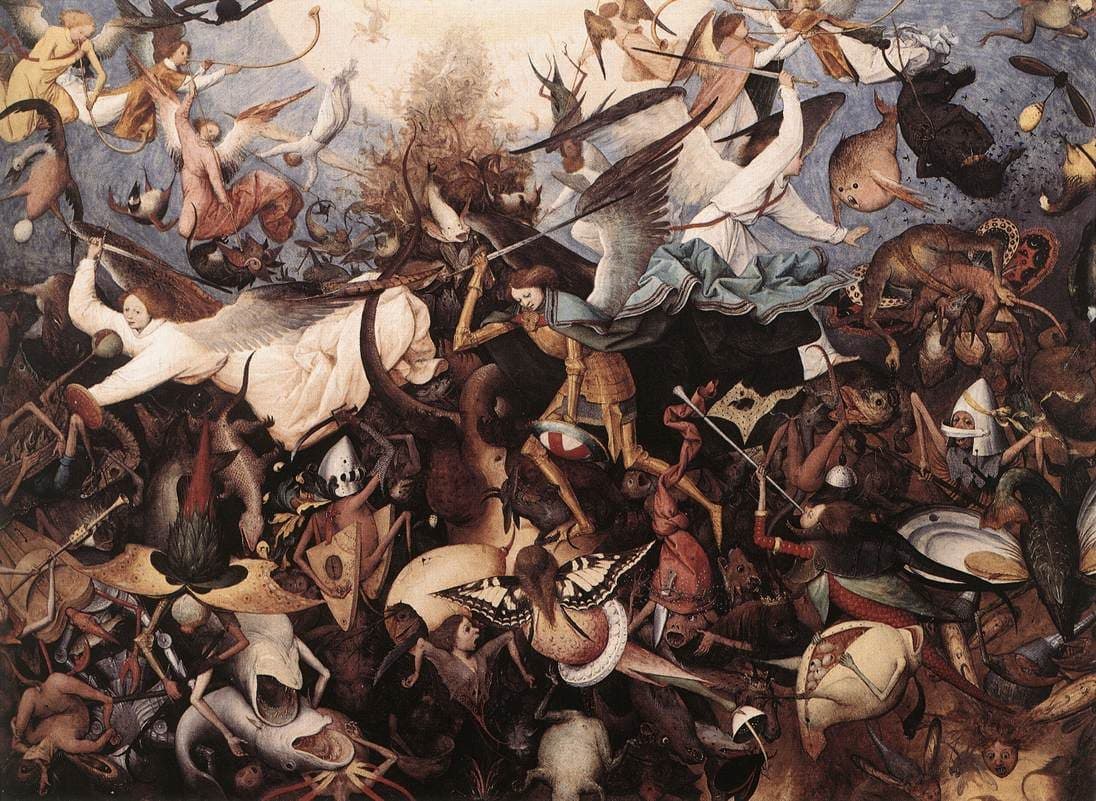
Pieter Bruegel the Elder, The Fall of the Rebel Angels, 1562. Public domain, via Wikimedia Commons.
THE ARTWORKBruegel painted the war in heaven as a rout: the armoured angel at the centre and his companions drive the rebels down, and the rebels turn into monsters as they fall.
Michael speaks once in Scripture, and the words he speaks are the LORD's.
Summary
Michael is one of the two holy angels Scripture names; Gabriel is the other.
- Origen traced Jude's scene of the dispute over the body of Moses to a treatise called The Ascension of Moses.
- Jewish tradition ranks him above Gabriel, and by the eighth century the church kept his feast on 29 September.
- The Talmud and the early fathers read him as an angel; Calvin read Daniel's great prince as Christ.
Where Michael Stands in Scripture
Fifteen verses carry the name, and five of them name the angel
Three of the five are in Daniel, one is in Jude and one is in Revelation. The other ten name men called Michael, such as the father of Sethur, the spy sent from the tribe of Asher.
“At that time Michael, the great prince who stands watch over your people, will rise up. There will be a time of distress, the likes of which will not have occurred from the beginning of nations until that time. But at that time your people—everyone whose name is found written in the book—will be delivered.Only here does Daniel call Michael the great prince, and he sets Michael's rising in the time of the end.
But even the archangel Michael, when he disputed with the devil over the body of Moses, did not presume to bring a slanderous charge against him, but said, “The Lord rebuke you!”Even the highest angel defers to the Lord's judgment when he faces the devil.
Michael in Five Verses
Daniel gives him three titles of prince, Jude calls him the archangel, and Revelation gives him angels of his own
| Title | What he does | Verse |
|---|---|---|
| One of the chief princes | Comes to help the angel the prince of Persia opposed | Daniel 10:13 |
| Your prince | Stands alone with the angel against the princes of the nations | Daniel 10:21 |
| The great prince | Rises up for Daniel's people in a time of distress | Daniel 12:1 |
| The archangel | Will not slander even the devil | Jude 1:9 |
| Michael and his angels | Fight the dragon, who is hurled down | Revelation 12:7 |
- What he does
- Comes to help the angel the prince of Persia opposed
- Verse
- Daniel 10:13
- Title
- Your prince
- What he does
- Stands alone with the angel against the princes of the nations
- Verse
- Daniel 10:21
- Title
- The great prince
- What he does
- Rises up for Daniel's people in a time of distress
- Verse
- Daniel 12:1
- Title
- The archangel
- What he does
- Will not slander even the devil
- Verse
- Jude 1:9
- What he does
- Fight the dragon, who is hurled down
- Verse
- Revelation 12:7
From Daniel to Revelation
Three scenes: Daniel's vision, Jude's warning and the war in heaven
Daniel's last vision comes in the third year of Cyrus king of Persia, after the exiles' return had begun.
However, the prince of the kingdom of Persia opposed me for twenty-one days. Then Michael, one of the chief princes, came to help me, for I had been left there with the kings of Persia.Daniel's answer waits on a struggle in the unseen world, and Michael's coming ends the delay.
“Do you know why I have come to you?” he said. “I must return at once to fight against the prince of Persia, and when I have gone forth, behold, the prince of Greece will come. But first I will tell you what is inscribed in the Book of Truth. Yet no one has the courage to support me against these, except Michael your prince.Michael is the one ally the angel names in this conflict.
Jude's warning about slanderJude 1:8 to 10
Jude sets Michael beside the false teachers who slander glorious beings, and Second Peter makes the same point of the angels.
So Moses the servant of the LORD died there in the land of Moab, as the LORD had said. And He buried him in a valley in the land of Moab facing Beth-peor, and no one to this day knows the location of his grave.Moses' grave is hidden from every man, and Jude sets Michael's dispute with the devil over this body.
Then the angel showed me Joshua the high priest standing before the angel of the LORD, with Satan standing at his right hand to accuse him. And the LORD said to Satan: “The LORD rebukes you, Satan! Indeed, the LORD, who has chosen Jerusalem, rebukes you! Is not this man a firebrand snatched from the fire?”Michael's answer to the devil in Jude is the answer the LORD gives Satan the accuser in Zechariah's vision.
The war in heavenRevelation 12:7 to 11
The war stands between the child caught up to God's throne and the dragon's pursuit of the woman. John Wesley, in 1755, read it as the end of Satan's accusing the saints before God.
Then a war broke out in heaven: Michael and his angels fought against the dragon, and the dragon and his angels fought back. But the dragon was not strong enough, and no longer was any place found in heaven for him and his angels. And the great dragon was hurled down—that ancient serpent called the devil and Satan, the deceiver of the whole world. He was hurled to the earth, and his angels with him.Revelation is the last book to name Michael, and it sets him at the head of God's side in the conflict.
And I heard a loud voice in heaven saying: “Now have come the salvation and the power and the kingdom of our God, and the authority of His Christ. For the accuser of our brothers has been thrown down—he who accuses them day and night before our God. They have conquered him by the blood of the Lamb and by the word of their testimony. And they did not love their lives so as to shy away from death.The verses after the battle say what Michael's victory means for the saints the dragon charged.
What the Text Says of Him
Two points often missed, each with its verse
ONLY MICHAEL BEARS THE TITLE ARCHANGEL
The word stands twice in Scripture, and only Jude names the one it means.
HIS NAME ASKS MOSES' QUESTION
The lexicon reads the name as Who is like God?, the question Moses and the Israelites sang at the sea: Who among the gods is like You, O LORD?
The World Behind the Text
Persia, the princes of the nations, and what Jewish and church tradition add
Jerome, in his Commentary on Daniel, read the prince of Persia as the angel to whom Persia was committed. He tied it to Deuteronomy 32:8, where the Most High set the boundaries of the peoples according to the number of the sons of God.
Jewish writing outside Scripture names more angels than the Bible does. The book of 1 Enoch lists seven holy angels who watch, Michael among them, set over the best part of mankind.
Michael in the TalmudBerakhot 4b, Bava Metzia 86b, Yoma 37a, Chagigah 12b
The Babylonian Talmud ranks Michael above Gabriel: Michael reaches his task in one flight, Gabriel in two.
It names the three visitors at Abraham's tent as Michael, Gabriel and Raphael, with Michael the greatest of the three, and it places Michael, the great minister, at the altar of the heavenly temple.
Michael in the church's calendarThe sacramentaries
The Leonine Sacramentary of the sixth century keeps a feast of a church of the angel on 30 September. The Gregorian Sacramentary of the eighth century keeps the dedication of Saint Michael on 29 September.
The Catholic Encyclopedia of 1911 names four offices tradition gives him: to fight Satan, to rescue the souls of the faithful, to champion God's people, and to bring the souls of the dead to judgment.
Questions About Michael
Each answered from its verse and its witnesses
Where did Jude learn of the dispute over Moses' body?Jude 1:9
Scripture records no such dispute before Jude. Origen, in On First Principles, says the scene stands in a little treatise called The Ascension of Moses, which Jude mentions in his letter.
John Wesley wrote that it does not appear whether Jude learned it by revelation or from ancient tradition. Albert Barnes says the verse has perplexed expositors more than any other part of the letter, and Jamieson, Fausset and Brown hold that Jude, being inspired, could tell what in the tradition was true.
Is there one archangel or several?1 Thessalonians 4:16
Wesley held that whether there is one archangel or more, it is not possible for us to determine. Jamieson, Fausset and Brown held that Scripture never uses the plural and knows one archangel.
For the Lord Himself will descend from heaven with a loud command, with the voice of an archangel, and with the trumpet of God, and the dead in Christ will be the first to rise.This verse uses the word archangel without naming the angel, so it leaves the number open.
What the Text Leaves Unsaid
Where the five verses stop
Scripture does not give the devil's reason for disputing over the body of Moses, and it gives the burial in Moab to the LORD. It does not say that Michael outranks Gabriel.
It gives him no appearance and does not say he weighs souls. It does not name him as the commander of the LORD's army who met Joshua.
Where Michael Points
Hebrews 1 gives the throne to the Son alone
In Daniel and in Revelation, Michael fights under the LORD for His people.
Yet to which of the angels did God ever say: “Sit at My right hand until I make Your enemies a footstool for Your feet”? Are not the angels ministering spirits sent to serve those who will inherit salvation?Michael, for all his rank, is among the angels God sends out to serve.
Voices on Michael
Two teachers in their own words, from the second century and the sixth
“And the great and glorious angel Michael is he who has authority over this people, and governs them; for this is he who gave them the law into the hearts of believers.”
Shepherd of Hermas · Shepherd of Hermas, Similitude 8 · on Revelation 12:7Patristic
“Michael indeed means ‘Who is like God.’ And whenever something of wondrous power is accomplished, Michael is said to be sent, so that from the act itself and the name it may be understood that no one can do what God is able to do.”
Gregory the Dialogist · Forty Gospel Homilies, Homily 34 · on Revelation 12:7Patristic
Who Is Michael?
Matthew Henry, in 1710, set two readings side by side
The first reading takes Michael for a created angel, the chief of the angels. The Babylonian Talmud and the fathers Hermas and Hippolytus read him so, and so do Jamieson, Fausset and Brown. Hippolytus, early in the third century, names Michael the angel given to Israel in Exodus 33. Its strongest objection, in the second reading's terms, is that Daniel's great prince does for the elect what Christ does.
The second reading takes Michael for Christ. Its strongest objection, in the first reading's terms, is that Paul sets the voice of an archangel beside the Lord's own descent, and that Daniel calls Michael one of the chief princes. Calvin, in his commentary on Daniel, held it.
“But if it seems better to understand Michael as the archangel, this sense will prove suitable, for under Christ as the head, angels are the guardians of the Church. Whichever be the true meaning, God was the preserver of his Church by the hand of his only-begotten Son, and because the angels are under the government of Christ, he might entrust this duty to Michael.”
John Calvin · Commentaries · on Daniel 12:1Reformed
Books to Read Next
Five works, each free to read
Commentaries on the Book of the Prophet Daniel
John Calvin · sixteenth century (Thomas Meyers' translation)
The second of two volumes holds his notes on Daniel 10 to 12.
Read at CCELExplanatory Notes upon the New Testament
John Wesley · 1755
Wesley wrote short notes on every book of the New Testament, Jude and Revelation among them.
Read at CCELCommentary Critical and Explanatory on the Whole Bible
Robert Jamieson, A. R. Fausset and David Brown · 1871
The three authors wrote a commentary on the whole Bible, verse by verse.
Read at CCELOn First Principles
Origen · 1885 (Frederick Crombie's translation)
The passage on Jude's scene stands in Book III, chapter 2, section 1.
Read at New AdventThe Book of Enoch
R. H. Charles, translator · 1917
Charles translated the whole book, and W. O. E. Oesterley wrote its introduction.
Read at the Internet ArchiveThe Victory of the Lamb
Michael's name asks who is like God, and Revelation 12 answers with the Lamb.
Michael wins the war in heaven, yet the loud voice after it says the brothers conquered the accuser by the blood of the Lamb.
Keep studying
Read it4
Studies7
People3
Symbols1