
Lamentations 1 to 5 · Passage · Featured Study
The Qinah, the Rhythm of the Hebrew Lament
Five poems over fallen Jerusalem, four of them set in the order of the Hebrew letters.
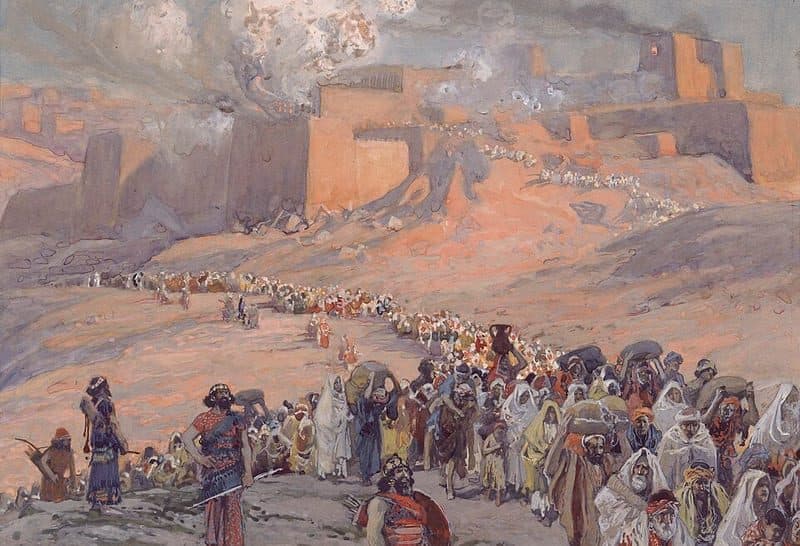
James Tissot, The Flight of the Prisoners, about 1896. Public domain, via Wikimedia Commons.
THE ARTWORKTissot painted the people of Jerusalem driven out as captives while smoke rises over the city behind them. Lamentations mourns that road in its third verse, where Judah has gone into exile.
In a Hebrew lament a long line is answered by a shorter one.
Summary
Qinah is the Hebrew word for a dirge, the song sung over the dead, and Lamentations mourns a city in that form.
- Lamentations 1, 2 and 4 open on the cry 'eikhah, How!
- Chapter 3 runs three verses to each letter of the alphabet.
- David, Amos and Ezekiel each take up a lament over the fallen.
- Readers differ over whether the long and short lines keep a true measure.
How Lonely Lies the City
The name of the dirge and the cry that opens the book
The word qinah stands eighteen times in the Hebrew Scriptures, and the verb from the same root, qun, means to chant a dirge.
How lonely lies the city, once so full of people! She who was great among the nations has become a widow. The princess of the provinces has become a slave.The book opens by mourning a city in the words used for a bereaved woman.
How the Lord has covered the Daughter of Zion with the cloud of His anger! He has cast the glory of Israel from heaven to earth. He has abandoned His footstool in the day of His anger.The second poem traces the ruin to God's own hand.
How the gold has become tarnished, the pure gold has become dull! The gems of the temple lie scattered on every street corner.The tarnished gold is the sons of Zion, as the next verse says.
“Your glory, O Israel, lies slain on your heights. How the mighty have fallen!David's lament for Saul opens its refrain with the short form of the cry, 'eikh.
The Long Line and Its Answer
Amos 5:2 and Lamentations 1:1 and 3:1
| Verse | The longer part | The shorter answer | Hebrew words |
|---|---|---|---|
| Amos 5:2 | nafelah lo-tosif qum | betulat yisra'el | 3 and 2 |
| Lamentations 1:1 | 'eikhah yashvah vadad ha'ir | rabbati 'am | 4 and 2 |
| Lamentations 3:1 | 'ani haggever ra'ah 'oni | beshevet 'evrato | 4 and 2 |
- Verse
- Amos 5:2
- The longer part
- nafelah lo-tosif qum
- The shorter answer
- betulat yisra'el
- Hebrew words
- 3 and 2
- Verse
- Lamentations 1:1
- The longer part
- 'eikhah yashvah vadad ha'ir
- The shorter answer
- rabbati 'am
- Hebrew words
- 4 and 2
- Verse
- Lamentations 3:1
- The longer part
- 'ani haggever ra'ah 'oni
- The shorter answer
- beshevet 'evrato
- Hebrew words
- 4 and 2
Five Poems and One Alphabet
The shape of Lamentations, chapter by chapter
| Chapter | Verses | The alphabet | First word |
|---|---|---|---|
| 1 | 22 | One verse to each letter, ayin before pe | 'eikhah, How! |
| 2 | 22 | One verse to each letter, pe before ayin | 'eikhah, How! |
| 3 | 66 | Three verses to each letter, pe before ayin | 'ani, I |
| 4 | 22 | One verse to each letter, pe before ayin | 'eikhah, How! |
| 5 | 22 | Twenty-two verses in no alphabetic order | zekhor, Remember |
- Chapter
- 1
- Verses
- 22
- The alphabet
- One verse to each letter, ayin before pe
- First word
- 'eikhah, How!
- Chapter
- 2
- Verses
- 22
- The alphabet
- One verse to each letter, pe before ayin
- First word
- 'eikhah, How!
- Chapter
- 3
- Verses
- 66
- The alphabet
- Three verses to each letter, pe before ayin
- First word
- 'ani, I
- Chapter
- 4
- Verses
- 22
- The alphabet
- One verse to each letter, pe before ayin
- First word
- 'eikhah, How!
- Chapter
- 5
- Verses
- 22
- The alphabet
- Twenty-two verses in no alphabetic order
- First word
- zekhor, Remember
Matthew Henry, in his Commentary on the Whole Bible, noted that chapters 1 and 2 run in long verses and chapter 3 in short ones. Adam Clarke, in his Commentary on the Bible, suggested that so technical a form was not thought proper in the agony of the last prayer.
Clarke also held that Lamentations 2:16 and 2:17 should change places to restore the usual order of the alphabet.
Remember, O LORD, what has happened to us. Look and see our disgrace!The last poem turns from lament to prayer and asks the LORD to see His people's disgrace.
Restore us to Yourself, O LORD, so we may return; renew our days as of old, unless You have utterly rejected us and remain angry with us beyond measure.The book ends on a plea to be restored and the fear that the LORD has rejected them.
Laments Elsewhere in Scripture
2 Samuel 1, Amos 5 and Ezekiel 19, 27 and 32
Then David took up this lament for Saul and his son Jonathan, and he ordered that the sons of Judah be taught the Song of the Bow. It is written in the Book of Jashar:The song is named a qinah in Hebrew and was kept in the Book of Jashar.
How the mighty have fallen and the weapons of war have perished!”The refrain How the mighty have fallen closes the song as it opened it.
Hear this word, O house of Israel, this lamentation I take up against you:Amos names his word to the northern kingdom a qinah.
Fire has gone out from its main branch and devoured its fruit; on it no strong branch remains fit for a ruler’s scepter.’ This is a lament and shall be used as a lament.”Ezekiel's lament for Israel's princes is given to be used as a lament afterward.
“Now you, son of man, take up a lament for Tyre.The lament is turned on Tyre, a city outside Israel.
“Son of man, take up a lament for Pharaoh king of Egypt and say to him: ‘You are like a lion among the nations; you are like a monster in the seas. You thrash about in your rivers, churning up the waters with your feet and muddying the streams.’Pharaoh is mourned with a dirge while he still reigns.
The Mourners and the Fall
Jeremiah 9, 2 Chronicles 35, 2 Kings 25 and Lamentations 2
This is what the LORD of Hosts says: “Take note, and summon the wailing women; send for the most skillful among them. Let them come quickly and take up a lament over us, that our eyes may overflow with tears, and our eyelids may gush with water.The LORD Himself orders a lament before the ruin has come.
“Let those therefore do it now whose trade it is. Or, rather, it intimates the extreme sottishness and stupidity of the people, that laid not to heart the judgments they were under, nor, even when there was so much blood shed, could find in their hearts to shed a tear.”
Matthew Henry · Commentary on the Whole Bible · on Jeremiah 9:18Puritan
Now, O women, hear the word of the LORD. Open your ears to the word of His mouth. Teach your daughters to wail, and one another to lament.The skill of mourning passes from one generation of women to the next.
Then Jeremiah lamented over Josiah, and to this day all the choirs of men and women sing laments over Josiah. They established them as a statute for Israel, and indeed they are written in the Book of Laments.Laments for a king were sung by choirs in the Chronicler's day and written down.
On the seventh day of the fifth month, in the nineteenth year of Nebuchadnezzar’s reign over Babylon, Nebuzaradan captain of the guard, a servant of the king of Babylon, entered Jerusalem. He burned down the house of the LORD, the royal palace, and all the houses of Jerusalem—every significant building.The history gives the day that Lamentations remembers.
The Lord has rejected His altar; He has abandoned His sanctuary; He has delivered the walls of her palaces into the hand of the enemy. They have raised a shout in the house of the LORD as on the day of an appointed feast.The poem mourns the same loss from inside the city.
What the Text Leaves Unsaid
The measure, the author and the reason for the alphabet
No verse names a measure for a lament or counts its stresses.
Lamentations names no author.
The book gives no reason for setting its poems to the alphabet.
Mercies New Every Morning
Lamentations 3:22 to 33
Albert Barnes calls verses 22 to 42 of the third poem the centre of the whole series of laments. Charles Spurgeon, in his sermon The Novelties of Divine Mercy, said that when the prophet remembers the mercy of God he takes his harp from the willows and sings.
Because of the loving devotion of the LORD we are not consumed, for His mercies never fail. They are new every morning; great is Your faithfulness!The poet holds to the LORD's loving devotion while the city lies in ruins.
For the Lord will not cast us off forever. Even if He causes grief, He will show compassion according to His abundant loving devotion. For He does not willingly afflict or grieve the sons of men.The grief is real, and the Lord's compassion outlasts it.
Voices on the Lament
Three voices, from Jerome to Albert Barnes
JeromeTranslator of the Latin Bible, on the four alphabets
“As for Isaiah, Jeremiah, Ezekiel and Daniel, who can fully understand or adequately explain them? The first of them seems to compose not a prophecy but a gospel. The second speaks of a rod of an almond tree and of a seething pot with its face toward the north, and of a leopard that has changed its spots. He also goes four times through the alphabet in different meters.”
Jerome · LETTER 53.8 · on Lamentations 1:1 to 2Patristic
John CalvinReformer of Geneva, on the man of chapter 3
“Jeremiah, then, does not here plead his own private cause, but shews to his own nation what remedy there was for them in such a state of despair, even to have an immediate recourse to God, and on the one hand to consider their sins, and on the other to look to the mercy of God, so that they might entertain hope, and exercise themselves in prayer.”
John Calvin · Commentaries · on Lamentations 3:1Reformed
Albert BarnesPresbyterian commentator of Philadelphia, on the dirge of Amos
“In order to impress Israel the more, Amos begins this his third appeal by a ‘dirge’ over its destruction, mourning over those who were full of joy, and thought themselves safe and enviable. As if a living man, in the midst of his pride and luxury and buoyant recklessness of heart, could see his own funeral procession, and hear, as it were, over himself the ‘earth to earth, ashes to ashes, dust to dust.’ It would give solemn thoughts, even though he should impatiently put them from him.”
Albert Barnes · Notes, Explanatory and Practical, on the Old and New Testaments (1832-1869) · on Amos 5:1Evangelical
Where Readers Differ
Two readings of the long and short lines, with their holders
The lines keep a measureJerome, Albert Barnes
Jerome holds this reading in his Letter 53, and Albert Barnes, in his Notes, wrote of the carefully studied rhythm of the original at Lamentations 5:4.
Against it, Jamieson, Fausset and Brown, who hold the second reading, set the sense of a line above any count.
The lines divide by their senseJamieson, Fausset and Brown, after Maurer
Jamieson, Fausset and Brown, in their Commentary Critical and Explanatory, follow Maurer and divide Lamentations 1:1 by the balance of its antithesis.
The objection comes from their own note: the King James translators divided the verse by the Hebrew accents.
Weep for Yourselves
Lamentations 2:19 and 3:40, Luke 19 and 23
Lamentations calls its hearers to pour out their hearts like water in the presence of the Lord.
On the road to the cross Jesus told the daughters of Jerusalem to weep for themselves and for their children.
As Jesus approached Jerusalem and saw the city, He wept over it and said, “If only you had known on this day what would bring you peace! But now it is hidden from your eyes.Christ Himself laments over Jerusalem, as this book does.
Let us examine and test our ways, and turn back to the LORD.The call to repent stands inside the lament, close to its centre.
Keep studying
Studies5
People9