
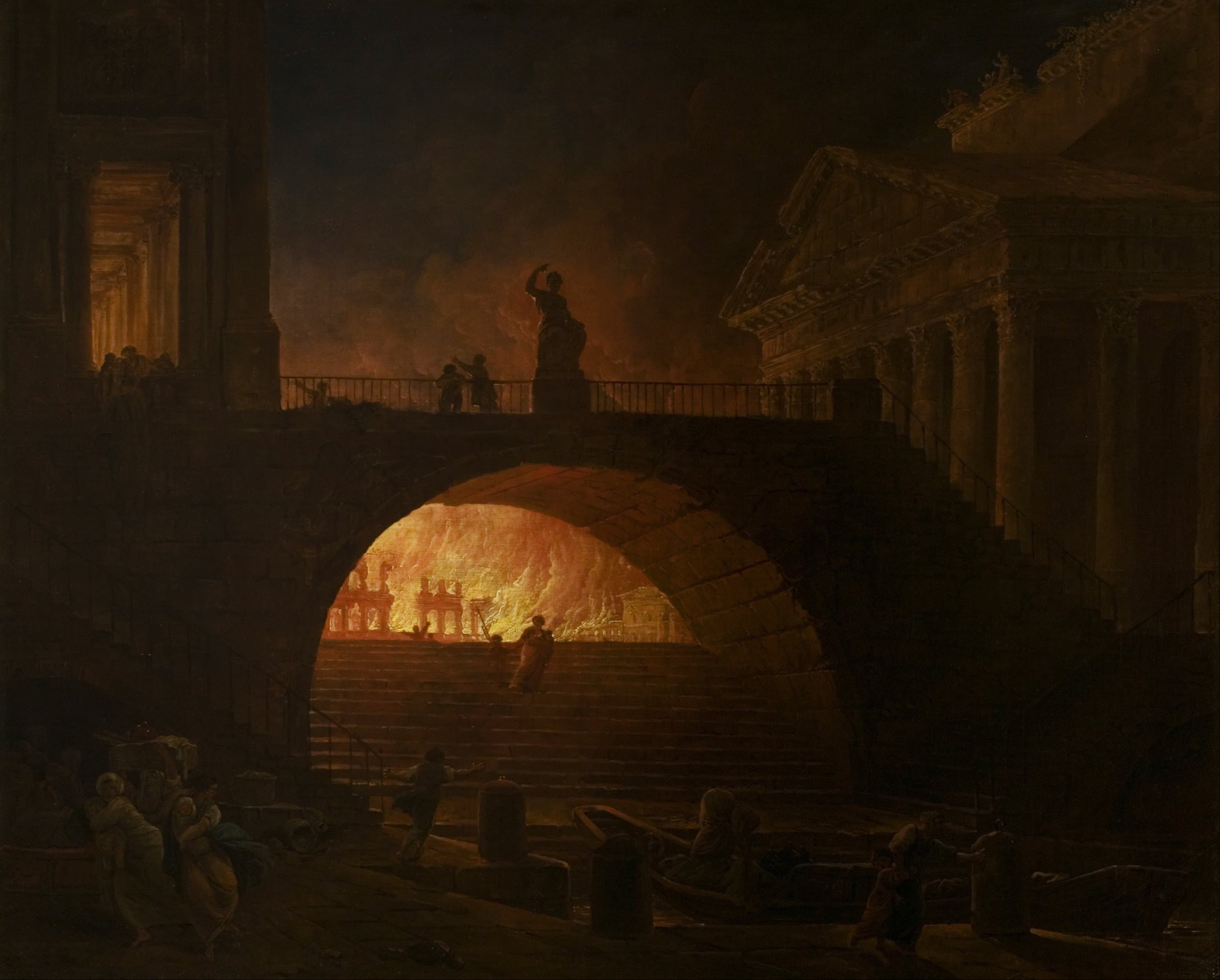
Hubert Robert, The Fire of Rome, 1785. Public domain.
AD 64 · Story · Featured Study
The Fire of Rome and Nero
Rome burned in July AD 64, and Nero had Christians put to death in his gardens.
- Where
- Rome
- Who
- Peter, Paul
- When
- July AD 64
The Roman historian who tells this story says the fire's cause is uncertain.
Beloved, do not be surprised at the fiery trial that has come upon you, as though something strange were happening to you.
Summary
The fire ended on the sixth day, with three of the city's fourteen districts levelled. Tacitus writes that Nero, to end the report that he had ordered it, put the blame on the Christians and had a great number of them killed. Later Christian writers remember Nero as the first emperor to persecute the church.
- Suetonius records the punishment of the Christians among Nero's laws, with no word of the fire.
- Tacitus names no apostle among the dead.
- Brent Shaw argues that the tie to the fire belongs to Tacitus's own day, and Christopher Jones answers him.
The Church at Rome Before the Fire
The texts come from Acts 28 and Philippians 1 and 4.
Acts closes with Paul at Rome. Philippians names believers in Caesar's household, and the New Testament tells nothing of the fire.
Paul stayed there two full years in his own rented house, welcoming all who came to visit him.Acts ends here, with no word of what became of Paul.
As a result, it has become clear throughout the whole palace guard and to everyone else that I am in chains for Christ.This verse stands here for the church that knew Paul's chains before the fire.
All the saints send you greetings, especially those from the household of Caesar.This verse stands here for the believers who served in the emperor's house.
Who Wrote of the Fire and the Christians
Three Roman historians and five Christian writers.
What each says of the fire and of the Christians.
| Witness | Of the fire | Of the Christians |
|---|---|---|
| Tacitus, Annals 15 | Began in the shops by the Circus. | Blamed for it, and put to death in great numbers. |
| Suetonius, Nero 16 and 38 | Nero set it openly. | Listed among Nero's measures, apart from the fire. |
| Cassius Dio, book 62 | Nero sent men to start it. | Not named. |
| 1 Clement 6, about 96 | Not named. | Many of the elect suffered, women among them. |
| Tertullian, Apology 5 | Not named. | Named Nero as the first persecutor. |
| Lactantius, Of the Manner in Which the Persecutors Died 2 | Not named. | Peter crucified and Paul slain by Nero. |
| Eusebius, Church History 2.25, about 324 | Not named. | Paul beheaded and Peter crucified under Nero. |
| Sulpicius Severus, Sacred History 2.29, about 400 | Rome burned while Nero was at Antium. | Nero turned the charge on them. |
Eusebius, Church History 2.25, about 324, Sulpicius Severus, Sacred History 2.29, about 400
The Fire and the Punishment, AD 64
From the shops by the Circus to the deaths in Nero's gardens, and after.
Tacitus dates the year by its consuls, Gaius Laecanius and Marcus Licinius, and says some observed that the fire began on 19 July. It started in the part of the Circus next to the Palatine and Caelian hills, among shops full of goods that burn.
Nero was at Antium and came back only when the fire drew near his own house. He opened the Campus Martius and his own gardens to the homeless and cut the price of corn, yet a rumour said he had sung of the fall of Troy while the city burned.
In the Latin the fire ended at the foot of the Esquiline "Sexto demum die", on the sixth day. Of the fourteen districts of Rome four stood whole, three were levelled, and in seven only a few half-burnt ruins were left.
To end the belief that the fire had been ordered, Tacitus writes, Nero put the guilt on a class the crowd called Christians. He names their founder, Christus, who was put to death under Tiberius by the procurator Pontius Pilate.
Those who confessed were seized first, and on their word "an immense multitude was convicted, not so much of the crime of firing the city, as of hatred against mankind."
Some were covered with the skins of beasts and torn by dogs, some were nailed to crosses, and some were burned as lights when the daylight had gone. Nero gave his gardens for the show and mixed with the crowd dressed as a charioteer.
But if you suffer as a Christian, do not be ashamed, but glorify God that you bear that name.This is the name the crowd at Rome gave the people Nero blamed.
1 Clement, written from Rome about 96, says Peter suffered martyrdom after many labours, and names no city.
Eusebius records that Peter was crucified under Nero, and Lactantius that Nero crucified Peter. No one who saw it wrote of it, and the year is not known.
Truly, truly, I tell you, when you were young, you dressed yourself and walked where you wanted; but when you are old, you will stretch out your hands, and someone else will dress you and lead you where you do not want to go.”The early church read this as the word of Peter's death, which Eusebius puts under Nero.
Eusebius records that Paul was beheaded at Rome itself. 1 Clement says Paul came to the extreme limit of the west and suffered martyrdom under the prefects.
Neither writer ties the death of Peter or of Paul to the fire.
For I am already being poured out like a drink offering, and the time of my departure is at hand.Paul wrote this from prison, and Eusebius says he was beheaded at Rome.
After Nero's death, Tacitus writes, many believed he was alive, and Suetonius says some set up his edicts as if he would soon return.
Augustine reports that some of his day thought Nero would rise again as Antichrist, and he wondered at the boldness of such guesses. Irenaeus, weighing names for the number of the beast, offered Evanthas, Lateinos and Teitan, and did not name Nero.
Here is a call for wisdom: Let the one who has insight calculate the number of the beast, for it is the number of a man, and that number is 666.This is the number Irenaeus tried to read as a name.
2 Timothy 4:6, Revelation 13:18
How the Key Verse Was Taught
Three writers of three centuries on 1 Peter 4:12.
Cyprian (died 258)
Treatise XI Exhortation to Martyrdom Addressed to Fortunatus
Cyprian of Carthage set this verse among the Scriptures he gathered for those facing death.
“That afflictions and persecutions arise for the sake of our being proved. In Deuteronomy, ‘The Lord your God proveth you, that He may know if ye love the Lord your God with all your heart, and with all your soul, and with all your strength.’ And again, Solomon: ‘The furnace proveth the potter's vessel, and righteous men the trial of tribulation.’ Paul also testifies similar things, and speaks, saying: ‘We glory in the hope of the glory of God.”
on 1 Peter 4:12Patristic
John Calvin (1509 to 1564)
Commentaries on the Catholic Epistles, on 1 Peter 4:12
John Calvin tied the verse to the believer's readiness for what is coming.
“For whosoever has resolved to fight under Christ's banner, will not be dismayed when persecution happens, but, as one accustomed to it, will patiently bear it.”
Reformed
John Wesley (1703 to 1791)
Explanatory Notes upon the New Testament
John Wesley gave the Greek word its literal sense, a burning.
“It seems to include both martyrdom itself, which so frequently was by fire, and all the other sufferings joined with, or previous to, it; which is permitted by the wisdom of God for your trial.”
on 1 Peter 4:12Evangelical
In Their Own Words
A Roman historian, the church at Rome and a writer of Carthage on Nero's victims.
Clement of Rome (died 99)
The First Epistle of Clement to the Corinthians, chapter 6
The women who suffered
“To these men who spent their lives in the practice of holiness, there is to be added a great multitude of the elect, who, having through envy endured many indignities and tortures, furnished us with a most excellent example. Through envy, those women, the Danaids and Dircæ, being persecuted, after they had suffered terrible and unspeakable torments, finished the course of their faith with stedfastness, and though weak in body, received a noble reward.”
Early Church
About this saying1 paragraph
The church at Rome, writing to Corinth late in the first century, about AD 96, set the women who died beside the apostles.
Tertullian (died 220)
Apology, chapter 5
The first to strike
“Consult your histories; you will there find that Nero was the first who assailed with the imperial sword the Christian sect, making progress then especially at Rome.”
Early Church
About this saying1 paragraph
Tertullian addressed his Apology to the Roman governors, and its editors date it to 198 or 204.
Tacitus
Annals 15.44
The pity of the crowd
“Hence, even for criminals who deserved extreme and exemplary punishment, there arose a feeling of compassion; for it was not, as it seemed, for the public good, but to glut one man's cruelty, that they were being destroyed.”
Roman historian
About this saying1 paragraph
Tacitus closed his account of the deaths of AD 64, in the first century, with the crowd's pity for those Nero killed.
Where Historians Disagree
Two questions of the fire and its record, with the writers who answer them.
Did Nero punish the Christians for the fire?2 paragraphs
Brent Shaw argued in 2015 that Tacitus is the only source for the event. He holds the passage "probably genuine Tacitus", but says it reflects the ideas of the historian's own time and "not the realities of the 60s."
Christopher Jones answered him in New Testament Studies that there are "no grounds for doubting Tacitus' report of the persecution". In his reply of 2018 Shaw granted some of Jones's criticisms and still judged a persecution tied to the fire improbable.
Is the sentence on Christus genuine?2 paragraphs
Richard Carrier argued in 2014 that the sentence naming Christ "should be considered suspect" as a later Christian addition. Shaw and Jones, who differ on the persecution, both read the passage as Tacitus's own.
The texts differ on one letter. The Latin Library prints "Chrestianos", while Fisher's Oxford text of 1906 and Furneaux's edition of 1907 print "Christianos".
Books to Read Next
The Roman and the Christian witnesses are free to read online.
The Annals of Tacitus
Tacitus, translated by Alfred John Church and William Jackson Brodribb · 1895
Tacitus tells the fire, Nero's rebuilding and the punishment of the Christians in book 15.
Free at the Internet ArchiveThe Ante-Nicene Fathers, volume 1
Edited by Alexander Roberts and James Donaldson · 1885
It holds 1 Clement, the letter of the church at Rome that names Peter, Paul and the women who suffered.
Free at the Christian Classics Ethereal LibraryWhat the Fire Left
Of the Christian writers in the table, only Sulpicius Severus, about 400, tells the fire itself.
Sources
Scripture is the Berean Standard Bible.
- The Holy Bible, Berean Standard Bible (read 2026)
- Tacitus, Annals 15.33 and 15.38 to 15.44, translated by A. J. Church and W. J. Brodribb (the Macmillan printing of 1895 and the Perseus reprint of 1942), with the Latin of The Latin Library, Fisher (Oxford, 1906) and Furneaux (1907), and the Loeb English (1937)
- Tacitus, Histories 2.8, translated by C. H. Moore, Loeb (1925)
- Suetonius, Lives of the Caesars, Nero 16.2, 38 and 57, translated by J. C. Rolfe, Loeb (1914), with the Latin.
- Cassius Dio, Roman History, the epitome of book 62, chapters 16 to 18, translated by Earnest Cary, Loeb (1925)
- 1 Clement 5 and 6, in The Ante-Nicene Fathers, volume 1 (1885)
- Tertullian, Apology 5, in The Ante-Nicene Fathers, volume 3 (1885)
- Eusebius, Church History 2.25, translated by A. C. McGiffert, Nicene and Post-Nicene Fathers, second series, volume 1 (1890)
- Lactantius, Of the Manner in Which the Persecutors Died, chapter 2, in The Ante-Nicene Fathers, volume 7 (1886)
- Sulpicius Severus, Sacred History 2.29, in the second series of the Nicene Fathers, volume 11.
- Irenaeus, Against Heresies 5.30.3, in The Ante-Nicene Fathers, volume 1 (1885)
- Augustine, The City of God 20.19, translated by Marcus Dods, Nicene and Post-Nicene Fathers, first series, volume 2.
- Brent D. Shaw, "The Myth of the Neronian Persecution", Journal of Roman Studies 105 (2015), pages 73 to 100, the abstract, and his "Response to Christopher Jones", New Testament Studies 64 (2018), the abstract.
- Christopher P. Jones, "The Historicity of the Neronian Persecution: A Response to Brent Shaw", New Testament Studies 63, pages 146 to 152, the abstract.
- Richard Carrier, "The Prospect of a Christian Interpolation in Tacitus, Annals 15.44", Vigiliae Christianae 68 (2014), pages 264 to 283, the abstract.
- Cyprian, Exhortation to Martyrdom, Addressed to Fortunatus.
- John Calvin, Commentaries on the Catholic Epistles, on 1 Peter 4:12.
- John Wesley, Explanatory Notes upon the New Testament (1755), on 1 Peter 4:12.
Keep Studying
Studies5
Trials of life1
Places1
Church history2
Doctrines2