
Chalcedon, AD 451 · Story · Featured Study
The Council of Chalcedon
The fourth council of the church, the formula it set, and the family of churches that kept another.
The judges put one question to the bishops: “Which would you follow, the most holy Leo or Dioscorus?”
- Where
- Chalcedon, Alexandria, Constantinople
- Who
- Leo, Dioscorus, Marcian, Severus
- When
- 8 October to 1 November AD 451 (probable)
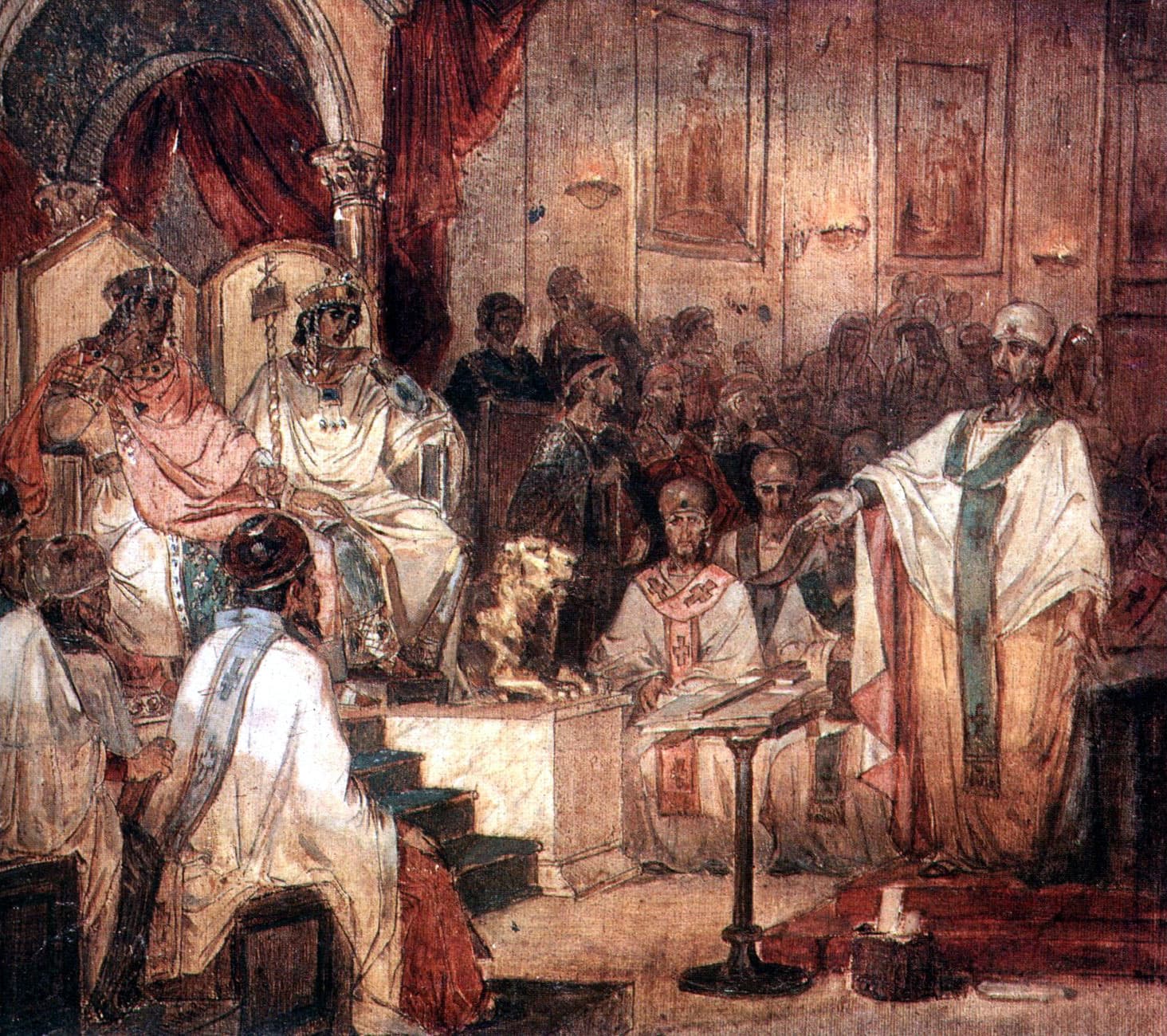
Vasily Surikov, The Fourth Ecumenical Council of Chalcedon, 1876. Public domain.
The Word became flesh and made His dwelling among us. We have seen His glory, the glory of the one and only Son from the Father, full of grace and truth.
Summary
In 451 the emperor Marcian called the bishops to Chalcedon. They undid the synod of 449 and deposed the patriarch of Alexandria. They confessed Christ in two natures, and the Oriental Orthodox churches did not receive the council.
- Leo, the bishop of Rome, wrote the letter the bishops hailed.
- The council's canon on New Rome split it from Rome.
- In 482 an emperor's letter of union set its formula aside.
The Texts Both Families Confess
Three verses both families confess.
Each family reads these verses of the one Christ, and the quarrel turned on the words for Him after the Word became flesh.
For in Christ all the fullness of the Deity dwells in bodily form.The fullness of the Deity in a body is the union both families confess.
For we do not have a high priest who is unable to sympathize with our weaknesses, but we have one who was tempted in every way that we are, yet was without sin.The Definition calls Him “made in all things like unto us, sin only excepted.”
For there is one God, and there is one mediator between God and men, the man Christ Jesus,It names the one mediator a man, the manhood the Definition confesses perfect.
Two Natures or One Nature Out of Two
Four questions, with the source of each answer named in the caption.
Both confess Christ true God and true man, and they part over one nature or two after the union.
| The question | The Definition and Leo | The Oriental Orthodox fathers |
|---|---|---|
| Is Christ true God and true man? | “perfect in Godhead and perfect in manhood, very God and very man” | Yes: of one essence with the Father and with us, as Severus confesses |
| One nature or two after the union? | “in two natures, unconfusedly, immutably, indivisibly, inseparably” | One nature out of two, as Severus confesses it |
| What of the council itself? | It holds the creed of the 318 of Nicaea “pre-eminent” | Philoxenus anathematized it as “agreeing with” Nestorius |
| What of the man Eutyches? | Leo calls him “very unwary and exceedingly ignorant” | They were “ready to condemn” the absorbing of the manhood, as Bethune-Baker records |
The Council Told Plainly, From the Tome to the Henoticon
A synod overturned, a patriarch deposed, a Definition, and a city in revolt.
The bishops met in the church of the martyr Euphemia at Chalcedon, called by the emperors Marcian and Valentinian. Schaff gives the opening as 8 October and the close as 1 November.
At the first session Leo's legate Lucentius asked that the sentence on Flavian of Constantinople, passed at Ephesus two years before, “should be turned back upon them.”
The sentence sent to Dioscorus of Alexandria says that on 13 October he was deposed “on account of your disregard of the divine canons, and of your disobedience to this holy and ecumenical synod.”
He had been called three times and had not come.
Leo of Rome had written his letter to Flavian, the Tome, on 13 June 449, on the two natures of Christ.
When it was read at the second session, the bishops cried, “Peter has spoken thus through Leo.”
Who, existing in the form of God, did not consider equality with God something to be grasped, but emptied Himself, taking the form of a servant, being made in human likeness.Leo's two forms are the form of God and the form of a servant.
The Definition declares that the faith of the Three Hundred and Eighteen fathers at Nicaea “shall be pre-eminent.” It calls Mary “the Mother of God according to his manhood.”
It confesses one Christ “in two natures, unconfusedly, immutably, indivisibly, inseparably [united].”
The angel replied, “The Holy Spirit will come upon you, and the power of the Most High will overshadow you. So the Holy One to be born will be called the Son of God.It stands beside the Definition's title for Mary, Mother of God according to his manhood.
Marcian came to the sixth session in person and addressed the council.
Its twenty-eighth canon gave the throne of New Rome “equal privileges” with Rome. Leo answered that what went against the canons of Nicaea “is ipso facto null and void.”
Evagrius's Ecclesiastical History tells that Dioscorus was sent to Gangra and Proterius was set over Alexandria. “A very great and intolerable tumult arose among the people.”
After Marcian died in 457, the Alexandrians raised Timothy Aelurus while Proterius still lived, and Proterius was killed in the baptistery. The report sent to the emperor Leo blames the crowd, and a Life of Peter that Evagrius cites blames a soldier.
that all of them may be one, as You, Father, are in Me, and I am in You. May they also be in Us, so that the world may believe that You sent Me.Jesus prayed that His people be one, the unity the city lost.
In 482 the emperor Zeno's letter of union, the Henoticon, admitted no creed but that of the 318 of Nicaea confirmed by the 150 of Constantinople. It anathematized any other opinion held “at Chalcedon or in any synod whatever.”
The Oriental Orthodox Churches
Their fathers' case, and the name others gave them.
Severus of Antioch answered a correspondent who held that those at Chalcedon divided Christ “by calling Him two natures after the union.”
Philoxenus of Mabbogh reasoned, in Budge's English of 1894, that because the Word who put on a body is one Person, His nature is one.
Behind them stands the formula one incarnate nature of the Divine Word, which Cyril of Alexandria received as Athanasius's. Bethune-Baker records that a writer of about 500 judged the creed that carries it to be the work of Apollinarius.
Shenouda III, the Coptic pope, writes that the name “Monophysites” given to them “has been intentionally or unintentionally misinterpreted.” These churches are the Oriental Orthodox.
Read The Oriental Orthodox Churches and the Church of the East
What the Record Leaves Unsaid
Three counts of the bishops, one witness to a remark, and two accounts of a death.
The number of bishops is not known. The synod's letter to Leo gives 520, Leo speaks of about 600, and Tillemont counts 630 with the deputies, as Schaff reports the three.
Percival's extracts of the acts omit the remark of Anatolius of Constantinople that Evagrius keeps, that “Dioscorus had not been deposed on a point of faith.”
Schaff puts the murder of Proterius in Antioch, where Evagrius puts it in Alexandria.
How the Key Verse Was Taught
Four writers on John 1:14, from the fourth century to the sixteenth.
Athanasius of Alexandria (296 to 373)
On the Incarnation of the Word 8.3
Athanasius, in a work his editor dates about 318, taught that the Word took a body of our kind.
“For He did not simply will to become embodied, or will merely to appear. For if He willed merely to appear, He was able to effect His divine appearance by some other and higher means as well. But He takes a body of our kind, and not merely so, but from a spotless and stainless virgin, knowing not a man, a body clean and in very truth pure from intercourse of men.”
Early Church
Augustine of Hippo (died 430)
Tractates on the Gospel of John 2.16
Augustine, preaching at Hippo, read the Word's flesh as the healing of the eyes that see Him.
“But because ‘the Word was made flesh, and dwelt among us,’ by His very nativity he made an eye-salve to cleanse the eyes of our heart, and to enable us to see His majesty by means of His humility.”
Patristic
Leo the Great (died 461)
Letter 28, the Tome, chapter 4
Leo's Tome, the letter the council received, gives each form of Christ its own work.
“For each form does what is proper to it with the co-operation of the other; that is the Word performing what appertains to the Word, and the flesh carrying out what appertains to the flesh.”
Patristic
John Calvin (1509 to 1564)
Institutes of the Christian Religion 2.14.1
John Calvin, for the Reformed churches, kept the council's two natures in one person.
“He who was the Son of God became the Son of man, not by confusion of substance, but by unity of person.”
Reformed
Leo the Great, John Calvin
In Their Own Words
A patriarch deposed, the emperor who called the council, a Syriac patriarch and Nestorius.
Marcian (died 457)
His decree at the sixth session, in the Acts of the Council of Chalcedon, Session VI
The city honoured
“To the honour of the holy martyr Euphemia, and of your holiness, we decree that the city of Chalcedon, in which the synod of the holy faith has been held, shall have the honours of a metropolis, in name only giving it this honour, the proper dignity of the city of Nicomedia being preserved.”
Roman emperor
About this saying1 paragraph
In 451 the emperor Marcian gave the city of the council this honour.
Severus of Antioch (died 538)
The Sixth Book of the Select Letters, section V, letter 1, volume 2, part 2, page 281
Emmanuel one nature
“proclaiming Emmanuel to be one nature out of two, the Godhead that is and the manhood, and the same of one essence with the Father in the Godhead, and of one essence with us men in the manhood.”
Syriac
About this saying1 paragraph
Severus, patriarch of Antioch, wrote this in one of his letters, which E. W. Brooks put into English in 1904.
Dioscorus of Alexandria
Acts of the Council of Chalcedon, Session I, in The Seven Ecumenical Councils
The patriarch's refusal
“I receive ‘the of two;’ ‘the two’ I do not receive (to ek duo dechomai; to duo, ou dechomai). I am forced to be impudent, but the matter is one which touches my soul.”
Patriarch of Alexandria
About this saying1 paragraph
Dioscorus of Alexandria spoke at the first session, as Percival's extracts of the acts give it (1899).
Nestorius
The Bazaar of Heracleides, page 340
Rome confessing rightly
“I gave thanks unto God that the Church of Rome was confessing correctly and without fault”
Bishop of Constantinople
About this saying1 paragraph
Nestorius, whom Cyril of Alexandria opposed before the council of Ephesus in 431, wrote in his Bazaar of Heracleides of reading Leo's judgment. Driver and Hodgson put the book into English in 1925.
Dioscorus of Alexandria, Nestorius
Where the Churches and the Historians Disagree
Churches and historians ask whether the parting was over the faith or over words, and why Dioscorus fell.
Was the parting over the faith or over words?3 paragraphs
Schaff wrote that the council's opponents held “that the doctrine of two natures necessarily led to that of two persons.”
Bethune-Baker wrote that large bodies of Christians refused the doctrine of two natures as Chalcedon proclaimed it.
In 1990 the joint commission of the Orthodox and the Oriental Orthodox churches spoke for the other reading. It said that “both families have always loyally maintained the same authentic Orthodox Christological faith,” though they used the terms in different ways. Hefele reports Baur and Dorner holding that the two prepositions, of and in, mean “essentially the same.”
Was Dioscorus deposed for the faith?2 paragraphs
Percival notes that the bishops spoke for the sentence “usually on the ground of his refusal to appear when thrice summoned.”
Against that, the fifth session set his “of two natures” against Leo's two natures as the test of the Definition.
Where MannaFest stands2 paragraphs
MannaFest stands in the Wesleyan-Pentecostal line, which keeps the Definition. Wesley's Articles of Religion of 1784 confess in Christ “two whole and perfect natures” joined in one person.
The strongest evidence against reading the parting as words alone is the Definition itself, which made two natures its test. The strongest evidence for it is the joint commission's statement of 1990.
Books to Read Next
The Seven Ecumenical Councils
Henry R. Percival, editor · 1899
It prints the Definition, the canons and extracts of the acts of Chalcedon in English.
Free at the Christian Classics Ethereal LibraryThe Sixth Book of the Select Letters of Severus
Severus of Antioch, translated by E. W. Brooks · 1904
Severus states the case of the churches that did not receive the council in his own letters.
Free at the Internet ArchiveAn Introduction to the Early History of Christian Doctrine
J. F. Bethune-Baker · 1910
It traces the quarrel from Cyril to the council in the second edition of a standard history.
Free at the Internet ArchiveWhat the Council Left
The Definition still stands in the creeds of the churches that received it, among them the Methodist Articles of Religion of 1784. The churches that did not receive it confess the same Christ, true God and true man, in the words of Cyril and Severus.
Sources
Scripture is the Berean Standard Bible.
- The Holy Bible, Berean Standard Bible (read 2026)
- Henry R. Percival, ed., The Seven Ecumenical Councils, Nicene and Post-Nicene Fathers, second series, volume 14 (preface dated Pentecost 1899): the Definition of Chalcedon, the extracts of Sessions I, III, V and VI, the sentence on Dioscorus and canon 28, with Hefele's notes.
- Leo the Great, Letter 28 (the Tome, 13 June 449) and Letter 106, translated by C. L. Feltoe, Nicene and Post-Nicene Fathers, second series, volume 12.
- Philip Schaff, History of the Christian Church, volume 3, sections 141 and 143, and The Creeds of Christendom, volume 2.
- Evagrius, Ecclesiastical History 2.5, 2.8, 2.18 and 3.14, translated by E. Walford (London: Henry G. Bohn, 1854), with the notes of Valesius.
- Severus of Antioch, The Sixth Book of the Select Letters, translated by E. W. Brooks, volume 2, part 2 (London, 1904), section V, letters 1 and 6.
- The Discourses of Philoxenus, Bishop of Mabbogh, translated by E. A. Wallis Budge, volume 2 (London, 1894), introduction, pages xxxiv and xl.
- J. F. Bethune-Baker, An Introduction to the Early History of Christian Doctrine, second edition (London: Methuen, 1910)
- Nestorius, The Bazaar of Heracleides, translated by G. R. Driver and Leonard Hodgson (Oxford, 1925), page 340.
- Shenouda III, The Nature of Christ (St. Mark Coptic Orthodox Church, 1999), page 3.
- Joint Commission of the Theological Dialogue between the Orthodox Church and the Oriental Orthodox Churches, Second Agreed Statement, Chambésy, 23 to 28 September 1990, paragraph 9.
- The Methodist Articles of Religion (1784), article 2, in Philip Schaff, The Creeds of Christendom, volume 3.
- Athanasius, On the Incarnation of the Word 8.3, translated by Archibald Robertson, Nicene and Post-Nicene Fathers, second series, volume 4 (print basis 1892)
- Augustine, Tractates on the Gospel of John 2.16, translated by John Gibb, Nicene and Post-Nicene Fathers, first series, volume 7 (print basis 1886)
- John Calvin, Institutes of the Christian Religion 2.14.1, translated by Henry Beveridge.
Keep Studying
Studies1
People and groups10
Subjects1
Church history1