
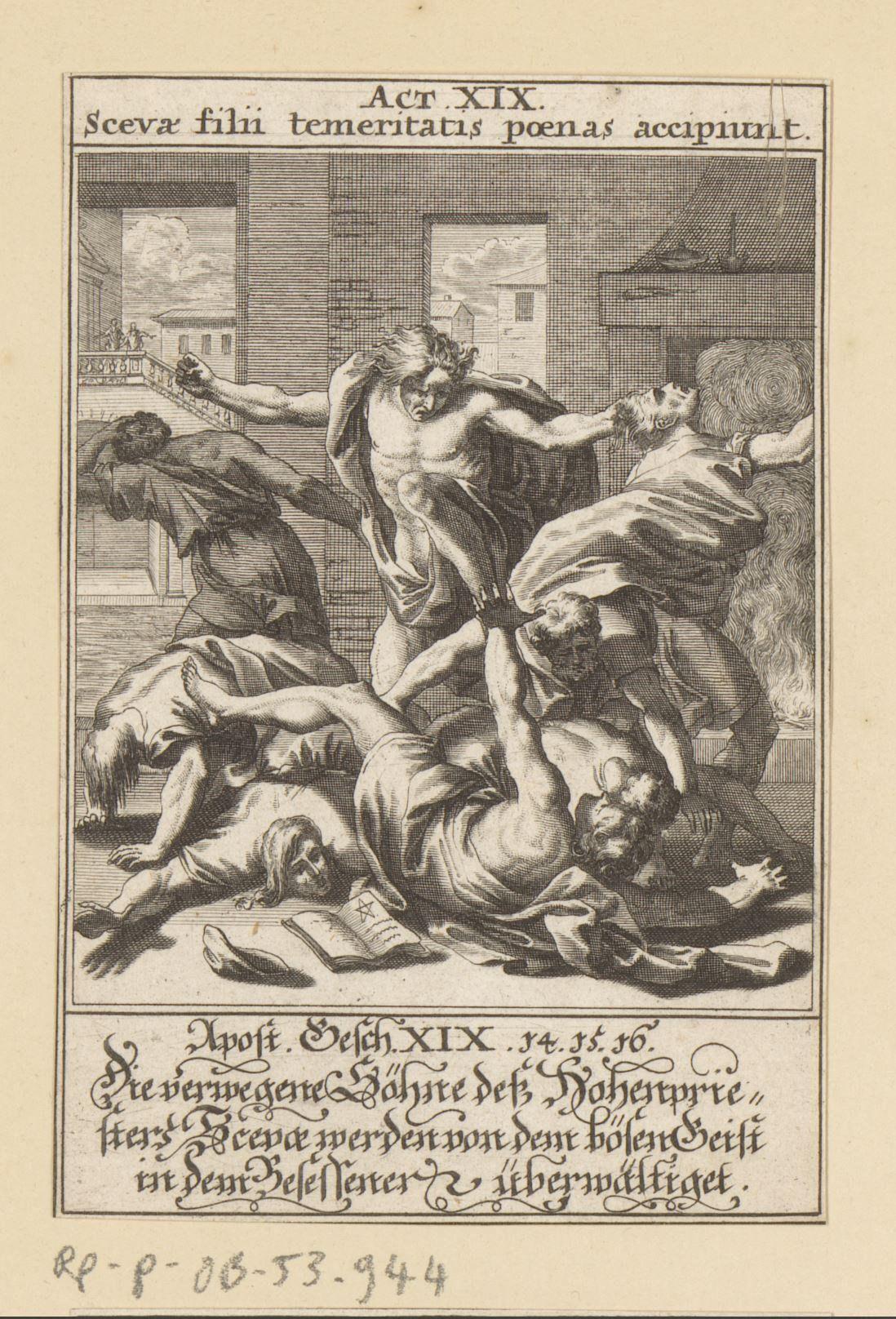
After Johann Jakob von Sandrart, The Sons of Sceva Overpowered, 1697. Public domain.
Acts 19 · Story · Featured Study
The Sons of Sceva and the Burned Books
Seven Jewish exorcists at Ephesus used the name of Jesus as a formula, and the spirit they addressed turned on them.
A failed exorcism at Ephesus ended with a public fire of magic books.
So the word of the Lord powerfully continued to spread and prevail.
So the word of the Lord powerfully continued to spread and prevail.
- Where
- Ephesus
- Who
- Paul
- When
- During Paul's two years at Ephesus, Acts 19:10 (probable)
Summary
Paul taught at Ephesus for two years, and the sick were healed through him. Seven sons of a priest named Sceva tried to drive out a spirit in the name of Jesus. The man with the spirit overpowered them, and fear fell on the city.
- Luke gives the value of the burned books as fifty thousand drachmas.
- Ancient writers tied Ephesus to magic words called the Ephesian letters.
- Readers have long asked whether Sceva really held the rank of chief priest.
The Story in Four Verses
Four verses carry the miracles, the borrowed words, the spirit's answer and the confessions.
Luke tells the whole scene in ten verses of Acts 19.
God did extraordinary miracles through the hands of Paul,Luke makes God the one at work before he tells of men who tried to copy the work.
Now there were some itinerant Jewish exorcists who tried to invoke the name of the Lord Jesus over those with evil spirits. They would say, “I bind you by Jesus, whom Paul proclaims.”Luke records the exorcists' own words, which name Jesus only as the One Paul preached.
Eventually, one of the evil spirits answered them, “Jesus I know, and I know about Paul, but who are you?”The spirit's question exposes men who used a name that was not theirs to use.
Many who had believed now came forward, confessing and disclosing their deeds.The confessions came from people who already believed, which makes the fire an act of the church.
Acts 19:15, Acts 19:18
The Story Among Paul's Years at Ephesus
Luke gives lengths only for the months in the synagogue and the years in the lecture hall.
Luke tells of the exorcists after the two years of teaching and before the riot.
- ArrivalPaul finds about twelve disciples who knew only John's baptismActs 19:1
- Three monthsPaul speaks boldly in the synagogueActs 19:8
- Two yearsPaul teaches daily in the lecture hall of TyrannusActs 19:10
- MiraclesCloths that had touched Paul are taken to the sickActs 19:12
- The seven sonsThe exorcists invoke Jesus and are overpoweredActs 19:16
- The fireBelievers confess their deeds and burn their booksActs 19:18
- The planPaul resolves to go to Jerusalem and then to RomeActs 19:21
- The riotDemetrius stirs the silversmiths against the WayActs 19:24
Eight events of Acts 19, in Luke's order.
The plan, The riot
Charms and Spell Books at Ephesus
Ancient writers knew Ephesus for its charms, and a later book of spells used the name of Jesus.
W. J. Conybeare and J. S. Howson, in 1869, described the Ephesian letters as signs carved on the statue of the goddess. Spoken aloud they served as a charm against evil spirits, and written down they were carried as amulets.
Clement of Alexandria reports that Androcydes the Pythagorean read the Ephesian letters as symbols. R. J. Knowling, in 1900, took the books burned in Acts 19:19 to be parchments of such formulas.
Adolf Deissmann set a later spell book beside the scene, the Great Magical Papyrus of Paris, written about AD 300. One of its spells adjures a demon by the god of the Hebrews, Jesus. Deissmann judged that a pagan had added the name, since no Christian or Jew would call Jesus the god of the Hebrews.
The Name and the One Who Bears It
Two teachers read the spirit's answer as a lesson about faith in Christ.
John Chrysostom wrote that the seven wanted the power of the name without believing in Jesus. He read the spirit's confession of Jesus as proof that the failure lay with the men and not with the name.
John Calvin named two faults in their prayer: they used the name without faith, and they claimed a power God had not called them to use. He wrote that God's power does not lie in the sound of a word.
The Voices
Matthew Henry and Jamieson, Fausset and Brown wrote on the confessions and the fire.
Matthew Henry (1662 to 1714)
Commentary on the Whole Bible
Confession that no one forced
“These confessions were not extorted from them, but were voluntary, for the ease of their consciences, upon which the late miracles had struck a terror. Note, Where there is true contrition for sin there will be an ingenuous confession of sin to God in every prayer, and to man whom we have offended when the case requires it.”
on Acts 19:18Puritan
Jamieson, Fausset & Brown (1802 to 1910)
Commentary Critical and Explanatory on the Whole Bible
A scene long remembered
“From their nature they would be costly, and books then bore a value above any standard we are familiar with. The scene must have been long remembered at Ephesus, as a strong proof of honest conviction on the part of the sorcerers and a striking triumph of Jesus Christ over the powers of darkness.”
on Acts 19:19Reformed
Where Readers Differ
Three questions of the scene, with the writers who answer them.
Was Sceva a high priest?2 paragraphs
Conybeare and Howson gave two readings of the title. Sceva may once have held the office at Jerusalem, or he may have led one of the twenty-four courses of priests. Knowling added that he may have belonged to the high-priestly families, and wrote that nothing more is known of him.
W. M. Ramsay, in 1896, judged that the chief priest looks more like a detail of a popular tale than a sure fact of history. Knowling reports that the text of Codex Bezae calls Sceva only a priest, and that Ramsay called that reading intelligent, consistent and possible.
Were there seven sons or two?1 paragraph
Ramsay noted that the seven sons of Acts 19:14 become two in the Greek of Acts 19:16, where the man overpowers both of them, except in the text of Codex Bezae. He counted it among the signs that this passage is less exact than Luke's other scenes.
What were the books worth?2 paragraphs
Conybeare and Howson took each piece of silver to be a drachma and reckoned the sum at about two thousand pounds of their own money. Calvin took the coin to be the Roman denarius.
Knowling called the sum very large and explained it by the cost of such books and the wealth of Ephesus. Deissmann allowed that Luke might have stated it with some pious exaggeration.
Books to Read Next
Three works of the nineteenth and early twentieth centuries, each free to read online.
The Life and Epistles of Saint Paul
W. J. Conybeare and J. S. Howson · 1869 edition
They describe the Ephesian letters and name the coin Luke counts in.
Free at the Internet ArchiveThe Acts of the Apostles, in The Expositor's Greek Testament, volume 2
R. J. Knowling · 1900
Knowling weighs Sceva's title and the reading of Codex Bezae.
Free at the Internet ArchiveLight from the Ancient East
Adolf Deissmann · 1910
Deissmann prints the Paris magical papyrus beside the books burned at Ephesus.
Free at the Internet ArchiveWhat the Fire Left Behind
The scene set the name of Jesus apart from the magic of the city.
Sources
Scripture is the Berean Standard Bible.
- The Holy Bible, Berean Standard Bible (read 2026)
- John Chrysostom, Homily 41 on Acts, Nicene and Post-Nicene Fathers, first series, volume 11 (1889)
- John Calvin, Commentary upon the Acts of the Apostles, volume 2, translated by Christopher Fetherstone, edited by Henry Beveridge (1844)
- W. J. Conybeare and J. S. Howson, The Life and Epistles of Saint Paul, People's Edition (Cincinnati, 1869)
- R. J. Knowling, The Acts of the Apostles, in The Expositor's Greek Testament, volume 2, edited by W. Robertson Nicoll (1900)
- W. M. Ramsay, St. Paul the Traveller and the Roman Citizen (New York and London: Putnam, 1896)
- Clement of Alexandria, Stromata 5.8, Ante-Nicene Fathers, volume 2 (1885)
- Adolf Deissmann, Light from the Ancient East, translated by Lionel R. M. Strachan (1910)
- Matthew Henry, Commentary on the Whole Bible (1710); Jamieson, Fausset and Brown, Commentary Critical and Explanatory (1871)
Keep Studying
People and groups3
Symbols1
Doctrines1