
Wittenberg to Aldersgate Street · Story · Featured Study
Luther's Preface to Romans
Luther wrote a preface to open Romans for German readers, and English readers took it up.
Luther told his readers to know Romans by heart and to use it, in Tyndale's English, “as with the daily bread of the soul.”
- When
- 21 September 1522 to 24 May 1738
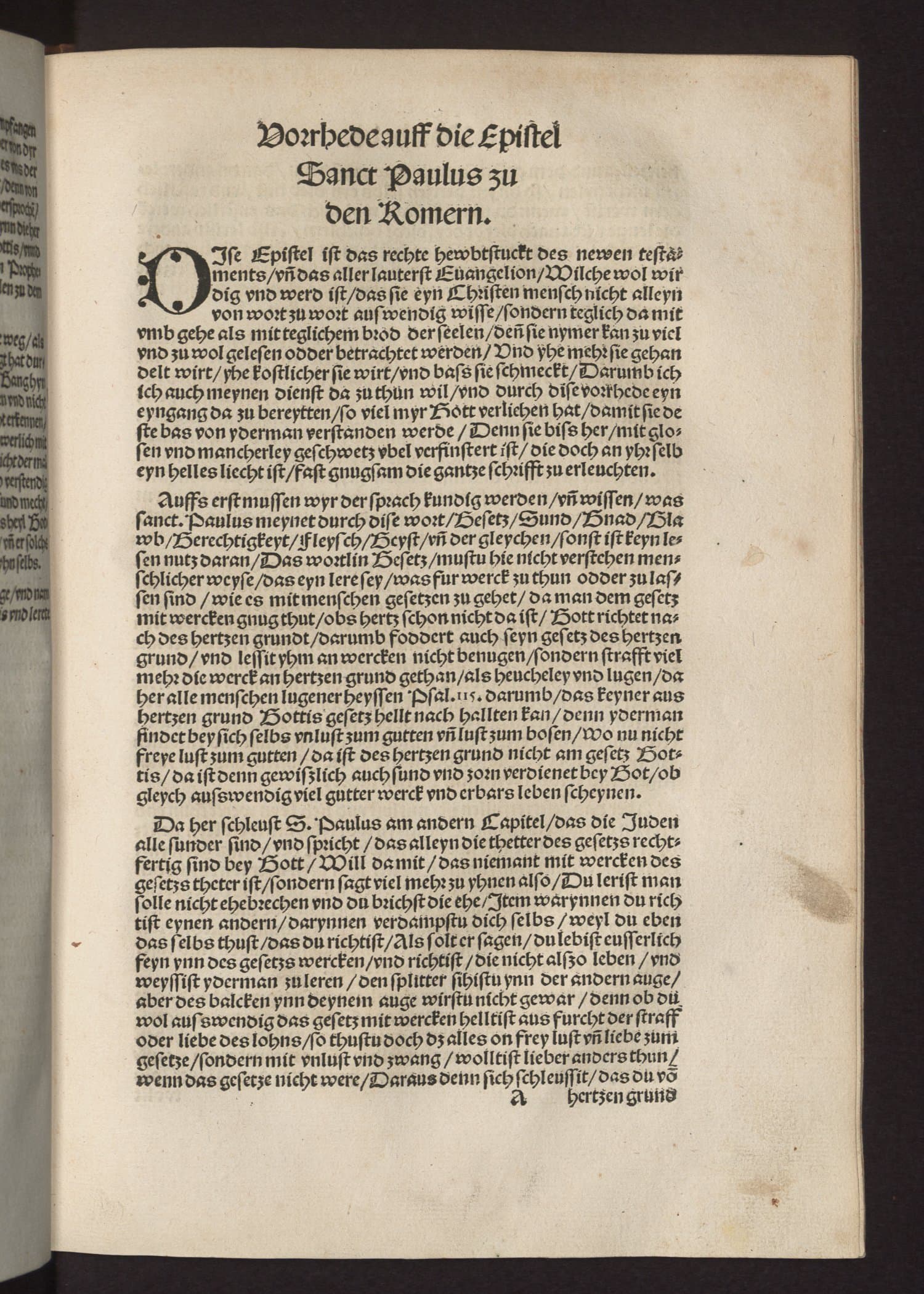
Martin Luther, the first page of the preface to Romans in Das Newe Testament Deutzsch, 1522. Public domain.
For the gospel reveals the righteousness of God that comes by faith from start to finish, just as it is written: “The righteous will live by faith.”
Summary
Luther set a preface before Romans in his German New Testament. Tyndale put most of it into English within four years. Two centuries later it was read at Aldersgate Street.
- It calls the letter the chief part of the New Testament and the purest gospel.
- Tyndale's English of it stood in his New Testament of 1536.
- An English of it from the Latin was printed at London, by the catalogue in 1594.
The Verses the Preface and Its Readers Turned On
Romans 3, 8 and 14 stand behind the preface and Wesley's evening.
Luther's preface walks through Romans chapter by chapter, and Wesley tied his evening at Aldersgate to a verse of the same letter.
For we maintain that a man is justified by faith apart from works of the law.The preface draws its teaching of faith alone from the third chapter, in Tyndale's words “faith only justifieth.”
But the one who has doubts is condemned if he eats, because his eating is not from faith; and everything that is not from faith is sin.The preface ends its account of righteousness on this verse of the fourteenth chapter.
For in Christ Jesus the law of the Spirit of life set you free from the law of sin and death.Wesley's Journal takes up the words of this verse for the assurance he says was given him that evening.
Four Readers of Romans
The table sets four readings in order, from Augustine to Wesley.
Augustine, Luther, Tyndale and Wesley each read Romans, and each reading is told by the reader himself.
| Reader | Year | The text | Told in |
|---|---|---|---|
| Augustine | 386 | The thirteenth chapter | His Confessions |
| Luther | Disputed, 1508 to 1519 | The righteousness of God | His own account of 1545 |
| Tyndale | 1526 | The preface | His prologue |
| John Wesley | 24 May 1738 | The preface, read by another | His Journal |
From Wittenberg to London
The preface went from German into Latin and English before it reached Aldersgate Street.
Luther's German New Testament came out on 21 September, “but without his name,” Schaff writes. Its preface to Romans is headed “Vorrhede auff die Epistel Sanct Paulus zu den Romern,” and Schaff calls it the most important of his prefaces.
Its first task is the words Paul uses, law, sin, grace, faith, righteousness, flesh and spirit.
On the law it says that God judges by the ground of the heart, so his law asks for the heart and is not content with works.
On faith it says, in Tyndale's English, that “right faith is a thing wrought by the Holy Ghost in us, which changeth us.”
On righteousness it says that such faith “is called God's righteousness, or righteousness that is of value before God,” because it is God's gift.
Justus Jonas put the preface into Latin in 1523. William Tyndale's prologue to Romans, printed as a separate pamphlet in 1526, is “for the most part a paraphrase or a translation of Luther's Preface,” Westcott writes.
Tyndale used both the German and the Latin, Westcott says, and the prologue was printed again in Matthew's Bible of 1537.
Thomas More, writing against Tyndale in 1532, said the prologue led readers “into a false understanding of St Paul.”
Augustine in the Garden
Augustine read Romans in a garden at Milan, and Luther later read Augustine.
In the eighth book of his Confessions Augustine tells of “a little garden belonging to our lodging” at Milan. He heard a child's voice chanting, “Take up and read; take up and read.”
He opened the book of the apostles and read the words of Romans 13. Alypius, who was with him, read on to the next words, on receiving the one who is weak in faith.
Let us behave decently, as in the daytime, not in carousing and drunkenness, not in sexual immorality and debauchery, not in dissension and jealousy. Instead, clothe yourselves with the Lord Jesus Christ, and make no provision for the desires of the flesh.These are the words Augustine says he read.
Schaff dates the garden to September 386 and the writing of the Confessions to about 397, so the book was written eleven years after the day.
In Luther's account of 1545, as Michelet gives it in English, he says that after his own turn “I read St. Augustin's work, Of the Letter and the Spirit,” and found him reading the righteousness of God as God's gift.
Aldersgate Street
Wesley's Journal is the one witness to the evening.
John Wesley wrote that “In the evening I went very unwillingly to a society in Aldersgate Street, where one was reading Luther's preface to the Epistle to the Romans.”
“About a quarter before nine, while he was describing the change which God works in the heart through faith in Christ, I felt my heart strangely warmed.”
“I felt I did trust in Christ, Christ alone for salvation,” he went on, and an assurance was given him that Christ had taken away his sins.
The same night, he wrote, the enemy suggested that this could not be faith, since he felt no joy.
A week earlier, on 17 May, his brother Charles wrote that he had first seen “Luther on the Galatians,” which Mr. Holland had come upon. That was Luther's commentary on Galatians and not the preface.
Three years later, on 15 June 1741, Wesley read Luther's commentary on Galatians for himself and wrote, “I was utterly ashamed.” He said it spoke “blasphemously” of good works and of the law of God.
What the Record Leaves Unsaid
Wesley names the preface and leaves out the reader, the room and the English.
Wesley does not name the man who was reading, and Curnock writes only that it “has been suggested” he was William Holland.
Curnock weighs two rooms and finds “the balance of evidence is in favour of the Nettleton Court site.” Which English of the preface was read that night is not known.
How the Key Verse Was Taught
Three writers of three centuries taught Romans 1:17.
John Chrysostom (died 407)
Homilies on the Epistle to the Romans, Homily 2
From the early church, a homily on the letter.
“he adds also righteousness; and righteousness, not thine own, but that of God; hinting also the abundance of it and the facility. For you do not achieve it by toilings and labors, but you receive it by a gift from above, contributing one thing only from your own store, ‘believing.’”
Patristic
John Calvin (1509 to 1564)
Commentaries on the Epistle of Paul the Apostle to the Romans
From the Reformed side of the Reformation, a commentary on the letter.
“But instead of the expression he used before, ‘to every one who believeth,’ he says now, from faith; for righteousness is offered by the gospel, and is received by faith.”
Reformed
John Wesley (1703 to 1791)
Explanatory Notes upon the New Testament
From the revival that began at Aldersgate, a note on the verse.
“Sometimes it means that righteousness by which a man, through the gift of God, is made and is righteous; and that, both by receiving Christ through faith, and by a conformity to the essential righteousness of God.”
on Romans 1:17Evangelical
In Their Own Words
Luther, Tyndale and Charles Wesley wrote these words on faith and righteousness.
William Tyndale (1494 to 1536)
A Prologue upon the Epistle of St Paul to the Romans (1526), in Doctrinal Treatises and Introductions to Different Portions of the Holy Scriptures, the prologue to Romans
A thousand times
“Faith is, then, a lively and a stedfast trust in the favour of God, wherewith we commit ourselves altogether unto God; and that trust is so surely grounded, and sticketh so fast in our hearts, that a man would not once doubt of it, though he should die a thousand times therefor.”
Reformation translator
About this saying1 paragraph
Luther's sentence on faith, as Tyndale put it into English in 1526.
Martin Luther (1483 to 1546)
his account of 1545, in Jules Michelet, The Life of Luther, Luther's account of Romans 1:17
The righteousness of God
“I perceived that the righteousness of God is that by which the just man, through God's goodness, lives, that is to say, faith”
Other
About this saying1 paragraph
Written the year before his death, looking back on the verse he could not get past.
Charles Wesley (1707 to 1788)
The Journal of the Rev. Charles Wesley, M.A., volume I, Wednesday 17 May 1738
Faith alone
“Who would believe our Church had been founded on this important article of justification by faith alone?”
Methodist
About this saying1 paragraph
A week before his brother's evening at Aldersgate, after reading Luther on Galatians.
Where Historians Disagree
Historians differ on two questions of the preface and its author.
When did Luther come to his reading of Romans 1:17?2 paragraphs
Köstlin reads Luther's account of 1545 as placing it in 1519, and holds that “Luther was confused in his recollection as to the time,” since his writings of 1517 already teach it.
Schaff puts it “toward the close of his convent life,” and Smith in 1508 or 1509. Against the early dates stands the one account from Luther's own hand, which puts it late.
Is Tyndale's prologue Luther's preface?1 paragraph
Westcott, Demaus and the Parker Society's editor find most of it taken from Luther. Demaus says Tyndale also wrote expositions of his own and a closing summary, so his prologue is Luther's preface in English, enlarged.
Books to Read Next
Doctrinal Treatises and Introductions to Different Portions of the Holy Scriptures
William Tyndale, edited by Henry Walter · 1848
It prints Tyndale's prologue to Romans with the passages taken from Luther marked.
Search the Internet ArchiveThe Journal of the Rev. John Wesley, Standard Edition, volume I
John Wesley, edited by Nehemiah Curnock · 1909
Curnock prints the Aldersgate evening with his notes on the room and the reader.
Free at the Internet ArchiveWhat the Preface Left
The preface carried Luther's reading of Romans into English through Tyndale, and into the Methodist revival through Wesley.
Sources
Scripture is the Berean Standard Bible.
- The Holy Bible, Berean Standard Bible (read 2026)
- Martin Luther, Vorrhede auff die Epistel Sanct Paulus zu den Romern, in Das Newe Testament Deutzsch (Wittenberg, 1522), as transcribed by de.wikisource with the pages of the Weimar edition, Deutsche Bibel 7.
- William Tyndale, A Prologue upon the Epistle of St Paul to the Romans (1526), in Doctrinal Treatises and Introductions to Different Portions of the Holy Scriptures, ed. Henry Walter (Cambridge: Parker Society, 1848), with the editor's introduction.
- B. F. Westcott, A General View of the History of the English Bible, third edition revised by W. A. Wright (London: Macmillan, 1905)
- Robert Demaus, William Tindale, a Biography, revised by Richard Lovett (London: Religious Tract Society, 1904)
- A Methodicall Preface Prefixed before the Epistle of S. Paul to the Romanes, translated by W. W. from the Latin of Justus Jonas (London: for Thomas Woodcock, catalogued 1594)
- John Wesley, Journal, 24 May 1738 and 15 June 1741, in The Works of the Rev. John Wesley, volume III (New York: J. Emory and B. Waugh, 1832)
- John Wesley, The Journal of the Rev. John Wesley, Standard Edition, edited by Nehemiah Curnock, volume I (London: Charles H. Kelly, 1909), 24 May 1738 and its notes.
- The Journal of the Rev. Charles Wesley, M.A., volume I, ed. Thomas Jackson (London: John Mason, 1849), 17 May 1738.
- Augustine, Confessions 8.8.19 and 8.12.29 to 30, translated by J. G. Pilkington, in Nicene and Post-Nicene Fathers, first series, volume 1, ed. Philip Schaff (New York, 1886), with Schaff's prolegomena.
- Jules Michelet, The Life of Luther, translated by G. H. Smith (London, 1846, from the French of 1835), Luther's account of 1545.
- Julius Köstlin, The Theology of Luther, translated by Charles E. Hay, volume I (Philadelphia: Lutheran Publication Society, 1897)
- Philip Schaff, History of the Christian Church, volume VII, Modern Christianity: The German Reformation.
- Preserved Smith, The Life and Letters of Martin Luther (Boston and New York: Houghton Mifflin, 1911)
- John Chrysostom, Homilies on the Epistle to the Romans, Homily 2, in Nicene and Post-Nicene Fathers, first series, volume 11, ed. Philip Schaff (Edinburgh: T. and T. Clark)
- John Calvin, Commentaries on the Epistle of Paul the Apostle to the Romans, on Romans 1:17.
- John Wesley, Explanatory Notes upon the New Testament (1755), on Romans 1:17.
Keep Studying
People and groups9
Doctrines4
Church history1