
Genesis 37 to 50 · Person · Featured Study
Joseph
The life of Joseph in Genesis 37 to 50, from the pit at Dothan to the court of Pharaoh, and the turns of it the church has read as a pattern of Christ.
The brother sold for twenty shekels of silver became the man every nation came to for grain, and he fed the brothers who sold him.
- The name means
- May he add, as Rachel's words at his birth explain the name
- Died
- at 110 years, in Egypt
- Family
- father: Jacob; mother: Rachel; brother: Benjamin; wife: Asenath; son: Manasseh; son: Ephraim
- Places
- Hebron, Shechem, Dothan, Egypt, Goshen, Machpelah
- First named
- Genesis 30:24 “She named him Joseph, and said,…”
- Last named
- Hebrews 11:22 “By faith Joseph, when his…”
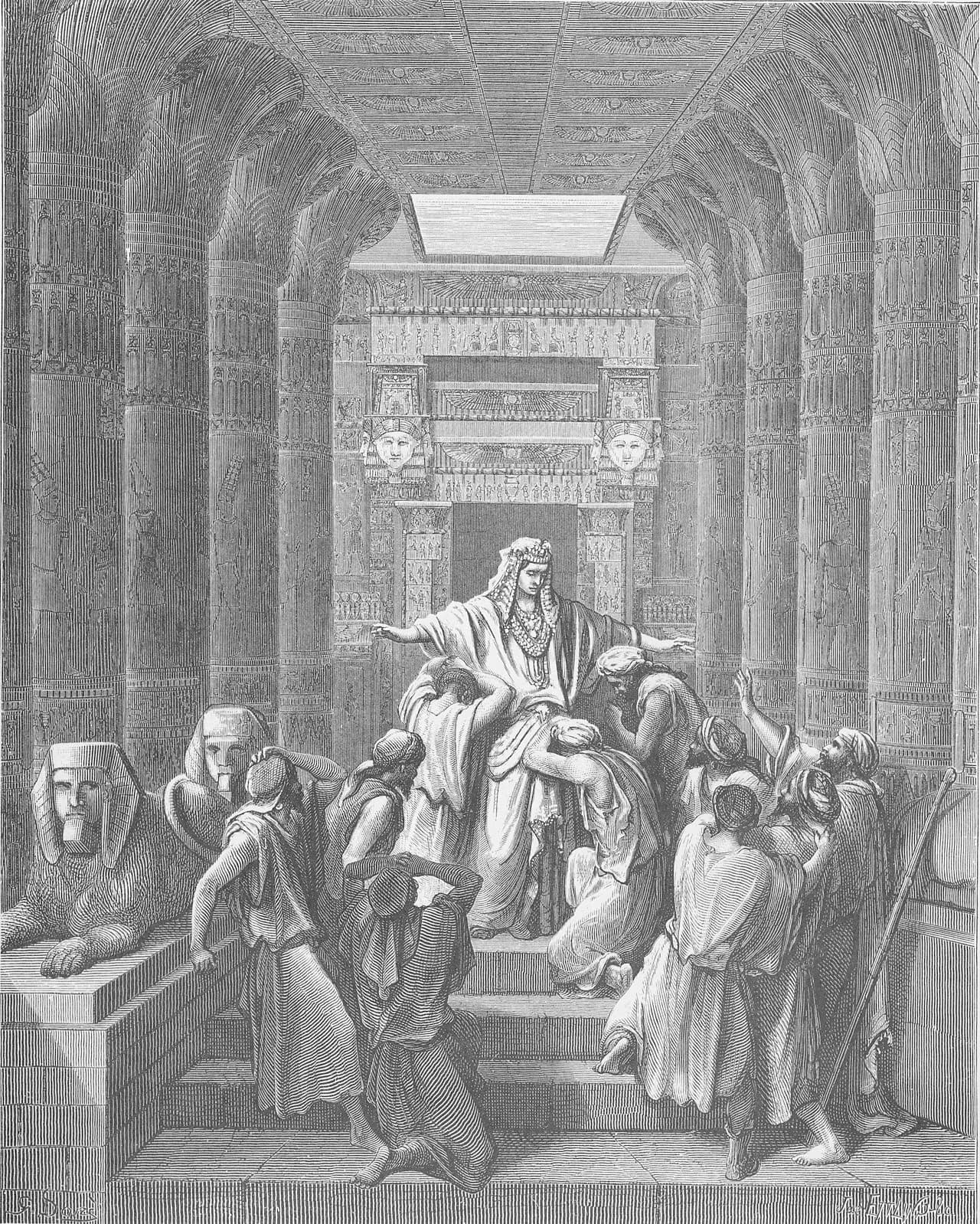
Gustave Doré, Joseph Reveals Himself to His Brothers, 1866. Public domain.
Summary
Joseph was the eleventh son of Jacob and the first son of Rachel, and he ruled Egypt under Pharaoh through seven years of plenty and a great famine.
- Israel loved him more than his other sons, and his brothers hated him for that favor and for his dreams.
- At seventeen his brothers sold him into Egypt, where he served Potiphar until a false charge put him in prison.
- At thirty he interpreted Pharaoh's dreams, and Pharaoh set him over all the land of Egypt.
- When his brothers came to buy grain, he tested them, made himself known, and settled Jacob's household in Goshen.
- He died in Egypt at 110.
Where Joseph Stands in Scripture
His first scene in Genesis 37 and his last in Genesis 50
This is the account of Jacob. When Joseph was seventeen years old, he was tending the flock with his brothers, the sons of his father’s wives Bilhah and Zilpah, and he brought their father a bad report about them.The account of Jacob opens on Joseph, so the last fourteen chapters of Genesis follow him.
Then Joseph said to his brothers, “I am about to die, but God will surely visit you and bring you up from this land to the land He promised on oath to Abraham, Isaac, and Jacob.” And Joseph made the sons of Israel take an oath and said, “God will surely attend to you, and then you must carry my bones up from this place.” So Joseph died at the age of 110. And they embalmed his body and placed it in a coffin in Egypt.His last words hold God to the promise sworn to Abraham, Isaac and Jacob, and Moses kept his charge about his bones in Exodus 13:19.
The Life, Turn by Turn
Fourteen turns from his father's house to his coffin in Egypt
The three ages are the three Genesis gives.
To scale: 3 of 14 stops dated.
- Brings his father a bad report of his brothersage 17Genesis 37:2
- Dreams of sheaves, and of the sun, moon and eleven starshis father's houseGenesis 37:9
- The pit and the caravanDothanGenesis 37:28
- Bought by Potiphar, captain of the guardEgyptGenesis 39:1
- Put in the king's prisonEgyptGenesis 39:20
- Interprets the dreams of the cupbearer and the bakerthe prisonGenesis 40:8
- Interprets Pharaoh's dreams and enters his serviceage 30Genesis 41:46
- Manasseh and Ephraim are born to himbefore the famineGenesis 41:50
- His brothers bow before himthe first trip to buy grainGenesis 42:6
- Makes himself known to his brothersthe second year of famineGenesis 45:3
- Meets his father againGoshenGenesis 46:29
- Brings his two sons to his sick fatherEgyptGenesis 48:1
- Buries Jacob in the cave of MachpelahCanaanGenesis 50:13
- Dies and is placed in a coffinage 110Genesis 50:26
Interprets Pharaoh's dreams and enters his service, Manasseh and Ephraim are born to him, His brothers bow before him, Makes himself known to his brothers, Meets his father again, Brings his two sons to his sick father, Buries Jacob in the cave of Machpelah, Dies and is placed in a coffin
From the Pit to Pharaoh's Court
Genesis 37 to 47
When Joseph came to his brothers at Dothan, they stripped him of his robe, threw him into an empty pit and sold him to traders bound for Egypt.
In Egypt he served Potiphar until Potiphar's wife accused him falsely, and he stayed in prison until Pharaoh sent for him.
Pharaoh called him from the dungeon to interpret two dreams of seven good years and seven of famine, and set him over the land to store the grain.
In the famine his brothers came to buy grain and bowed before him without knowing him. When they came back a second time with Benjamin, Joseph made himself known.
Jacob came down with his household and settled in Goshen, and Joseph provided food for all his father's household through the famine.
The robe and the dreamsGenesis 37:1 to 11
Now Israel loved Joseph more than his other sons, because Joseph had been born to him in his old age; so he made him a robe of many colors.The verse gives the reason for the favor and names the robe the brothers would strip from him.
Rashi, the eleventh-century commentator of northern France, reads son of his old age as a wise son. He says Jacob taught Joseph all he had learned from Shem and Eber, after the midrash Genesis Rabbah 84:8.
He told his father and brothers, but his father rebuked him and said, “What is this dream that you have had? Will your mother and brothers and I actually come and bow down to the ground before you?” And his brothers were jealous of him, but his father kept in mind what he had said.Jacob rebukes the second dream and still keeps it in mind, the first sign in the text that the dreams will stand.
The pit at DothanGenesis 37:12 to 36
They dipped the robe in a young goat's blood and sent it to their father, and Jacob mourned for his son many days.
Potiphar's house and the prisonGenesis 39 and 40
No one in this house is greater than I am. He has withheld nothing from me except you, because you are his wife. So how could I do such a great evil and sin against God?”Joseph answers the temptation with two reasons, his master's trust and his duty to God.
Pharaoh's dreams and the years of plentyGenesis 41
So Pharaoh asked them, “Can we find anyone like this man, in whom the Spirit of God abides?”A king outside the covenant says the Spirit of God abides in Joseph.
Joseph named the firstborn Manasseh, saying, “God has made me forget all my hardship and all my father’s household.” And the second son he named Ephraim, saying, “God has made me fruitful in the land of my affliction.”The names he gave his sons are his own reading of his years in Egypt.
The brothers in EgyptGenesis 42 to 44
Then they said to one another, “Surely we are being punished because of our brother. We saw his anguish when he pleaded with us, but we would not listen. That is why this distress has come upon us.”The brothers connect their distress in Egypt with what they did to Joseph at Dothan.
Now please let your servant stay here as my lord’s slave in place of the boy. Let him return with his brothers. For how can I go back to my father without the boy? I could not bear to see the misery that would overwhelm him.”Judah, who had proposed selling Joseph, offers himself as a slave so that Benjamin can go home.
The revealing and the move to GoshenGenesis 45 to 47
And now, do not be distressed or angry with yourselves that you sold me into this place, because it was to save lives that God sent me before you. For the famine has covered the land these two years, and there will be five more years without plowing or harvesting. God sent me before you to preserve you as a remnant on the earth and to save your lives by a great deliverance. Therefore it was not you who sent me here, but God, who has made me a father to Pharaoh—lord of all his household and ruler over all the land of Egypt.Joseph reads the sale three times as God's sending: to save lives, to keep a remnant, and to make him a father to Pharaoh.
Rashi reads a father to Pharaoh as a title of office, Father of the king.
What Genesis Sets Beside the Hero
Five details retellings often drop
TWO FULL YEARS FORGOTTEN
The restored cupbearer forgot Joseph, and two full years passed before Pharaoh's dream.
HE WEPT BEFORE HE MADE HIMSELF KNOWN
When his brothers spoke of their guilt among themselves, Joseph turned away from them and wept.
AN OATH BY PHARAOH'S LIFE
Joseph set the test for his brothers with an oath by the life of Pharaoh.
THE LAND OF EGYPT BECAME PHARAOH'S
In the famine Joseph acquired all the land of Egypt for Pharaoh, as the Egyptians sold their fields for food.
THE YOUNGER SON SET FIRST
Jacob crossed his hands and put Ephraim, the younger son, before Manasseh, the firstborn.
An oath by Pharaoh's life, The land of Egypt became Pharaoh's, The younger son set first
The Egypt Joseph Served
The customs of Pharaoh's court that Genesis records
Pharaoh gave Joseph an Egyptian name, Zaphenath-paneah. John Gill reports that the Targum of Onkelos, the old Aramaic translation of the Torah, reads the name as one to whom hidden things are revealed. Gill gives the reading of the Targum of Jonathan as a revealer of secrets, and Jamieson, Fausset and Brown list saviour of the land among its readings.
Apart at tableGenesis 43:32
They separately served Joseph, his brothers, and the Egyptians. They ate separately because the Egyptians would not eat with the Hebrews, since that was detestable to them.Egyptians kept apart from Hebrews at table, so Joseph ate apart from his brothers while he hid who he was.
Shepherds in GoshenGenesis 46:34
you are to say, ‘Your servants have raised livestock ever since our youth—both we and our fathers.’ Then you will be allowed to settle in the land of Goshen, since all shepherds are detestable to the Egyptians.”Shepherds were detestable to Egyptians, and Joseph used that to settle his family apart in Goshen.
The signs of officeGenesis 41:42 to 43
Then Pharaoh removed the signet ring from his finger, put it on Joseph’s finger, clothed him in garments of fine linen, and placed a gold chain around his neck. He had Joseph ride in his second chariot, with men calling out before him, “Bow the knee!” So he placed him over all the land of Egypt.Each gift is a sign of the authority Joseph now held under the king.
Embalming and mourningGenesis 50:2 to 3
And Joseph directed the physicians in his service to embalm his father Israel. So they embalmed him, taking the forty days required to complete the embalming. And the Egyptians mourned for him seventy days.Joseph had his father embalmed in the Egyptian manner, and Egypt itself mourned the Hebrew patriarch.
The Family of Joseph
Nine ties, each with its verse
Jacob reckoned Ephraim and Manasseh as his own sons, as he reckoned Reuben and Simeon, in Genesis 48:5.
| Person | Tie to Joseph | Verse |
|---|---|---|
| Jacob | His father, also named Israel. | Genesis 37:3 |
| Rachel | His mother, who died giving birth to Benjamin. | Genesis 35:16 to 19 |
| Benjamin | His only full brother, Rachel's second son. | Genesis 35:18 |
| Leah | His father's first wife, who bore Jacob six sons. | Genesis 30:20 |
| Reuben | The firstborn, who meant to rescue him from the pit. | Genesis 37:22 |
| Judah | Leah's fourth son. | Genesis 29:35 |
| Asenath | His wife, daughter of Potiphera, priest of On. | Genesis 41:45 |
| Manasseh | His firstborn son, by Asenath. | Genesis 41:51 |
| Ephraim | His second son, by Asenath. | Genesis 41:52 |
Asenath, Manasseh, Ephraim
The Places of His Life
Seven places, from Canaan to the grave at Shechem
The places in the order Joseph's story reaches them.
- 1Canaan, Jacob lived there, in the land where his father had resided. Genesis 37:1
- 2Hebron, Jacob sent Joseph from its valley to find his brothers. Genesis 37:14
- 3Dothan, Joseph found his brothers there, and they sold him. Genesis 37:17
- 4Egypt, Potiphar bought him there from the Ishmaelites. Genesis 39:1
- 5Goshen, Jacob's household settled there, near Joseph. Genesis 45:10
- 6Machpelah, Joseph and his brothers buried Jacob in its cave. Genesis 50:13
- 7Shechem, Joseph's bones were buried there, in the plot Jacob had bought. Joshua 24:32
Not placed: Canaan (1), Egypt (4).
The coasts and rivers are simplified; each place stands at its place page's coordinates.
Questions the Life Raises
Four questions answered from their verses
Were the brothers guilty if God meant it for good?R. C. Sproul; Matthew Henry
The brothers ask forgiveness for their transgression in Genesis 50:17, and Joseph answers that God intended their evil for good. Sproul places the guilt in the brothers' motive, and Henry places the purpose in God's care for His people.
“Joseph's brothers meant his suffering for evil, and insofar as this was their motivation, they were culpable before God.”
R. C. Sproul · How Can God Bring Good Out of Evil? · on Genesis 50:20Reformed
“God's Israel is the particular care of God's providence. Joseph reckoned that his advancement was not so much designed to save a whole kingdom of Egyptians as to preserve a small family of Israelites: for the Lord's portion is his people; whatever becomes of others, they shall be secured.”
Matthew Henry · Commentary on the Whole Bible · on Genesis 45:5 to 7Puritan
Who sold Joseph into Egypt?Genesis 37:28; Genesis 39:1; Acts 7:9
Genesis names Midianite traders and Ishmaelites in the sale, and Ishmaelites again in the purchase by Potiphar in Genesis 39:1.
So when the Midianite traders passed by, his brothers pulled Joseph out of the pit and sold him for twenty shekels of silver to the Ishmaelites, who took him to Egypt.Whatever part the traders played, the verse names the brothers as the ones who pulled him from the pit and sold him, and Stephen says the patriarchs sold him in Acts 7:9.
Seventy or seventy-five went down to Egypt?Bede; Jamieson, Fausset and Brown
Genesis 46:27 counts the household of Jacob in Egypt at seventy, and Stephen counts it at seventy-five in Acts 7:14. Bede traces the difference to the Greek translation Stephen followed.
“Joseph called his father Jacob and all his kin, seventy-five souls. He follows the Septuagint in saying this, but in the Hebrew truth, only seventy souls are found. And if you wish to count the series of souls in Genesis, adding Jacob himself and Joseph …”
Bede · Commentary on Acts · on Acts 7:14Patristic
Jamieson, Fausset and Brown reach seventy-five by adding five sons of Ephraim and Manasseh born in Egypt, and conclude that the two accounts agree.
Why did Joseph treat his brothers as strangers?Genesis 42:7 to 17
And when Joseph saw his brothers, he recognized them, but he treated them as strangers and spoke harshly to them. “Where have you come from?” he asked. “From the land of Canaan,” they replied. “We are here to buy food.” Although Joseph recognized his brothers, they did not recognize him.The test begins here; in the next verse Joseph remembers his dreams about them.
Jamieson, Fausset and Brown weigh whether Joseph was guilty of cruel dissimulation in calling his brothers spies when he knew they were not. Genesis records the outcome of the test in the brothers' own words at Genesis 42:21 and Genesis 44:33 to 34.
What Genesis Leaves Unsaid
Two silences: a message home and a command of Jacob's
Joseph was seventeen when he was sold and thirty when he stood before Pharaoh, and seven years of plenty and two of famine had passed when he made himself known, about twenty-two years in all. Genesis records no word from him to his father in that time.
After Jacob's death the brothers sent Joseph word that their father had commanded him to forgive them. Genesis records no such command from Jacob.
Joseph and Christ
Joseph's life set beside the life of Christ, and the providence of Genesis 50:20
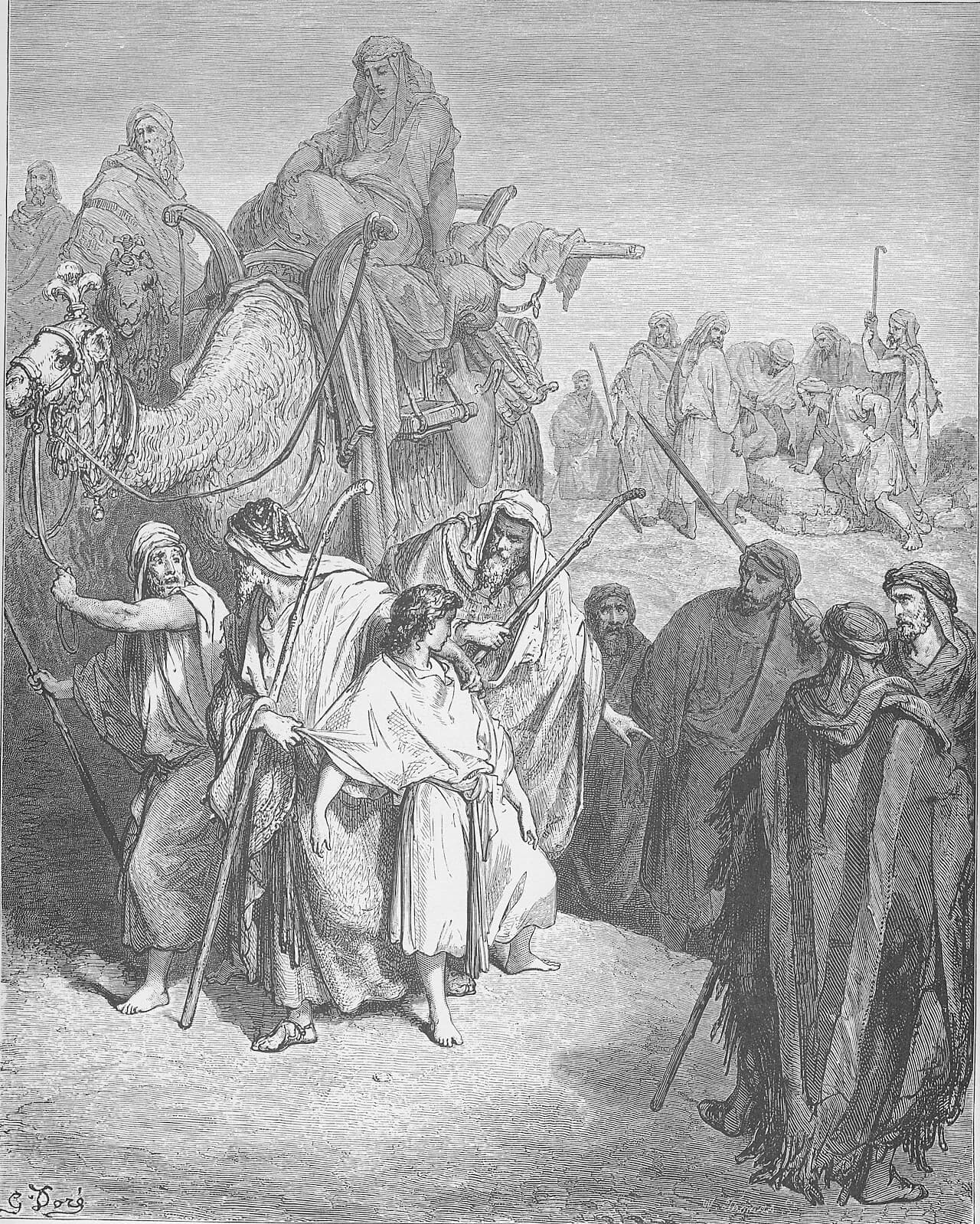
Gustave Doré, Joseph Is Sold by His Brothers, 1866, from Doré's English Bible. Public domain.
Doré set Joseph, still a boy, among the traders of the caravan as they lead him away, the sale of the second row of the table below.
Six rows, each a turn in Joseph's life beside its match in the life of Christ.
| Joseph, the shadow | Genesis | Christ, the substance | New Testament |
|---|---|---|---|
| Beloved of his father | Genesis 37:3 | The beloved Son | Matthew 3:17 |
| Rejected and sold by his brothers for silver | Genesis 37:28 | Betrayed for thirty pieces of silver | Matthew 26:15 |
| Descends into pit and prison, falsely accused | Genesis 39:20 | Descends into death, falsely condemned | 1 Peter 2:22 to 24 |
| Raised over all Egypt, second only to Pharaoh on the throne | Genesis 41:40 | Exalted to the right hand of God | Acts 2:33 |
| Unrecognized until he reveals himself | Genesis 45:1 to 4 | To be recognized by His brethren at the last | Zechariah 12:10 |
| The giver of bread to a dying world | Genesis 41:57 | The bread of life | John 6:35 |
The Joseph cycle argues across fourteen chapters that God rules the free acts of men, wicked acts among them, to bring about salvation. Genesis 50:20 sets the brothers' intent and God's intent in one sentence, and Acts 2:23 sets God's set plan beside the guilt of the men who crucified Jesus in the same way.
As for you, what you intended against me for evil, God intended for good, in order to accomplish a day like this—to preserve the lives of many people.Joseph speaks this to brothers who feared he would repay them once their father was dead, so the verse answers their fear.
He was delivered up by God’s set plan and foreknowledge, and you, by the hands of the lawless, put Him to death by nailing Him to the cross.Peter spoke this to the crowd in Jerusalem on the day of Pentecost, in the first sermon of the church after the Spirit came.
The holders of the type readingAmbrose of Milan, Cyril of Alexandria, Matthew Henry, John Wesley
Ambrose of Milan, Cyril of Alexandria, Matthew Henry and John Wesley read Joseph as a type of Christ. John Wesley, in his Explanatory Notes upon the Old Testament of 1765, calls Christ our Joseph, and Cyril's reading of the robe stands in the voices below.
“Accordingly, even at that time, the cross that was to come was prefigured in sign; and at the same time that he was stripped of his tunic, that is, of the flesh he took on, he was stripped of the handsome diversity of colors that represented the virtues. Therefore his tunic, that is, his flesh, was stained with blood, but not his divinity; and his enemies were able to take from him his covering of flesh but not his immortal life.”
Ambrose of Milan · On Joseph the Patriarch · on Genesis 37:23Patristic
“And herein Joseph was a type of Christ, ‘who took upon him the form of a servant,’ and yet then did that which made it evident that ‘God was with him,’ who was tempted by Satan, but overcame the temptation, who was falsely accused and bound, and yet had all things committed to his hand.”
Matthew Henry · Commentary on the Whole Bible · on Genesis 39:21 to 23Puritan
What the New Testament says of JosephJohn 4:5; Acts 7:9 to 18; Hebrews 11:21 to 22; Revelation 7:8
None of these verses names Joseph a type of Christ. The table above rests on the readers named in the fold before this one.
Voices on Joseph, Earliest First
Eight teachers in their own words, from Ephrem the Syrian to Jamieson, Fausset and Brown
died 373 · Ephrem the Syrian
“Joseph wept and said, ‘Do not be afraid of me, for although your father has died, the God of your father, on account of whom I will never strike you, is still alive.”
Ephrem the Syrian · Commentary on Genesis 44:2 · on Genesis 50:19Patristic
died 444 · Cyril of Alexandria
GLAPHYRA ON GENESIS, 6. 4
Two more early voices
The quotation1 quotation
“And Joseph was loved by his father a great deal. And he gave him a multicolored garment as an excellent gift and a proof of the love with which he accompanied him. And this was an incentive to envy for his brothers and a cause of hatred, as the following events will demonstrate. In fact, the Pharisees were inflamed with anger against the beloved, that is, Christ, because he had been clothed by God the Father with a multiform glory.”
Cyril of Alexandria · Glaphyra on Genesis, 6. 4 · on Genesis 37:4Patristic
died 542 · Caesarius of Arles
SERMON 90.2
The quotation1 quotation
“The young man is desired by his mistress but is not provoked to lust. He is asked and runs away. She who commanded in other matters, in this one thing coaxes and pleads. She loved him, or was it rather herself?”
Caesarius of Arles · SERMON 90.2 · on Genesis 39:10Patristic
died 1107 · Theophylact of Ohrid
Commentary on Acts
Five later voices
The quotation1 quotation
“‘They sold Joseph into Egypt.’ Not knowing of any fault in their brother, they treated him so badly, and moreover at the time when he had come to them with food for them, and by their action they furthered the prophecy without realizing it, involuntarily …”
Theophylact of Ohrid · Commentary on Acts · on Acts 7:9Patristic
1509 to 1564 · John Calvin
Commentaries
The quotation1 quotation
“But it was not surprising that the boy should be a great favorite with his aged father, for so it is wont to happen: and no just ground is here given for envy; seeing that sons of a more robust age, by the dictate of nature, might well concede such a point.”
John Calvin · Commentaries · on Genesis 37:3Reformed
1662 to 1714 · Matthew Henry
Commentary on the Whole Bible
The quotation1 quotation
“Joseph was eminent for his faith, though he had not enjoyed the helps for it which the rest of his brethren had. He was tried by temptations, by sin, by persecution, for retaining his integrity. He was tried by preferment and power in the court of Pharaoh, and yet his faith held out and carried him through to the last.”
Matthew Henry · Commentary on the Whole Bible · on Hebrews 11:22Puritan
1703 to 1791 · John Wesley
Explanatory Notes upon the Old Testament
The quotation1 quotation
“He doth not reflect upon his brethren that sold him, only saith, I was stolen out of the land of the Hebrews. Nor doth he reflect on the wrong done him in this imprisonment by his mistress that was his persecutor, and his master that was his judge, but mildly avers his own innocency.”
John Wesley · Explanatory Notes upon the Old Testament · on Genesis 40:15Evangelical
1802 to 1910 · Jamieson, Fausset & Brown
Commentary Critical and Explanatory on the Whole Bible
The quotation1 quotation
“Joseph's eminent position in Egypt did not make him regard it as his home: in faith he looked to God's promise of Canaan being fulfilled and desired that his bones should rest there: testifying thus: (1) that he had no doubt of his posterity obtaining the promised land: and (2) that he believed in the resurrection of the body, and the enjoyment in it of the heavenly Canaan.”
Jamieson, Fausset & Brown · Commentary Critical and Explanatory on the Whole Bible · on Hebrews 11:22Reformed
Caesarius of Arles, Theophylact of Ohrid, John Calvin, Matthew Henry, John Wesley, Jamieson, Fausset & Brown
Books to Read Next
Six books: early, Reformation and modern studies
On Joseph
Ambrose of Milan · about 389
Ambrose wrote this treatise on the story of Joseph, from Genesis 37 into the years in Egypt.
Glaphyra on Genesis
Cyril of Alexandria · fifth century
Cyril's Glaphyra comments on chosen passages of Genesis, the Joseph story among them.
Commentaries on the First Book of Moses Called Genesis
John Calvin · 1554
Calvin comments on each chapter of the life, in John King's English translation of 1847.
Commentary on the Whole Bible
Matthew Henry · 1710
Henry's commentary goes through Genesis verse by verse, the Joseph chapters among them.
Genesis 16 to 50, Word Biblical Commentary 2
Gordon J. Wenham · 1994
Wenham's volume covers the chapters of the patriarchs from Hagar to the death of Joseph.
In print: find it wherever books are sold.
Genesis, The JPS Torah Commentary
Nahum M. Sarna · 1989
Sarna comments on the Hebrew text with the Jewish commentators beside it.
In print: find it wherever books are sold.
God Meant It for Good
Joseph told the brothers who had sold him not to be afraid, and he promised to provide for them and their little ones. The life asks the reader to come to Christ, who was delivered up for those who betrayed Him, to forgive as Joseph forgave, and to trust God's purpose in what others intend for evil.
Sources
Scripture is the Berean Standard Bible.
- Rashi on Genesis, in Pentateuch with Rashi's Commentary, translated by M. Rosenbaum and A. M. Silbermann, 1929 to 1934, public domain.
- John Gill, Exposition of the Old Testament, 1748 to 1763, on Genesis 41:45.
- Jamieson, Fausset and Brown, Commentary Critical and Explanatory on the Whole Bible, 1871, on Genesis 41:45.
- Jamieson, Fausset and Brown, Commentary Critical and Explanatory on the Whole Bible, 1871, on Genesis 46:8 to 27.
- Jamieson, Fausset and Brown, Commentary Critical and Explanatory on the Whole Bible, 1871, on Genesis 42:9.
- Bede, Commentary on Acts, on Acts 7:14.
- R. C. Sproul, How Can God Bring Good Out of Evil?, on Genesis 50:20.
- Matthew Henry, Commentary on the Whole Bible, 1710, on Genesis 39:21 to 23, 45:5 to 7 and Hebrews 11:22.
- Ambrose of Milan, On Joseph, about 389.
- Cyril of Alexandria, Glaphyra on Genesis 6.4.
- John Wesley, Explanatory Notes upon the Old Testament, 1765, on Genesis 37:8 and 40:15.
- Ephrem the Syrian, Commentary on Genesis 44.2.
- Caesarius of Arles, Sermon 90.2.
- Theophylact of Ohrid, Commentary on Acts, on Acts 7:9.
- John Calvin, Commentaries on Genesis, 1554, on Genesis 37:3.
- Jamieson, Fausset and Brown, Commentary Critical and Explanatory on the Whole Bible, 1871, on Hebrews 11:22.
- Gordon J. Wenham, Genesis 16 to 50, Word Biblical Commentary 2, 1994; Nahum M. Sarna, Genesis, The JPS Torah Commentary, 1989; John Calvin, Commentaries on the First Book of Moses Called Genesis, translated by John King, Calvin Translation Society, 1847.
- Gustave Doré, Joseph Reveals Himself to His Brothers and Joseph Is Sold by His Brothers, 1866, Doré's English Bible, public domain.
Keep Studying
Studies11
People and groups6
Places9
Show the next 3 titles
Symbols8
Doctrines15
Subjects7
Show the next 1 title
Values10