
1 Samuel 8 to 12 · Subject · Featured Study
The Rise of the Monarchy and the Law of the King
Israel's request for a king in 1 Samuel 8 to 12, read beside the law of the king in Deuteronomy 17 and the prophet Hosea.
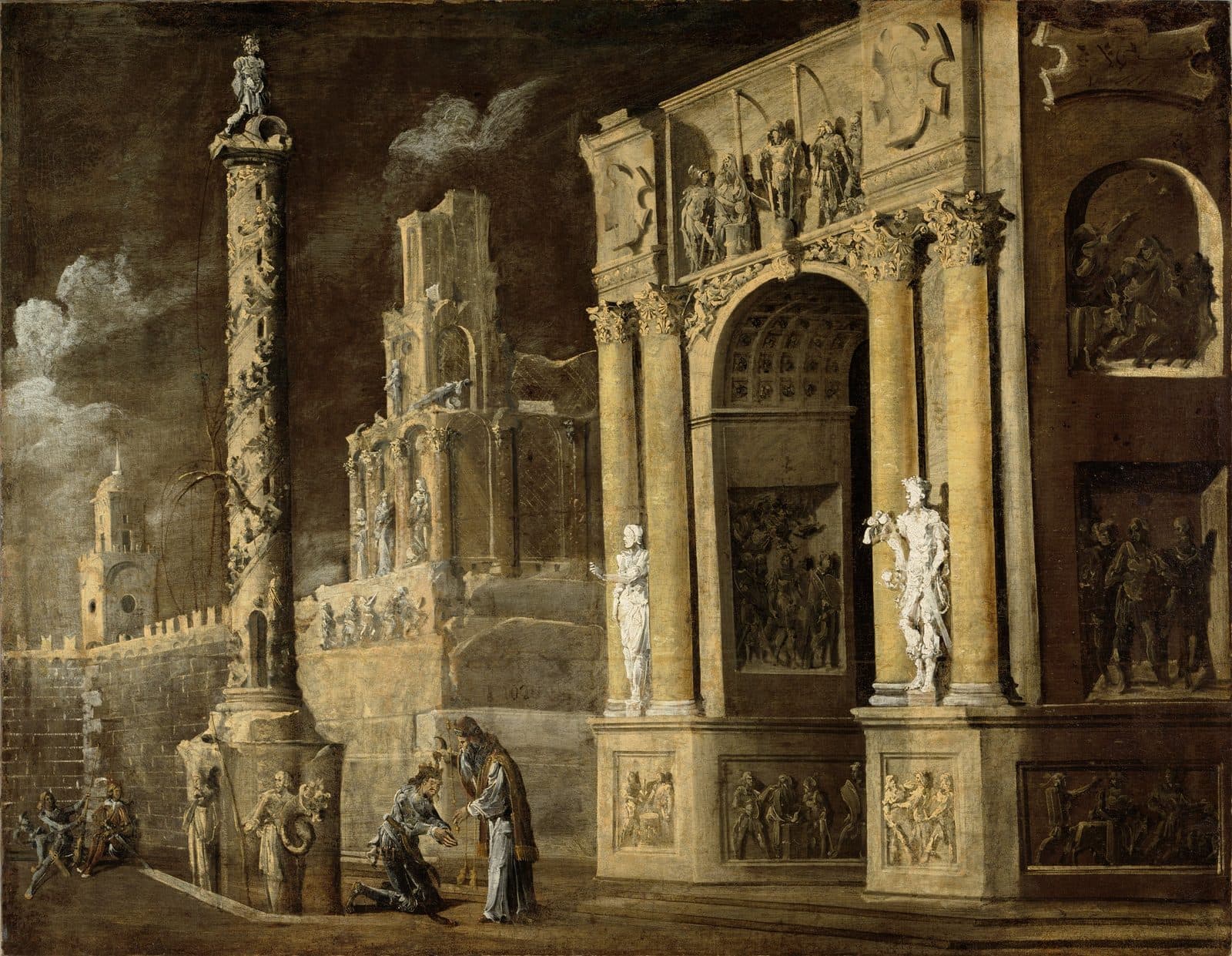
François de Nomé, Samuel Anointing Saul, between about 1625 and 1650, Harvard Art Museums. Public domain, via Wikimedia Commons.
THE ARTWORKDe Nomé set the anointing at the foot of a triumphal arch carved with reliefs and statues, beside a tall column and a ruined palace. Saul kneels before Samuel in the lower centre.
Israel asked for a king like all the nations, and the LORD told Samuel that the people had rejected Him as their king.
Summary
Israel passes from Samuel, the last judge, to Saul, its first king.
- Deuteronomy 17 makes room for a king and binds him to copy the law and read it all his life.
- The elders asked because Samuel's sons took bribes, and the people wanted a king to fight their battles.
- Saul was anointed in private, chosen by lot at Mizpah and confirmed at Gilgal.
- Jewish and Christian teachers differ on whether the law commanded a king or only allowed one.
From the Elders' Request to Gilgal
Six passages of 1 Samuel 8 to 11 run from Samuel's sons to the peace offerings at Gilgal.
When Samuel grew old, he appointed his sons as judges over Israel. The name of his firstborn son was Joel, and the name of his second was Abijah. They were judges in Beersheba. But his sons did not walk in his ways; they turned aside toward dishonest gain, accepting bribes and perverting justice.The failure of the next judges is the first ground the elders give for their request.
And the LORD said to Samuel, “Listen to the voice of the people in all that they say to you. For it is not you they have rejected, but they have rejected Me as their king.From this answer on, Samuel brings the people the LORD's words and not his own.
From Benjamin to Mizpah1 Samuel 9:16 to 10:25
“At this time tomorrow I will send you a man from the land of Benjamin, and you are to anoint him leader over My people Israel; he will save them from the hand of the Philistines. For I have looked upon My people, because their cry has come to Me.”This is the first place the LORD names the coming king, a day before Samuel meets him.
Then Samuel took a flask of oil, poured it on Saul’s head, kissed him, and said, “Has not the LORD anointed you ruler over His inheritance?Saul holds the office from this day, though the people do not yet know it.
Samuel said to all the people, “Do you see the one the LORD has chosen? There is no one like him among all the people.” And all the people shouted, “Long live the king!” Then Samuel explained to the people the rights of kingship. He wrote them on a scroll and laid it up before the LORD. And Samuel sent all the people away, each to his own home.The public choosing ends with the first written terms of Israel's kingship.
The kingdom renewed at Gilgal1 Samuel 11:14 to 15
Then Samuel said to the people, “Come, let us go to Gilgal and renew the kingship there.” So all the people went to Gilgal and confirmed Saul as king in the presence of the LORD. There they sacrificed peace offerings before the LORD, and Saul and all the Israelites rejoiced greatly.The people celebrate here Saul's victory over Nahash the Ammonite, told in 1 Samuel 11:1 to 11.
The King Through the Canon
Six passages from Genesis to Hosea frame the request.
GENESIS
God promises Abraham that kings will descend from him.
DEUTERONOMY
If Israel sets a king over itself, he must be the one the LORD chooses, from among their brothers and never a foreigner.
JUDGES 8
Gideon refuses to rule and says that the LORD shall rule over Israel.
JUDGES 21
The book closes on a land with no king, where everyone did what was right in his own eyes.
1 SAMUEL 13
Saul does not keep the LORD's command, and the LORD seeks a man after His own heart.
HOSEA
Hosea says that the LORD gave Israel a king in anger and took him away in wrath.
What the Text Says and What Is Often Said
What the verses say of the request, and two readings of Hosea 13:11.
The LORD calls the request a rejection of Himself, yet He grants it three times in 1 Samuel 8, at verses 7, 9 and 22.
Hosea 13:11 is often read of Saul. Augustine reads it so in Against Julian and calls Saul a punishment for sinners. John Calvin, in his Commentary on Hosea, reads it of the northern tribes' choice of Jeroboam, and he sets it beside the LORD's word to Samuel in 1 Samuel 8.
The World Behind the Request
The enemies Israel faced, the numbers of Saul's reign, Josephus on the request, and Solomon's breach of the law of the king.
The Philistines and the Ammonites under Nahash both pressed on Israel.
The Hebrew text of 1 Samuel 13:1 lacks Saul's age and gives his reign as two years, and the Septuagint lacks the verse. The Berean text supplies thirty years and forty-two years, and Paul in Acts 13:21 gives forty years.
Josephus on Moses and SamuelAntiquities 4.8.17 and 6.3.3
Josephus, retelling the law in Antiquities 4.8.17, has Moses call aristocracy the best constitution and say that Israel needs no supreme governor but God. If the people desire a king, he must be an Israelite who keeps the laws and does nothing without the high priest and the senate.
In Antiquities 6.3.3 Josephus says that Samuel hated kingly government and was very fond of an aristocracy, and that he lay awake all night after the request.
Solomon and the law of the king1 Kings 10:28 and 11:3
Solomon’s horses were imported from Egypt and Kue; the royal merchants purchased them from Kue.This breaks the first limit of Deuteronomy 17:16. The Jewish Publication Society's note on 1 Kings 10:28 says that the land named there may be Musru, beside Cilicia, rather than Egypt.
He had seven hundred wives of royal birth and three hundred concubines—and his wives turned his heart away.Here the warning of Deuteronomy 17:17 comes true in full.
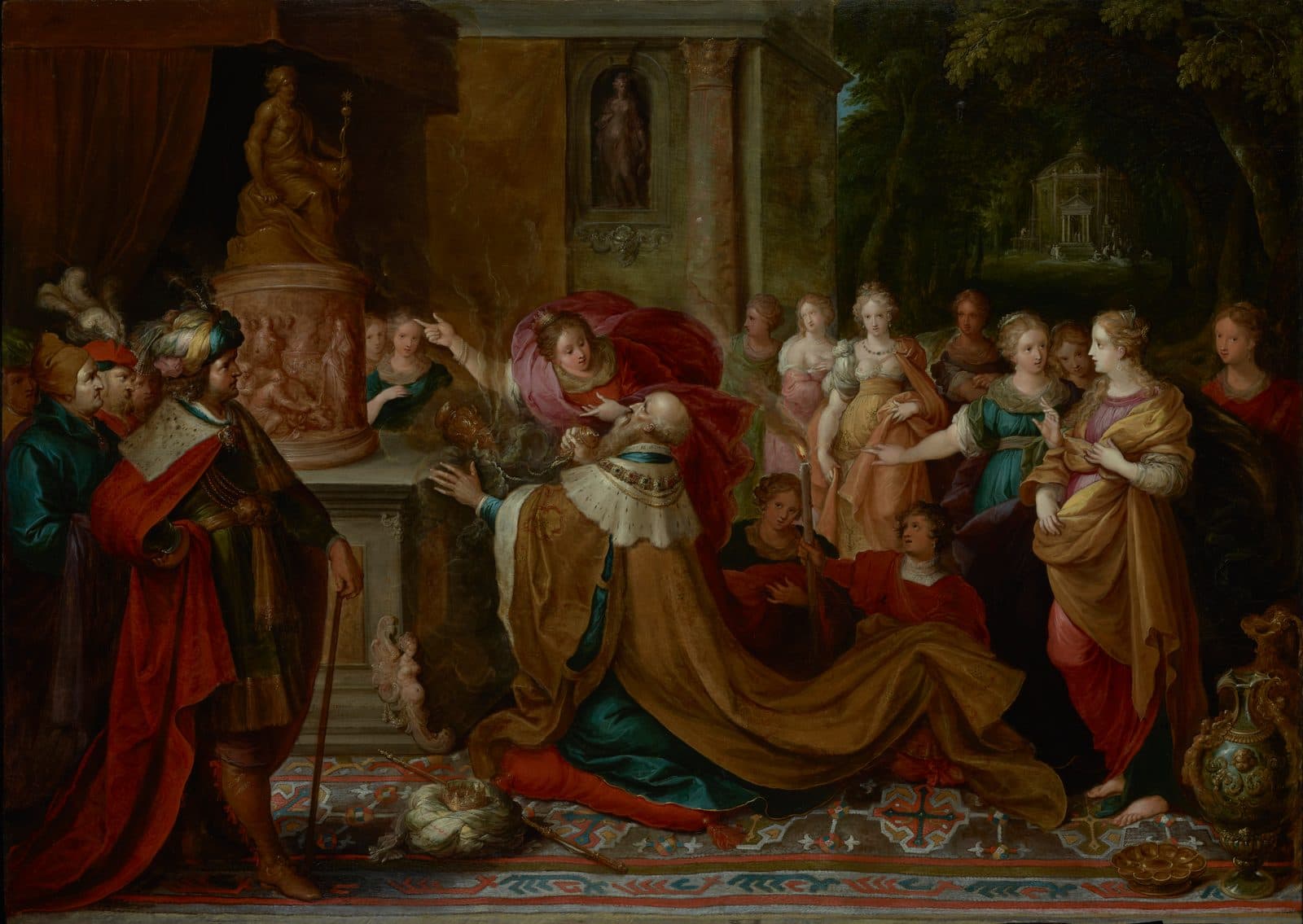
Frans Francken the Younger, The Idolatry of Solomon, 1622, J. Paul Getty Museum. Public domain, via Wikimedia Commons.
Francken painted Solomon on his knees before a golden statue on a pillar, with his wives crowding behind him.
Every Verse of the Request, Book by Book
The Law foresees the request, 1 Samuel tells it, and Hosea and Paul remember it.
Deuteronomy (1 verse)
When you enter the land that the LORD your God is giving you and have taken possession of it and settled in it, and you say, “Let us set a king over us like all the nations around us,”This is the only verse of the Law that speaks of the request.
1 Samuel (10 verses)
“Look,” they said, “you are old, and your sons do not walk in your ways. Now appoint a king to judge us like all the other nations.”The request is first spoken here, when the elders come to Samuel at Ramah.
But when they said, “Give us a king to judge us,” their demand was displeasing in the sight of Samuel; so he prayed to the LORD.The first response to the request turns it over to the LORD.
So Samuel spoke all the words of the LORD to the people who were asking him for a king.The LORD's warning reaches the people before they decide.
Nevertheless, the people refused to listen to Samuel. “No!” they said. “We must have a king over us.The LORD grants the king in 1 Samuel 8:22 after this refusal.
Then we will be like all the other nations, with a king to judge us, to go out before us, and to fight our battles.”The people answer Samuel's list of what a king would take with what they want a king to do for them.
But today you have rejected your God, who saves you from all your troubles and afflictions, and you have said to Him, ‘No, set a king over us.’ Now therefore present yourselves before the LORD by your tribes and clans.”Samuel gives this rebuke before the lot is cast, so the king is chosen under it.
But when you saw that Nahash king of the Ammonites was moving against you, you said to me, ‘No, we must have a king to rule over us’—even though the LORD your God was your king.This verse names the threat behind the request, which 1 Samuel 8 does not give.
Now here is the king you have chosen, the one you requested. Behold, the LORD has placed a king over you.Samuel ties the king to the request before he calls for the sign of 1 Samuel 12:17.
Is it not the wheat harvest today? I will call on the LORD to send thunder and rain, so that you will know and see what a great evil you have committed in the sight of the LORD by asking for a king.”Rain at the harvest is out of season, as Proverbs 26:1 says, so no one can mistake the sign.
They pleaded with Samuel, “Pray to the LORD your God for your servants so that we will not die! For we have added to all our sins the evil of asking for a king.”The people's own confession closes the record in 1 Samuel.
Hosea (1 verse)
Where is your king now to save you in all your cities, and the rulers to whom you said, “Give me a king and princes”?Centuries later Hosea looks back on the request.
Acts (1 verse)
Then the people asked for a king, and God gave them forty years under Saul son of Kish, from the tribe of Benjamin.Paul keeps the request in his sermon's account of Israel at Antioch of Pisidia.
The Words of the Kingdom
Four Hebrew words the request and the law of the king turn on, from the lexicon.
MELEK (HEBREW, H4428)
The common noun for a king, used of Israel's kings and the kings of the nations alike.
MISHPAT (HEBREW, H4941)
A verdict or decree, and by extension a right or a custom; it names the king's manner in 1 Samuel 8:11 and the rights of kingship in 1 Samuel 10:25.
MISHNEH (HEBREW, H4932)
A repetition or duplicate, used of the copy of the law the king must write.
NAGID (HEBREW, H5057)
A leader, one who goes in front; it is the title the LORD gives Saul before he is called king.
What the Text Leaves Unsaid
Three questions the chapters leave open.
The text does not give the contents of Samuel's scroll. Albert Barnes thought it not improbable that it was a copy of Deuteronomy 17:14 to 20, and John Wesley called its rules agreeable to Deuteronomy 17.
The elders echo the words of the law of the king about a king like all the nations, and the text does not say whether they knew the law they echoed.
1 Samuel records no copy of the law written by Saul.
What the Request Teaches
What the chapters teach of the sin and of the LORD's answer, and the law the king was to keep.
The rejection named at Ramah is named again at Mizpah. Samuel names it a third time in his farewell.
The LORD takes the people's request into His own purpose. The king they asked for is His instrument from the first.
The same terms bind the people and the king. If both follow the LORD all will be well, and if they persist in doing evil both will be swept away.
When he is seated on his royal throne, he must write for himself a copy of this instruction on a scroll in the presence of the Levitical priests. It is to remain with him, and he is to read from it all the days of his life, so that he may learn to fear the LORD his God by carefully observing all the words of this instruction and these statutes. Then his heart will not be exalted above his countrymen, and he will not turn aside from the commandment, to the right or to the left, in order that he and his sons may reign many years over his kingdom in Israel.Of the rules of the law of the king, only this one gives the king something to do rather than something to refrain from.
Three Voices on the Request
Voices from the eighteenth and nineteenth centuries.
Matthew Henry finds both shame and grace in the king Samuel presents at Gilgal.
“‘And now,’ said he, ‘you have a king, a king of your own asking--let that be spoken to your shame; but a king of God's making--let that be spoken to his honour and the glory of his grace.’ God did not cast them off, even when they in effect cast him off. He shows them that they are now upon their good behaviour, they and their king.”
Matthew Henry · Commentary on the Whole Bible · on 1 Samuel 12:12 to 13Puritan
John Wesley, writing in 1765 on Samuel's farewell at Gilgal, sets the request against what God had already done for Israel.
“Your king - That is, when God was your immediate king and governor, who was both able and willing to deliver you, if you had cried to him, whereof you and your ancestors have had plentiful experience; so that you did not at all need any other king; and your desire of another, was a manifest reproach against God.”
John Wesley · Explanatory Notes upon the Old Testament · on 1 Samuel 12:12Evangelical
Adam Clarke explains why the LORD granted at Ramah a request that displeased Him.
“They have rejected me - They wish to put that government in the hands of a mortal, which was always in the hands of their God. But hearken unto their voice - grant them what they request. So we find God grants that in his displeasure which he withholds in his mercy.”
Adam Clarke · Commentary on the Bible · on 1 Samuel 8:7Evangelical
Where Readers of the Request Differ
Five positions on three questions, each with its holders, its tradition and an objection.
A king was commanded, and the request was wrong in its spiritRabbi Yehuda in the Talmud; Maimonides · Rabbinic law
The Babylonian Talmud was compiled in Babylonia between about 450 and 550. In Sanhedrin 20b it gives a teaching of Rabbi Yehuda that counts the appointing of a king among three commands given to Israel on entering the land. Maimonides holds the same in the Laws of Kings and Wars 1:1 to 2 of his code, written in Egypt between 1176 and 1178. In his reading God was displeased with the complaint behind the request, which was aimed at Samuel.
The objection comes from Rabbi Nehorai in the same passage. He holds that Deuteronomy 17:14 answers the people's complaint and commands nothing, since it opens with the people saying that they want a king like the nations.
A king was allowed as a concessionIbn Ezra; Matthew Henry; Albert Barnes · Rabbinic and Protestant commentary
Abraham ibn Ezra, in his commentary on Deuteronomy written between 1155 and 1165, calls the appointing of a king optional. Matthew Henry, on Deuteronomy 17:14 to 15, says that a king was neither promised as a mercy nor commanded as a duty, and was permitted if the people desired one. Albert Barnes, on Deuteronomy 17:14, says that the desire is neither encouraged nor blamed.
The objection is Adam Clarke's, who calls Deuteronomy 17:15 a command in his comment on the verse.
A nation needs no king at allIsaac Abarbanel · Rabbinic commentary
Isaac Abarbanel, writing in Italy between 1483 and 1513, argues in the first introduction to his comment on Deuteronomy 17:14 that a king is not necessary to a nation. He points to Venice and Florence, ruled in his day by leaders elected for set terms, and says that many leaders who must give account err less than one man.
The objection is Rabbi Eliezer's in Sanhedrin 20b. He holds that the elders sought rightly a steady leader to follow Samuel, and that the unlearned among them spoiled the request with the wish to copy the nations.
Samuel's list is a warning to the peopleRabbi Yehuda in the Talmud; Gregory the Great · Rabbinic and patristic commentary
A second question is what a king may take. In Sanhedrin 20b Rabbi Yehuda holds that Samuel's list in 1 Samuel 8:11 to 17 was spoken only to make the people fear the king. Gregory the Great, in his commentary on First Kings, the book now called 1 Samuel, says that the law of kingship in the narrative is shown rather than prescribed. In his reading kings are to defend their subjects and not strip them of their goods.
The objection is Rabbi Yosei's in the same passage. He holds that a king may do everything the list names.
Two accounts of the monarchy, one for it and one against itJulius Wellhausen · Historical criticism
Julius Wellhausen, in chapter 7 of his Prolegomena to the History of Israel, sets 1 Samuel 8 against 1 Samuel 9 and after. In 1 Samuel 8 Samuel resists the request, and in 1 Samuel 9 the monarchy is the means of saving Israel from its humiliation. He dates the resisting account to the exile or later.
The objection is John Wesley's, on 1 Samuel 12:13. He says that God chose Saul by lot and the people chose him too, either because they chose that form of government or because they approved God's choice and confirmed it.
Books on the Rise of the Monarchy
Four works on the request and the law of the king, each free to read.
Antiquities of the Jews
Flavius Josephus, translated by William Whiston · 93
Book 6 retells the request and the making of Saul as a first-century Jewish historian read them.
Read it at Project GutenbergCommentary on the Whole Bible
Matthew Henry · 1710
Henry gives the people's motive and their haste in his notes on 1 Samuel 8 to 12.
Read it at the Christian Classics Ethereal LibraryCommentary Critical and Explanatory on the Whole Bible
Robert Jamieson, A. R. Fausset and David Brown · 1871
The notes on 1 Samuel 8 explain the request against the judges' limited rule.
Read it at the Christian Classics Ethereal LibraryProlegomena to the History of Israel
Julius Wellhausen · 1883
The chapter on Judges, Samuel and Kings reads all three books by the same method.
Read it at Project GutenbergThe King Who Keeps the Law
Keep studying
Read it4
Studies7