
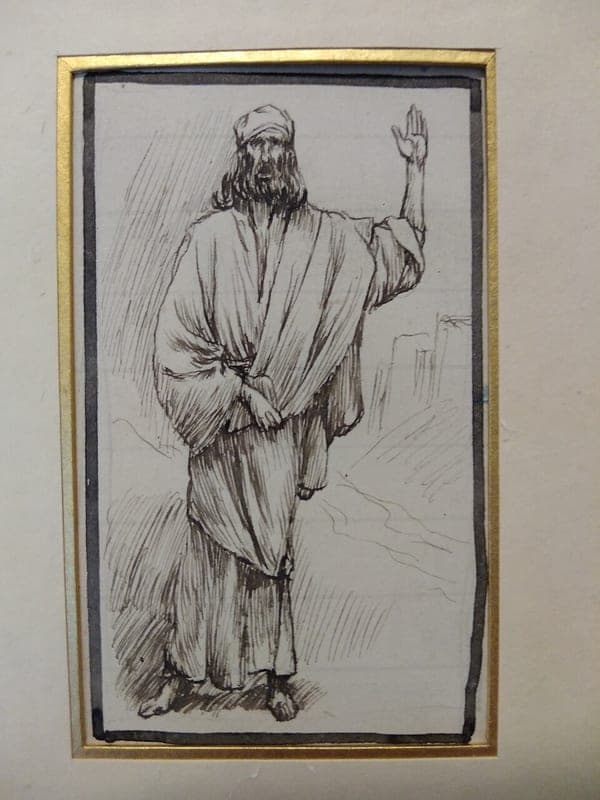
Hosea, James Tissot, 1902. Public domain.
Old Testament · Book 28 of 66
Hosea
Hosea records how God told the prophet to marry Gomer, a wife who proved unfaithful. His marriage pictures Israel's unfaithfulness to God, and the book ends with God's promise to heal his people and love them freely.
Hosea records how God told the prophet to marry Gomer, a wife who proved unfaithful. His marriage pictures Israel's unfaithfulness to God, and the book ends with God's promise to heal his people and love them freely.
What is Hosea about?
Hosea is the word of the LORD to the northern kingdom of Israel in its last years. The LORD tells the prophet to marry Gomer, and her three children are named for what is coming: Jezreel, No Compassion and Not My People. The wife leaves, and the LORD promises to win her back and to say to Not My People “You are My people” (2:23). Hosea buys her back. Then the LORD brings His case against Israel: no knowledge of God, priests who fail, kings set up without Him, a calf in Samaria. The book ends with a father who cannot give up his son and the call “Return, O Israel” (14:1).
All 14 chapters
Every chapter of the book, in one grid. Each cell opens that chapter.
- The marriageHosea 1 to 3
- The chargeHosea 4 to 10
- The returnHosea 11 to 14
The colour is the movement of the book the chapter stands in, and every cell opens that chapter's Study level.
Who wrote it, where, when, for whom, and why?
The book names its prophet in its first verse, Hosea son of Beeri (1:1). Chapter 1 tells of his marriage in the third person and chapter 3 in his own voice (3:1). The rest is the word of the LORD through him with no writer named, and its last verse speaks to whoever is wise (14:9).
The word is spoken to the northern kingdom, called Israel and Ephraim, with Judah named beside it (5:5, 6:4). The text names Samaria (8:5), Bethel and Beth-aven (4:15, 10:5), Gilgal (9:15), Gilead (6:8) and Jezreel (1:4), and the two powers Ephraim turns to, Egypt and Assyria (7:11).
The text dates the book by kings: the days of Uzziah, Jotham, Ahaz and Hezekiah, kings of Judah, and of Jeroboam son of Jehoash, king of Israel (1:1). It speaks of kings set up without the LORD (8:4), of kings who fall (7:7) and of Samaria's king carried off (10:7), and it gives no year.
The book is addressed to the children of Israel (4:1), to the priests, the house of Israel and the royal house (5:1), and in its last verse to the reader who is wise and discerning (14:9).
Whoever is wise, let him understand these things; whoever is discerning, let him know them. For the ways of the LORD are right, and the righteous walk in them but the rebellious stumble in them.
Hosea 14:9, Berean Standard Bible.
The book gives its reason in its own words: the LORD has a case against the people of the land (4:1). It calls Israel to return (14:1) and closes with the LORD's promise to heal and to love freely (14:4).
Hear the word of the LORD, O children of Israel, for the LORD has a case against the people of the land: “There is no truth, no loving devotion, and no knowledge of God in the land!
Hosea 4:1, Berean Standard Bible.
2 Kings tells the same years, from the reign of Jeroboam son of Jehoash in Samaria (2 Kings 14:23) to the capture of Samaria by the king of Assyria (2 Kings 17:6). Amos prophesied in the days of the same Jeroboam (Amos 1:1). Isaiah saw his vision in the days of the same four kings of Judah (Isaiah 1:1), and Micah in the days of the last three (Micah 1:1).
Sources. Hosea 1:1, 1:4, 3:1, 4:1, 4:15, 5:1, 5:5, 6:4, 6:8, 7:7, 7:11, 8:4, 8:5, 9:15, 10:5, 10:7, 14:1, 14:4, 14:9; 2 Kings 14:23, 17:6; Amos 1:1; Isaiah 1:1; Micah 1:1. Every verse is read in the Berean Standard Bible.
How is Hosea arranged, and what is it for?
The three movements the book falls into, then what it teaches and what it was written to do.
- The marriageHosea 1 to 3, 39 verses, the turn at 3:1
Hosea marries Gomer, her three children are named for the judgment, and the wife who left is bought back.
- The chargeHosea 4 to 10, 107 verses, the turn at 6:6
The LORD brings His case against Israel: no knowledge of God, failing priests, kings, a calf and foreign allies.
- The returnHosea 11 to 14, 51 verses, the turn at 11:8
The father who taught Ephraim to walk cannot give him up, and the book ends with the call to return and the promise to heal.
The theme
The LORD is the husband of an unfaithful wife and the father of a son who turned away. Israel has gone after the Baals and after Egypt and Assyria, and the book names the sin as harlotry and the lack of the knowledge of God (4:1, 4:12). The LORD judges it, and still He will not give Israel up (11:8). The children named for the judgment are named again in mercy (2:23), and the book ends with His promise to heal and to love freely (14:4).
The purpose
Hosea sets the LORD's case before the northern kingdom in the years before it fell, and shows it in a prophet's own household. It calls Israel to return and gives the words to bring (14:2). Its last verse gives the book to whoever is wise, to understand that the ways of the LORD are right (14:9), and the New Testament takes up its words on mercy, on the son called out of Egypt, and on those who were not a people.
Three names given in judgment and turned in mercy
the name given, in the colour of the marriage the name turned, in the colour of the return
The marriage, Hosea 1 to 3
What the text says in these 3 chapters, and the pages they open on.
The LORD tells Hosea to take a wife and have children, because the land has departed from the LORD, and Hosea marries Gomer daughter of Diblaim. She bears a son, a daughter and a son, and the LORD names them Jezreel, Lo-ruhamah and Lo-ammi: the bloodshed of Jezreel will be punished, there will be no more compassion, and Israel is not His people. Then the LORD speaks as the husband of an unfaithful wife. She goes after her lovers and forgets who gave her the grain, the wine and the oil; He hedges up her path, takes back His gifts, and then leads her into the wilderness, speaks to her tenderly and betroths her to Himself forever. In chapter 3 the prophet is sent to love his wife again, and he buys her for silver and barley.
Then the LORD said to me, “Go show love to your wife again, though she is loved by another and is an adulteress. Love her as the LORD loves the Israelites, though they turn to other gods and offer raisin cakes to idols.”
- Study
Hosea 1the marriage to Gomer and the naming of Jezreel, Lo-ruhamah and Lo-ammiShow the summary and 5 pagesShow summary, 5 pagesHide the summary
The word of Jehovah comes to Hosea in the last decades of the northern kingdom, and the first command is a marriage: 'Go, take a prostitute as your wife and have children of adultery, because this land is flagrantly prostituting itself by departing from the LORD.' Gomer bears three children whose names are the sermon: Jezreel, blood to be avenged; Lo-ruhamah, 'I will no longer have compassion'; and Lo-ammi, 'you are not My people, and I am not your God.' Yet the chapter refuses to end there: Israel shall be as the sand of the sea, and where it was said 'You are not My people' it shall be said 'sons of the living God' (1:10): Paul quotes it in Romans 9, Peter echoes it in 1 Peter 2.
- The chapter tells the marriage in the third person, and chapter 3 tells the next part in Hosea's own voice.
- The three names are turned in 1:10 to 11 and again in 2:23.
On this chapter (5)
- Hosea and Gomer
The marriage as the sign of the LORD and Israel.
- Why God is not finished with Israel
The promises to Israel that stand.
- Was Gomer a prostitute when Hosea married her, or did she become one?
Answered under Where do readers disagree, lower on this page, with each reading and who holds it.
- Are chapters 1 to 3 history or a parable?
Answered under Where do readers disagree, lower on this page, with each reading and who holds it.
- Hosea 1:10
The verse on its own page, with the commentators on it by era.
- Study
Hosea 2the wife rebuked, hedged in, led to the wilderness and betrothed foreverShow the summary and 4 pagesShow summary, 4 pagesHide the summary
A covenant lawsuit against an unfaithful wife, who is Israel. She chased her lovers for bread and wool and flax, 'she does not acknowledge that it was I who gave her grain, new wine, and oil': the silver and gold she spent on Baal. So Jehovah hedges her way with thorns and strips her feast days away. Then the turn no lawsuit predicts: 'I will allure her and lead her to the wilderness, and speak to her tenderly', giving the valley of Achor for a door of hope. She will call him Ishi, my husband, not Baali. 'I will betroth you to Me forever' (2:19).
- The chapter turns from the charge (2:2 to 13) to the betrothal (2:14 to 23) at the word therefore.
- Romans 9:25 quotes the last verse of the chapter.
On this chapter (4)
- Hosea and Gomer
The marriage as the sign of the LORD and Israel.
- Why God is not finished with Israel
The promises to Israel that stand.
- What does hesed mean in Hosea?
Answered under Where do readers disagree, lower on this page, with each reading and who holds it.
- Hosea 2:19
The verse on its own page, with the commentators on it by era.
- Study
Hosea 3the wife bought back for silver and barley, and Israel's many daysShow the summary and 3 pagesShow summary, 3 pagesHide the summary
Fourteen verses that carry the whole book. Hosea is sent back: 'Go show love to your wife again, though she is loved by another and is an adulteress. Love her as the LORD loves the Israelites, though they turn to other gods and offer raisin cakes to idols.' He buys her for fifteen pieces of silver and a homer and a half of barley, then sets her under a long discipline of waiting. The interpretation follows exactly: Israel shall abide many days without king, without sacrifice, without pillar, without ephod: 'Afterward, the people of Israel will return and seek the LORD their God and David their king … in the last days' (3:5), the nation restored as a nation.
- Hosea tells this chapter in his own voice (3:1).
- Its last verse promises that Israel will seek the LORD and David their king in the last days (3:5).
On this chapter (3)
- Hosea and Gomer
The marriage as the sign of the LORD and Israel.
- Is the woman of chapter 3 Gomer?
Answered under Where do readers disagree, lower on this page, with each reading and who holds it.
- Hosea 3:1
The verse on its own page, with the commentators on it by era.
The marriage in five stations, from the command to the purchase
- 1. The commandHosea 1:2The LORD tells Hosea to take a wife, because the land has departed from the LORD.
- 2. The childrenHosea 1:3 to 9Gomer bears Jezreel, Lo-ruhamah and Lo-ammi, each named by the LORD.
- 3. The wife pursuedHosea 2:2 to 13She goes after her lovers; the LORD hedges up her path and takes back His gifts.
- 4. The wilderness betrothalHosea 2:14 to 23The LORD leads her to the wilderness, speaks tenderly and betroths her forever.
- 5. The purchaseHosea 3:1 to 5Hosea buys her back, and Israel waits many days before it returns.
Characters (5)
Who the text names. A name with a page carries its door.
- Hosea
Son of Beeri, the prophet to whom the word of the LORD came (1:1).
- Gomer
Daughter of Diblaim, the wife Hosea marries (1:3).
- Jezreel
The first son, named for the bloodshed of Jezreel (1:4).
- Lo-ruhamah
The daughter, named No Compassion (1:6).
Show the next 1
- Lo-ammi
The second son, named Not My People (1:9).
Places (3)
Where the chapters stand.
Themes (3)
What these chapters raise, each on its own page where one stands.
- Hosea and Gomer
The marriage as the sign of the LORD and Israel.
- Covenant love, hesed
The loving devotion the LORD betroths her in (2:19).
- Harlotry as idolatry
The land prostituting itself by departing from the LORD (1:2).
Where the New Testament uses these chapters (2)each marked as a quotation or an allusion, with the evidence
- Explicit quotationHosea 2:23 and 1:10 at Romans 9:25 to 26. Paul quotes the reversal of Not My People and No Compassion, and the promise that they will be called sons of the living God. Introduced with the formula as He says in Hosea, and 1:10 reproduced word for word in the Berean text.
- Probable allusionHosea 1:6, 1:9 and 2:23 at 1 Peter 2:10. Peter tells his readers that once they were not a people and had not received mercy, and now they are the people of God. No formula; the two names of the children and their reversal are echoed in the order Hosea gives them.
The charge, Hosea 4 to 10
What the text says in these 7 chapters, and the pages they open on.
The LORD brings a case against the people of the land: there is no truth, no loving devotion and no knowledge of God. The priests have rejected knowledge, the people consult wooden idols, and the royal house has been a snare. Ephraim sends to Assyria for healing, and the LORD will be like a lion to him. The people sing of returning, but their loyalty is like the morning mist, and the LORD desires mercy, not sacrifice. Ephraim is an unturned cake, a silly dove, a faulty bow. They set up kings without the LORD and a calf in Samaria; they sow the wind and will reap the whirlwind. There will be no feast in exile, and the luxuriant vine that multiplied altars will see them broken down.
For I desire mercy, not sacrifice, and the knowledge of God rather than burnt offerings.
- Study
Hosea 4the LORD's case: no truth, no loving devotion, no knowledge of GodShow the summary and 2 pagesShow summary, 2 pagesHide the summary
The indictment opens in court: 'the LORD has a case against the people of the land … There is no truth, no loving devotion, and no knowledge of God in the land!' Swearing, lying, murder, stealing, adultery: 'one act of bloodshed follows another.' The charge lands hardest on the priests: 'My people are destroyed for lack of knowledge' (4:6); because you have rejected knowledge, I will reject you. The people sacrifice on hilltops under oak and poplar and terebinth, ask counsel of a stick, and are led astray by a spirit of whoredom. The chapter's chilling verdict: 'Ephraim is joined to idols; leave him alone!'
- The chapter opens the second movement, the charge, with the LORD's case against the people of the land.
- It names Gilgal and Beth-aven as places not to go (4:15).
On this chapter (2)
- The covenant lawsuit
The LORD's case against His people, in the prophets.
- Hosea 4:6
The verse on its own page, with the commentators on it by era.
- Study
Hosea 5priests and royal house judged, and Ephraim sends to AssyriaShow the summary and 3 pagesShow summary, 3 pagesHide the summary
Judgment is announced to priests, people, and royal house together, for all three were a snare at Mizpah and a net spread on Tabor. The diagnosis is a lodged condition, not a lapse: 'the spirit of whoredom is within them, and they know not Jehovah.' They will come with flocks and herds to seek him and not find him, for he has withdrawn. Sick Ephraim runs to Assyria for a cure: 'yet can he not heal you, neither will he cure you of your wound.' Jehovah becomes a moth to Ephraim and a lion who tears and departs, until in their affliction they seek his face earnestly.
- The chapter speaks to the priests, the house of Israel and the royal house together (5:1).
- It ends with the LORD waiting until they seek His face (5:15).
On this chapter (3)
- The covenant lawsuit
The LORD's case against His people, in the prophets.
- Assyria
The empire Ephraim sent to for healing.
- Hosea 5:15
The verse on its own page, with the commentators on it by era.
- Study
Hosea 6the song of return, the morning mist, mercy and not sacrificeShow the summary and 3 pagesShow summary, 3 pagesHide the summary
The people's repentance song opens the chapter ('He has torn us to pieces, but He will heal us … After two days He will revive us; on the third day He will raise us up') and the church has never read those words apart from Christ's rising. But God tests the song: 'What shall I do with you, O Ephraim? … your loyalty is like a morning mist, like the early dew that vanishes.' He has hewn them by the prophets. Then the line Jesus quotes twice in Matthew: 'I desire mercy, not sacrifice, and the knowledge of God rather than burnt offerings' (6:6).
- Jesus quotes 6:6 twice in Matthew, at 9:13 and 12:7.
- The chapter sets the people's song of return (6:1 to 3) beside the LORD's answer (6:4).
On this chapter (3)
- Repentance
Turning back to God, the call of the prophets.
- What does hesed mean in Hosea?
Answered under Where do readers disagree, lower on this page, with each reading and who holds it.
- Hosea 6:6
The verse on its own page, with the commentators on it by era.
- Study
Hosea 7the oven, the unturned cake, the silly dove and the faulty bowShow the summary and 2 pagesShow summary, 2 pagesHide the summary
Ephraim's sin is exposed the moment God moves to heal. The court is an oven the baker need not stir, passion banked all night, blazing at morning, princes made sick with the heat of wine. Foreign alliances have hollowed the nation out: 'Ephraim is an unturned cake' (7:8), scorched one side and raw the other; strangers devour his strength and he does not know it; gray hairs are on him and he does not know it. He flutters between empires: 'Ephraim has become like a silly, senseless dove … calling out to Egypt, then turning to Assyria.' They return, but not to the Most High.
- The chapter holds three of the five images of Ephraim the page draws: the cake, the dove and the bow.
- It names Egypt and Assyria as the two powers Ephraim calls to (7:11).
On this chapter (2)
- Study
Hosea 8kings set up without the LORD, the calf, the wind and the whirlwindShow the summary and 2 pagesShow summary, 2 pagesHide the summary
'Put the ram’s horn to your lips!': the alarm chapter. Israel has set up kings without God's counsel and made a calf of its own silver: the workman made it, and it is no God. The harvest law follows: 'they sow the wind, and they shall reap the whirlwind' (8:7), stalks with no ear, and if any ear, strangers eat it. Israel is already swallowed among the nations, 'a worthless vessel', hiring lovers among the empires. Ephraim multiplied altars. And they became altars for sinning. God wrote for him the ten thousand things of his law, 'they regarded them as something strange.'
- The chapter says a craftsman made the calf of Samaria (8:6).
- It says Israel set up kings without the LORD (8:4).
On this chapter (2)
- The golden calf
From Sinai to the calf of Samaria.
- Hosea 8:7
The verse on its own page, with the commentators on it by era.
- Study
Hosea 9no feast in exile, grapes in the wilderness, the sin at Baal-peorShow the summary and 2 pagesShow summary, 2 pagesHide the summary
Rejoice not, Israel: the festival joy is bought with harlot's hire on every threshing-floor. Exile is coming and it will taste like uncleanness, no wine-press, no drink-offerings poured to Jehovah, bread eaten as the bread of mourners in Assyria. 'The days of visitation are come'; Israel calls the prophet a fool and the man of the spirit mad. Their fathers came to Baal-peor and consecrated themselves to the shameful thing, 'and became abominable like that which they loved.' So Ephraim's glory flies away like a bird, no birth, no womb, no conception. Their root is dried up; they shall bear no fruit.
- The chapter says the prophet is called a fool (9:7).
- It reaches back to the days of Gibeah (9:9) and to Baal-peor (9:10).
On this chapter (2)
- The covenant lawsuit
The LORD's case against His people, in the prophets.
- Hosea 9:10
The verse on its own page, with the commentators on it by era.
- Study
Hosea 10the vine, the calf of Beth-aven, and the call to sow righteousnessShow the summary and 3 pagesShow summary, 3 pagesHide the summary
'Israel is a luxuriant vine', and the more fruit, the more altars; the better the land, the better the pillars. A divided heart is now found guilty. The calf of Beth-aven will be crated off to Assyria as tribute, its priests wailing over departed glory, and Samaria's king will vanish like foam on water. Thorn and thistle will grow over the altars, and men will say to the mountains, 'Cover us', the cry Jesus and Revelation both take up. Then the plea in farming terms: 'break up your unplowed ground. For it is time to seek the LORD' (10:12), for they had plowed wickedness and reaped iniquity.
- Luke 23:30 and Revelation 6:16 take up the cry of 10:8.
- The chapter says Samaria's king will be carried off like a twig on the water (10:7).
On this chapter (3)
- The golden calf
From Sinai to the calf of Samaria.
- Who is the "king" of 10:3 and 13:10?
Answered under Where do readers disagree, lower on this page, with each reading and who holds it.
- Hosea 10:12
The verse on its own page, with the commentators on it by era.
Five images of Ephraim, from the unturned cake to the luxuriant vine
- A cake not turnedHosea 7:8“Ephraim is an unturned cake.”Mixed with the nations, like a cake the baker never turned (7:4 to 8).
- A silly doveHosea 7:11“like a silly, senseless dove”Calling to Egypt, then turning to Assyria.
- A faulty bowHosea 7:16“they are like a faulty bow”They turn, but not to the Most High.
- A wild donkeyHosea 8:9“like a wild donkey on its own”Going up to Assyria alone and hiring lovers.
- A luxuriant vineHosea 10:1“Israel was a luxuriant vine, yielding fruit for himself.”The more fruit, the more altars.
Characters (4)
Who the text names. A name with a page carries its door.
- Ephraim
The book's name for the northern kingdom, joined to idols (4:17).
- The priests
Rejected for rejecting knowledge; like people, like priest (4:6, 4:9).
- Jeroboam II
King of Israel in the days of the book's heading (1:1).
- Assyria's king
The great king Ephraim sends to, who cannot heal him (5:13, 10:6).
Places (5)
Where the chapters stand.
- Samaria
The capital, whose calf will be broken to pieces (8:5 to 6).
- Bethel, called Beth-aven
The shrine of the calf, which the book calls Beth-aven (4:15, 10:5).
- Gilgal
Where all their evil appears (9:15).
- Gilead
A city of evildoers, tracked with blood (6:8).
Show the next 1
- Assyria
Where Ephraim goes up like a wild donkey (8:9).
Themes (4)
What these chapters raise, each on its own page where one stands.
- The knowledge of God
What the land lacks and the LORD desires (4:1, 6:6).
- Mercy, not sacrifice
The verse Jesus sends the Pharisees to learn (6:6).
- The covenant lawsuit
The LORD's case against the people of the land (4:1).
- The golden calf
From Sinai to the calf of Samaria (8:5).
Where the New Testament uses these chapters (3)each marked as a quotation or an allusion, with the evidence
- Explicit quotationHosea 6:6 at Matthew 9:13 and 12:7. Jesus answers the Pharisees twice with the verse, once over eating with sinners and once over the Sabbath grain. The words I desire mercy, not sacrifice are reproduced, with go and learn what this means and if only you had known the meaning.
- Explicit quotationHosea 10:8 at Luke 23:30. On the way to the cross Jesus tells the women of Jerusalem that they will say to the mountains, Fall on us. The two cries of 10:8 are reproduced with their order turned, without a formula of citation.
- Probable allusionHosea 10:8 at Revelation 6:16. At the sixth seal the kings of the earth say to the mountains and the rocks, Fall on us and hide us. No formula; the cry to the mountains of 10:8 is echoed, with the rocks in place of the hills.
The return, Hosea 11 to 14
What the text says in these 4 chapters, and the pages they open on.
When Israel was a child the LORD loved him and called His son out of Egypt, taught Ephraim to walk and led him with cords of kindness, and still they turned away. The sentence is set, and then the LORD asks how He could give Ephraim up; His compassion is stirred, and He will not come in wrath. Chapter 12 sets Ephraim's lies beside Jacob, who wrestled with God and found Him at Bethel. Chapter 13 brings the calves, the lion and the bear, the ransom from Sheol and the east wind that dries the spring. The book ends with the words Israel is to bring when it returns, and the LORD's promise to heal them and love them freely, to be like the dew to Israel.
How could I give you up, O Ephraim? How could I surrender you, O Israel? How could I make you like Admah? How could I treat you like Zeboiim? My heart is turned within Me; My compassion is stirred!
- Study
Hosea 11the son called out of Egypt, the cords of love, the LORD's compassionShow the summary and 3 pagesShow summary, 3 pagesHide the summary
The tenderest chapter in the prophets. 'When Israel was a child, I loved him, and out of Egypt I called My son' (11:1): the line Matthew applies to the Christ-child's return from Egypt (Matthew 2:15). God remembers teaching Ephraim to walk, taking him up in his arms, drawing him with cords of a man and bands of love, lifting the yoke to feed him: 'but they never realized that it was I who healed them.' Judgment is announced, and then divine anguish breaks in: 'How could I give you up, O Ephraim? … My heart is turned within Me' (11:8). He will not execute the fierceness of his anger, 'For I am God and not man … and I will not come in wrath.'
- The chapter opens the third movement, the return.
- Matthew quotes its first verse of the child brought back from Egypt.
On this chapter (3)
- The flight to Egypt
Where Matthew hears Hosea 11:1.
- How does Matthew read "out of Egypt I called my son"?
Answered under Where do readers disagree, lower on this page, with each reading and who holds it.
- Hosea 11:8
The verse on its own page, with the commentators on it by era.
- Study
Hosea 12Jacob at the womb and at Bethel, the dishonest scales, the prophetsShow the summary and 3 pagesShow summary, 3 pagesHide the summary
Ephraim feeds on wind and chases the east wind, cutting deals with Assyria while shipping oil to Egypt. Against that restless diplomacy the chapter sets Jacob: grasping his brother's heel in the womb, wrestling at Peniel with power over the angel, weeping and making supplication, meeting God at Beth-el: 'the LORD is His name of renown.' The application is direct: 'you must return to your God, maintaining love and justice, and always waiting on your God.' Instead Ephraim is a merchant with false balances who says, 'How rich I have become!' God, who brought them from Egypt and multiplied visions by the prophets, will make them dwell in tents again as in the feast days.
- The chapter sets Ephraim beside Jacob at the womb, at the wrestling and at Bethel (12:3 to 4).
- It says the LORD spoke through the prophets and gave parables through them (12:10).
On this chapter (3)
- Jacob wrestles the angel
Hosea 12:3 to 4 and the night at Peniel.
- Repentance
Turning back to God, the call of the prophets.
- Hosea 12:6
The verse on its own page, with the commentators on it by era.
- Study
Hosea 13the calves kissed, the lion and the bear, Sheol's sting, the east windShow the summary and 3 pagesShow summary, 3 pagesHide the summary
Ephraim once spoke and men trembled; he offended in Baal and died. Now they sin more and more, casting molten images by their own skill and kissing calves. So they shall be as the morning cloud, as the early dew, as chaff whirled from the threshing-floor, as smoke out of the chimney. 'there is no Savior besides Me.' Fed in the wilderness, they were filled; being filled, they forgot him. So he comes as a lion, a leopard by the way, a bear bereaved. 'You are destroyed, O Israel, because you are against Me … against your helper.' Then a taunt Paul remakes into gospel: 'Where, O Death, are your plagues?' (13:14; 1 Corinthians 15:55).
- Paul takes up the questions of 13:14 in 1 Corinthians 15.
- The chapter asks where Israel's king is now (13:10).
On this chapter (3)
- Why God is not finished with Israel
The promises to Israel that stand.
- Who is the "king" of 10:3 and 13:10?
Answered under Where do readers disagree, lower on this page, with each reading and who holds it.
- Hosea 13:14
The verse on its own page, with the commentators on it by era.
- Study
Hosea 14the words to bring, the healing, the dew, the lily and the cedarShow the summary and 3 pagesShow summary, 3 pagesHide the summary
The book closes with the shortest road home and the most beautiful. 'Return, O Israel, to the LORD your God, for you have stumbled by your iniquity. … Bring your confessions', and the words are given: take away all iniquity, Assyria shall not save us, we will not ride upon horses, we will call no more the work of our hands our gods, 'For in You the fatherless find compassion.' God's answer is pure grace: 'I will heal their apostasy; I will freely love them … I will be like the dew to Israel; he will blossom like the lily and take root like the cedars of Lebanon.' Ephraim renounces idols at last; the final verse asks who is wise enough to understand these things.
- The chapter gives the words Israel is to bring when it returns (14:2 to 3).
- Its last verse gives the book to whoever is wise (14:9).
On this chapter (3)
- Repentance
Turning back to God, the call of the prophets.
- Why God is not finished with Israel
The promises to Israel that stand.
- Hosea 14:4
The verse on its own page, with the commentators on it by era.
The son called out of Egypt, and the dew on Israel
1When Israel was a child, I loved him, and out of Egypt I called My son.
2But the more I called Israel, the farther they departed from Me. They sacrificed to the Baals and burned incense to carved images.
3It was I who taught Ephraim to walk, taking them in My arms, but they never realized that it was I who healed them.
4I led them with cords of kindness, with ropes of love; I lifted the yoke from their necks and bent down to feed them.
where he stayed until the death of Herod. This fulfilled what the Lord had spoken through the prophet: “Out of Egypt I called My Son.”
- The dewHosea 14:5“I will be like the dew to Israel”
- The lilyHosea 14:5“he will blossom like the lily”
- The oliveHosea 14:6“his splendor will be like the olive tree”
- The cedarHosea 14:6“his fragrance like the cedars of Lebanon”
Characters (3)
Who the text names. A name with a page carries its door.
- Ephraim, the son
Taught to walk and led with cords of kindness (11:3 to 4).
- Jacob
Who grasped his brother's heel and wrestled with God (12:3 to 4).
- The prophet from Egypt
By whom the LORD brought Israel out of Egypt (12:13).
Places (4)
Where the chapters stand.
Themes (4)
What these chapters raise, each on its own page where one stands.
- Return
The book's last call: Return, O Israel (14:1).
- Compassion
The LORD's compassion stirred (11:8).
- Why God is not finished with Israel
The promises that stand.
- The flight to Egypt
Where Matthew hears 11:1.
Where the New Testament uses these chapters (2)each marked as a quotation or an allusion, with the evidence
- Explicit quotationHosea 11:1 at Matthew 2:15. Matthew says the return of the child Jesus from Egypt fulfilled what the Lord had spoken through the prophet. Introduced with the formula this fulfilled what the Lord had spoken through the prophet, and the words out of Egypt I called My Son reproduced.
- Explicit quotationHosea 13:14 at 1 Corinthians 15:55. Paul takes up the two questions to death at the end of his chapter on the resurrection. Follows the formula the saying that is written (15:54); the questions Where, O Death and your sting are reproduced, with victory in the place of plagues.
- Author
- Hosea son of Beeri (1:1)
- Date
- Ministry c. 755–715 BC, the decades leading up to the 722 BC fall of the northern kingdom
- Audience
- The northern kingdom of Israel, with bearing on Judah
Where do readers disagree?
One list: the readings with their holders, and what the evidence does not settle.
Was Gomer a prostitute when Hosea married her, or did she become one?
Hosea and Gomer→- She was one, and the marriage turned her. Held by Theodore of Mopsuestia in his Commentary on Hosea, on 1:2, and by Jerome in his Commentary on Hosea, on 1:2 to 3.
- She is named for what she became. Held by Robert Jamieson, A. R. Fausset and David Brown in their Commentary Critical and Explanatory, on 1:2.
What the evidence does not settle: The command calls her a prostitute (1:2) and the text names no act of hers before the marriage; chapter 2 speaks of a wife who went after her lovers after the children were born.
The argument in full
She was one, and the marriage turned her. The law allowed the prophet to marry her, and marrying her he brought her to chaste ways; the prophet lost no virtue, and she gained what she never had.
She is named for what she became. Gomer is called a wife of harlotry by anticipation, and the children of harlotry are the kingdom's own people, with the kingdom seen as their mother.
Is the woman of chapter 3 Gomer?
- Gomer, bought back. Held by Albert Barnes, on 3:1.
- A second command and a second picture. Held by Adam Clarke in his Commentary on the Bible, on 3:1.
What the evidence does not settle: The chapter never gives her name; the price paid (3:2) and the long wait (3:3 to 4) are stated, and whose wife she had been is read from chapter 1.
The argument in full
Gomer, bought back. She is the same Gomer, who had left him and was living with another man, and the friend who loves her is the prophet himself.
A second command and a second picture. Chapter 1 pictures the kingdom of Israel given up to captivity, and the woman of chapter 3 pictures the Jews in Babylon, separated from their idols and not yet reconciled to their God.
How does Matthew read "out of Egypt I called my son"?
The Flight to Egypt→- Israel the son is a type of Christ the Son. Held by John Wesley in his Explanatory Notes upon the Old Testament, on 11:1, and by Matthew Henry in his Commentary on the Whole Bible, on 11:1.
- One love and one prophecy for Messiah and His people. Held by Jamieson, Fausset and Brown in their Commentary Critical and Explanatory, on 11:1.
- The verse speaks of the nation's birth. Held by John Calvin, on 11:1.
What the evidence does not settle: The verse speaks of Israel in the past tense, and Matthew calls the child's return from Egypt a fulfilment of it; neither text says how the second reads the first.
The argument in full
Israel the son is a type of Christ the Son. Israel, the first adopted son, was a type of Christ the firstborn, and Israel's coming out of Egypt a type of Christ's coming out of Egypt.
One love and one prophecy for Messiah and His people. God included Messiah, and Israel for Messiah's sake, in one love and one prophecy, since Messiah and His people are one, as the head and the body.
The verse speaks of the nation's birth. The prophet sets the people's ingratitude against the love shown them from childhood, and the nation's birth was its coming out of Egypt.
What does hesed mean in Hosea?
hesed, loving devotion→- Devotion to God, of which mercy is a branch. Held by Jamieson, Fausset and Brown in their Commentary Critical and Explanatory, on 6:6.
- Love of man out of love for God. Held by Albert Barnes, on 6:6, and by Theodoret of Cyrus in his Commentary on Hosea, on 6:6 to 7.
- Mercy that outranks the ritual. Held by Matthew Henry in his Commentary on the Whole Bible, on 6:6.
What the evidence does not settle: The Berean text renders the word loving devotion (2:19, 4:1), loyalty (6:4) and mercy (6:6), and the book never defines it; its sense is read from where it stands beside truth, justice, compassion and the knowledge of God.
The argument in full
Devotion to God, of which mercy is a branch. Mercy in 6:6 is put for godliness in general, and mercy or charity to others is one branch of it.
Love of man out of love for God. What God desires and Israel withheld is love of others for God's sake, the right disposition toward Him and loving kindness toward the neighbour.
Mercy that outranks the ritual. Jesus quotes the verse to show that moral duties come before rituals when the two compete, in mercy to the souls and to the bodies of men.
Are chapters 1 to 3 history or a parable?
- A vision or a type, not a marriage in the street. Held by John Calvin, on 3:1.
- A real marriage with a meaning. Held by Adam Clarke in his Commentary on the Bible, on 1:3.
What the evidence does not settle: The text tells the marriage as events, with a named wife, weaned children and a price in silver and barley (1:3, 1:8, 3:2), and gives each event its meaning for Israel in the same breath.
The argument in full
A vision or a type, not a marriage in the street. God describes His favour to Israel in a type or vision, and it is too gross a notion that the prophet married a woman who had been a harlot.
A real marriage with a meaning. All of it appears to be a real transaction that carries a typical meaning, and a wife taken from Israel was a wife from a people given to idols.
Hosea 12:10 says the LORD gave parables through the prophets, and the vision reading cites it; the children's names return as the LORD's own words to Israel in 2:23, which the historical reading cites.
Who is the "king" of 10:3 and 13:10?
- Israel's own king, lost. Held by Albert Barnes, on 10:3.
- The LORD, Israel's abiding King. Held by John Wesley in his Explanatory Notes upon the Old Testament, on 13:10, and by Matthew Henry, on 13:10.
- The king given in anger was Saul. Held by Adam Clarke, on 13:10 to 11.
What the evidence does not settle: Neither verse names a king. The Berean text of 13:10 reads Where is your king now, and the older English reads I will be thy king; the Hebrew bears both.
The argument in full
Israel's own king, lost. The people say they have no king because their king is taken from them, and the words are despair and not repentance.
The LORD, Israel's abiding King. The Hebrew can be read I will be your king: the LORD would have been their king to save them, and He will yet be Israel's King as He was of old.
The king given in anger was Saul. Give me a king and princes points back to the people's demand for Saul, and the same note records a reading that takes the king taken away as Hoshea.
The Text and the Spade
- The Samaria ostraca63 inscribed potsherds from the palace acropolis at Samaria, excavated 1910, dated to the 8th century BC
Administrative dockets recording deliveries of wine and oil to the crown from estates in the surrounding countryside. Two things in them bear directly on Hosea. The commodities are the ones Hosea 2:8 lists as gifts Israel credited to Baal. And the personal names on the sherds include names built on Baal alongside names built on the divine name, in the same royal archive, which is the mixed religion Hosea is preaching against shown in a tax record rather than in a sermon.
- The Kuntillet Ajrud inscriptionsa way station in the northeastern Sinai, excavated 1975-76; inscriptions dated c. 800 BC
Painted storage jars and plaster inscriptions carrying blessing formulas that pair YHWH with an asherah, including one that names 'YHWH of Samaria.' The site is on a southern trade route and the pottery and script point north, which ties the formula to the kingdom Hosea addressed. This is the syncretism of the book documented outside the book: not a rejection of Israel's God but a mixing of him with the local cult, which is exactly what a wife with lovers pictures.
- The high place at Tel Danexcavated by Avraham Biran from 1966; the monumental platform and altar precinct in use through the 9th and 8th centuries BC
A large stepped platform, a walled precinct, and an altar area at the northern sanctuary Jeroboam I established with a golden calf (1 Kings 12:29). The scale shows a working state shrine rather than a village site, which is the situation behind Hosea's line to the northern capital, 'He has rejected your calf, O Samaria' (8:5), and behind his verdict on the shrines at 10:8.
- Assyrian royal inscriptions naming Israel's last kings and the fall of Samariaannals and summary inscriptions of Tiglath-pileser III (745-727 BC) and Sargon II (722-705 BC)
Tiglath-pileser's records name Menahem of Samaria paying tribute and Hoshea installed as king, and Sargon's Khorsabad annals claim the capture of Samaria and the deportation of 27,290 of its people. The numbers and the boasting belong to Assyrian court style and are read accordingly, but the events line up with 2 Kings 15 to 17 and with the political running Hosea describes from the inside, 'calling out to Egypt, then turning to Assyria' (7:11). The dispute among Assyriologists is over whether Shalmaneser V or Sargon II actually took the city, since the biblical account credits the siege to Shalmaneser and Sargon claims the capture; the fall itself is not in doubt.
The pages Hosea opens on
Studies65
- Hosea and Gomer
- The Flight to Egypt
- Why God Is Not Finished With Israel
- The Covenant Lawsuit
- The Golden Calf
- Repentance
Show the next 6 titles
- Assyria
- The Remnant
- Chesed, the Loyalty No Law Compels
- Joel, the Study Guide
- Micah, the Study Guide
- Song of Solomon: the Study Guide
Show the next 6 titles
- The Bride & the Jewish Wedding
- The God Who Sings: Zephaniah 3:17
- The Vine & the Vineyard
- Bridegroom
- Messianic Psalms
- The Words Rachamim, Chesed and Eleos
Show the next 6 titles
- Not My People becomes My People
- The Harlot
- Achan
- Baal and the religion of Canaan
- Hesed, the LORD's Loving Devotion
- The Words Tiqvah and Elpis
Show the next 6 titles
- The devoted thing (herem)
- The Ordeal of the Suspected Wife
- The Wilderness
- The Words Agape, Philia, Chesed and Ahavah
- The teraphim
- The Urim and Thummim and Inquiring of the LORD
Show the next 6 titles
Show the next 6 titles
- To Act Justly, to Love Mercy, and to Walk Humbly
- Blessed Are the Merciful
- Obedience Is Better Than Sacrifice
- The Sacrificial System
- The Burnt Offering
- The Dove
Show the next 6 titles
People and groups5
Words6
Sources for this page
The painting in the band is Hosea, James Tissot, 1902. Public domain. The movements, the chapter entries, the figures and the Context are read off the text of Hosea, every count on the page is read from the store by scripts/count-hosea.mjs, and the Hebrew of the three names is the store's lexicon entries H3157, H3819 and H3818. The works behind the readings under Where do readers disagree, as the store's quotation rows name them, are Jerome, Commentary on Hosea (420); Theodore of Mopsuestia, Commentary on Hosea (428); Theodoret of Cyrus, Commentary on Hosea (458); John Calvin, Commentaries (1554); Matthew Henry, Commentary on the Whole Bible (1710); John Wesley, Explanatory Notes upon the Old Testament (1765); Adam Clarke, Commentary on the Bible (1832); Albert Barnes, Notes, Explanatory and Practical, on the Old and New Testaments, 1832 to 1869; and Robert Jamieson, A. R. Fausset and David Brown, Commentary Critical and Explanatory on the Whole Bible (1871). Every verse quoted on this page is the Berean Standard Bible, read from the store.