
AD 1527 · Story · Featured Study
The Schleitheim Confession
Swabian and Swiss Brethren agreed seven articles in February 1527, and the man who sent them out was burned that May.
Zwingli called the men who made these articles “most seditious,” and the man who led their meeting told his judges they were “ministers of God.”
- When
- 24 February to 21 May 1527
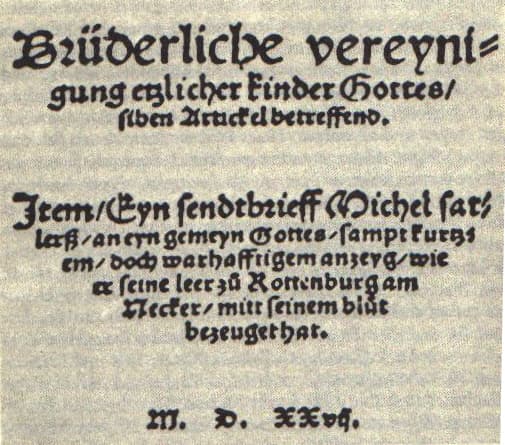
The title of Brüderliche vereynigung etzlicher kinder Gottes, siben Artickel betreffend, 1527. Public domain.
Therefore go and make disciples of all nations, baptizing them in the name of the Father, and of the Son, and of the Holy Spirit,
Summary
The articles set the Brethren's rule on baptism, the ban and the breaking of bread. They also rule on separation, pastors, the sword and the oath.
- Calvin called the articles “cette belle Resolution cornue.” Böhmer says Calvin held them a very slight work.
- At the trial the town clerk of Ensisheim called Sattler a “villain and monk.”
- Sattler's short answers to the court included “God's will be done” and “God will judge aright.”
- Zwingli said the Brethren had conspired. He said they gave it “a more respectable nomenclature” when they called it an agreement.
The Verses the Articles Name
Two of the seven articles cite their Scripture by name.
The other five echo Scripture, and Böhmer's edition supplies their references in square brackets.
If your brother sins against you, go and confront him privately. If he listens to you, you have won your brother over.The second article names Matthew 18 for the warning in private.
The Seven Articles
The seven articles stand one to a row, in their own order.
The articles run from baptism to the oath, and the sixth and seventh set the Brethren apart from the magistrate.
| Article | What it says | The verse |
|---|---|---|
| 1. Baptism | Baptism belongs to those taught repentance and a change of life, and not to infants. | Matthew 28, the article's own |
| 2. The ban | A member who falls is warned twice in private and the third time before the church, before the breaking of bread. | Matthew 18, the article's own |
| 3. The breaking of bread | Those who break the one bread must first be united into the one body of Christ by baptism. | 1 Corinthians 10:21, the modern editor's addition |
| 4. Separation | The Brethren hold no fellowship with the world's evils, and its weapons of violence fall away. | 2 Corinthians 6:17, the modern editor's addition |
| 5. Shepherds | A pastor of good report serves, and another takes his place at once if he is expelled or led to the Lord through the cross. | 1 Timothy 3:7, the modern editor's addition |
| 6. The sword | The sword is God's ordinance outside the perfection of Christ, and inside it the church uses the ban alone. | 1 Peter 2:21, the modern editor's addition |
| 7. The oath | Christ forbids all swearing. | Matthew 5:34, the modern editor's addition |
The Story From Zurich in 1525 to Calvin in 1544
Nineteen years separate Sattler's banishment from Zurich and Calvin's answer to the articles.
Zurich banished “Michael Sattler of Staufen, in Breisgau,” with others of the Brethren on 18 November 1525, as Newman and Burrage both report.
The Brethren met on St. Matthias' day in 1527, which Böhmer gives as 24 February. Their letter says some false brethren had caused great offence, turning from the faith while they claimed the freedom of the Spirit and of Christ.
McGlothlin's English of its close reads, “there has been, therefore, need that we be agreed in the Lord.”
Those who belong to Christ Jesus have crucified the flesh with its passions and desires.The letter sets against the false brethren those who have crucified the flesh, which Böhmer matches to this verse.
The articles went out in German print with Sattler's letter and the account of his death at Rottenburg.
Berchtold Haller sent Zwingli a copy in April as the confession of the Bernese Brethren. Zwingli dated his Latin refutation of it 31 July.
“Therefore come out from among them and be separate, says the Lord. Touch no unclean thing, and I will receive you.”Böhmer matches the fourth article, on separation, to this verse.
Sattler and the brethren of Horb were taken to Binzdorf, and from the tower there he wrote to the church at Horb.
He told them to put away the false brethren from among them. He asked that if he were “offered up to the Lord” they would care for his wife.
to sanctify her, cleansing her by the washing with water through the word,Sattler's letter to Horb cites this verse where it calls the church cleansed through Christ's blood.
The Martyrs Mirror lists nine charges. The first was that he and his followers had acted against the emperor's mandate. The eighth was that he had left his order and married, and the ninth that he had said the Turks should not be resisted.
He answered that he took a wife “according to the command of God.” When the judge asked whether he would commit his case to the law, he would not.
For he is God’s servant for your good. But if you do wrong, be afraid, for he does not carry the sword in vain. He is God’s servant, an agent of retribution to the wrongdoer.The Mirror sets this verse after his speech that told the judges to consider why God had appointed them.
The Mirror holds the trial on the day he died and dates the sentence 21 May. His tongue was cut out, his body torn with red-hot tongs, and he was burned.
Newman gives the day as 20 May. His wife “remained very steadfast,” the Mirror says, and was drowned a few days after him in the Neckar.
For to this you were called, because Christ also suffered for you, leaving you an example, that you should follow in His footsteps:Böhmer matches the sixth article's appeal to Christ's example to this verse.
Zwingli wrote of the Brethren, “These most seditious men therefore would take away the sword so that they may the more freely throw all into confusion,” and of the seventh article, “Take away the oath and you have dissolved all order.”
Calvin answered the articles in 1544. Böhmer says he cited only the first, second, sixth and seventh, knew neither where they were made nor who wrote them, and called the martyr of the story printed after them “je ne say quel Michel.”
Burrage adds that the evangelical pastors of Strasbourg, after Sattler's death, “did not hesitate to call him a martyr of Christ.” Newman says that even Bucer could speak of him so.
But I tell you not to swear at all: either by heaven, for it is God’s throne;Böhmer matches the seventh article, which Zwingli answered on the oath, to this verse.
Ephesians 5:26, Romans 13:4, 1 Peter 2:21, Matthew 5:34
Who Tells the Story
Two witnesses took a side, and a third edited the German text.
The trial comes from the Martyrs Mirror, the movement's own book of its martyrs. Van Braght compiled it, and Joseph Sohm put it into English in 1886. It records the Brethren's side.
The articles survive in German and in Zwingli's Latin, which Henry Preble put into English in 1901. Zwingli was their opponent, and he printed them to refute them.
Heinrich Böhmer printed the German text at Bonn in 1910.
What the Record Leaves Unsaid
Three questions about the people and the papers stay open.
The Martyrs Mirror and Burrage tell of Sattler's wife without giving her name. Böhmer names Sattler as the leader who sent the articles out, and Newman calls him “probably the author,” so the writer is not certain.
The other letters of the Pressburg manuscript have not been printed or tested, Böhmer wrote in 1910.
How the Key Verse Was Taught
Three writers of three centuries on Matthew 28:19.
Gregory of Nazianzus (died 390)
Oration 31, the Fifth Theological Oration, section 10
The first defends the Spirit, named in the verse beside the Father and the Son, as fully divine.
“What then? Is the Spirit God? Most certainly. Well then, is He Consubstantial? Yes, if He is God.”
Patristic
William Carey (1761 to 1834)
An Enquiry, Section I (1792)
The second turns the verse into a call for missions.
“This commission was as extensive as possible, and laid them under obligation to disperse themselves into every country of the habitable globe, and preach to all the inhabitants, without exception, or limitation.”
Particular Baptist
E. N. Bell (1866 to 1923)
The Sad New Issue, in the Weekly Evangel of 5 June 1915, page 1
The third defends the verse's threefold name against doubt about its origin.
“If the New Testament is true, as we believe it is, Christ is the inventor and author of it. Matthew is the oldest history we know of on this Trinitarian formula. He was an Apostle of Jesus. What is wrong with his history?”
Pentecostal
In Their Own Words
Two sayings come from Sattler's trial and two from his last letter.
Michael Sattler (died 1527)
his answer at his trial (1527), in Thieleman J. van Braght, Martyrs Mirror (1660), translated by Joseph F. Sohm (Elkhart, 1886), page 418
Sent to bear witness
“Ye ministers of God, I am not sent to judge the Word of God; we are sent to bear witness of it, and, hence, cannot consent to any law, since we have no command from God concerning it”
Swiss Anabaptist
About this saying1 paragraph
Before he was sentenced, he gave the court his reason for refusing its law.
Michael Sattler
his answer at his trial (1527), in Thieleman J. van Braght, Martyrs Mirror (1660), translated by Joseph F. Sohm (Elkhart, 1886), page 417
Turks after the spirit
“The Turk is a true Turk, knows nothing of the Christian faith; and is a Turk after the flesh; but you, who would be Christians, and who make your boast of Christ, persecute the pious witnesses of Christ, and are Turks after the spirit.”
Swiss Anabaptist
About this saying1 paragraph
After he heard the charges read, he turned the one about the Turks back on his judges.
Michael Sattler
his letter to the church of God at Horb (1527), in Thieleman J. van Braght, Martyrs Mirror (1660), translated by Joseph F. Sohm (Elkhart, 1886), page 420
Another laborer
“I did indeed desire, and it would have been profitable, I trust, if I had labored a little while longer in the work of the Lord; but it is better for me, to be released, and to await with Christ the hope of the blessed. The Lord is able to raise up another laborer to finish this work.”
Swiss Anabaptist
About this saying1 paragraph
While he waited in the tower, he set his coming death beside the church's need of him.
Michael Sattler
his letter to the church of God at Horb (1527), in Thieleman J. van Braght, Martyrs Mirror (1660), translated by Joseph F. Sohm (Elkhart, 1886), page 420
Remember our assembly
“Remember our assembly, and strictly follow that which was resolved on therein; and if anything has been forgotten, pray the Lord for understanding.”
Swiss Anabaptist
About this saying1 paragraph
The meeting he points to is most likely the one of February 1527.
Michael Sattler, Michael Sattler
Where Historians Disagree
Three questions of the articles, with the writers who answer them.
Where did they meet?2 paragraphs
The document twice names Schlaten am Randen, and Böhmer placed it at Schlatt am Randen, in the district of Engen in Baden. McGlothlin gave Schlatten am Randen, near Schaffhausen. Böhmer cites a topographical dictionary for his placing.
Burrage in 1882, Newman in 1897 and Vedder in 1905 call it Schleitheim, and so does Wenger's English of 1945.
The first Anabaptist confession, or one circle's agreement?2 paragraphs
McGlothlin called them the earliest Anabaptist articles, and Calvin wrote that all Anabaptists commonly held to them. Zwingli said almost every Anabaptist had a copy.
The print itself calls the articles a brotherly union of some children of God, and Haller, as Böhmer reports, sent them to Zwingli as the confession of the Bernese Brethren.
Rebels, or subjects who would not bear the sword?2 paragraphs
Zwingli said the Brethren wished “to destroy the magistracy and the power of which it consists,” and would abolish oaths “only for the sake of sedition and tumult.”
The sixth article itself calls the sword an ordinance of God, and Sattler told the court that neither he nor his brethren and sisters had “offended in word or deed against any authority.”
Books to Read Next
Three free books that print the articles or tell the story.
Baptist Confessions of Faith
W. J. McGlothlin · 1911
It gives the seven articles in English, with their date and place.
Read it free onlineSelected Works of Huldreich Zwingli
Samuel Macauley Jackson, editor · 1901
It holds Zwingli's refutation, with the articles inside it.
Read it free onlineA History of the Anabaptists in Switzerland
Henry S. Burrage · 1882
It follows the Swiss Brethren from Zurich to Sattler's death.
Read it free onlineWhat the Articles Left
The articles kept their standing among the Brethren thirty years on. Böhmer counts a letter of 1557 from the Anabaptist assembly at Strasbourg to the Dutch brethren among its proofs.
Sources
Scripture is the Berean Standard Bible.
- The Holy Bible, Berean Standard Bible (read 2026)
- Heinrich Böhmer, editor, Urkunden zur Geschichte des Bauernkrieges und der Wiedertäufer (Bonn: A. Marcus und E. Weber, 1910), Kleine Texte 50 and 51, part IV, pages 25 to 35.
- W. J. McGlothlin, Baptist Confessions of Faith (Philadelphia: American Baptist Publication Society, 1911), pages 2 to 9.
- Huldreich Zwingli, Refutation of the Tricks of the Catabaptists (1527), translated by Henry Preble, in Samuel Macauley Jackson, editor, Selected Works of Huldreich Zwingli (Philadelphia, 1901), pages 158, 177 to 178, 196 to 198, 206 to 208 and 218.
- Thieleman J. van Braght, Martyrs Mirror (1660), translated by Joseph F. Sohm (Elkhart, 1886), Michael Sattler, A. D. 1527, pages 416 to 420.
- Henry S. Burrage, A History of the Anabaptists in Switzerland (Philadelphia, 1882), pages 142 and 219.
- A. H. Newman, A History of Anti-Pedobaptism (Philadelphia: American Baptist Publication Society, 1897), pages 137 and 243 to 244.
- Henry C. Vedder, Balthasar Hübmaier (New York, 1905), pages 159 and 212.
- J. C. Wenger, translator, The Schleitheim Confession of Faith, Mennonite Quarterly Review XIX, 4 (October 1945), pages 247 to 253, the cover letter.
- Gregory of Nazianzus, Oration 31, the Fifth Theological Oration, section 10, in the Nicene and Post-Nicene Fathers, second series, volume 7.
- William Carey, An Enquiry into the Obligations of Christians to Use Means for the Conversion of the Heathens (1792), section I.
- E. N. Bell, The Sad New Issue, in the Weekly Evangel of 5 June 1915, page 1.
Keep Studying
People and groups9
Doctrines1
Trials of life1
Subjects1
Church history1