
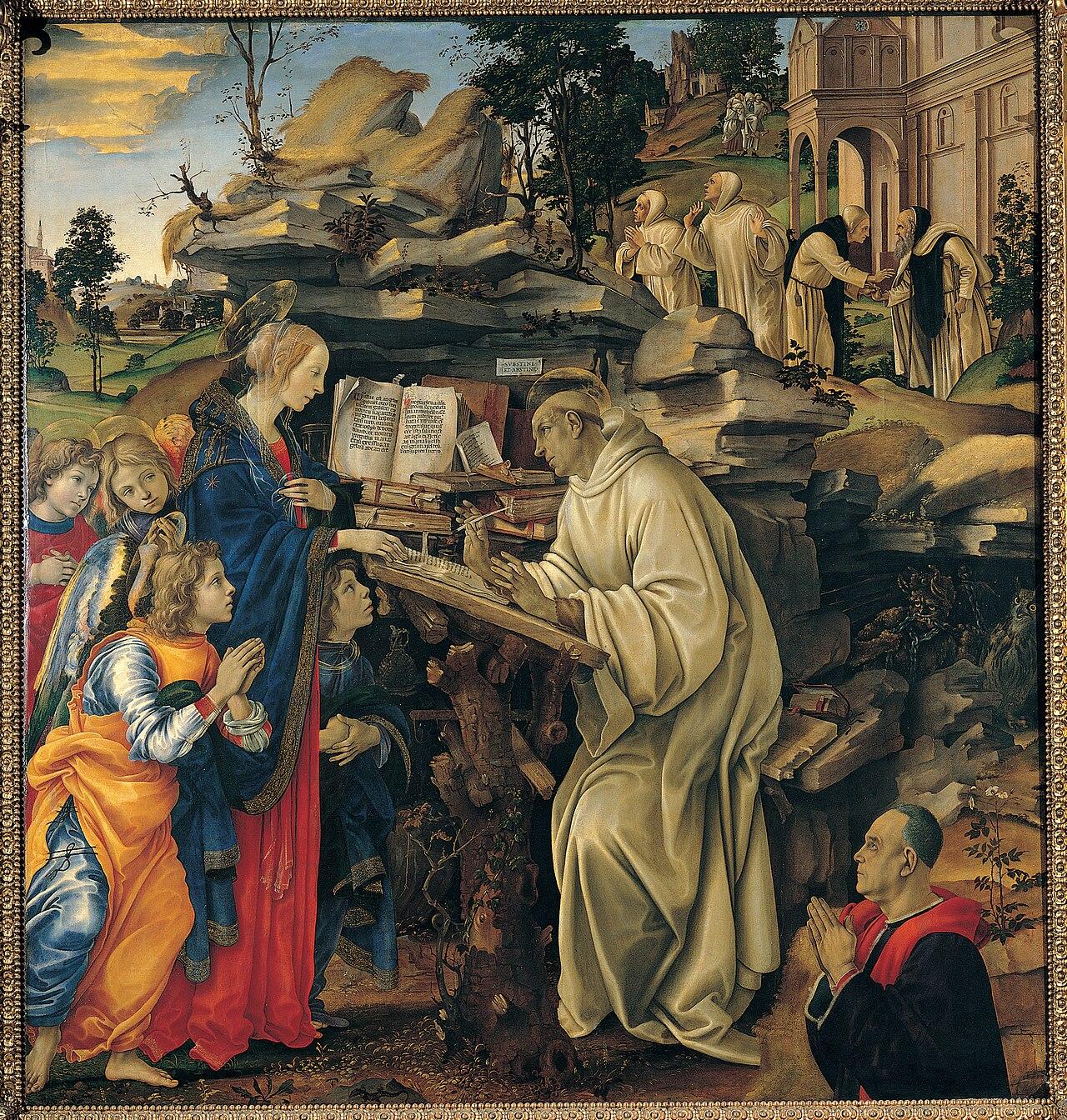
The Apparition of the Virgin to Saint Bernard, Filippino Lippi, 1486. Public domain.
Burgundy and the West, to 1153 · Person · Featured Study
Bernard of Clairvaux
He led the Cistercian abbey of Clairvaux in Burgundy from 1115 until he died there.
He cut up his own robe at Vezelay to make crosses for an army, and that crusade failed.
We love because He first loved us.
- Born
- 1090 by Schaff and Marie Gildas, 1091 by J. C. Morison (probable)
- Died
- 21 August 1153, at Clairvaux
- Family
- father: Tescelin; mother: Aleth; brother: Gerard; sister: Humbeline
- Places
- Fontaines, Citeaux, Clairvaux, Troyes, Sens, Vezelay
Summary
Bernard came from a noble family near Dijon and joined the strict new house at Citeaux with thirty companions. He preached eighty-six sermons on the Song of Songs and reached only the third chapter. Popes and kings came to him for judgment.
- Philip Schaff calls his defence of the Jews in 1146 charity far beyond his age, and the letter itself calls their scattering a penalty.
- He drew the condemnation of Peter Abelard at the Council of Sens.
- Hymns sung under his name are disputed, and M. Haureau denied one of them to him in 1890.
The Love He Preached
He turned to the Song of Songs for his sermons and to the Psalms to defend the Jews.
The question of this life is how one man could write of the love of God as sweetly as he did and also preach an army to the East. He answered a friend's question about how much God is to be loved in a short book, On Loving God. There he gives first place to God's prior love for us.
He gave years of sermons to the book of love in the Old Testament, and he opened with its first words. When a monk stirred up killing on the Rhine, he took up a line of a Psalm to stop it.
Let him kiss me with the kisses of his mouth! For your love is more delightful than wine.He preached his first sermons on this verse, and Sermon 3 takes it as its heading.
Do not kill them, or my people will forget. Scatter them by Your power, and bring them down, O Lord, our shield.He cited this Psalm in his letter of 1146 to argue that the Jews were not to be killed.
The Life in Order
The modern lives and the letters agree on most dates, with two small differences.
From 1128 his life moves between the cloister and the councils.
- 1090 or 1091He was born at Fontaines near DijonGildas (1907); Morison
- 1113He entered Citeaux under Abbot StephenSchaff (1907), section 65; Gildas
- June 1115He went to the Valley of Wormwood and founded ClairvauxMorison; Gildas
- About 1125He wrote his Apologia against the splendour of the monks of ClunyCoulton (1910), number 27; Gildas
- 1128He attended the Council of Troyes and spoke for the TemplarsSchaff, section 65; Gildas
- 1130He judged between two popes in favour of Innocent IIGildas; Schaff, section 65
- 1140 or 1141The Council of Sens condemned Abelard's teachingMorison and Gildas; Schaff, section 99
- Easter 1146He preached the crusade at VezelaySchaff, section 52; Gildas
- 21 August 1153He died at ClairvauxGildas
- About twenty years laterAlexander III canonized himSchaff, section 65
Each step of the life stands with its witness.
1140 or 1141, Easter 1146, 21 August 1153, About twenty years later
From the Wormwood Valley to the World
The story moves between a hard valley in Burgundy and the courts of Europe.
His parents belonged to the high nobility of Burgundy. His mother Aleth died when he was about nineteen, and he was the third of seven children. He went to school at Chatillon, had a gift for poetry and aimed to study Scripture.
Citeaux had been founded to restore the Rule of Benedict in full rigour. He persuaded his brothers and young nobles to go with him, and he lived there on bread and milk or a brew of herbs until his body suffered for it. He later reproached himself for that severity.
Stephen Harding sent him at the head of a band of monks to a wooded valley with a clear stream, and he began by looking for shelter against the winter. William of Saint-Thierry visited and wrote, "The silence of the noon was as the silence of the midnight". His father and his brothers joined him there. His sister Humbeline took the veil in her turn, after he had refused to see her.
When two men claimed the papacy in 1130, he decided for Innocent II and took him to the kings. The people of Milan fell at his feet and would have made him their bishop. He also lectured a pope he had trained, Eugenius III, on the danger of papal business to prayer.
William of Saint-Thierry warned him of Peter Abelard's teaching. He called on the bishops to act at Sens and went over the case with them on the eve of the meeting. Abelard declined to argue and appealed to Rome, and Innocent condemned him.
When Edessa fell, the pope told him to preach a new crusade. At Vezelay the crowd pressed for crosses until he tore up his own habit to make more. He went on along the Rhine, and there he opposed the monk Radulph, who was stirring up attacks on the Jews.
The crusade failed. Critics laid the whole of it on him and said he had claimed to bring a message from God. He answered in his Book of Consideration, comparing the crusaders' sins to those of Israel in the wilderness and himself to Moses, who led the people toward the land and not into it.
The Sermons and the Lives
His works fill many volumes, and the earliest Lives came from friends who wrote to honour him.
Schaff names the first Life, in six parts, by William of Saint-Thierry, begun while Bernard lived, and continued by Gaufrid of Clairvaux and Ernald, abbot of Bona Vallis. Those Lives are full of healings. Schaff finds them well attested by contemporary accounts, and they are the biographers' claims.
Marie Gildas counts 530 letters, and beside the sermons on the Song he counts eighty-six sermons for the whole church year.
Later hands added works under his name, and Gildas lists some that are falsely attributed. He was called the honey-flowing doctor, Schaff reports.
In Their Own Words
Five passages from his sermons, his letters and his Apologia, each with its place.
Bernard of Clairvaux (died 1153)
Sermons on the Song of Songs, Sermon 15
The Name of Jesus
“As honey to the mouth, as melody in the ear, as a song of gladness to the heart, is the Name of Jesus.”
Patristic
About this saying1 paragraph
In Sermon 15 on the Song, from a series he left unfinished at his death in 1153, he comes to the verse on the name poured out like oil.
Bernard of Clairvaux
Sermons on the Song of Songs, Sermon 3
The book of experience
“Turn your minds inward upon yourselves, and let each of you examine his own conscience in regard to those things which are to be mentioned.”
Patristic
About this saying1 paragraph
Early in the same twelfth-century series, he opened Sermon 3 by telling the monks that their reading for the day was the book of experience.
Bernard of Clairvaux
Letter 106, to Henry Murdach, section 2
More in the woods
“Believe one who has tried: you shall find a fuller satisfaction in the woods than in books. The trees and the rocks will teach you that which you cannot hear from masters.”
Patristic
About this saying1 paragraph
In the twelfth century he wrote this to Henry Murdach, a master of the schools, when he urged him to come to the monastery.
Bernard of Clairvaux
Apologia to William of Saint-Thierry (about 1125), in G. G. Coulton, A Medieval Garner (London, 1910), number 27, St Bernard as Puritan
Her stones in gold
“The church is resplendent in her walls, beggarly in her poor; she clothes her stones in gold, and leaves her sons naked; the rich man's eye is fed at the expense of the indigent.”
Patristic
About this saying1 paragraph
He wrote this about 1125 in his Apologia, against the great churches of the Benedictine houses.
Bernard of Clairvaux
Letter 363, Letter 363, section 6
To the people of eastern France
“The Jews must not be persecuted, slaughtered, nor even driven out.”
Patristic
About this saying1 paragraph
He wrote this in Letter 363 of 1146, while the monk Radulph was preaching on the Rhine.
The People Around Him
His family followed him into the cloister, and popes and scholars met him outside it.
He drew his brothers to Clairvaux, and he trained a future pope there.
| Person | Tie to Bernard | The witness |
|---|---|---|
| Aleth | His mother was a deeply pious woman. | Schaff; Gildas |
| Gerard | Bernard mourned this brother in Sermon 26 on the Song. | Eales, volume 4 |
| Humbeline | This sister entered the convent of Jully. | Schaff; Gildas |
| Stephen Harding | This abbot of Citeaux received him and sent him out. | Schaff; Gildas |
| William of Saint-Thierry | This friend visited Clairvaux and began his Life. | Schaff, section 65 |
| Peter the Venerable | This abbot of Cluny stood on the other side of the Apologia. | Schaff, section 65 |
| Innocent II | Bernard won the kings over to this pope's side. | Schaff; Gildas |
| Peter Abelard | Bernard brought his teaching before the bishops at Sens. | Schaff, section 99 |
| Eugenius III | This former monk of Clairvaux received the Book of Consideration. | Schaff; Gildas |
| Radulph | This monk preached attacks on the Jews, and Bernard rebuked him. | Schaff, section 52; Letter 365 |
Innocent II, Peter Abelard, Eugenius III, Radulph
The Places of His Life
He worked from Burgundy, and councils and courts drew him across France and into Italy.
He left Clairvaux often for councils and courts, and he died there.
| Place | What the witnesses say | The witness |
|---|---|---|
| Fontaines | His family's home lay near Dijon. | Schaff; Gildas |
| Citeaux | This abbey stood about four leagues from Dijon. | Gildas |
| Clairvaux | The name replaced the Valley of Wormwood, in the diocese of Langres. | Gildas; Morison |
| Troyes | The council of 1128 met here, and he served as its secretary. | Gildas |
| Etampes | The French bishops met here and left the choice of pope to him. | Gildas |
| Milan | Its people tried to compel him to be their bishop. | Schaff, section 65 |
| Sens | Abelard appealed to Rome here rather than answer him. | Schaff, section 99 |
| Vezelay | He preached the crusade here before King Louis. | Schaff, section 52 |
Sens, Vezelay
What He Taught of Love
He began from the love of God for us, and later readers from Luther to Calvin praised him for it.
On Loving God opens with an answer: "the reason for loving God is God Himself; and the measure of love due to Him is immeasurable love". The chapter goes on to name God's first claim on us, "Because He first loved us".
Schaff reports that Luther said, "Bernard is superior to all the doctors in his sermons, even to Augustine himself, because he preaches Christ most excellently". Schaff also cites Calvin on the Book of Consideration. So the Reformers still read this abbot when they had rejected much else in his world.
How the Key Verse Was Taught
Augustine, John Wesley and Charles Spurgeon read the words on God's first love.
Augustine of Hippo (died 430)
Ten Homilies on the First Epistle of John, Homily 9
Augustine asked how a soul unlovely by its sin could become lovely.
“But our soul, my brethren, is unlovely by reason of iniquity: by loving God it becomes lovely. What a love must that be that makes the lover beautiful!”
Patristic
John Wesley (1703 to 1791)
Explanatory Notes upon the New Testament, on 1 John 4:19
John Wesley named this verse the sum of the whole faith.
“This is the sum of all religion, the genuine model of Christianity. None can say more: why should any one say less, or less intelligibly?”
Evangelical
Charles Spurgeon (1834 to 1892)
The Metropolitan Tabernacle Pulpit, Sermon 1008, Love's Logic
Charles Spurgeon drew from it the order of the two loves.
“It is also clear enough from the text that God’s love is the cause of ours”
Particular Baptist
What the Witnesses Leave Open
Readers differ on small dates and on large questions of his justice, his crusade, his hymns and his last words.
The years of his birth and of SensPhilip Schaff and Marie Gildas; J. C. Morison
Schaff and Gildas give 1090 for his birth, and the title of Morison's Life gives 1091. Morison and Gildas set Sens in 1140, and Schaff sets it in 1141.
Was he fair to Abelard?Philip Schaff; Marie Gildas
Schaff writes that Bernard "saw only evil in views which did not conform strictly to the doctrinal system of the Church". He reports that Bernard called Abelard a ravenous lion and a dragon, and that the bishops seem to have decided before the public session.
Gildas, writing for the Catholic Encyclopedia, says Bernard showed the errors with such clearness that Abelard could make no reply, and that the pope confirmed the council's judgment.
Who bears the failure of the crusade?Bernard, in the Book of Consideration; Marie Gildas; Philip Schaff
Bernard laid the failure on the crusaders' sins. Gildas lays it on the German troops' lack of discipline, the intrigues of the Prince of Antioch and Queen Eleanor and the treason of the nobles of Syria. Gildas adds that he had "not guaranteed its success".
Schaff writes of the Crusade "which he had preached with such warmth" and he records the taunt that Bernard had falsely claimed a message from God.
What was his defence of the Jews?Bernard, Letter 363; Philip Schaff
Schaff says Bernard shows "a spirit of humaneness and Christian charity far beyond his age", and that he wrote that the church should gain the Jews by discussion and not by the sword.
The letter reads Psalm 59 to mean that the Jews "are living signs to us, representing the Lord's Passion", and it says they are scattered to "pay the just penalty of so great a crime". Both stand in the one letter, so a reader must weigh the protection with its ground.
Did he write the hymns?D. S. Schaff; M. Haureau; Samuel Eales
D. S. Schaff lists the hymn Jesu dulcis memoria and the poem behind O Sacred Head among Bernard's works, and he says Bernard influences us "chiefly by his hymns".
Eales reports that Haureau declared positively in 1890 that the first poem is not from Bernard's hand. Eales replies that a passage of Sermon 15 shows the writer, if not Bernard, borrowed his words.
Did he set aside his vow at the end?Martin Luther, Denifle and David S. Schaff
Luther said that at the close of his life Bernard turned from his monk's vow to grace alone, and that he "hung his cowl on the hook and returned to Christ". Denifle replies that Luther joined two sayings Bernard had spoken at different times.
D. S. Schaff grants Denifle's point about the sayings. He holds that Bernard's writings give enough ground for Luther's claim that he rested on grace.
Books to Read Next
Life and Works of Saint Bernard, volume 1
Samuel J. Eales, translator · 1889
This volume holds the first letters, among them the letter on the woods.
Read volume 1 free at the Internet ArchiveLife and Works of Saint Bernard, volume 4
Samuel J. Eales, translator · 1889
This volume holds Sermons 3, 15 and 26 in Eales's English.
Read volume 4 free at the Internet ArchiveThe Life and Times of Saint Bernard
J. Cotter Morison · 1877
Philip Schaff calls Morison's account cool and impartial in his history.
Read Morison free at the Internet ArchiveHistory of the Christian Church, volume 5
Philip Schaff and David S. Schaff · 1907
Section 65 gives the life, and its notes carry the argument over Luther.
Read volume 5 free at CCELWhat Bernard Left
D. S. Schaff wrote in 1907 that the free English of Ray Palmer, "Jesus, thou Joy of loving hearts", was the form of the poem most used in American churches.
Sources
Scripture is the Berean Standard Bible.
- The Holy Bible, Berean Standard Bible (read 2026)
- Philip Schaff and David S. Schaff, History of the Christian Church, volume 5 (1907), sections 52, 65 and the section on Abelard.
- Marie Gildas, St. Bernard of Clairvaux, The Catholic Encyclopedia, volume 2 (1907)
- J. Cotter Morison, The Life and Times of Saint Bernard (Internet Archive copy dated 1877)
- Samuel J. Eales, translator, Life and Works of Saint Bernard, volumes 1, 2 and 4 (Internet Archive dates 1889): Letters 106, 363 and 365; Sermons 3, 15 and 26 on the Song.
- Bernard, On Loving God, chapter 1, in the CCEL text, which names no translator.
- Bernard, Apologia to William of Saint-Thierry, in G. G. Coulton, A Medieval Garner (London, 1910), number 27.
- Augustine, Ten Homilies on the First Epistle of John, Homily 9, translated by H. Browne, Nicene and Post-Nicene Fathers, first series, volume 7 (1888)
- John Wesley, Explanatory Notes upon the New Testament (1755), on 1 John 4:19.
- Charles Spurgeon, The Metropolitan Tabernacle Pulpit, Sermon 1008, Love's Logic.
Keep Studying
Studies1
People and groups9
Subjects1