
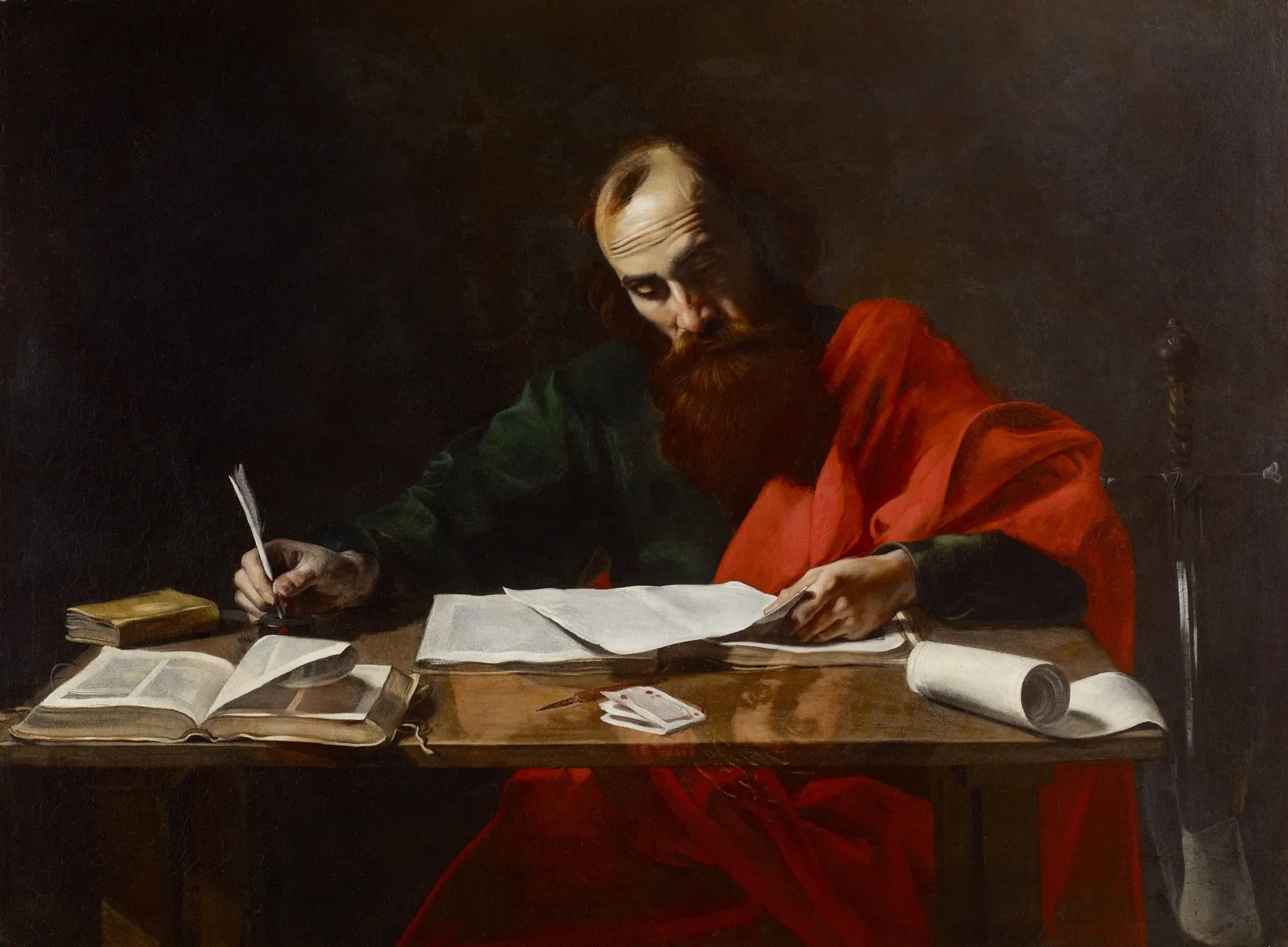
Saint Paul Writing His Epistles, Valentin de Boulogne, about 1618 to 1620, Museum of Fine Arts, Houston. Public domain.
New Testament · Book 45 of 66
Romans
Romans is Paul's letter to the church in Rome, setting out the gospel in order. It shows that all have sinned, that God makes people right with him through faith in Christ, and how believers should live.
Romans is Paul's letter to the church in Rome, setting out the gospel in order. It shows that all have sinned, that God makes people right with him through faith in Christ, and how believers should live.
What is Romans about?
Romans is a letter Paul wrote to the believers in Rome before he had visited them. He opens with the gospel, which he calls “the power of God for salvation to everyone who believes” (1:16). He shows that Gentile and Jew alike stand guilty before God, and that God gives his righteousness as a gift through faith in Christ, as he did to Abraham. He then shows the new life of the Spirit, answers whether God's word to Israel has failed, and turns to how a church lives. It ends with his plans to visit Rome on the way to Spain and his greetings.
All 16 chapters
Every chapter of the book, in one grid. Each cell opens that chapter.
- The gospel and the wrathChapters 1 to 3
- Righteousness by faithChapters 4 to 5
- Freed from sin, death and the lawChapters 6 to 8
- Israel and the mercy of GodChapters 9 to 11
- The living sacrificeChapters 12 to 14
- Paul's plans and greetingsChapters 15 to 16
The colour is the movement of the letter the chapter stands in, and every cell opens that chapter's Study level. Two movements begin inside a chapter, in chapters 3 and 15, and each chapter takes the colour of the movement that holds most of its verses.
Who wrote it, where, when, for whom, and why?
The letter names its writer in its first word, Paul, called to be an apostle (1:1), and his scribe near its end: Tertius wrote it down (16:22). Paul calls himself an Israelite of the tribe of Benjamin (11:1) and the apostle to the Gentiles (11:13). Peter names Paul's letters beside the other Scriptures (2 Peter 3:15 to 16).
Paul, a servant of Christ Jesus, called to be an apostle, and set apart for the gospel of God—
Romans 1:1, Berean Standard Bible.
Paul writes while he is about to carry a gift from Macedonia and Achaia to Jerusalem (15:25 to 26). He commends Phoebe of the church at Cenchrea, the port of Corinth, who carries the letter (16:1 to 2), and sends greetings from Gaius his host and Erastus the city treasurer (16:23). Acts tells of three months Paul spent in Greece before that journey (Acts 20:2 to 3).
The letter stands at the close of Paul's work in the east: he has preached from Jerusalem to Illyricum (15:19) and says his work in those regions is done (15:23). By the text's own order it comes after the collection was gathered and before Paul reached Jerusalem, where Acts records his arrest (Acts 21:33).
It is written to all in Rome who are loved by God and called to be saints (1:7), a church whose faith is spoken of in all the world (1:8). Paul speaks to Gentiles among them (11:13) and to those who know the law (7:1), and greets a house church that meets with Prisca and Aquila (16:5).
Paul says he has long wanted to come to Rome to impart a spiritual gift and to preach the gospel there (1:11 and 15). He writes to prepare his visit on the way to Spain and to be sent on by them (15:24), to ask their prayers for the journey to Jerusalem (15:30 to 31), and to set out the gospel he preaches in full.
Sources. Romans 1:1, 1:7 to 8, 1:11, 1:15, 7:1, 11:1, 11:13, 15:19, 15:23 to 26, 15:30 to 31, 16:1 to 2, 16:5, 16:22 to 23; Acts 20:2 to 3, 21:33; 2 Peter 3:15 to 16. Every verse is read in the Berean Standard Bible.
How is Romans arranged, and what is it for?
The six movements the letter falls into, then what it teaches and what it was written to do.
- The gospel and the wrath1:1 to 3:20, 81 verses, the turn at 1:17
Paul greets Rome, names the gospel as God's power, and shows Gentile and Jew alike under sin.
- Righteousness by faith3:21 to 5:21, 57 verses, the turn at 3:21
God's righteousness given through faith in Christ, proved in Abraham, ending in peace with God.
- Freed from sin, death and the law6 to 8, 87 verses, the turn at 8:1
Baptized into Christ's death, released from the law, and given life by the Spirit.
- Israel and the mercy of God9 to 11, 90 verses, the turn at 11:32
Whether God's word to Israel has failed, answered from election, the word of faith and the olive tree.
- The living sacrifice12:1 to 15:13, 71 verses, the turn at 12:1
The life that answers God's mercy: the renewed mind, love, the authorities, the weak and the strong.
- Paul's plans and greetings15:14 to 16:27, 46 verses, the turn at 15:24
Paul's priestly work among the nations, his road to Jerusalem and Spain, and the greetings.
The theme
God's righteousness, revealed in the gospel, is given to everyone who believes, Jew and Gentile alike. The letter first shows why every person needs it, then how God gives it through the death of Christ and counts it to faith, then what life it brings through the Spirit. It then shows that God's promise to Israel has not failed, and ends with the worship of a life offered back to him.
The purpose
Paul wrote to a church he had often planned to visit (1:13), to prepare his visit and to win its help for the mission to Spain. He sets out his gospel so that Jewish and Gentile believers in Rome would receive one another as Christ received them (15:7), and he closes by giving glory to the God who makes the mystery known to all nations.
The letter climbs by six hinge sentences
- Step 1, The gospel and the wrathRomans 1:16 to 17
“the power of God for salvation to everyone who believes”
The thesis: the gospel reveals God's righteousness by faith.
- Step 2, Righteousness by faithRomans 3:21
“But now, apart from the law, the righteousness of God has been revealed”
After the charge against all, the turn to the gift.
- Step 3, Righteousness by faithRomans 5:1
“since we have been justified through faith, we have peace with God”
What justification brings: peace with God and hope.
- Step 4, Freed from sin, death and the lawRomans 8:1
“there is now no condemnation for those who are in Christ Jesus”
The answer to the cry of 7:24: life in the Spirit.
- Step 5, Israel and the mercy of GodRomans 11:32
“so that He may have mercy on everyone”
The end of the argument over Israel: mercy on all.
- Step 6, The living sacrificeRomans 12:1
“to offer your bodies as living sacrifices”
The turn from what God has done to how his people live.
The gospel and the wrath, Romans 1:1 to 3:20
What chapters 1 to 3 say, and the pages they open on.
Paul greets the church, gives thanks for its faith and names his debt to Greeks and non-Greeks alike. He states his theme: the gospel reveals God's righteousness by faith (1:16 to 17). Then he turns to God's wrath against people who knew God and did not honour him, and who were given over to what they chose. The one who judges others does the same things, and the Jew who has the law and breaks it stands with the Gentile. The Jew's advantage is real, for Israel was given the words of God, yet a chain of Scripture shows that no one is righteous and every mouth is silenced (3:19).
For the gospel reveals the righteousness of God that comes by faith from start to finish, just as it is written: “The righteous will live by faith.”
- Study
Romans 1the gospel of God's power, and the wrath on the ungodlyShow the summary and 5 pagesShow summary, 5 pagesHide the summary
Paul greets the Roman saints and unveils his theme: the gospel is the power of God for salvation for Jew first and also Greek. Humanity's descent is traced. The truth suppressed, the Creator exchanged for images, God giving men over to the passions they chose. The wrath of God is revealed against all ungodliness. Henry reads the chapter as a moral charge-sheet; Calvin marks that even the heathen are without excuse because the knowledge of God was given them. The courtroom is set; the gospel's necessity is proven.
On this chapter (5)
- The Romans Road
Verses of Romans used to explain the gospel.
- Faith
Faith from start to finish.
- When and from where did Paul write Romans?
Answered under Where do readers disagree, lower on this page, with each reading and who holds it.
- What is the righteousness of God in 1:17?
Answered under Where do readers disagree, lower on this page, with each reading and who holds it.
- Romans 1:16
The verse on its own page, with the commentators on it by era.
- The Romans Road
- Study
Romans 2judgment by truth, the law and the heartShow the summary and 1 pageShow summary, 1 pageHide the summary
The self-righteous moralist standing in judgment on others is exposed standing under the same judgment. God's judgment is according to truth, according to deeds, without partiality. Paul then addresses the Jew. To whom the law is given. And argues that circumcision without obedience is no better than uncircumcision with it. The true Jew is inward; circumcision of the heart, by the Spirit. JFB notes the rhetorical turn: privilege unaccompanied by obedience heightens guilt. The letter accuses; only the doer is justified before God.
On this chapter (1)
- Romans 2:11
The verse on its own page, with the commentators on it by era.
- Romans 2:11
- Study
Romans 3the Jew's advantage, none righteous, and the turn to the giftShow the summary and 4 pagesShow summary, 4 pagesHide the summary
What advantage, then, has the Jew? Much every way. Chiefly, the oracles of God. Yet every mouth is stopped. Paul catalogues the Psalms and Prophets to show Jew and Greek alike under sin. Then the pivot: a righteousness of God manifested apart from the law, witnessed by the law and prophets, by faith in Jesus Christ. Boasting is excluded, not by the law of works but by the law of faith. Calvin marks this as the heart of the letter. Justification by faith, impartial to the two peoples.
On this chapter (4)
- The Romans Road
Verses of Romans used to explain the gospel.
- Justification by faith
The verdict of the cross.
- The mercy seat
The lid of the ark, and the atoning sacrifice of 3:25.
- Romans 3:23
The verse on its own page, with the commentators on it by era.
- The Romans Road
The charge of 3:10 to 18 is built from the Psalms and Isaiah
- Romans 3:10As it is written: “There is no one righteous, not even one.Psalm 14:1The fool says in his heart, “There is no God.” They are corrupt; their acts are vile. There is no one who does good.
- Romans 3:13“Their throats are open graves; their tongues practice deceit.” “The venom of vipers is on their lips.”Psalm 5:9For not a word they speak can be trusted; destruction lies within them. Their throats are open graves; their tongues practice deceit.
- Romans 3:13the same verse, second sourcePsalm 140:3They sharpen their tongues like snakes; the venom of vipers is on their lips. Selah
- Romans 3:14“Their mouths are full of cursing and bitterness.”Psalm 10:7His mouth is full of cursing, deceit, and violence; trouble and malice are under his tongue.
- Romans 3:15“Their feet are swift to shed blood;Isaiah 59:7Their feet run to evil; they are swift to shed innocent blood. Their thoughts are sinful thoughts; ruin and destruction lie in their wake.
- Romans 3:18“There is no fear of God before their eyes.”Psalm 36:1An oracle is in my heart regarding the transgression of the wicked man: There is no fear of God before his eyes.
Characters (2)
Who the text names. A name with a page carries its door.
Themes (2)
What these chapters raise, each on its own page.
- The Romans Road
Verses of Romans used to explain the gospel.
- Faith
Faith from start to finish, the ground of the letter.
Where these chapters take up the Old Testament (9)each marked as the store marks it, with the letters beside it
- Explicit quotationRomans 1:17 at Habakkuk 2:4. Marked a quotation in the store's table of quotations.
- Explicit quotationRomans 2:24 at Isaiah 52:5. Marked a quotation in the store's table of quotations.
- Explicit quotationRomans 3:4 at Psalm 51:4. Marked a quotation in the store's table of quotations.
- Explicit quotationRomans 3:10 at Psalm 14:1. Marked a quotation in the store's table of quotations.
- Explicit quotationRomans 3:13 at Psalm 5:9. Marked a quotation in the store's table of quotations.
- Explicit quotationRomans 3:13 at Psalm 140:3. Marked a quotation in the store's table of quotations.
- Explicit quotationRomans 3:14 at Psalm 10:7. Marked a quotation in the store's table of quotations.
- Explicit quotationRomans 3:15 at Isaiah 59:7. Marked a quotation in the store's table of quotations.
- Explicit quotationRomans 3:18 at Psalm 36:1. Marked a quotation in the store's table of quotations.
Beside it in Paul's other letters and in Acts: Romans 1:17 with Galatians 3:11; Romans 1:1 with Acts 20:24, the store's cross references with the most votes.
Righteousness by faith, Romans 3:21 to 5:21
What chapters 4 to 5 say, and the pages they open on.
But now God's righteousness has been revealed apart from the law through faith in Christ, for all who believe. God presented Christ as the atoning sacrifice in his blood, so that he is just and justifies the one who has faith in Jesus. Boasting is excluded. Abraham believed God and it was credited to him as righteousness before he was circumcised, so he is the father of all who believe. Justified by faith, believers have peace with God and a hope that suffering does not shame. Adam brought sin and death to all, and Christ, the one man, brings the gift of righteousness and life.
But now, apart from the law, the righteousness of God has been revealed, as attested by the Law and the Prophets.
- Study
Romans 4Abraham counted righteous by faith, David's blessingShow the summary and 2 pagesShow summary, 2 pagesHide the summary
Abraham justified by faith. Before circumcision, therefore father of believing Gentiles too. David's blessedness (Ps 32) echoes the same gospel. Paul argues by chronology: righteousness was imputed before the covenant sign. The promise therefore flows by faith, that it might be by grace, and sure to all the seed. Abraham believed against hope, giving glory to God; his faith is a pattern for every Christian. Matthew Henry reads the chapter as the great Scriptural argument for justification by faith, anchored in a single test-case believer.
On this chapter (2)
- Justification by faith
The verdict of the cross.
- Romans 4:3
The verse on its own page, with the commentators on it by era.
- Justification by faith
- Study
Romans 5peace with God, and Adam and ChristShow the summary and 3 pagesShow summary, 3 pagesHide the summary
Being justified by faith, we have peace with God. Tribulation worketh patience; God commends his love in that while yet sinners Christ died for us. The two-Adam comparison unfolds: one man's disobedience brought death upon all; one man's obedience brings righteousness and life to many. The law entered to enlarge the reckoning of sin. Where sin abounded, grace did much more abound. Wesley stresses the breadth of the benefit. As broad as Adam's curse, so broad is Christ's remedy, for all who receive him.
On this chapter (3)
- The two Adams
One man, one act, one result.
- The Romans Road
Verses of Romans used to explain the gospel.
- Romans 5:8
The verse on its own page, with the commentators on it by era.
- The two Adams
Adam and Christ, the one man and the one man
In each row the first line is through adam and the second through christ.
Characters (3)
Who the text names. A name with a page carries its door.
Themes (3)
What these chapters raise, each on its own page.
- Justification by faith
The verdict of the cross.
- The two Adams
One man, one act, one result.
- The new perspective on Paul
A newer reading of the works of the law.
Where these chapters take up the Old Testament (4)each marked as the store marks it, with the letters beside it
- Explicit quotationRomans 4:3 at Genesis 15:6. Marked a quotation in the store's table of quotations.
- Explicit quotationRomans 4:7 at Psalm 32:1. Marked a quotation in the store's table of quotations.
- Explicit quotationRomans 4:17 at Genesis 17:5. Marked a quotation in the store's table of quotations.
- Explicit quotationRomans 4:18 at Genesis 15:5. Marked a quotation in the store's table of quotations.
Beside it in Paul's other letters and in Acts: Romans 5:5 with Galatians 4:6; Romans 5:1 with Acts 13:38 to 39, the store's cross references with the most votes.
Freed from sin, death and the law, Romans 6 to 8
What chapters 6 to 8 say, and the pages they open on.
Should believers go on sinning so that grace may increase? Paul answers that they were baptized into Christ's death and raised to walk in new life, and are now slaves of righteousness. A woman is released from the law of her husband by his death, and believers have died to the law through the body of Christ. The law is holy, yet sin used it to bring death, and the chapter ends with the cry of a wretched man (7:24). Chapter 8 opens with no condemnation for those who are in Christ. The Spirit gives life, makes them children and heirs, helps them in weakness, and nothing can separate them from God's love.
Therefore, there is now no condemnation for those who are in Christ Jesus.
- Study
Romans 6baptized into his death, slaves of righteousnessShow the summary and 2 pagesShow summary, 2 pagesHide the summary
Shall we continue in sin that grace may abound? God forbid. The believer has died with Christ in baptism and is raised to walk in newness of life. Sin shall not have dominion over you, for you are not under the law but under grace. Paul commands: yield your members as servants of righteousness. The wages of sin is death; the gift of God, eternal life. Calvin calls this chapter the answer to every antinomian misreading of justification. Union with Christ ends sin's reign.
On this chapter (2)
- The Romans Road
Verses of Romans used to explain the gospel.
- Romans 6:23
The verse on its own page, with the commentators on it by era.
- The Romans Road
- Study
Romans 7released from the law, and the wretched manShow the summary and 3 pagesShow summary, 3 pagesHide the summary
The law has dominion over a man as long as he liveth; believers are dead to the law through the body of Christ, that they should be married to another. Paul then paints the awakened conscience under law: what I would, I do not; what I would not, that I do. O wretched man! Who shall deliver me? I thank God through Jesus Christ our Lord. Henry shows the chapter preparing chapter 8's deliverance; Calvin sees in it the believer's continuing humbling under inward sin's pull.
On this chapter (3)
- The divided self
The struggle of Romans 7 and its readings.
- Who is the "I" of chapter 7?
Answered under Where do readers disagree, lower on this page, with each reading and who holds it.
- Romans 7:24
The verse on its own page, with the commentators on it by era.
- The divided self
- Study
Romans 8no condemnation, the Spirit, and no separationShow the summary and 2 pagesShow summary, 2 pagesHide the summary
No condemnation to them that are in Christ Jesus. The law of the Spirit of life has freed them from the law of sin and death. Children of God by adoption; the Spirit bears witness with our spirit. All things work together for good to them that love God. Creation groans; the Spirit intercedes. Who shall separate us from the love of Christ? Neither life nor death, height nor depth, shall separate us. Calvin marks this as a chapter to be written on every heart. The believer's charter.
On this chapter (2)
- No condemnation
The arc of Romans 8.
- Romans 8:28
The verse on its own page, with the commentators on it by era.
- No condemnation
The I of chapter 7 beside the Spirit of chapter 8
In each row the first line is the i of chapter 7 and the second the spirit of chapter 8.
Characters (1)
Who the text names. A name with a page carries its door.
- The Spirit
The Spirit of life who sets free, testifies and intercedes (8:2, 8:16, 8:26).
Themes (3)
What these chapters raise, each on its own page.
- No condemnation
The arc of Romans 8.
- The divided self
The struggle of Romans 7 and its readings.
- The law fulfilled
What Christ did with the law.
Where these chapters take up the Old Testament (1)each marked as the store marks it, with the letters beside it
- Explicit quotationRomans 8:36 at Psalm 44:22. Marked a quotation in the store's table of quotations.
Beside it in Paul's other letters and in Acts: Romans 8:1 with Galatians 3:13; Romans 8:18 with Acts 20:24, the store's cross references with the most votes.
Israel and the mercy of God, Romans 9 to 11
What chapters 9 to 11 say, and the pages they open on.
Paul grieves for Israel, to whom belong the adoption, the covenants and the promises, and from whom comes the Christ (9:4 to 5). Not all descended from Israel are Israel: the children of the promise are counted, as with Isaac and Jacob, and God has mercy on whom he will. Israel pursued righteousness by works and stumbled over the stone, while the word of faith is near, and everyone who calls on the name of the Lord will be saved. God has not rejected his people; a remnant stands, as in Elijah's day. Branches of the olive tree were broken off and wild ones grafted in, and the natural branches can be grafted back. All Israel will be saved, and Paul ends in praise of God's wisdom.
For God has consigned everyone to disobedience so that He may have mercy on everyone.
- Study
Romans 9Paul's grief, the children of promise, the potterShow the summary and 4 pagesShow summary, 4 pagesHide the summary
Paul's heart's grief for his kinsmen according to the flesh, for whom he could wish himself accursed. Not all Israel are of Israel; the promise flows through election. Potter and clay; vessels of mercy and of wrath. Gentiles have attained; Israel has stumbled at the stone appointed. JFB reads the chapter theologically, tracing sovereign mercy without demeaning Israel's privileges. The chapter names a mystery without collapsing it. God's purposive election without injustice to any.
On this chapter (4)
- Predestination and election
The readings of God's choosing.
- Israel and the olive tree
Romans 9 to 11 read in full.
- What do chapters 9 to 11 teach of election and of Israel?
Answered under Where do readers disagree, lower on this page, with each reading and who holds it.
- Romans 9:6
The verse on its own page, with the commentators on it by era.
- Predestination and election
- Study
Romans 10the righteousness of faith and the word nearShow the summary and 3 pagesShow summary, 3 pagesHide the summary
Paul's desire is their salvation. Israel has a zeal, but not according to knowledge; seeking to establish their own, they submitted not to God's. Christ is the end of the law for righteousness to everyone who believes. Confess with the mouth, believe in the heart. You will be saved. Faith comes by hearing, and hearing by the word of God. Isaiah's lament: Lord, who has believed our report? Wesley stresses the open door. Whosoever shall call upon the name of the Lord shall be saved.
On this chapter (3)
- The Romans Road
Verses of Romans used to explain the gospel.
- The new perspective on Paul
A newer reading of the works of the law.
- Romans 10:9
The verse on its own page, with the commentators on it by era.
- The Romans Road
- Study
Romans 11the remnant, the olive tree, all Israel savedShow the summary and 4 pagesShow summary, 4 pagesHide the summary
Has God cast away his people? God forbid. Paul himself is an Israelite. A remnant according to the election of grace is preserved. The olive tree's natural branches have been broken off for unbelief; Gentile branches have been grafted in by faith. Israel's hardening is in part, until the fulness of the Gentiles be come in. And so all Israel shall be saved. Henry marks the doxology: O the depth of the riches both of the wisdom and knowledge of God. Unsearchable his judgments, past finding out his ways.
On this chapter (4)
- Israel and the olive tree
Romans 9 to 11 read in full.
- Why God is not finished with Israel
God's promise to Israel still stands.
- The remnant
The faithful few in every age.
- Romans 11:26
The verse on its own page, with the commentators on it by era.
- Israel and the olive tree
The olive tree: broken off, grafted in, grafted back
The parts (5)
- 1The root11:16“if the root is holy, so are the branches”
- 2Natural branches broken off11:20“They were broken off because of unbelief”
- 3Wild branches grafted in11:17“you, a wild olive shoot, have been grafted in among the others”
- 4The root supports11:18“You do not support the root, but the root supports you”
- 5Natural branches grafted back11:24“the natural branches, be grafted into their own olive tree”
Green is the cultivated tree and its natural branches; yellow is the wild shoots; a dashed branch is broken off.
Characters (4)
Who the text names. A name with a page carries its door.
Places (1)
Where the chapters stand.
- Zion
The stone laid there, and the Deliverer who will come from it (9:33, 11:26).
Themes (4)
What these chapters raise, each on its own page.
- Israel and the olive tree
Romans 9 to 11 read in full.
- Why God is not finished with Israel
God's promise to Israel still stands.
- Predestination and election
The readings of God's choosing.
- The remnant
The faithful few in every age.
Where these chapters take up the Old Testament (27)each marked as the store marks it, with the letters beside it
- Explicit quotationRomans 9:7 at Genesis 21:12. Marked a quotation in the store's table of quotations.
- Explicit quotationRomans 9:9 at Genesis 18:10. Marked a quotation in the store's table of quotations.
- Explicit quotationRomans 9:12 at Genesis 25:23. Marked a quotation in the store's table of quotations.
- Explicit quotationRomans 9:13 at Malachi 1:2. Marked a quotation in the store's table of quotations.
- Explicit quotationRomans 9:15 at Exodus 33:19. Marked a quotation in the store's table of quotations.
- Explicit quotationRomans 9:17 at Exodus 9:16. Marked a quotation in the store's table of quotations.
- Explicit quotationRomans 9:25 at Hosea 2:23. Marked a quotation in the store's table of quotations.
- Explicit quotationRomans 9:26 at Hosea 1:10. Marked a quotation in the store's table of quotations.
- Explicit quotationRomans 9:27 at Isaiah 10:22. Marked a quotation in the store's table of quotations.
- Explicit quotationRomans 9:29 at Isaiah 1:9. Marked a quotation in the store's table of quotations.
- Explicit quotationRomans 9:33 at Isaiah 28:16. Marked a quotation in the store's table of quotations.
- Explicit quotationRomans 10:5 at Leviticus 18:5. Marked a quotation in the store's table of quotations.
- Explicit quotationRomans 10:6 at Deuteronomy 30:12. Marked a quotation in the store's table of quotations.
- Explicit quotationRomans 10:11 at Isaiah 28:16. Marked a quotation in the store's table of quotations.
- Explicit quotationRomans 10:13 at Joel 2:32. Marked a quotation in the store's table of quotations.
- Explicit quotationRomans 10:15 at Isaiah 52:7. Marked a quotation in the store's table of quotations.
- Explicit quotationRomans 10:16 at Isaiah 53:1. Marked a quotation in the store's table of quotations.
- Explicit quotationRomans 10:18 at Psalm 19:4. Marked a quotation in the store's table of quotations.
- Explicit quotationRomans 10:19 at Deuteronomy 32:21. Marked a quotation in the store's table of quotations.
- Explicit quotationRomans 10:20 at Isaiah 65:1. Marked a quotation in the store's table of quotations.
- Explicit quotationRomans 10:21 at Isaiah 65:2. Marked a quotation in the store's table of quotations.
- Explicit quotationRomans 11:3 at 1 Kings 19:10. Marked a quotation in the store's table of quotations.
- Explicit quotationRomans 11:4 at 1 Kings 19:18. Marked a quotation in the store's table of quotations.
- Explicit quotationRomans 11:8 at Isaiah 29:10. Marked a quotation in the store's table of quotations.
- Explicit quotationRomans 11:9 at Psalm 69:22. Marked a quotation in the store's table of quotations.
- Explicit quotationRomans 11:26 at Isaiah 59:20. Marked a quotation in the store's table of quotations.
- Explicit quotationRomans 11:34 at Isaiah 40:13. Marked a quotation in the store's table of quotations.
Beside it in Paul's other letters and in Acts: Romans 10:17 with Galatians 3:2; Romans 9:5 with Acts 20:28, the store's cross references with the most votes.
The living sacrifice, Romans 12:1 to 15:13
What chapters 12 to 14 say, and the pages they open on.
In view of God's mercy, believers are to offer their bodies as living sacrifices and be transformed by the renewing of their minds. They are one body with different gifts, and their love is to be sincere, blessing those who persecute and overcoming evil with good. Everyone is to submit to the governing authorities, pay what is owed, and owe no debt but love, which fulfils the law. The night is nearly over, so they are to put on the Lord Jesus Christ. The strong are not to despise the weak over food and days, and each is to welcome the other as Christ welcomed them, so that the Gentiles glorify God for his mercy.
Therefore I urge you, brothers, on account of God’s mercy, to offer your bodies as living sacrifices, holy and pleasing to God, which is your spiritual service of worship.
- Study
Romans 12the renewed mind, the gifts and sincere loveShow the summary and 3 pagesShow summary, 3 pagesHide the summary
I beseech you therefore. By the mercies of God. Present your bodies a living sacrifice. Be not conformed to this world; be transformed by the renewing of your mind. Sober self-estimation under the gifts given by grace. Love without dissimulation. Abhor evil; cleave to good. Bless them that persecute. Live peaceably with all men so far as lieth in you. Overcome evil with good. Calvin observes that the letter's long doctrine turns at this chapter into embodied life. Living sacrifice is reasonable service.
On this chapter (3)
- The living sacrifice
The body offered to God.
- Spiritual gifts
The gifts given to the body.
- Romans 12:2
The verse on its own page, with the commentators on it by era.
- The living sacrifice
- Study
Romans 13the governing authorities, and love fulfilling the lawShow the summary and 4 pagesShow summary, 4 pagesHide the summary
Let every soul be subject to the higher powers. Ordained of God for good. Render to all their dues. The one debt that remains is love; love is the fulfilling of the law. Awake, for the night is far spent and the day is at hand. Cast off the works of darkness, put on the armor of light. Put on the Lord Jesus Christ; make no provision for the flesh. JFB notes the practical scope. Conscience-rule for Christians under Caesar, rooted in God's ordering of authority.
On this chapter (4)
- The governing authorities
Romans 13 and its readings.
- Love one another
The debt of love.
- Does 13:1 to 7 call for obedience to every state?
Answered under Where do readers disagree, lower on this page, with each reading and who holds it.
- Romans 13:8
The verse on its own page, with the commentators on it by era.
- The governing authorities
- Study
Romans 14the weak and the strong, food and daysShow the summary and 1 pageShow summary, 1 pageHide the summary
Receive him that is weak in the faith, but not to doubtful disputations. One man esteems every day alike; another esteems one day above another. Let every man be fully persuaded in his own mind; let none judge or despise his brother. Every knee shall bow; every one of us shall give account. The kingdom of God is not meat and drink, but righteousness, peace, and joy in the Holy Ghost. Henry reads this as the pastoral application of the gospel to mixed-conscience communities. Liberty guided by love.
On this chapter (1)
- Romans 14:17
The verse on its own page, with the commentators on it by era.
- Romans 14:17
Seven gifts, each with its charge
- 1prophecy“in proportion to his faith”12:6
- 2serving“let him serve”12:7
- 3teaching“let him teach”12:7
- 4encouraging“let him encourage”12:8
- 5giving“let him give generously”12:8
- 6leading“let him lead with diligence”12:8
- 7showing mercy“let him do it cheerfully”12:8
Characters (1)
Who the text names. A name with a page carries its door.
- The weak and the strong
Believers who differ over food and days, told to welcome one another (14:1).
Themes (4)
What these chapters raise, each on its own page.
- The living sacrifice
The body offered to God.
- Spiritual gifts
The gifts given to the body.
- The governing authorities
Romans 13 and its readings.
- Love one another
The debt of love.
Where these chapters take up the Old Testament (10)each marked as the store marks it, with the letters beside it
- Explicit quotationRomans 12:19 at Deuteronomy 32:35. Marked a quotation in the store's table of quotations.
- Explicit quotationRomans 12:20 at Proverbs 25:21. Marked a quotation in the store's table of quotations.
- Explicit quotationRomans 13:9 at Exodus 20:13. Marked a quotation in the store's table of quotations.
- Explicit quotationRomans 13:9 at Leviticus 19:18. Marked a quotation in the store's table of quotations.
- Explicit quotationRomans 14:11 at Isaiah 45:23. Marked a quotation in the store's table of quotations.
- Explicit quotationRomans 15:3 at Psalm 69:9. Marked a quotation in the store's table of quotations.
- Explicit quotationRomans 15:9 at Psalm 18:49. Marked a quotation in the store's table of quotations.
- Explicit quotationRomans 15:10 at Deuteronomy 32:43. Marked a quotation in the store's table of quotations.
- Explicit quotationRomans 15:11 at Psalm 117:1. Marked a quotation in the store's table of quotations.
- Explicit quotationRomans 15:12 at Isaiah 11:10. Marked a quotation in the store's table of quotations.
Beside it in Paul's other letters and in Acts: Romans 12:2 with Galatians 5:22 to 23; Romans 12:11 with Acts 20:19, the store's cross references with the most votes.
Paul's plans and greetings, Romans 15:14 to 16:27
What chapters 15 to 16 say, and the pages they open on.
Paul explains why he wrote boldly: he serves as a priest of the gospel so that the Gentiles become an offering acceptable to God (15:16). He has preached from Jerusalem to Illyricum where Christ was not known. Now he goes to Jerusalem with the gift of Macedonia and Achaia, and then hopes to see Rome on his way to Spain, asking their prayers. He commends Phoebe, greets a long list of believers by name, warns against those who cause divisions, and passes on greetings from those with him. The letter closes with praise to the only wise God.
I hope to see you on my way to Spain. And after I have enjoyed your company for a while, you can equip me for my journey.
- Study
Romans 15Christ the servant, the nations' hope, and SpainShow the summary and 1 pageShow summary, 1 pageHide the summary
We that are strong ought to bear the infirmities of the weak, not to please ourselves. Christ pleased not himself; now the Scriptures are written for our learning, that we through patience and comfort might have hope. Paul's ministry to the Gentiles summarized; his travel plan named. Jerusalem first with the offering, then Rome, then Spain. Request for prayer that the offering be accepted by the saints. Calvin notes the apostle's willingness to serve before enjoying the Roman brethren, modelling gospel priority.
On this chapter (1)
- Romans 15:13
The verse on its own page, with the commentators on it by era.
- Romans 15:13
- Study
Romans 16Phoebe, the greetings, the warning and the doxologyShow the summary and 6 pagesShow summary, 6 pagesHide the summary
Commendation of Phoebe, servant of the church at Cenchrea. A long roll of greetings. Twenty-six named by name, with particular service noted. Mark those that cause divisions contrary to the doctrine, and avoid them. The God of peace shall bruise Satan under your feet shortly. Final doxology: to him that is of power to establish you according to my gospel, to the only wise God, be glory through Jesus Christ for ever. Henry treats the names as a window on the primitive church. Jew and Gentile, bond and free, women and men, together.
On this chapter (6)
- The greetings of Romans
Every name of chapter 16.
- Phoebe
The woman who carried the letter.
- How we got the Bible
How letters were copied and gathered.
- Was Junia an apostle (16:7)?
Answered under Where do readers disagree, lower on this page, with each reading and who holds it.
- Is chapter 16 part of the letter, and where does the doxology stand?
Answered under Where do readers disagree, lower on this page, with each reading and who holds it.
- Romans 16:7
The verse on its own page, with the commentators on it by era.
- The greetings of Romans
Every name in chapter 16 (35)
Commended and greeted in Rome (27)
- Phoebe 16:1 “a servant of the church in Cenchrea”
- Prisca 16:3 “my fellow workers”
- Aquila 16:3 “my fellow workers”
- Epenetus 16:5 “the first convert to Christ in the province of Asia”
- Mary 16:6 “has worked very hard for you”
- Andronicus 16:7 “outstanding among the apostles”
- Junia 16:7 “outstanding among the apostles”
- Ampliatus 16:8 “my beloved in the Lord”
- Urbanus 16:9 “our fellow worker in Christ”
- Stachys 16:9 “my beloved Stachys”
- Apelles 16:10 “approved in Christ”
- Aristobulus 16:10 “those who belong to the household of Aristobulus”
- Herodion 16:11 “my fellow countryman”
- Narcissus 16:11 “the household of Narcissus who are in the Lord”
- Tryphena 16:12 “women who have worked hard in the Lord”
- Tryphosa 16:12 “women who have worked hard in the Lord”
- Persis 16:12 “has worked very hard in the Lord”
- Rufus 16:13 “chosen in the Lord”
- Asyncritus 16:14 “the brothers with them”
- Phlegon 16:14 “the brothers with them”
- Hermes 16:14 “the brothers with them”
- Patrobas 16:14 “the brothers with them”
- Hermas 16:14 “the brothers with them”
- Philologus 16:15 “all the saints with them”
- Julia 16:15 “all the saints with them”
- Nereus 16:15 “Nereus and his sister”
- Olympas 16:15 “all the saints with them”
Sending greetings with Paul (8)
- Timothy 16:21 “my fellow worker”
- Lucius 16:21 “my fellow countrymen”
- Jason 16:21 “my fellow countrymen”
- Sosipater 16:21 “my fellow countrymen”
- Tertius 16:22 “who wrote down this letter”
- Gaius 16:23 “who has hosted me and all the church”
- Erastus 16:23 “the city treasurer”
- Quartus 16:23 “our brother Quartus”
Characters (5)
Who the text names. A name with a page carries its door.
- Phoebe
A servant of the church in Cenchrea, commended to Rome (16:1).
- Prisca and Aquila
Fellow workers who risked their lives for Paul (16:3 to 4).
- Andronicus and Junia
Paul's countrymen and fellow prisoners, in Christ before him (16:7).
- Tertius
Wrote down this letter (16:22).
Show the next 1
- Gaius and Erastus
Paul's host and the city treasurer (16:23).
Places (5)
Where the chapters stand.
- Jerusalem
Where Paul takes the gift for the poor among the saints (15:26).
- Spain
Where Paul hopes to go by way of Rome (15:24).
- Illyricum
The edge of the lands where Paul has preached (15:19).
- Corinth and Cenchrea
Phoebe's church at the port of Corinth (16:1).
Show the next 1
- Macedonia and Achaia
The churches that gave for Jerusalem (15:26).
Themes (2)
What these chapters raise, each on its own page.
- The greetings of Romans
Every name of chapter 16.
- How we got the Bible
How letters such as this were copied and gathered.
Where these chapters take up the Old Testament (1)each marked as the store marks it, with the letters beside it
- Explicit quotationRomans 15:21 at Isaiah 52:15. Marked a quotation in the store's table of quotations.
Beside it in Paul's other letters and in Acts: Romans 15:13 with Galatians 5:22; Romans 15:25 with Acts 20:22, the store's cross references with the most votes.
- Author
- Paul the apostle, dictated to Tertius (Rom 16:22)
- Date
- c. AD 57, from Corinth before the Jerusalem offering
- Audience
- The church at Rome: believers Paul had not yet visited
Where do readers disagree?
One list: the readings with their holders, and what the evidence does not settle.
When and from where did Paul write Romans?
- Corinth, in the winter before the journey to Jerusalem. Held by F. F. Bruce, Paul: Apostle of the Heart Set Free (1977), and by Joseph A. Fitzmyer, Romans (1993), who date it to about AD 57.
- Corinth, a year or so earlier. Held by Robert Jewett, Romans: A Commentary (2007), who dates it to the winter of AD 56 to 57.
What the evidence does not settle: The year, since the date hangs on how the whole chronology of Paul is built; the place, Corinth or its port, is read from the same verses by both.
The argument in full
Corinth, in the winter before the journey to Jerusalem. Phoebe of Cenchrea carries the letter (16:1), Gaius hosts Paul (16:23; 1 Corinthians 1:14), and Paul is about to take the gift to Jerusalem (15:25), which fits the three months in Greece of Acts 20:2 to 3.
Corinth, a year or so earlier. The same evidence is set against a chronology of Paul fixed by the Gallio inscription at Delphi, which dates Paul's first stay in Corinth (Acts 18:12).
What is the righteousness of God in 1:17?
Justification by faith→- A righteousness God gives, which makes a person righteous. Held by Augustine, On the Spirit and the Letter (412), chapter 9, and by John Wesley, Explanatory Notes upon the New Testament (1755), on 1:17.
- A righteousness God reckons to faith. Held by Martin Luther, Preface to the Latin Writings (1545), and by John Calvin, Commentary on Romans (1540), on 1:17.
- God's saving power and his faithfulness to his covenant. Held by Ernst Käsemann, The Righteousness of God in Paul (1961), and by N. T. Wright, What Saint Paul Really Said (1997).
What the evidence does not settle: Whether the Greek phrase names chiefly a gift from God, a status before God or an act of God; the readings agree that it is revealed in the gospel and received by faith.
The argument in full
A righteousness God gives, which makes a person righteous. It is the righteousness God gives, by which the ungodly are made righteous through grace received in faith.
A righteousness God reckons to faith. It is the righteousness that stands before God's judgment, credited to the one who believes, as Abraham's faith was credited to him (4:3).
God's saving power and his faithfulness to his covenant. The phrase names God's own action in keeping his promises and putting the world right, which the gospel reveals and faith receives.
Who is the "I" of chapter 7?
The divided self→- Paul as a believer, still at war with sin. Held by Augustine, Retractations (427), book 1, chapter 23, and by Martin Luther, Lectures on Romans (1516), on 7:14.
- A person under the law, before or without the Spirit. Held by John Chrysostom, Homilies on Romans, homily 13, and by John Wesley, Explanatory Notes upon the New Testament (1755), on 7:14.
- Paul speaking for Israel under the law. Held by Douglas J. Moo, The Epistle to the Romans (1996), on 7:7 to 25.
What the evidence does not settle: Whether the present tense is Paul's present, and how chapter 7 stands to chapter 8; each reading holds that only the Spirit answers the cry of 7:24.
The argument in full
Paul as a believer, still at war with sin. The one who delights in God's law in the inner being (7:22) speaks as a believer, and the present tense of 7:14 to 25 describes the ongoing struggle.
A person under the law, before or without the Spirit. The one sold as a slave to sin (7:14) is the one the Spirit sets free in 8:2, so the chapter describes life under the law, which chapter 8 answers.
Paul speaking for Israel under the law. The coming of the commandment (7:9) recalls Sinai, and the I speaks for Israel's experience of the law, with Paul standing in it.
What do chapters 9 to 11 teach of election and of Israel?
Israel and the olive tree→- God chooses persons to salvation by his will alone. Held by Augustine, To Simplician (396), and by John Calvin, Institutes of the Christian Religion (1559), book 3, chapters 21 to 24.
- God chooses those he foreknows will believe, and chooses a people for a purpose. Held by Jacobus Arminius, Declaration of Sentiments (1608), and by John Wesley, Predestination Calmly Considered (1752).
- All Israel: a future turning of Israel to Christ. Held by Charles Hodge, Commentary on the Epistle to the Romans (1835), on 11:26, and by John Murray, The Epistle to the Romans (1965).
- All Israel: the whole people of God, or the elect of Israel through the ages. Held by N. T. Wright, The Climax of the Covenant (1991), and by O. Palmer Robertson, The Israel of God (2000).
What the evidence does not settle: How the chapters join God's choosing to human faith, and whether all Israel in 11:26 names a future turning; every reading holds that God's word has not failed (9:6) and his gifts and calling are irrevocable (11:29).
The argument in full
God chooses persons to salvation by his will alone. Jacob was chosen before he had done good or bad (9:11 to 12), and the potter has the right over the clay (9:21).
God chooses those he foreknows will believe, and chooses a people for a purpose. The chapters answer who God's people are, and Paul says Israel stumbled through unbelief and the Gentiles stand by faith (9:32, 11:20), so faith is the condition God sets.
All Israel: a future turning of Israel to Christ. The hardening is in part and until the Gentiles come in (11:25), and the natural branches will be grafted into their own olive tree (11:24).
All Israel: the whole people of God, or the elect of Israel through the ages. The phrase is read as the full number of the saved, Jew and Gentile, or as the remnant of Israel gathered through history (11:5).
This site's tradition, Wesleyan-Pentecostal, reads election with Arminius and Wesley and holds that God has a plan for Israel: the natural branches will be grafted back, and replacement theology is refused.
Was Junia an apostle (16:7)?
- A woman counted among the apostles. Held by John Chrysostom, Homilies on Romans, homily 31, and by Eldon Jay Epp, Junia: The First Woman Apostle (2005).
- A woman well known to the apostles. Held by Michael Burer and Daniel Wallace, Was Junia Really an Apostle? (2001), in New Testament Studies.
- A man named Junias. Held by Erwin Nestle, Novum Testamentum Graece (1927), whose editions accented the name as a man's until 1979, and printed in the American Standard Version (1901).
What the evidence does not settle: Whether the Greek means among the apostles or known to them, and what apostle means in the verse; the Berean Standard Bible prints Junia and outstanding among the apostles.
The argument in full
A woman counted among the apostles. Chrysostom praises the woman thought worthy of the name apostle, Junia is a common woman's name of the period, and the accent that makes it a man's name first appears in later copies.
A woman well known to the apostles. The Greek phrase is read as well known to the apostles, from parallels in Greek of the period.
A man named Junias. The accent placed on the name in later copies makes it a man's, and the pair are then read as two men known as apostles.
Is chapter 16 part of the letter, and where does the doxology stand?
How we got the Bible→- Chapter 16 belongs to the letter to Rome. Held by Harry Gamble, The Textual History of the Letter to the Romans (1977).
- Chapter 16 was a note sent to Ephesus. Held by T. W. Manson, St. Paul's Letter to the Romans, and Others (1948).
- The doxology stood in more than one place. Held by Bruce M. Metzger, A Textual Commentary on the Greek New Testament (1971), on 16:25 to 27.
What the evidence does not settle: Why the doxology moved and whether shorter forms of the letter circulated; the Berean Standard Bible prints it at 16:25 to 27, after the greetings of 16:23.
The argument in full
Chapter 16 belongs to the letter to Rome. Every Greek copy of the full letter carries the chapter, and Paul greets friends he met elsewhere who had moved to Rome, as Prisca and Aquila had come from Rome (Acts 18:2).
Chapter 16 was a note sent to Ephesus. Paul greets many people in a city he had yet to see (1:13), and Prisca and Aquila were last seen at Ephesus (Acts 18:19, 1 Corinthians 16:19).
The doxology stood in more than one place. The praise of 16:25 to 27 stands after 14:23 in most later copies, after 15:33 in the oldest papyrus of Paul's letters, and after 16:23 in the great codices of the fourth century; Origen, Commentary on Romans, says Marcion cut the letter after 14:23.
Does 13:1 to 7 call for obedience to every state?
The governing authorities→- Obedience in all things lawful, never in sin. Held by Martin Luther, Temporal Authority: To What Extent It Should Be Obeyed (1523), and by John Calvin, Institutes of the Christian Religion (1559), book 4, chapter 20.
- God ordains the office itself, and the ruler serves under it. Held by John Chrysostom, Homilies on Romans, homily 23, and by Samuel Rutherford, Lex, Rex (1644).
What the evidence does not settle: Where the line falls between submission and refusal, since the passage gives the rule and Acts 5:29 the exception.
The argument in full
Obedience in all things lawful, never in sin. Authority is appointed by God (13:1) and is to be obeyed for conscience' sake, but where a ruler commands what God forbids, God is obeyed first (Acts 5:29).
God ordains the office itself, and the ruler serves under it. Paul speaks of authority itself as God's ordering, and he describes the ruler as God's servant who punishes wrong and praises good (13:3 to 4), which is the task the office is given.
The pages Romans opens on
Studies204
- The Romans Road
- Justification by Faith
- The Two Adams
- No Condemnation
- The Divided Self
- Israel and the Olive Tree
Show the next 6 titles
- Predestination and Election
- Why God Is Not Finished With Israel
- The New Perspective on Paul
- The Living Sacrifice
- The Governing Authorities
- Spiritual Gifts
Show the next 6 titles
- The Greetings of Romans
- Phoebe
- The Mercy Seat
- How We Got the Bible
- 1 Corinthians, the Study Guide
- 2 Corinthians, the Study Guide
Show the next 6 titles
- Ephesians, the Study Guide
- Overcome Evil with Good
- Habakkuk, the Study Guide
- Hope Against Hope
- Hope That Does Not Disappoint
- Hosea, the Study Guide
Show the next 6 titles
- James, the Study Guide
- Joy in the Spirit
- The Land Covenant
- Paul
- Priscilla: She Explained the Way More Accurately
- The Flesh
Show the next 6 titles
- The Groaning Creation
- The Universal Indictment
- The Weak and the Strong
- Turn the Other Cheek
- War and Peace: Just War and Christian Nonresistance
- The Potter Refused
Show the next 6 titles
- The Just Shall Live by His Faith: Habakkuk 2:4
- The Tabernacle
- The Jerusalem Council: Acts 15
- Reconciliation
- Second Adam
- The Bronze Serpent
Show the next 6 titles
- Jacob Have I Loved: the Election Thread
- The Potter and the Clay: Jeremiah 18-19
- The Remnant: she'erith
- The Suffering Servant
- Names of God
- The Covenants
Show the next 6 titles
- Trees: Eden, Cross, New Jerusalem
- The Restrainer: 2 Thessalonians 2:6-7
- The Words Qadosh and Hagios
- Circumcision of the Heart
- Judge Not
- The Kindness of God Leads to Repentance
Show the next 6 titles
- The Words Chesed and Chrestotes
- The Words Erek Appayim and Makrothymia
- The Patience and the Wrath of God
- The Covenant Lawsuit: When God Sues His People
- The Day of Atonement
- Faith and Works
Show the next 6 titles
- The Words Emunah and Pistis
- How the Cross Saves: The Views of the Atonement
- Justice
- The Words Mishpat and Tsedaqah
- Theological Words
- Redemption
Show the next 6 titles
- The Sacrificial System
- The Solas of the Reformation
- Abraham
- Infant Baptism and Believers' Baptism
- Abraham and Sarah: The Twenty-Five Years
- Sarah: Mother of Nations
Show the next 6 titles
- Saved by Grace Through Faith
- The Covenant of the Pieces
- The Penitential Psalms
- The sign of circumcision
- The Watchers' Secrets
- Adam
Show the next 6 titles
- Creation and Evolution
- The Edenic Covenant
- Corrie ten Boom and the Guard
- Hope
- God Is Love
- The Words Shama and Hypakoe
Show the next 6 titles
- The Word Hypomone
- The Exodus, Redemption's Master-Type
- The Fall & the Protoevangelium
- The Love Chapter: 1 Corinthians 13
- Types of Christ
- Made Holy
Show the next 6 titles
- You Shall Not Covet
- Abba, Father
- The God Who Gets Named
- The Binding of Isaac
- Creation to New Creation
- Eternal Security, and the Five Warnings of Hebrews
Show the next 6 titles
- Firstfruits
- Forgiving Yourself: What Scripture Says
- Gethsemane (The Garden Called the Oil Press)
- The Goodness of God and the Problem of Evil
- In All Circumstances
- Hebel: the word the Berean text renders futility
Show the next 6 titles
- How Scripture Shapes Christian Ethics
- How to Study the Bible
- Jesus on the Father
- Led by the Spirit
- Love
- Molech and Topheth
Show the next 6 titles
- The Noahic Covenant
- Waiting on the Lord
- Providence
- The Fruit of Self-control
- The Ascension: Acts 1:1-11 · Luke 24:50-53
- The Birthright
Show the next 6 titles
- The Firstborn
- The Image of God
- The Right Hand
- The Sanctity of Human Life
- The Sons of Korah
- Covenant Theology and Dispensationalism
Show the next 6 titles
- Ephraim and Manasseh, the two tribes of Joseph
- Isaac
- Jacob
- Not My People becomes My People
- Patience
- Pharaoh
Show the next 6 titles
- Rebekah
- The Hardening of the Heart
- The Intercession of Moses
- The Stone
- The Younger Set Before the Elder
- The Deity of Christ
Show the next 6 titles
- Joel 2:28-32 in Acts 2
- I Can Plod
- The Law Fulfilled
- The Song of Moses
- The Two Lines of Cain and Seth
- Baal and the religion of Canaan
Show the next 6 titles
- Elijah the Tishbite
- Little Faith and Great Faith
- God and the Nations, from Abraham to the New Jerusalem
- Hagar and Sarah: the Allegory
- Hard Questions in the Old Testament
- Hope in the Cell
Show the next 6 titles
- The Appointed Times Read as a Calendar of Prophecy
- The Imprecatory Psalms
- The Levite's concubine and the war on Benjamin
- The Mountain
- The Unveiled Face
- The Valley of Dry Bones: Ezekiel 37
Show the next 6 titles
- The Times of the Gentiles
- An Eye for an Eye in the Law of Moses
- The Protestant Work Ethic
- The Words Charuts and Spoude
- Joseph Forgives His Brothers
- The Words Nadab and Haplotes
Show the next 6 titles
- Goodness
- Hospitality in Israel and the Early Church
- Entertaining Angels Unaware
- Lydia and the House Church
- Rejoice in the Lord Always
- Love Your Enemies
Show the next 6 titles
- The Words Agape, Philia, Chesed and Ahavah
- Blessed Are the Peacemakers
- Peace and the Nervous System
- Self-control
- Self-control and the Brain
- Take Up Your Cross
Show the next 6 titles
- The Altar
- The Body and Sexual Ethics in Scripture
- The Burnt Offering
- The Golden Rule
- The Grain Offering
- The House Churches
Show the next 6 titles
- The Kingdom and Culture: Dominion, Transformation and Separation
- The Nazirite Vow
- Worship
- Put Off, Put On
- Rome
- The Death Penalty in the Law of Moses
Show the next 6 titles
Words6
Sources for this page
The movements, the chapter entries, the figures and the Context are read off the text of Romans. Romans quotes the Old Testament more than any other letter: the store's table of quotations marks 52 quotations in it, listed under each movement, and the lines to Galatians and Acts are its cross references. The works behind the readings under Where do readers disagree are Augustine, To Simplician (396), On the Spirit and the Letter (412) and Retractations (427); John Chrysostom, Homilies on Romans; Origen, Commentary on Romans; Martin Luther, Lectures on Romans (1516), Temporal Authority (1523) and the Preface to the Latin Writings (1545); John Calvin, Commentary on Romans (1540) and Institutes of the Christian Religion (1559); Jacobus Arminius, Declaration of Sentiments (1608); Samuel Rutherford, Lex, Rex (1644); John Wesley, Predestination Calmly Considered (1752) and Explanatory Notes upon the New Testament (1755); Charles Hodge, Commentary on the Epistle to the Romans (1835); T. W. Manson, St. Paul's Letter to the Romans, and Others (1948); Ernst Käsemann, The Righteousness of God in Paul (1961); John Murray, The Epistle to the Romans (1965); Bruce M. Metzger, A Textual Commentary on the Greek New Testament (1971); F. F. Bruce, Paul: Apostle of the Heart Set Free (1977); Harry Gamble, The Textual History of the Letter to the Romans (1977); Joseph A. Fitzmyer, Romans (1993); Douglas J. Moo, The Epistle to the Romans (1996); N. T. Wright, The Climax of the Covenant (1991) and What Saint Paul Really Said (1997); O. Palmer Robertson, The Israel of God (2000); Michael Burer and Daniel Wallace, Was Junia Really an Apostle? (2001); Erwin Nestle, Novum Testamentum Graece (1927); Eldon Jay Epp, Junia: The First Woman Apostle (2005); Robert Jewett, Romans: A Commentary (2007). Every verse quoted on this page is the Berean Standard Bible, read from the store.