
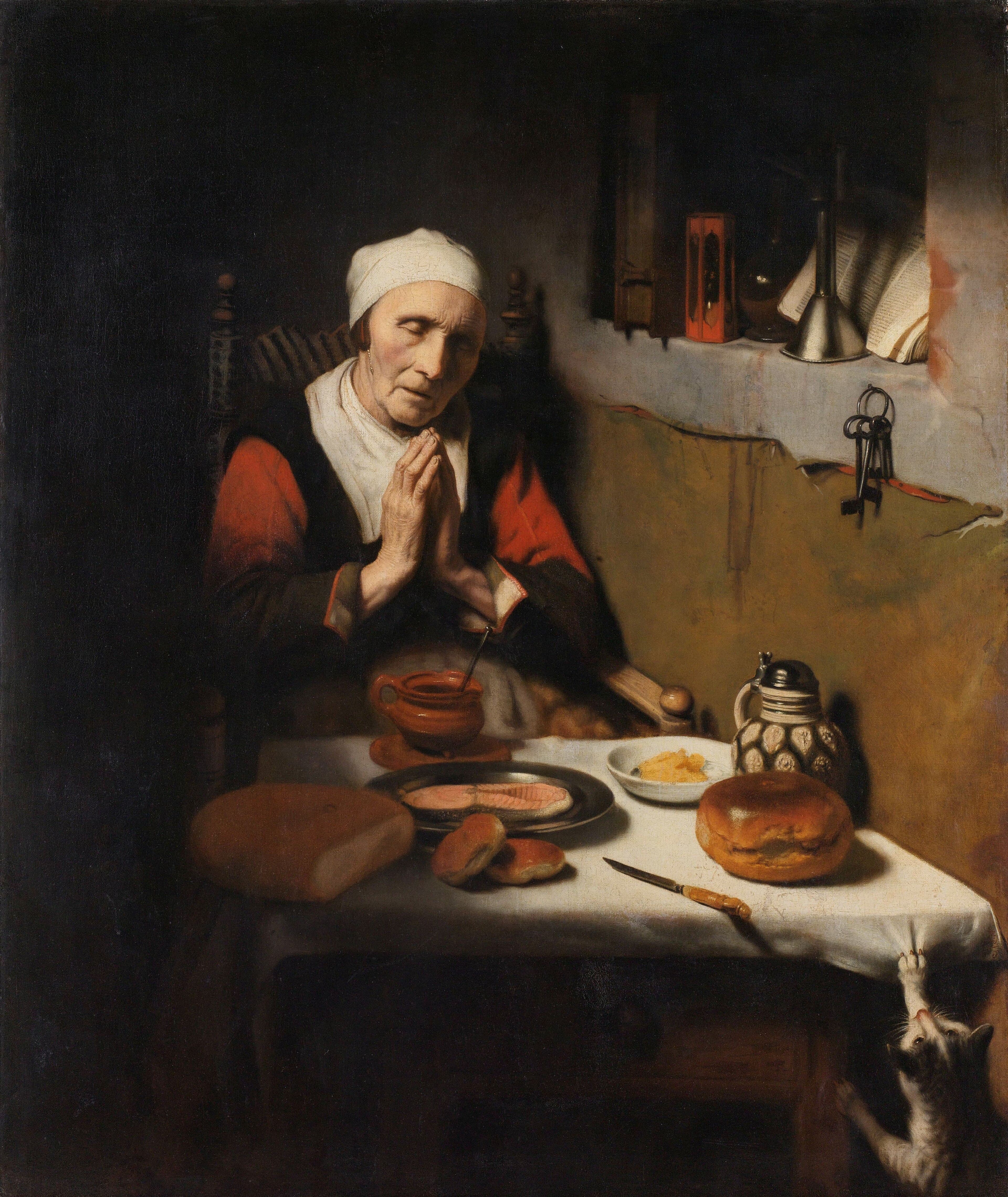
1 Thessalonians 5:17 · Passage · Prayer
Pray Without Ceasing
1 Thessalonians 5:17 is the second of three short commands that Paul gives near the close of his first letter to the church at Thessalonica.
In Greek this command and the one before it are two words each.
Rejoice at all times. Pray without ceasing. Give thanks in every circumstance, for this is God’s will for you in Christ Jesus.
- The passage
- 1 Thessalonians 5:17, 1 Thessalonians 5:12 to 28
- Book
- 1 Thessalonians
- Hold in memory
- 1 Thessalonians 5:16 to 18, Colossians 4:2
Summary
Paul's command to pray without ceasing asks for prayer that has no gap in it. He gave it to a church he had prayed for night and day. Augustine read it as a desire of the heart that never stops, and Matthew Henry as prayer that nothing else is allowed to hinder in its proper season.
- The verb is a present imperative addressed to the whole church.
- The adverb adialeiptōs means uninterruptedly, without omission.
- Fixed hours of prayer stand in the psalms and in Daniel's practice, and the early church kept them too.
The Command in Its Letter
Paul wrote the letter to a church he and Silas had been sent away from by night.
Pray Without Ceasing studies one command of Paul and the life of prayer it asks of a believer. It belongs to the value of prayer, because it asks for prayer at every point of a believer's life and not only in its crises.
The question the study answers is what Paul meant by unceasing prayer and how the church has kept it. It sets out the charge of 1 Thessalonians 5:12 to 28 in seven parts, the two Greek words of the command, and what Paul himself practised and asked. It then gives the readings of the command from Augustine to Matthew Henry, and the old question of set hours of prayer.
The Closing Charge of 1 Thessalonians 5
The charge runs in seven parts from the church's leaders to Paul's last words.
The three commands of the inner life stand between the charge about the church's people and the charge about the Spirit.
| Part | What Paul asks | The Berean words | Verses |
|---|---|---|---|
| 1 | Honour those who lead you | “hold them in highest regard because of their work” | 1 Thessalonians 5:12 to 13 |
| 2 | Care for the weak and repay no evil | “help the weak, and be patient with everyone” | 1 Thessalonians 5:14 to 15 |
| 3 | Rejoice, pray and give thanks | “Pray without ceasing.” | 1 Thessalonians 5:16 to 18 |
| 4 | Keep the Spirit's gifts and test them | “Do not extinguish the Spirit.” | 1 Thessalonians 5:19 to 22 |
| 5 | A blessing for the whole person | “The One who calls you is faithful, and He will do it.” | 1 Thessalonians 5:23 to 24 |
| 6 | Remember the apostles before God | “Brothers, pray for us as well.” | 1 Thessalonians 5:25 |
| 7 | Greeting, charge and blessing | “The grace of our Lord Jesus Christ be with you.” | 1 Thessalonians 5:26 to 28 |
Paul Prayed as He Commanded
Thanks and requests for the Thessalonians run from the first chapter to the last.
We always thank God for all of you, remembering you in our prayers and continually recalling before our God and Father your work of faith, your labor of love, and your enduring hope in our Lord Jesus Christ.The letter opens on Paul's own prayer, so the command at its close asks the church to do what he did.
In the next chapter Paul says that he thanks God without ceasing because the church received his message as the true word of God (1 Thessalonians 2:13).
Night and day we pray most earnestly that we may see you face to face and supply what is lacking from your faith.The verse shows that Paul's own prayer had an aim he could name.
Before he asks for the church's prayer, Paul prays for it: “Now may the God of peace Himself sanctify you completely” (1 Thessalonians 5:23).
The Two Words of the Command
The adverb is one Paul also uses of his own prayer and thanks.
The command reads adialeiptōs proseuchesthe, and the tagged Greek text codes the verb V-PNM-2P, the present tense in the imperative mood and the second person plural. It codes the verbs of 1 Thessalonians 5:16 and 1 Thessalonians 5:18, rejoice and give thanks, in the same tense and mood.
The adverb adialeiptōs (G89) is glossed “uninterruptedly, i.e. without omission (on an appropriate occasion)”, and the tagged text has it also at Romans 1:9 and 1 Thessalonians 2:13.
God, whom I serve with my spirit in preaching the gospel of His Son, is my witness how constantly I remember you in my prayers at all times, asking that now at last by God’s will I may succeed in coming to you.The verse gives the adverb in a letter to another church, which shows the word belongs to Paul's own way of praying.
Jamieson, Fausset and Brown stand here for the sense of the adverb.
“The Greek is, ‘Pray without intermission’; without allowing prayerless gaps to intervene between the times of prayer.”
Jamieson, Fausset & Brown · Commentary Critical and Explanatory on the Whole Bible · on 1 Thessalonians 5:17Reformed
Prayer at Set Hours
Israel kept fixed times of prayer long before the church set its hours.
Morning, noon, and night, I cry out in distress, and He hears my voice.The psalm names three times of the day for prayer, so a fixed pattern stands in Israel's own songs.
Daniel kept the same habit in exile and went on kneeling three times a day after the king's decree forbade it (Daniel 6:10).
Brothers, Pray for Us
Paul asks the church to pray for him, and he and the writer to the Hebrews make the request in other letters too.
The request uses the same verb and the same form as the command of 1 Thessalonians 5:17. Paul makes it also in Romans 15:30 and Ephesians 6:19.
Finally, brothers, pray for us, that the word of the Lord may spread quickly and be held in honor, just as it was with you.Paul repeats the request in his second letter to the same church.
as you pray also for us, that God may open to us a door for the word, so that we may proclaim the mystery of Christ, for which I am in chains. Pray that I may declare it clearly, as I should.The request stands again in a letter Paul wrote from prison.
Pray for us; we are convinced that we have a clear conscience and desire to live honorably in every way.The writer to the Hebrews makes the request in his own words.
Chrysostom stands here for the request itself, which he took as Paul's humility and made his own.
“‘Brethren, pray for us also.’ Strange! what humility is here! But he indeed said this for the sake of humility, but we, not from humility, but for the sake of great benefit, and wishing to gain some great profit from you, say, ‘Pray for us also.’ For although you do not receive any great or wonderful benefit from us, do it nevertheless for the sake of the honor and the title itself. Some one has had children, and even if they had not been benefited by him, nevertheless, because he has been their father, he perhaps sets this before them, saying, ‘For one day I have not been called father by thee.’ On this account we too say, ‘Pray for us also.’ I am not merely saying this, but really desiring your prayers. For if I have become responsible for this presidency over you all, and shall have to render an account, much more ought I to have the benefit of your prayers. On your account my responsibilities are greater, therefore the help also from you should be greater.”
John Chrysostom · Homily on 1 Thessalonians 11 · on 1 Thessalonians 5:25Patristic
Hebrews 13:18, John Chrysostom
Voices on Unceasing Prayer
One voice speaks to the church's worship and one to the heart that prays.
296 to 373 · Athanasius of Alexandria
Athanasius stands here for unceasing prayer as the life of the church's feast.
“For such meditation and exercise in godliness, being at all times the habit of the saints, is urgent on us at the present time, when the divine word desires us to keep the feast with them if we are in this disposition. For what else is the feast, but the constant worship of God, and the recognition of godliness, and unceasing prayers from the whole heart with agreement? So Paul wishing us to be ever in this disposition, commands, saying, 'Rejoice evermore; pray without ceasing; in everything give thanks.'”
Athanasius of Alexandria · Festal Letter 11 · on 1 Thessalonians 5:16 to 18Patristic
died 435 · John Cassian
Cassian stands here for the pure heart that makes every thought and act a prayer.
“When the mind is freed from lust, established in tranquility and does not waver in its intention toward the one supreme good, the monk will fulfill the precept of St. Paul, ‘Pray without ceasing,’ and ‘In every place lifting up holy hands without wrath and controversy.’ By purity of heart the mind is drawn away from earthly feelings and is reformed in the likeness of an angelic spirit. Then, whatever thought the mind receives, whatever it considers, whatever it does, will be a prayer of true purity and sincerity.”
John Cassian · CONFERENCES 9.6 · on 1 Thessalonians 5:17Patristic
What the Command Asks, and When to Pray
Teachers of the church have divided over what unceasing prayer is and over whether it needs set hours.
The first question is whether the command reaches past the times of spoken prayer.
The desire of the heart, with words at stated hoursAugustine of Hippo
Augustine wrote to Proba (Letter 130, translated by J. G. Cunningham, 1887) that “When we cherish uninterrupted desire along with the exercise of faith and hope and charity, we pray always”.
Prayer kept at its seasons without a gapMatthew Henry; Basil of Caesarea
Matthew Henry wrote in his Commentary (1710) that “The meaning is not that men should do nothing but pray, but that nothing else we do should hinder prayer in its proper season”. Basil, in his Long Rules (question 37), set the command beside Paul's words “We worked night and day” (1 Thessalonians 2:9) and taught prayer “while our hands are busy at their tasks”.
The objection: Augustine, on Psalm 38, asked whether the command means bending the knee and lifting the hands, and wrote of that kind of prayer, “this, I believe, we cannot do ‘without ceasing.’”
The second question is whether fixed times serve the command or replace it.
Set hours as the church's received practiceThe Didache
The Didache, an early manual of the church in M. B. Riddle's translation (1886), gives the Lord's Prayer and adds, “Thrice in the day thus pray.”
The objection: Tertullian wrote in On Prayer that of times of prayer “nothing at all has been prescribed”, except to pray at every time and place.
Set hours as a discipline that helps weaknessJohn Calvin
John Calvin, in the Institutes, book 3, chapter 20, section 50, translated by Henry Beveridge (1845), held that “it is requisite for us to appoint special hours for this exercise”. He warned that this “must not be a superstitious observance of hours”.
Pray at All Times
Paul gives the charge again in his letters to the Ephesians and the Romans.
Pray in the Spirit at all times, with every kind of prayer and petition. To this end, stay alert with all perseverance in your prayers for all the saints.Ephesians gives the charge a second time in other words.
Be joyful in hope, patient in affliction, persistent in prayer.Romans sets the charge in a list of short commands, as 1 Thessalonians does.
Paul joins the command to the thanks of the next verse, 1 Thessalonians 5:18.
Jesus told His disciples a parable “about their need to pray at all times and not lose heart” (Luke 18:1).
Sources
Scripture is the Berean Standard Bible.
- STEP Bible, Translators Amalgamated Greek New Testament, the tagged Greek text (Tyndale House, Cambridge), CC BY 4.0.
- STEP Bible TBESG lexicon of Extended Strongs for Greek (Tyndale House, Cambridge), CC BY 4.0, based on Abbott-Smith (1922), with the Strong's definitions (1890) the rows carry.
- Augustine of Hippo, Letter 130, to Proba, chapter 9, translated by J. G. Cunningham, Nicene and Post-Nicene Fathers, first series, volume 1 (1887)
- Augustine of Hippo, Exposition on Psalm 38 (37), section 14.
- Basil of Caesarea, The Long Rules, question 37.
- Matthew Henry, Commentary on the Whole Bible (1710), on 1 Thessalonians 5:17.
- Robert Jamieson, A. R. Fausset and David Brown, Commentary Critical and Explanatory on the Whole Bible (1871), on 1 Thessalonians 5:17.
- The Didache, chapter 8, translated by M. B. Riddle, Ante-Nicene Fathers, volume 7 (1886)
- Tertullian, On Prayer (Ante-Nicene Fathers, volume 3)
- John Calvin, Institutes of the Christian Religion, book 3, chapter 20, section 50, translated by Henry Beveridge (1845)
- John Chrysostom, Homilies on 1 Thessalonians, homily 11, on 1 Thessalonians 5:25.
- Athanasius of Alexandria, Festal Letter 11.
- John Cassian, Conferences, 9.6.
Keep Studying
In this value4
People and groups11