
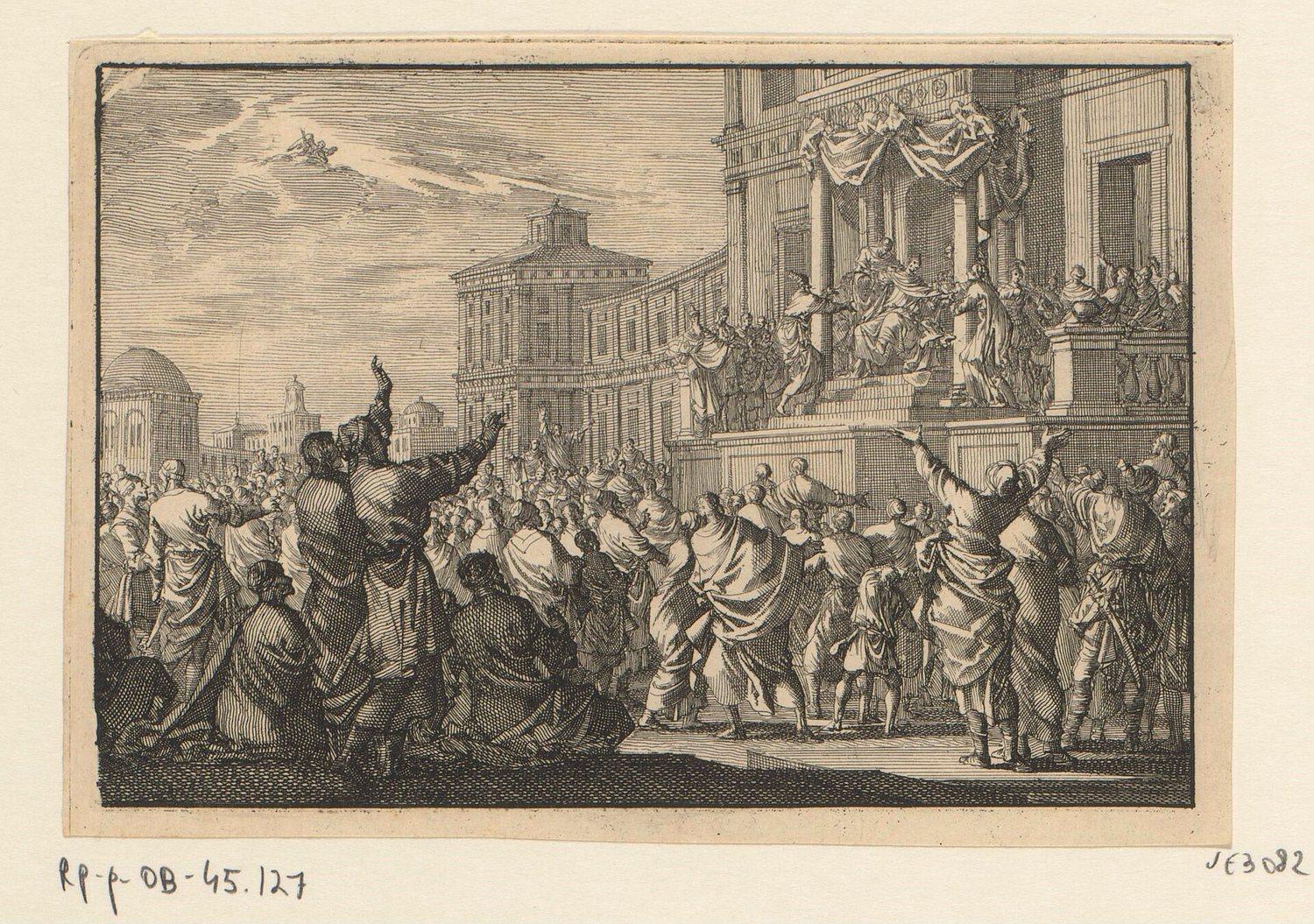
Jan Luyken, 1703. CC0.
Acts 12 · Person · Featured Study
Herod Agrippa I
Herod the Great's grandson ruled Judea as king for the last years of his life.
Immediately, because Herod did not give glory to God, an angel of the Lord struck him down, and he was eaten by worms and died.
- Born
- about 10 BC, from Josephus's count of his age at death (probable)
- Died
- AD 44, at Caesarea (probable)
- Family
- grandfather: Herod the Great; son: Agrippa; daughters: Bernice, Mariamne and Drusilla
- Places
- Rome, Jerusalem, Caesarea
- First named
- Acts 12:1 “About that time, King Herod reached out…”
- Last named
- Acts 12:23 “Immediately, because Herod did not…”
Acts calls him only King Herod, and Josephus calls him Agrippa.
Summary
Agrippa ran up great debts and spent time in chains under the emperor Tiberius. The next emperor, Gaius, set him free and made him a king, and Claudius added Judea. In Acts he is the King Herod who killed the apostle James, and he died at Caesarea in AD 44.
- Agrippa hung the gold chain Gaius gave him in the temple, over the treasury.
- R. J. Knowling dates his attack on the church to the early part of AD 44.
- Antonia, the mother of Claudius, lent him the money to pay a debt.
Herod Agrippa in Acts
Two verses show the king's first blows against the church.
Luke tells of the king from his attack on the church in Acts 12:1 to his death in Acts 12:23.
He had James, the brother of John, put to death with the sword.James is the only one of the Twelve whose killing Acts records.
And seeing that this pleased the Jews, Herod proceeded to seize Peter during the Feast of Unleavened Bread.The verse ties the king's policy to the crowd he ruled, the theme his death will close.
From Debtor to King
Josephus follows Agrippa from his debts to his throne at Jerusalem.
Agrippa went from a prisoner of Tiberius to a king in Jerusalem.
- Under TiberiusThe emperor's courtHe borrowed 300,000 drachmae and fled without paying
- Under TiberiusThe emperor's courtTiberius ordered him bound for wishing Gaius to reign
- When Gaius reignedThe emperor's courtGaius freed him and made him king of Philip's lands
- When Gaius was killedRomeAgrippa urged Claudius to take the empire
- Under ClaudiusJudea and SamariaClaudius added his grandfather's kingdom to his own
- During the feastJerusalemHe seized PeterActs 12:4
- AD 44CaesareaHe diedActs 12:23
Josephus gives the first five rows, and Acts 12 gives the last two.
Agrippa and the Church
Three scenes of Acts 12, from Peter's arrest to the crowd's cry.
Herod had Peter guarded by four squads of soldiers and meant to bring him out after the feast. An angel led Peter out the night before the trial.
So Peter was kept in prison, but the church was fervently praying to God for him.Luke sets the church's prayer against the king's guard.
In the morning the soldiers could not find Peter.
After Herod had searched for him unsuccessfully, he examined the guards and ordered that they be executed. Then he went down from Judea to Caesarea and spent some time there.The king's move to Caesarea sets the stage for the last scene of his life.
The people of Tyre and Sidon won over Blastus, the king's chamberlain, and asked for peace, since their food came from his land. On the set day Herod put on his royal robes and spoke to them.
And they began to shout, “This is the voice of a god, not a man!”The crowd's cry is the flattery Luke says Herod failed to refuse.
How Others Saw Him
A Jewish writer of Egypt records the insult a Greek city gave him.
Philo of Alexandria writes that Agrippa passed through that city as a new king. A crowd there dressed a madman named Carabbas as a king, with a papyrus leaf for a crown and a mat for a robe.
Philo says the crowd hailed Carabbas as Maris, the name Syrians gave their kings, because they knew Agrippa was a Syrian by birth.
His Death in Josephus and in Acts
Josephus tells the same story with details Luke leaves out.
Josephus says Agrippa came into the theatre at Caesarea in a robe made wholly of silver. His flatterers cried out that he was a god, and he did not rebuke them.
Then he looked up, saw an owl sitting on a rope over his head, and was seized with pain in his belly. He died after five days, in the fifty-fourth year of his age and the seventh of his reign.
The House of Agrippa
Josephus names his grandfather and the four children he left at his death.
Agrippa left one son and three daughters.
| Person | Tie to Agrippa | The name in Scripture |
|---|---|---|
| Herod the Great | His grandfather | Matthew 2:1 calls him King Herod |
| Agrippa | His son, aged seventeen | A King Agrippa hears Paul in Acts 25 and 26 |
| Bernice | His daughter, aged sixteen and married to her uncle Herod | A Bernice comes with King Agrippa in Acts 25:13 |
| Mariamne | His daughter, aged ten | No verse names her |
| Drusilla | His youngest daughter, aged six | A Drusilla is the wife of Felix in Acts 24:24 |
The Places of Acts 12
Four places of Acts 12, two in his kingdom and two on the coast of Phoenicia.
Agrippa struck at the church in Jerusalem and met Tyre and Sidon at Caesarea, where he died.
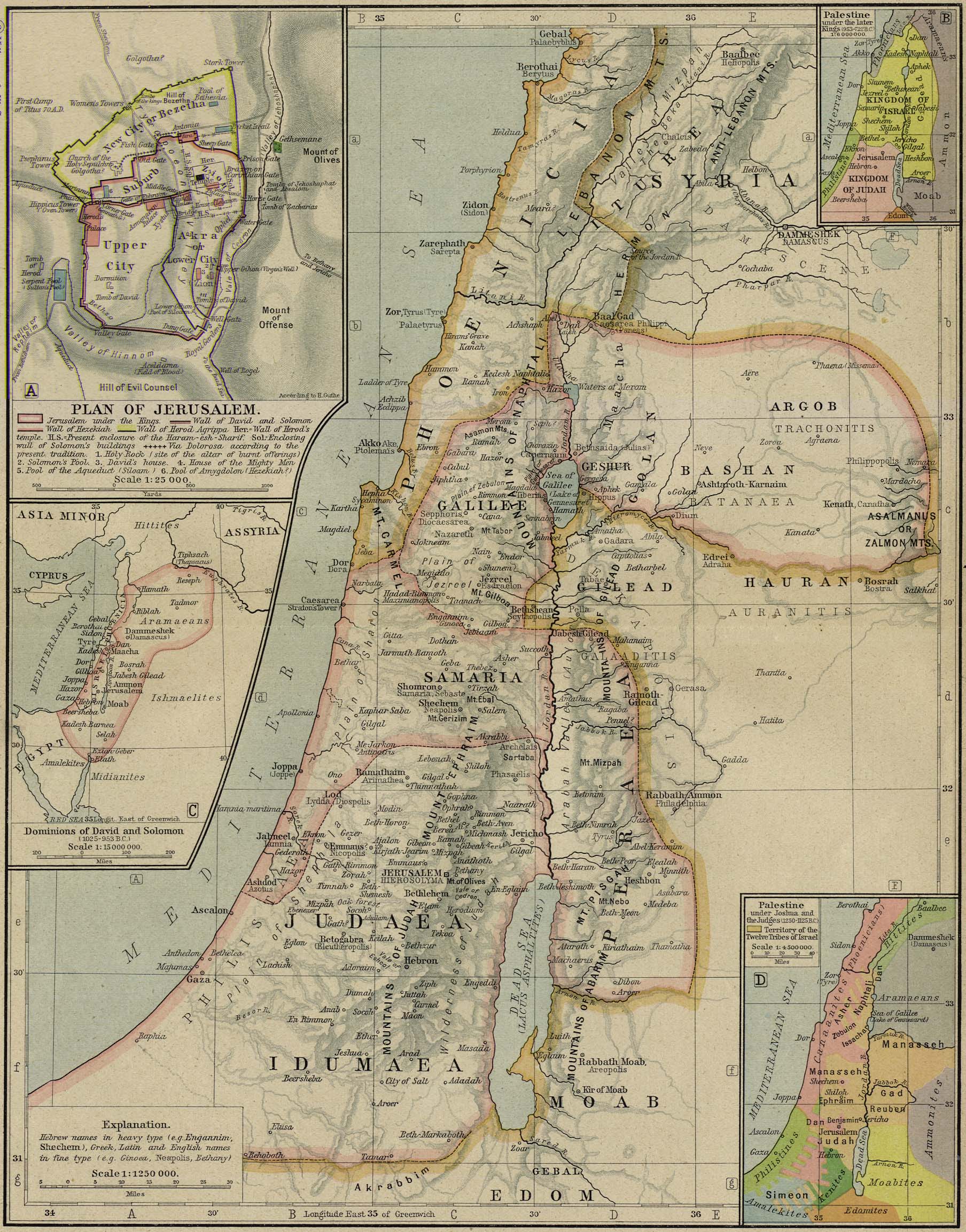
- 1Jerusalem, His sword fell on the church here. Acts 12:2
- 2Caesarea, He went down there and died there. Acts 12:19
- 3Tyre, Its people had quarrelled with him. Acts 12:20
- 4Sidon, Its people joined Tyre before the king. Acts 12:20
Base map: Reference map of ancient Palestine, Rand McNally reference map (1926), public domain. Places with a place page stand at its coordinates and the others at the point cited for each, set on the plate by Jerusalem and Damascus, as the plate prints them.
Four places on the Rand McNally reference map of ancient Palestine (1926). Each scores 1,000 of 1,000 in the OpenBible identification data.
What Acts Leaves Out
Luke gives the king no family, no age and no past.
Luke tells nothing of the king's years at Rome or of how he came to rule Judea. Acts also leaves unsaid whether the King Agrippa who heard Paul in Acts 25 and 26 was his son.
The Voices
Two commentators on his rule and on Peter's arrest at the feast.
Theophylact of Ohrid (died 1107)
Commentary on Acts
Theophylact notes when Peter was seized
“Again the excessive scrupulousness of the Jews is revealed: they did not object to killing him, but they objected to doing it at such a time.”
on Acts 12:3Patristic
Matthew Henry (1662 to 1714)
Commentary on the Whole Bible
Henry explains how far the king's rule reached
“He was not only (as Herod Antipas was) tetrarch of Galilee, but had also the government of Judea committed to him by Claudius the emperor, and resided most at Jerusalem, where he was at this time.”
on Acts 12:1Puritan
Where Readers Differ
Three questions about the king, with the writers who answer them.
What kind of king was he?3 paragraphs
John Calvin, in his Commentary upon the Acts, held that Herod acted from no zeal for the law of Moses and no hatred of the gospel. In Calvin's reading, the king sought only his own advantage with the people.
John Chrysostom, in Homily 26 on Acts, said the trial was heavier because a king held greater power, and that it was done to win favour with the Jews.
Josephus, in the Antiquities, paints another king. He says Agrippa loved to live at Jerusalem, kept the laws of his country and let no day pass without its sacrifice.
An owl or an angel?2 paragraphs
Eusebius quotes the passage of Josephus with an angel sitting above Agrippa, where the English Josephus of 1737 has the owl. He praised the account for its agreement with Scripture.
A note in that English Josephus reports a charge, by critics it does not name, that Eusebius changed the words to agree with Acts.
Which Agrippa wept at the reading of the law?2 paragraphs
The Mishnah tells that King Agrippa read the law standing and wept at the verse about a king who is not of Israel, and the people called him their brother. The Mishnah does not say which Agrippa.
Knowling, in The Expositor's Greek Testament, places the story at the Feast of Tabernacles in AD 41, under Agrippa I.
Books to Read Next
Two works, each free to read online.
The Antiquities of the Jews, books 18 and 19
Flavius Josephus · first century
Josephus tells Agrippa's whole life, from his debts to his death at Caesarea.
Free at the Christian Classics Ethereal LibraryChurch History, book 2, chapter 10
Eusebius, in the Nicene and Post-Nicene Fathers, second series, volume 1 · fourth century
Eusebius sets the account of Josephus beside Acts 12 and accounts for the king's two names.
Free at New AdventWhat His End Shows
Acts 12 opens with the king striking at the church and closes with the church growing while the king lies dead.
Sources
Scripture is the Berean Standard Bible.
- The Holy Bible, Berean Standard Bible (read 2026)
- Flavius Josephus, The Antiquities of the Jews, books 18 and 19, in The Complete Works (CCEL text, print basis 1737), with its notes.
- Eusebius, Church History 2.10, Nicene and Post-Nicene Fathers, second series, volume 1.
- Philo, Flaccus 25 to 39, in The Works of Philo.
- Mishnah Sotah 7:8, the William Davidson Edition (Koren), licence CC-BY-NC.
- John Calvin, Commentary upon the Acts of the Apostles, volume 1, translated by Christopher Fetherstone, edited by Henry Beveridge.
- John Chrysostom, Homily 26 on Acts, Nicene and Post-Nicene Fathers, first series, volume 11.
- R. J. Knowling, The Acts of the Apostles, in The Expositor's Greek Testament, volume 2 (1900)
- W. J. Conybeare and J. S. Howson, The Life and Epistles of Saint Paul, People's Edition (Cincinnati, 1869), chapter 4.
- Matthew Henry, Commentary on the Whole Bible.
- Theophylact of Ohrid, Commentary on Acts.
- OpenBible.info, Bible-Geocoding-Data, ancient.jsonl.
- Rand McNally, Reference Map of Ancient Palestine (1926)