
2 Timothy 1 and 4 · Story · Featured Study
Paul's Last Imprisonment and Death
Paul's last imprisonment in Rome, his first defence and his last letter, set beside what the early church recorded of his death under Nero.
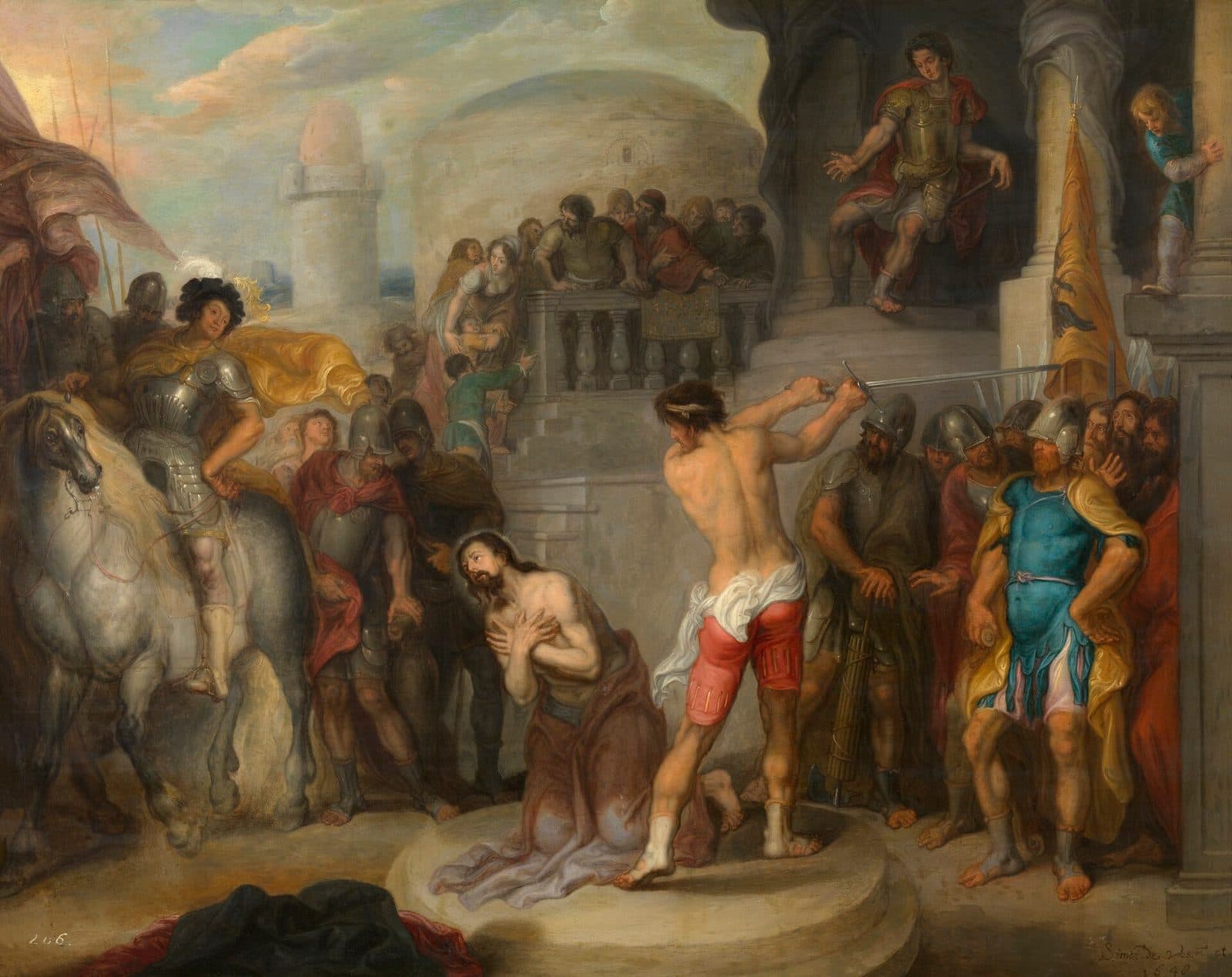
Simon de Vos, The Beheading of Saint Paul, 1648, Royal Museum of Fine Arts Antwerp. Public domain, via Wikimedia Commons.
THE ARTWORKDe Vos paints the moment before the stroke. Paul kneels on a round stone block with his hands on his chest, the executioner lifts the sword over his shoulder, and a Roman officer gives the sign from a raised seat. The scene follows the tradition Eusebius and Jerome record.
Paul's last letter asks Timothy to come before winter with a cloak and some scrolls, and its writer expected to be poured out like a drink offering.
Summary
Paul wrote 2 Timothy in Rome as a prisoner chained like a criminal.
- Clement of Rome is the earliest of the church's witnesses to Paul's death.
- Readers divide on whether Paul was released after Acts 28 or died in that one imprisonment.
- The beheading and the burial on the Ostian Way are recorded by Eusebius and Jerome.
The Last Letter in His Own Words
Seven passages of 2 Timothy, from the chain to the crown.
So do not be ashamed of the testimony of our Lord, or of me, His prisoner. Instead, join me in suffering for the gospel by the power of God.It makes Paul's chains the ground of the letter's call to courage.
for which I suffer to the extent of being chained like a criminal. But the word of God cannot be chained!It sets the chained preacher beside the free word, the contrast the whole letter turns on.
For I am already being poured out like a drink offering, and the time of my departure is at hand. I have fought the good fight, I have finished the race, I have kept the faith. From now on there is laid up for me the crown of righteousness, which the Lord, the righteous Judge, will award to me on that day—and not only to me, but to all who crave His appearing.It dates the letter to the end of Paul's life, and its crown is the hope Paul held to the end.
At my first defense, no one stood with me, but everyone deserted me. May it not be charged against them. But the Lord stood by me and strengthened me, so that through me the message would be fully proclaimed, and all the Gentiles would hear it. So I was delivered from the mouth of the lion. And the Lord will rescue me from every evil action and bring me safely into His heavenly kingdom. To Him be the glory forever and ever. Amen.It is Paul's only account of a hearing in this imprisonment, and readers divide over what that hearing was.
Deserted, and found by a friend2 Timothy 1:15 to 17
You know that everyone in the Province of Asia has deserted me, including Phygelus and Hermogenes. May the Lord grant mercy to the household of Onesiphorus, because he has often refreshed me and was unashamed of my chains. Indeed, when he arrived in Rome, he searched diligently until he found me.It shows how hard Paul was to find, a harsher prison than the rented house of Acts 28.
Come before winter2 Timothy 4:9 to 13 and 4:21
Make every effort to come to me quickly, because Demas, in his love of this world, has deserted me and gone to Thessalonica. Crescens has gone to Galatia, and Titus to Dalmatia. Only Luke is with me. Get Mark and bring him with you, because he is useful to me in the ministry. Tychicus, however, I have sent to Ephesus. When you come, bring the cloak that I left with Carpus at Troas, and my scrolls, especially the parchments.It sets the companions who left beside the one who stayed, the ground of the question whether Paul died alone.
Make every effort to come to me before winter. Eubulus sends you greetings, as do Pudens, Linus, Claudia, and all the brothers.It shows that Paul expected to live into the winter.
From Acts 28 to Paul's Death
From the rented house in Rome to his death under Nero, each step with its source and how sure it is.
- Rome, under guardTwo years in a rented house, preaching freely, Acts 28:30 to 31, Scripture
- Hope of releasePaul expects to visit Philippi and asks Philemon for a guest room, Philippians 1:25 to 26 and Philemon 22, Scripture
- The plan for SpainPaul means to go on to Spain by way of Rome, Romans 15:24 and 28, Scripture
- Release and more travelPreaching to the limit of the west, then a second coming to Rome, Clement's First Letter to the Corinthians 5; Eusebius, Church History 2.22, Tradition, contested
- Crete, Miletus, Troas, NicopolisTitus left in Crete, Trophimus left sick at Miletus, a cloak left at Troas, a winter planned at Nicopolis, Titus 1:5 and 3:12; 2 Timothy 4:13 and 4:20, Scripture; its place in the life contested
- The fire at RomeNero blames the Christians and puts many to death, Tacitus, Annals 15.44, Known, AD 64
- The last arrestChained like a criminal, and found only after a search, 2 Timothy 1:16 to 17 and 2:9, Scripture
- The first defenceNo one stands with him, and he is delivered from the lion's mouth, 2 Timothy 4:16 to 17, Scripture
- The last letterThe race finished and the faith kept, 2 Timothy 4:7, Scripture
- Death under NeroPut to death at Rome, Eusebius, Church History 2.25; Jerome, Lives of Illustrious Men 5, Tradition
Seven of the ten numbered steps rest on Scripture, one on Tacitus and two on the early church's tradition.
What the Text Says and What Is Often Said
Three things often said of Paul's end, each set beside its verse.
OFTEN SAID: ACTS TELLS HOW PAUL DIED
Acts ends while Paul is still a prisoner awaiting his case.
OFTEN SAID: THE FIRST DEFENCE ENDED IN HIS DEATH
Paul wrote this letter after that hearing and lived to report it.
OFTEN SAID: PAUL DIED ALONE
The letter's last chapter names one companion beside him and four believers in Rome.
Rome Under Nero
The fire of AD 64 and the first persecution by an emperor.
In AD 64 a fire broke out at Rome, worse, Tacitus says, than any the city had suffered. He writes that Nero, to stop the report that he had ordered it, fastened the guilt on the people the crowd called Christians.
An immense multitude was convicted, Tacitus says, and they were torn by dogs, nailed to crosses or burned as lights at night in Nero's gardens.
Eusebius quotes Tertullian that Nero was the first emperor to persecute the faith. Lactantius, who taught rhetoric under Diocletian, says Nero crucified Peter and slew Paul.
The Witnesses After Scripture
What the early church wrote of Paul's end, earliest first.
Clement of Rome died in the third year of Trajan. His letter to the church at Corinth says that Paul came to the extreme limit of the west and suffered martyrdom under the prefects, and it names no manner of death.
The Muratorian list on SpainCanon Muratorianus, Ante-Nicene Fathers 5
Tertullian on the swordThe Prescription Against Heretics 36
Tertullian, who flourished under Severus, says that at Rome Paul won his crown in a death like John's, the Baptist's death by the sword.
Eusebius on the two imprisonmentsChurch History 2.22 and 2.25
Eusebius records the beheading at Rome. He cites Caius, who could show the trophies of the apostles on the Vatican and on the Ostian Way, and Dionysius of Corinth, who says Peter and Paul suffered at the same time.
“Story has it that the apostle, after defending himself, was again sent upon the ministry of preaching and coming a second time to the same city met death by martyrdom under Nero. While he was being held in prison, he composed the second epistle to Timothy, at the same time indicating that his first defense had taken place and that martyrdom was at hand.”
Eusebius of Caesarea · Ecclesiastical History 2.22 · on 2 Timothy 4:17Patristic
Jerome on the year and the graveLives of Illustrious Men 5
Jerome says that Paul was beheaded at Rome in the fourteenth year of Nero, on the same day as Peter, and buried on the Ostian Way.
What the Text Leaves Unsaid
Four things Scripture leaves open.
The New Testament ends Paul's story with his letter, and the manner, the year and the place of his death come from later writers.
2 Timothy names the lion and leaves the emperor unnamed.
The letter places Paul in Rome and leaves his prison unnamed.
Romans states the plan for Spain, and Scripture records no arrival there.
A Drink Offering Poured Out
Three Greek words Paul used of his hearing and his death.
Paul's word for being poured out is spéndō, to pour out as a libation, and the New Testament uses it twice.
His word for departure is análysis, used only here in the New Testament. The same letter calls his first hearing an apología, a defence or plea.
But even if I am being poured out like a drink offering on the sacrifice and service of your faith, I am glad and rejoice with all of you.It is the word's other use, written from an earlier prison while Paul weighed life against death.
Voices on Paul's Last Days
Three works, from John Chrysostom in the fourth century to Jamieson, Fausset and Brown in 1871.
John Chrysostom on the friends who forsook PaulHomily 10 on 2 Timothy
“‘At my first answer,’ he says, ‘no man stood with me, but all men forsook me: I pray God that it may not be laid to their charge.’ Do you see how he spares his friends, notwithstanding it was a grievous thing they had done? For it is not the same thing to be despised by aliens, as by our own friends. Do you see his intense dejection? It cannot be said, that I was assailed by those without, but had comfort in the attention and support of my friends; for these also betrayed me. ‘All men,’ he says, ‘forsook me.’ And this was no light offense. For if he that in war abandons one who is exposed to danger, and shrinks from meeting the hands of his enemies, is justly smitten by his friends, as having utterly betrayed their cause, much more in the case of the Gospel. But what ‘first answer,’ does he speak of? He had stood before Nero, and had escaped. But afterwards, because he had converted his cup-bearer, he was beheaded. And here again is encouragement for his disciple in what follows.”
John Chrysostom · Homily on 2 Timothy 10 · on 2 Timothy 4:16Patristic
John Wesley on the drink offeringExplanatory Notes upon the New Testament, 1755
“The time of my departure is at hand - So undoubtedly God had shown him. I am ready to be offered up - Literally, to be poured out, as the wine and oil were on the ancient sacrifices.”
John Wesley · Explanatory Notes upon the New Testament · on 2 Timothy 4:6Evangelical
Jamieson, Fausset and Brown on the prayer for the desertersCommentary Critical and Explanatory, 1871
“‘May it not be laid to THEIR charge,’ for they were intimidated; their drawing back from me was not from bad disposition so much as from fear; it is sure to be laid to the charge of those who intimidated them. Still Paul, like Stephen, would doubtless have offered the same prayer for his persecutors themselves (Ac 7:60).”
Jamieson, Fausset & Brown · Commentary Critical and Explanatory on the Whole Bible · on 2 Timothy 4:16Reformed
Where Readers Divide
Three questions, the release, the first defence and the lion, with the holders of each answer and the objections raised.
Whether Paul wrote 2 Timothy at all is argued on its own page, Who Wrote the Pastorals. Each answer here reads the personal notes of 2 Timothy as Paul's own.
Was Paul released after Acts 28?Eusebius, Jerome, J. B. Lightfoot and P. N. Harrison · The early church, the traditional reading and critical scholarship
Eusebius in his Church History and Jerome in his Lives of Illustrious Men held that Paul was released and arrested again. J. B. Lightfoot, in his essay St Paul's History after the Close of the Acts, reads Clement's limit of the west as Spain and concludes that Paul reached it.
Lightfoot himself names the counter that Clement may only be assuming Paul carried out the plan of Romans 15.
P. N. Harrison, in The Problem of the Pastoral Epistles of 1921, held that the personal notes are fragments of Paul's own letters set inside later epistles. He held that they fit the life of Paul known from Acts and that the release is a legend.
The objection to Harrison is Lightfoot's, from Paul's own letter to the Philippians, where Paul says he knows he will remain. Trophimus gives a second objection, from two verses.
For they had previously seen Trophimus the Ephesian with him in the city, and they assumed that Paul had brought him into the temple.It proves Trophimus went on to Jerusalem, so the stop at Miletus in Acts 20 is not where he was left.
Erastus has remained at Corinth, and Trophimus I left sick in Miletus.It needs a later parting at Miletus, after a release.
What was the first defence?Eusebius, Jerome, Chrysostom, Adam Clarke and Albert Barnes · Early, Methodist and Presbyterian commentary
Eusebius in his Church History, Jerome in his Lives of Illustrious Men and Chrysostom in his tenth homily on 2 Timothy read it as the hearing that ended the first imprisonment. The objection is Adam Clarke's, in his Commentary on the Bible on 2 Timothy 4:16, who reads it as Paul's first examination after his second arrest.
The objection to Clarke is Albert Barnes's, in his Notes, Explanatory and Practical on 2 Timothy 4:16. Barnes asks why Paul was still held if he had been tried in this imprisonment, and places the first trial in an earlier one.
Who is the lion of 2 Timothy 4:17?Eusebius, Jerome and John Calvin · The early church and Reformed commentary
Eusebius in his Church History and Jerome in his Lives of Illustrious Men read the lion as Nero, whose court heard the case. The objection is John Calvin's, in his Commentaries on the Epistles to Timothy, Titus, and Philemon on 2 Timothy 4:17. He reads it as a figure for danger in general, as if Paul had said out of the jaws of death.
Books to Read Next
Five works on Paul's last years, each free to read.
The First Epistle of Clement to the Corinthians
Clement of Rome · first century
Chapter 5 gives the earliest account.
Read at New AdventChurch History, Book 2
Eusebius of Caesarea · fourth century
Eusebius gives the tradition with its sources in chapters 22 and 25.
Read at New AdventCommentaries on the Epistles to Timothy, Titus, and Philemon
John Calvin · 1856
Calvin reads the last chapter verse by verse.
Read at CCELBiblical Essays
J. B. Lightfoot · 1893
The volume holds his essay St Paul's History after the Close of the Acts.
Read at the Internet ArchiveThe Problem of the Pastoral Epistles
P. N. Harrison · 1921
Harrison sets out the case against Paul's authorship of the Pastoral Epistles.
Read at the Internet ArchiveWhat Paul Handed On
The gospel he suffered for and the charge he left Timothy.
Paul's last letter hands his work on to Timothy, with the charge to preach the word and fulfill his ministry.
Remember Jesus Christ, raised from the dead, descended from David, as proclaimed by my gospel,It answers why Paul suffered, since this is the gospel he was chained for.
For this reason, even though I suffer as I do, I am not ashamed; for I know whom I have believed, and I am convinced that He is able to guard what I have entrusted to Him for that day.It gives the reason a prisoner could call others to be unashamed.
Keep studying
Studies12