
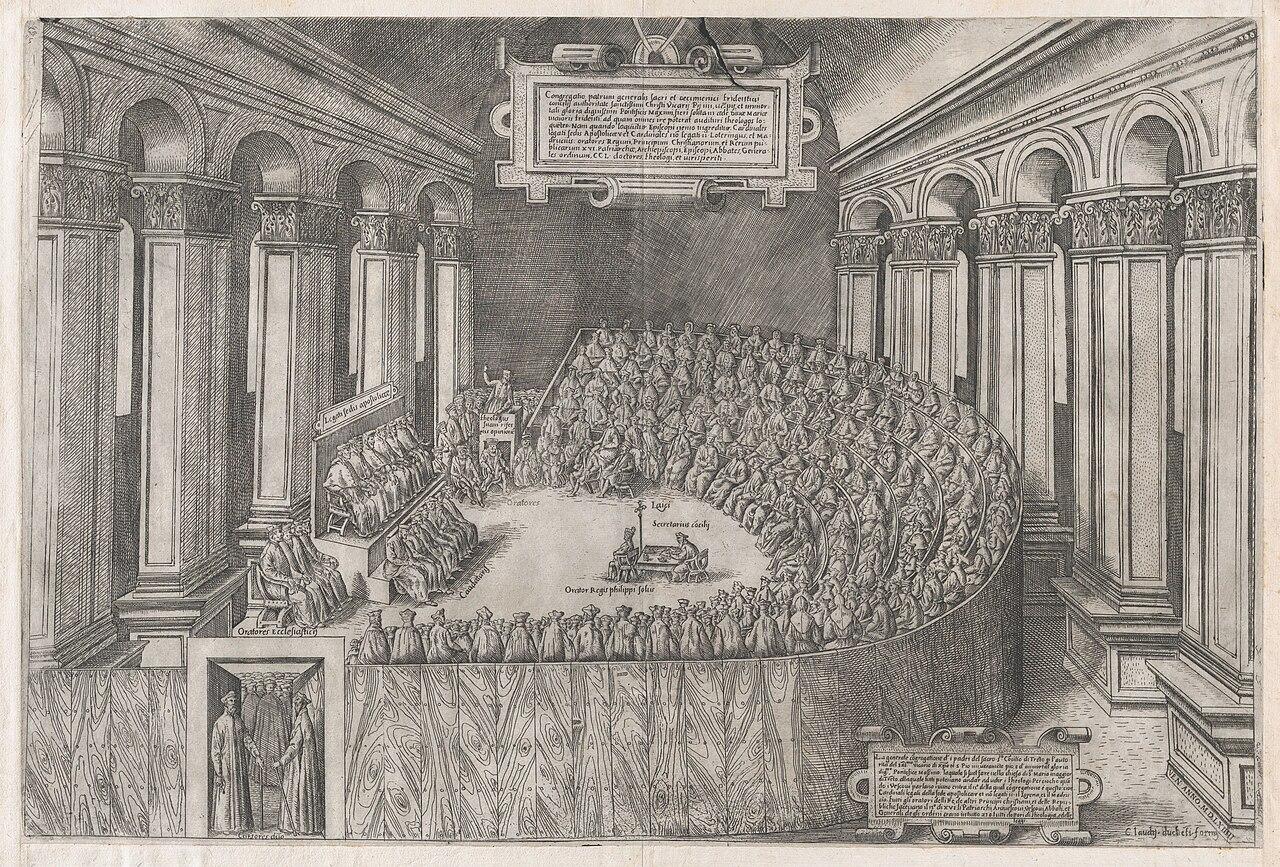
Claude Duchet, publisher, 1565. CC0.
1540 to 1610 · The churches · Featured Study
The Catholic Reform
The Roman church answered the Reformation with a council at Trent, decrees on doctrine and discipline, and new orders that carried its missions to Asia.
As you can see, a man is justified by his deeds and not by faith alone.
- Began
- 1540, when Paul III approved the Society of Jesus
- Bodies
- The Council of Trent, The Society of Jesus
The Council of Trent held its first session on 13 December 1545, and its twenty-fifth and last ended on 4 December 1563.
Summary
The Catholic reform was the Roman church's own reform in the age of the Reformation. Its council met at Trent for eighteen years and fixed its teaching. New orders arose, and the Jesuits sent priests to India, Japan and China.
- The pope approved the Jesuits in 1540 and first allowed them sixty members.
- At Trent the council condemned justification by faith alone, in the sense its ninth canon states.
- Calvin wrote a reply to the council's decrees.
- Francis Xavier landed at Goa in 1542 and reached Japan in 1549.
- In 1792 William Carey pointed to the Catholic missionaries to show that the work could be done.
The Two Texts the Council and the Reformers Read
Trent quoted James on works, and the Reformers read Paul on faith.
The sixth session of Trent, held on 13 January 1547, gave its decree on justification. Its tenth chapter quotes the letter of James for the place of works. The Reformers read Romans for the place of faith. The two verses below stood at the heart of the dispute.
For we maintain that a man is justified by faith apart from works of the law.Philip Schaff, a Protestant historian, records that Luther's German set the word allein, alone, into this verse and that the revisers of Luther's Bible kept it.
The Catholic Reform's Branch of the Family of Churches
The branch runs from the Society of Jesus and the council to the missions in Asia, with the Protestant missions after them.
The reform grew inside the Roman church, and its missions went before the Protestant ones.
1540 to 1547
- The Roman Catholic Church
- The Society of Jesus
- The council opened at Trent
1549 to 1563
- The council closed
- The mission to Japan
1601 to 1610
- The mission to Peking
1706 to 1792
1792 onward
Each date is read from the Catholic Encyclopedia, Waterworth's Trent or the title page of Carey's Enquiry.
The Reformation is the era page for the Protestant churches of the same century.
How the Reform Began: A New Order and a Council
The council's own decrees, a Protestant answer and a Catholic encyclopedia tell the start.
The Catholic Encyclopedia of 1912 says the Society of Jesus was approved by word of mouth on 3 September 1539, and formally on 27 September 1540. Its article on Ignatius names the bull of that day, Regimini militantis Ecclesiae.
J. Waterworth's English of the canons and decrees, printed in London in 1848, is the council's own text.
Calvin answered the first sessions in 1547 in his Acts of the Council of Trent with the Antidote. Henry Beveridge put it into English for the Calvin Translation Society in 1851.
The Reform They Pressed: Bishops Who Preach and Priests Who Are Trained
Two decrees of reformation, read from Waterworth's English, bound the bishops to preach and the cathedrals to train.
The fifth session, on 17 June 1546, bound every bishop, archbishop and prelate personally, unless lawfully hindered, “to preach the holy Gospel of Jesus Christ.”
The twenty-third session, on 15 July 1563, bound the cathedral and greater churches to keep “a certain number of youths”. They were to be trained for the priesthood. Waterworth's own history of the council calls these the ecclesiastical seminaries.
The Council's Decree on Justification
Two chapters of the decree on justification each answer a question.
Trent taught that justification is given freely and grows by works that follow it.
| Chapter | Its question | Its words |
|---|---|---|
| Session VI, chapter 8 | In what manner it is to be understood, that the impious is justified by faith, and gratuitously | “we are therefore said to be justified freely, because that none of those things which precede justification, whether faith or works, merit the grace itself of justification.” |
| Session VI, chapter 10 | On the increase of Justification received | The justified are “still further justified,” and the chapter cites the letter of James on works. |
The Society of Jesus and Its Counts
Each count is the encyclopedia's, with the year it gives.
The Society grew from a limit of sixty to thousands in one land by 1749.
| What was counted | The count | Who counted, and for when |
|---|---|---|
| The members the bull allowed | Sixty | The Catholic Encyclopedia (1910), the bull of 27 September 1540 |
| The Spanish Jesuits | 300 | The Catholic Encyclopedia (1912), at the death of Ignatius in 1556 |
| The Spanish Jesuits | 1,200 | The Catholic Encyclopedia (1912), at the close of Borgia's generalate in 1572 |
| The German provinces | 5,340 members in 307 houses | The Catholic Encyclopedia (1912), for 1749 |
Where the Missions Went
Each place stands with the date the encyclopedia gives.
The Jesuit missions reached India first, then Japan in 1549 and the Chinese capital in 1601.
| Date | Place | What happened there |
|---|---|---|
| 6 May 1542 | Goa | Francis Xavier landed. |
| 15 August 1549 | Kagoshima, Japan | Xavier and his companions came ashore. |
| 2 December 1552 | Sancian, off the coast of China | Xavier died on the island. |
| 24 January 1601 | Peking | Matteo Ricci entered, summoned by the emperor Wan-li. |
| 11 May 1610 | Peking | Ricci died in the capital. |
In Their Own Words
John Calvin (1509 to 1564)
Acts of the Council of Trent with the Antidote, the sixth session, on canon 9, Session VI, the antidote to canon 9
Calvin's answer
“when we say a man is justified by faith alone, we do not fancy a faith devoid of charity, but we mean that faith alone is the cause of justification.”
Reformed
About this saying1 paragraph
Calvin's answer to the ninth canon stands on page 151 of Beveridge's English of 1851.
William Carey (1761 to 1834)
An Enquiry into the Obligations of Christians, to use Means for the Conversion of the Heathens, section I
Carey's question
“Have not the popish missionaries surmounted all those difficulties which we have generally thought to be insuperable?”
Particular Baptist
About this saying1 paragraph
William Carey asked this on page 11 of his Enquiry, printed at Leicester in 1792, read from the page image.
The Council of Trent
The Canons and Decrees of the Council of Trent, Session VI, On Justification, canon 9, Session VI, canon 9
Canon 9
“If any one saith, that by faith alone the impious is justified; in such wise as to mean, that nothing else is required to co-operate in order to the obtaining the grace of Justification, and that it is not in any way necessary, that he be prepared and disposed by the movement of his own will; let him be anathema.”
Roman Catholic
About this saying1 paragraph
The ninth canon of the sixth session stands on page 45 of Waterworth's English of 1848.
The Anathemas and the Answers to Them
The council condemned the Reformers' teaching, and the Reformers and their heirs answered the council.
Calvin held in his Antidote that “faith alone is the cause of justification” and that the faith which justifies is joined to charity. He added on the next page, “It is therefore faith alone which justifies, and yet the faith which justifies is not alone.”
Carey held up the Catholic missionaries as an example and still judged their age hard. On page 34 he wrote that “blind zeal, gross superstition, and infamous cruelties” marked the religion of that time. In his view Christians needed conversion as much as the heathen.
Carey's dates for Xavier, 1541 to 1552 in the East Indies and Japan, differ by a year from the Catholic Encyclopedia's landing at Goa in 1542.
Books to Read Next
The Canons and Decrees of the Sacred and Oecumenical Council of Trent
J. Waterworth, translator · 1848
Every session of the council stands in English, with Waterworth's history of it.
Free at the Internet ArchiveTracts Relating to the Reformation, volume 3
John Calvin, translated by Henry Beveridge · 1851
Calvin's answers to Trent stand beside the text he answered.
Free at the Internet ArchiveAn Enquiry into the Obligations of Christians
William Carey · 1792
Carey surveys the missions before him, the Jesuits among them, and pleads for new ones.
Free at the Internet ArchiveWhat the Reform Handed On
The reform handed on a Roman church with its doctrine fixed against the Reformers, its bishops bound to preach and its priests trained in seminaries. Its missionaries reached Asia 250 years before Carey wrote, and he named them when he called the Protestant churches to follow.
Sources
Scripture is the Berean Standard Bible.
- The Holy Bible, Berean Standard Bible (read 2026)
- J. Waterworth, The Canons and Decrees of the Sacred and Oecumenical Council of Trent (London: C. Dolman, 1848), pages 12, 27, 36, 45, 187 and 232, and Session VI, chapter 10.
- John Calvin, Acts of the Council of Trent with the Antidote (1547), in Tracts Relating to the Reformation, volume 3, translated by Henry Beveridge (Edinburgh: Calvin Translation Society, 1851), pages 151 to 152.
- William Carey, An Enquiry into the Obligations of Christians, to use Means for the Conversion of the Heathens (Leicester: Ann Ireland, 1792), pages 11 and 34.
- Philip Schaff, History of the Christian Church, volume VI, The German Reformation, second edition revised (New York: Scribner, copyright 1888, printing of 1904), page 363, note 1.
- The Catholic Encyclopedia, volume 14 (New York: Robert Appleton, 1912), The Jesuits, and its history of the Society to 1773.
- The Catholic Encyclopedia, volume 7 (New York: Robert Appleton, 1910), St. Ignatius Loyola.
- The Catholic Encyclopedia, volume 6 (New York: Robert Appleton, 1909), St. Francis Xavier.
- The Catholic Encyclopedia, volume 13 (New York: Robert Appleton, 1912), Matteo Ricci.
Keep Studying
People and groups5