
Skip to content
mannafest.faith
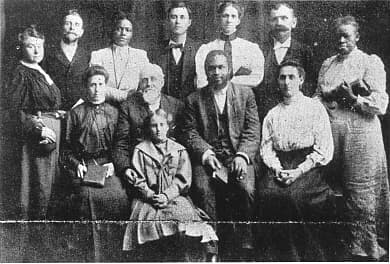
The workers of the Apostolic Faith Mission

The workers of the Apostolic Faith Mission, 312 Azusa Street, c. 1907. Public domain.

1906–1909 · Church history · Featured Study

The Azusa Street Revival

A former African Methodist Episcopal church, latterly a stable and warehouse, at 312 Azusa Street, Los Angeles, California.

Span
1906–1909

William Seymour led meetings in an old stable on Azusa Street from April 1906.

Summary

The movement that went out from them is now the fastest-growing part of the church. Black and white worshipped together there.

  • Seymour heard Parham teach in Houston in 1905, from the hallway.
  • It broke out at a house on Bonnie Brae Street on 9 April 1906.
  • The mission moved to 312 Azusa Street that month.
  • The Los Angeles Daily Times mocked it in print on 18 April 1906.
  • The mission's paper began in September 1906 and carried it worldwide.

The dated line

The outpouring in the order its moments came.

  1. 1870Seymour is born in LouisianaWilliam Joseph Seymour, born to parents who had been slaves; smallpox later took the sight of one eye.
  2. late 1905The hallway in HoustonCharles Parham will not seat a black man with his white students, so Seymour takes the lessons from the hallway, through a door left open a crack.
  3. Feb 1906Padlocked out on Santa Fe StreetInvited to preach in Los Angeles, Seymour preaches Acts 2:4 and returns to find the mission door locked against him. He stays in the city.
  4. April 9, 1906It breaks at 214 North Bonnie Brae StreetEdward Lee speaks in a language he never learned; that evening Jennie Evans Moore and others do the same. The crowd fills the house, the yard, the street, and the front porch collapses.
  5. mid-April 1906312 Azusa StreetA former African Methodist Episcopal church serving as a stable: sawdust floor, planks on nail kegs, two shoe crates for a pulpit. Meetings run three times a day for about three years.
  6. April 18, 1906“Weird Babel of Tongues”The Los Angeles Daily Times prints its mocking report, the same morning San Francisco is shaking apart, on a sect “mouthing a creed which it would seem no sane mortal could understand.”
  7. Sept 1906The Apostolic Faith begins printingThe mission's own free paper carries testimonies worldwide; its first issue runs to 5,000 copies, the mission's count of itself. That same month a Los Angeles paper sneers at the room's “disgraceful intermingling of the races”, the best thing about it.
  8. Autumn 1906Parham denounces the meetingsSeymour's former teacher arrives, condemns what he sees in racial terms, and is shown the door.
  9. 1908The mailing list is takenThe list goes to Portland, Oregon without Seymour's consent, and the mission's voice goes with it. The crowds thin.
  10. 1922Seymour diesA heart attack takes him while pastoring the small congregation Azusa had become; his wife Jennie keeps it going. The building comes down in 1931.
  11. 1994MemphisWhite and black Pentecostal leaders meet to repent publicly of the color line their movements rebuilt after Azusa had crossed it.

11 dated moments of The Azusa Street Revival, in order, each lifted from the story or its sources.

Sept 1906, Autumn 1906, 1908, 1922, 1994

The story

Los Angeles in 1906 was full of people asking God for something. Holiness churches were praying, small groups met in houses, and copies of the reports out of the Welsh revival were passing hand to hand. Frank Bartleman, a restless journalist and street preacher, wrote letters to Evan Roberts in Wales and read the replies aloud in the meetings. Nobody in the city was expecting what came, but a good many people had been asking for it.

The man God used had been kept out of the room where the teaching happened. William J. Seymour was born in Louisiana in 1870 to parents who had been slaves, and smallpox had taken the sight of one eye. In Houston he asked to study under Charles Parham, who taught that speaking in tongues was the sign of the Spirit's filling. Under Jim Crow, Parham would not seat a black man with his white students, so Seymour took the lessons from the hallway, through a door left open a crack.

An invitation brought him to Los Angeles early in 1906 to preach at a small holiness mission on Santa Fe Street. He preached Acts 2:4, that there was a filling of the Spirit the congregation had not yet received, and when he came back for the next service he found a padlock on the door. He did not leave town. He moved in with the Asberry family at 214 North Bonnie Brae Street and kept praying with whoever would pray with him.

And they were all filled with the Holy Spirit and began to speak in other tongues as the Spirit enabled them.
Acts 2:4BSB

The verse Seymour was preaching when the church that invited him padlocked its door against him, that the filling of the Spirit that fell at Pentecost is still on offer.

On April 9, 1906, it broke. A man named Edward Lee began to speak in a language he had not learned; that evening Jennie Evans Moore and others did the same, and Seymour himself a few days later. Word ran through the neighborhood, the house filled, the yard filled, the street filled, and the front porch gave way under the weight of the crowd. They needed a bigger building and had almost no money to find one.

What they found was a wreck at 312 Azusa Street, a former African Methodist Episcopal church that had been serving as a stable and warehouse, roughly forty feet by sixty. They put sawdust on the floor, laid planks across nail kegs for benches, and stacked two wooden shoe crates for a pulpit. Seymour often preached with his head bowed inside the crates, praying while others spoke. From about mid-April 1906 the meetings ran three times a day and effectively never stopped for three years.

The city noticed fast. On April 18, 1906, the same morning San Francisco was shaking apart in the earthquake, the Los Angeles Daily Times ran the story under the headline "Weird Babel of Tongues," and opened it: "Breathing strange utterances and mouthing a creed which it would seem no sane mortal could understand, the newest religious sect has started in Los Angeles." That September a Los Angeles paper went after the room itself, sneering at the mission's "disgraceful intermingling of the races." The reporters meant that one as an insult. It was, in fact, the most remarkable thing about the place.

The revival ledger's two lines: what marked the outpouring and what it left standing.

The ledgerWhat the record holds
What marked itWilliam Seymour, a one-eyed black preacher and son of former slaves, had learned the message in Texas while sitting in a hallway because the classroom was segregated. The outpouring began in a house on Bonnie Brae Street in April 1906 and moved to the Azusa Street building when the porch collapsed under the crowd. Meetings ran nearly around the clock for three years with no set order, no offerings taken by force, and no name on the door. Speaking in tongues, healings, and prophecy were reported constantly; the Los Angeles Daily Times covered it in April 1906 under the headline “Weird Babel of Tongues.”
What was left standingBlack, white, Hispanic, and Asian believers worshiped together in the Jim Crow era, Bartleman wrote that the color line was washed away in the blood, though the unity did not hold for long afterward. The mission’s free paper, The Apostolic Faith, printed 40,000 copies of an issue by 1907, by its own count, and sent workers to more than twenty-five nations within two years. Azusa is the single most influential source of the modern Pentecostal movement, and most American Pentecostal bodies trace their line back through that building, though historians now describe the movement’s birth as having several centers rather than one, counting Topeka, Chicago, and the 1905 outpouring at Mukti in India alongside it.

There was no printed order of service, no choir, no name on the door, and no offering forced on anyone; a box on the wall took what people chose to give. Black, white, Mexican, and Chinese believers sat on the same planks, and a black man led. In 1906. Bartleman, who was there, wrote the sentence the movement has never stopped quoting: "The 'color line' was washed away in the blood." Parham himself came in the autumn of 1906, denounced what he saw in racial terms, and was shown the door.

In September 1906 the mission began printing its own paper, The Apostolic Faith, and mailed it free to anyone who asked. It carried testimonies of healings, conversions, and tongues. By the paper's own count, its print run grew from 5,000 copies of the first issue to 40,000 in the spring of 1907. People came to Azusa, received, and went home. Within roughly two years workers had gone out to more than twenty-five nations, again by the mission's own reckoning.

The 5 people and groups the revival ledger names, in its order.

Who the ledger names
William J. Seymour; Jennie Evans Moore; Frank Bartleman; Lucy Farrow; Charles Parham

The unraveling was ordinary and sad. In 1908 the paper's mailing list was taken to Portland, Oregon without Seymour's consent, and the mission's voice went with it. Crowds thinned, leaders quarreled, and Azusa shrank back into a small black congregation. Seymour pastored it until he died of a heart attack in 1922; his wife, Jennie Moore Seymour, kept it going until her death, and the building was torn down in 1931. Nothing on that block marks it now but a plaque.

The hardest honesty comes last. The new Pentecostal bodies that grew out of Azusa organized themselves back along the color line it had crossed, the Assemblies of God formed in 1914 as a largely white fellowship, and the Church of God in Christ, whose founder Charles Harrison Mason had received at Azusa in 1907, remained a largely black one. American Pentecostalism stayed divided for most of a century, until white and black leaders met in Memphis in 1994 to repent of it publicly. God gave that church a picture of Revelation 7:9 and the church put it down. The picture was still real.

And afterward, I will pour out My Spirit on all people. Your sons and daughters will prophesy, your old men will dream dreams, your young men will see visions.
Joel 2:28BSB

Sons and daughters, servants and handmaids: the promise the people in that room read as covering everybody present, whatever their color, wages, or schooling.

What this revival teaches

God chose a half-blind son of slaves who had to learn through a doorway, and He did it on purpose: "God hath chosen the weak things of the world to confound the things which are mighty" (1 Corinthians 1:27). When a revival's leader could not have been chosen by any committee, that is a mark in its favor, not against it.

The participants held tongues to be the Bible evidence of the baptism with the Holy Ghost, their own paper, The Apostolic Faith, said exactly that in September 1906, but the evidence was never the prize. The prize was that Acts 2 had not been repealed. If Joel's promise reaches to servants and handmaids, then a laundress in a stable has the same access to the Spirit as a bishop, and the whole shape of the room follows from that one verse.

The gospel dissolved a racial wall in 1906 Los Angeles, which means it can. Ephesians 2:14 says Christ has broken down the middle wall of partition; Azusa proved the wall comes down where the Spirit is welcomed, and the decades after proved that a church can walk back out through a hole God has already made.

A locked door is not a closed door. Seymour was shut out of the building and kept praying in a house, and the room God filled was the one nobody had reserved for Him.

Revival does not fail because the fire was false; it fades because people fight over mailing lists. Guard what God gives with more care than you guard your own name, and remember that the same book that says "quench not the Spirit" also says "prove all things" (1 Thessalonians 5:19–21).

The case against this reading

What the record holds that cuts against the telling above.

Charles Parham, whose teaching Seymour had learned, came to Los Angeles in the autumn of 1906, denounced the meetings as fanaticism and was shut out of them; his own writing of that period objects to the races worshipping together. The mission's mailing list was taken from it in 1908 and the work declined from then. The best known line about the colour line washing away in the blood is Frank Bartleman's, written in 1925, nineteen years after the meetings he is describing.

The movement that began in a mixed congregation divided along the colour line inside a decade. The Assemblies of God formed as a white body in 1914, and the white and black American Pentecostal churches did not formally repent of the separation until the Memphis meeting of 1994.

Books to Read Next

How Pentecost Came to Los Angeles: As It Was in the Beginning (later printed as Azusa Street)
Frank Bartleman

Start here. An eyewitness wrote it from his own diaries, so you get the sawdust, the crowds, and the man's strong opinions all together. Free, public domain.

The Apostolic Faith (Los Angeles), September 1906 – May 1908
The Azusa Street Mission · 1906

The mission telling the world what it believed God was doing, in its own words. Read it as testimony rather than as an audit, and it is priceless. Free, public domain.

The Azusa Street Mission and Revival: The Birth of the Global Pentecostal Movement
Cecil M. Robeck Jr.

The careful modern history, built from the papers, the city records, and the participants' own accounts, the best place to see which famous stories hold up.

The Holiness-Pentecostal Tradition
Vinson Synan

The standard survey of where the streams came from and where they ran, including an honest account of the racial division that followed Azusa.

William J. Seymour and the Origins of Global Pentecostalism
Gastón Espinosa

Seymour's own documents gathered in one place, including the Latino and immigrant side of the mission that most tellings leave out.

The line through this page

The verse whose work this page shows continuing, then 4 links to other pages, in order of date.

  1. Acts 2:4

    The verse whose work this page shows continuing.

  2. 1858

    The Prayer Meeting Revival to The Ulster Revival

    New York's noon meetings in 1857 were read about in Ulster in 1858.

  3. 1859 to 1904

    The Ulster Revival to The Welsh Revival

    Ulster's own memory of 1859 stayed strong enough that Welsh and Irish believers were still praying against it as a standard half a century later, when the 1904 revival broke out over the water.

  4. May 1907

    The Church of God in Christ to The Azusa Street Revival

    G. B. Cashwell wrote to the Azusa mission's paper from Memphis in May 1907 that he had heard from Mason's church.

  5. 1905 to 1906, approximate

    The Welsh Revival to The Azusa Street Revival

    Frank Bartleman, a restless journalist and street preacher, wrote letters to Evan Roberts in Wales and read the replies aloud in the meetings.

  6. This page

    The Azusa Street Revival

Sources

Scripture is the Berean Standard Bible.

  1. Frank Bartleman, How Pentecost Came to Los Angeles: As It Was in the Beginning (1925), eyewitness, primary.
  2. The Apostolic Faith (Los Angeles), Sept 1906 – May 1908, the mission's own paper, primary.
  3. Los Angeles Daily Times, "Weird Babel of Tongues," April 18, 1906, primary.
  4. Los Angeles press reporting on the mission, September 1906, the "disgraceful intermingling of the races" line, quoted in Robeck below.
  5. Cecil M. Robeck Jr., The Azusa Street Mission and Revival (2006), cited.
  6. Vinson Synan, The Holiness-Pentecostal Tradition, 2nd edition (1997), cited.
  7. Gastón Espinosa, William J. Seymour and the Origins of Global Pentecostalism (2014), cited.

Every cited work: the sources registry →