
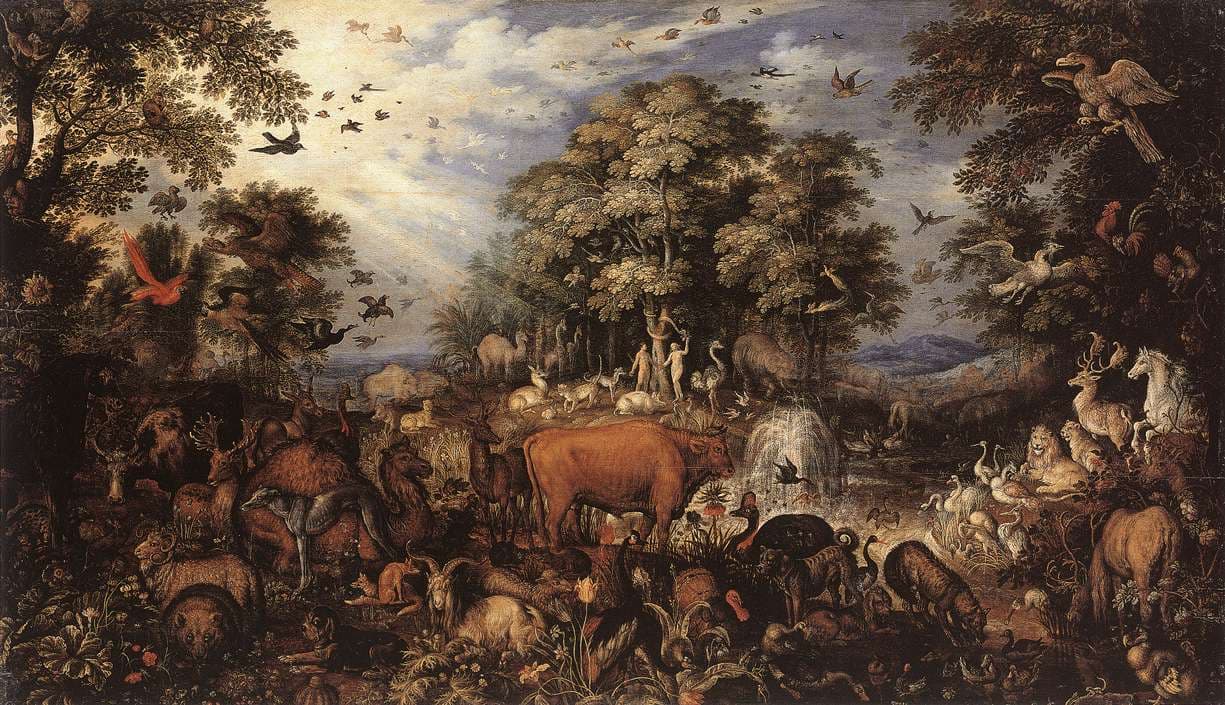
Genesis 2:15 · Subject · Stewardship
Creation Care: What Scripture Says
Scripture charges people with the care of the earth and its creatures, from the garden of Genesis 2 to the judgment of Revelation 11.
Israel's law told farmers to leave the land unsown in the seventh year and told an army at a siege to spare the fruit trees.
Then the LORD God took the man and placed him in the Garden of Eden to cultivate and keep it.
- Books
- Genesis, Leviticus, Romans
- Hold in memory
- Leviticus 25:23, Proverbs 12:10
Summary
God made the world, holds it as His own and gave humankind rule over all the living things in it. Israel's law bounded that rule with limits that protected the land, its trees and its animals, and the psalms and the Gospels show God Himself feeding every creature He made.
- Humankind was blessed to subdue the earth and rule its creatures, and the man was set in Eden to work the garden and guard it.
- God's care reaches beyond people to the beasts and the birds, and even to the cattle of a pagan city.
- Paul says the whole creation groans and waits for its freedom, which ties its future to the future of God's children.
The Charge at Creation
Genesis 1 and 2 state the charge in two forms, a blessing to rule and a task in a garden.
Creation Care: What Scripture Says gathers the texts that speak of the care of the earth and its creatures. It belongs to the value of stewardship, because the care of creation is the steward's charge carried out over land, plants and animals that belong to God.
The question the study answers is what Scripture asks of people in their use of the earth and its creatures, and where readers part ways. It reads the Hebrew verbs of the charge and the laws that bound it. It also gives two questions on which Christian readers have differed.
God blessed them and said to them, “Be fruitful and multiply, and fill the earth and subdue it; rule over the fish of the sea and the birds of the air and every creature that crawls upon the earth.”The blessing gives the charge in its widest form, over the whole earth and over every kind of creature.
Genesis 2 gives the charge again on a small scale, with one man set in one garden that God had planted.
And God looked upon all that He had made, and indeed, it was very good. And there was evening, and there was morning—the sixth day.God's verdict on all He had made comes before any charge is carried out, so what people are set to keep is what He called very good.
The Four Verbs of the Charge
Two verbs of Genesis 1:28 and two of Genesis 2:15 carry the charge.
The verbs of Genesis 1:28 speak of mastery, and the verbs of Genesis 2:15 speak of serving and keeping.
| Verb | Verse | The Berean words | Short meaning | Uses |
|---|---|---|---|---|
| kabash, H3533 | Genesis 1:28 | “subdue it” | to subdue | 14 |
| radah, H7287 | Genesis 1:28 | “rule over the fish of the sea” | to rule | 26 |
| abad, H5647 | Genesis 2:15 | “cultivate” | to serve | 288 |
| shamar, H8104 | Genesis 2:15 | “keep it” | to keep: obey | 468 |
The same pair returns after the fall, with abad in Genesis 3:23 for the man's work on the ground and shamar in Genesis 3:24 for the cherubim's watch over the tree of life.
Numbers 3:7 and Numbers 3:8 set both verbs over the Levites' work at the tabernacle, glossed “and they will keep” and “by serving”. Jamieson, Fausset and Brown read the garden in that light, writing that “it was in fact a temple in which he worshipped God”.
What the Law and Wisdom Ask
Israel's law limited the use of land, trees and animals, and Proverbs marks the righteous man by his care for his beast.
But in the seventh year there shall be a Sabbath of complete rest for the land—a Sabbath to the LORD. You are not to sow your field or prune your vineyard.The land itself is given a Sabbath, so its use is bounded by the LORD's rest.
Whatever grew of itself that year was food for the household, the foreigner, the livestock “and the wild animals in your land” (Leviticus 25:7).
The land must not be sold permanently, because it is Mine, and you are but foreigners and residents with Me.The verse stands here as the reason the law gives for its limits on the sale of land.
When you lay siege to a city for an extended time while fighting against it to capture it, you must not destroy its trees by putting an axe to them, because you can eat their fruit. You must not cut them down. Are the trees of the field human, that you should besiege them?Even in war the law spares the fruit trees, because they feed people and have no part in the fight.
If you come across a bird’s nest with chicks or eggs, either in a tree or on the ground along the road, and the mother is sitting on the chicks or eggs, you must not take the mother along with the young.The law spares the mother bird, so a family may take food without ending the line of the creature that gives it.
Do not muzzle an ox while it is treading out the grain.The working animal is to eat from the grain it treads, so its labour is repaid.
Paul quoted the ox law in 1 Corinthians 9:9 and asked, “Is it about oxen that God is concerned?” In 1 Corinthians 9:10 he answered that it “was written for us”. He applied it to those who work for a share in the harvest.
A righteous man regards the life of his animal, but the tender mercies of the wicked are only cruelty.Wisdom names the righteous man by the way he treats a beast that cannot speak for itself.
Deuteronomy 20:19, Deuteronomy 22:6, Deuteronomy 25:4, Proverbs 12:10
God's Care and the Creation's Hope
Scripture shows God feeding His creatures and promises the creation freedom from decay.
All creatures look to You to give them their food in due season.The psalm sets every creature in the sea and on land in God's hand for its food, so the steward cares for what God Himself feeds.
Look at the birds of the air: They do not sow or reap or gather into barns—and yet your heavenly Father feeds them. Are you not much more valuable than they?Jesus draws on the Father's feeding of the birds to teach His hearers not to worry, and the lesson rests on God's care for the birds.
So should I not care about the great city of Nineveh, which has more than 120,000 people who cannot tell their right hand from their left, and many cattle as well?”God's last word to Jonah counts the cattle of Nineveh among the reasons for His mercy.
that the creation itself will be set free from its bondage to decay and brought into the glorious freedom of the children of God.Paul ties the freedom of the creation to the freedom of God's children, so the creation has a future in God's purpose.
Paul adds that “the whole creation has been groaning together in the pains of childbirth until the present time” (Romans 8:22).
Jonah 4:11, Romans 8:21
Voices on the Garden
One voice draws from the garden that nothing held is one's own, and one names the first work given to man.
died 1274 · Bonaventure
Bonaventure (died 1274), in his Collations on the Hexaemeron (Collation 16), read Genesis 2:15 of the church: “It should be noted that the Church was placed in paradise, like the first man, ‘to till it,’ in such a way that no one would say ‘that anything he possessed’ was ‘his own’”.
1762 to 1832 · Adam Clarke
Adam Clarke, in his Commentary on the Bible (1832), called gardening “the first kind of employment on record” in his note on Genesis 2:15.
How Much Does the Charge Grant?
Readers differ on what dominion permits and on how far the charge reaches into public policy.
The first question is whether the dominion of Genesis 1:28 is chiefly a grant of rule over the creatures or a trust to be kept and handed on.
Dominion as rule over the creaturesJamieson, Fausset and Brown
Jamieson, Fausset and Brown (1871) called man “God's representative, clothed with authority and rule”. After the flood God widened the grant: “Everything that lives and moves will be food for you” (Genesis 9:3).
The objection: Genesis 2:15 sets the man to guard the garden as well as to work it, and the first grant of food in Genesis 1:29 was of plants only.
Dominion as a trust kept for those who come afterJohn Calvin
John Calvin wrote on Genesis 2:15 that the owner of a field should “so partake of its yearly fruits, that he may not suffer the ground to be injured by his negligence”. He added, “let him endeavor to hand it down to posterity as he received it, or even better cultivated.”
The objection: both Hebrew verbs of Genesis 1:28 are glossed “to tread down”, which are words of force.
The second question is how far the charge reaches into the public policy of the present day.
People first, as producers and stewardsThe Cornwall Declaration on Environmental Stewardship
The Cornwall Declaration on Environmental Stewardship was drawn up by Jewish, Catholic and Protestant signers. It says, “Many people mistakenly view humans as principally consumers and polluters rather than producers and stewards.” It puts the care of people “first and foremost”.
The objection: Genesis 2:15 and Proverbs 12:10 set the care of the land and the beast beside the care of people, and the texts give no order of rank between them.
The degradation of creation as a call to actAn Evangelical Declaration on the Care of Creation
Christianity Today reported on April 4, 1994 that “Nearly 150 Christian leaders, most of them well-known evangelicals,” had signed An Evangelical Declaration on the Care of Creation. The declaration appeals to the “full authority of Scripture” and names “seven degradations” of creation.
The objection: Scripture gives its charge to the man in the garden and to Israel's farmers and herdsmen, and it names no law of a modern state.
The Earth Held in Trust
Revelation 11:18 places the use of the earth under God's judgment.
The twenty-four elders sing the words of Revelation 11:18 after the seventh trumpet sounds (Revelation 11:15 to 16).
The nations were enraged, and Your wrath has come. The time has come to judge the dead and to reward Your servants the prophets, as well as the saints and those who fear Your name, both small and great—and to destroy those who destroy the earth.”The verse names the earth's destroyers among those the judgment reaches, so people answer for what they do to the earth.
The Greek of Revelation 11:18 uses one verb twice, glossed “to destroy” and “destroying”, so the judgment answers the deed with the same word.
Sources
Scripture is the Berean Standard Bible.
- STEP Bible, Translators Amalgamated Hebrew Old Testament, the tagged Hebrew text (Tyndale House, Cambridge), CC BY 4.0.
- Translators Amalgamated Greek New Testament, from the STEP Bible project, CC BY 4.0.
- STEP Bible, Translators Brief lexicon of Extended Strongs for Hebrew (Tyndale House, Cambridge), CC BY 4.0.
- Robert Jamieson, A. R. Fausset and David Brown, Commentary Critical and Explanatory on the Whole Bible (1871), on Genesis 1:26 and Genesis 2:15.
- Adam Clarke, Commentary on the Bible (1832), on Genesis 2:15.
- Bonaventure, Collations on the Hexaemeron, Collation 16, in a modern translation.
- John Calvin, Commentary on Genesis, volume 1, on Genesis 2:15.
- The Cornwall Declaration on Environmental Stewardship, Cornwall Alliance for the Stewardship of Creation.
- “Environmental Statement: 150 Sign ‘Care of Creation’”, Christianity Today, April 4, 1994.
Keep Studying
Read it1
Studies2
People and groups7
Show the next 1 title
Places1
Symbols1