
Exodus 28 · Exodus 29 · Leviticus 8 · Subject · Featured Study
The Ordination of the Priests
The seven days in which Moses washed, clothed and anointed Aaron and his sons as priests, from the command of Exodus 29 to the record of Leviticus 8 and 9.
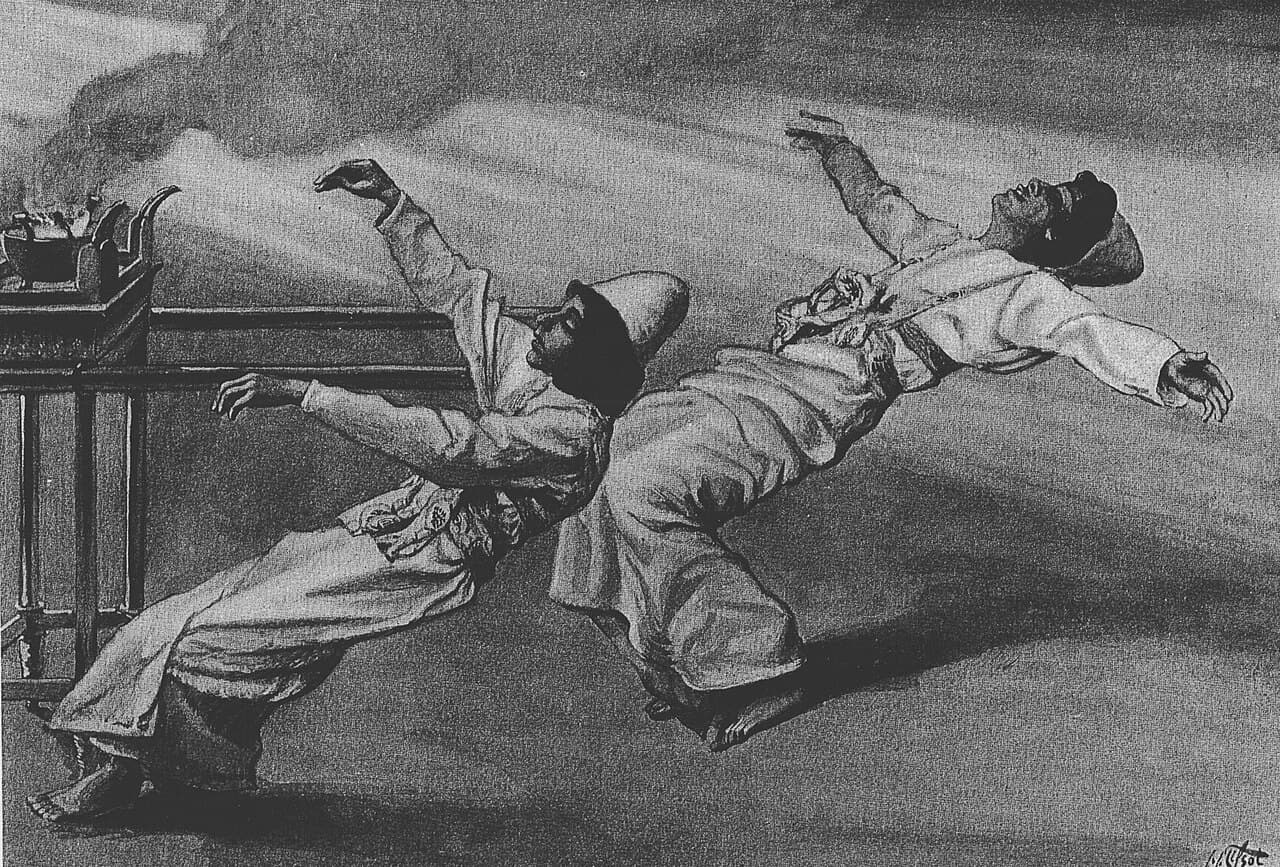
James Tissot, The Two Priests Are Destroyed (Leviticus 10:2), between 1896 and 1900, The Jewish Museum, New York. Public domain by date (the artist died in 1902), via Wikimedia Commons, File:Tissot_The_Two_Priests_Are_Destroyed.jpg.
THE ARTWORKJames Tissot painted Nadab and Abihu, Aaron's two eldest sons, falling beside the altar of incense as the fire of Leviticus 10:2 strikes them, with smoke rising behind them.
On the eighth day Aaron offered at the altar for the first time, and fire came out from the presence of the LORD and consumed the burnt offering.
Summary
The ordination of the priests is the rite of seven days by which Aaron's house was set apart to serve at the altar of the tabernacle.
- The rite took seven days and joined a washing, the holy garments, the anointing oil, three offerings and a meal at the entrance to the tent.
- The blood of the second ram was put on the right ear, thumb and big toe of each priest, and oil and blood were sprinkled on their garments.
- The Hebrew for ordaining is to fill the hand, and the second ram of the rite is named for that filling.
- Hebrews says Christ was called to be high priest as Aaron was, and that He holds His priesthood forever because He lives forever.
Five Passages of the Ordination
Exodus 28 and 29, Leviticus 8 and 9, and Hebrews 5
“Next, have your brother Aaron brought to you from among the Israelites, along with his sons Nadab, Abihu, Eleazar, and Ithamar, to serve Me as priests.God names the five men of the first priesthood here, Aaron and his four sons.
This is what you are to do for Aaron and his sons based on all that I have commanded you, taking seven days to ordain them.This verse sets the length of the rite at seven days.
So Aaron and his sons did everything the LORD had commanded through Moses.The week ends with the priests' full obedience, and their own service at the altar waits for the eighth day.
Moses and Aaron then entered the Tent of Meeting. When they came out, they blessed the people, and the glory of the LORD appeared to all the people. Fire came out from the presence of the LORD and consumed the burnt offering and the fat portions on the altar. And when all the people saw it, they shouted for joy and fell facedown.The eighth day ends with the glory that Moses promised in Leviticus 9:6.
No one takes this honor upon himself; he must be called by God, just as Aaron was. So also Christ did not take upon Himself the glory of becoming a high priest, but He was called by the One who said to Him: “You are My Son; today I have become Your Father.”Hebrews takes the call of Aaron as the pattern for the call of Christ.
The Rite in Order
The steps of the ordination in the order Leviticus 8 records them
- The washingAaron and his sons washed with water at the entrance, Exodus 29:4Leviticus 8:6
- The garmentsAaron clothed in tunic, robe, ephod, breastpiece and turban, Exodus 29:5 to 6Leviticus 8:7 to 9
- The anointingOil on the tabernacle and the altar, then poured on Aaron's head, Exodus 29:7 and 29:36Leviticus 8:10 to 12
- The sons clothedTunics, sashes and headbands for Aaron's sons, Exodus 29:8 to 9Leviticus 8:13
- The sin offeringA bull, its blood on the horns of the altar, its flesh burned outside the camp, Exodus 29:10 to 14Leviticus 8:14 to 17
- The burnt offeringThe first ram burned whole on the altar, Exodus 29:15 to 18Leviticus 8:18 to 21
- The ram of ordinationIts blood on the right earlobe, right thumb and right big toe, Exodus 29:19 to 20Leviticus 8:22 to 24
- The wave offeringFat, right thigh and bread placed in their hands, waved, then burned, Exodus 29:22 to 25Leviticus 8:25 to 29
- The sprinklingOil and blood from the altar on the priests and their garments, Exodus 29:21Leviticus 8:30
- The meal and the seven daysThe ram of ordination and the bread of the basket eaten at the entrance, Exodus 29:31 to 35Leviticus 8:31 to 35
A sequence of the ten steps of the rite, each with the verses of Exodus 29 that command it and the verses of Leviticus 8 that record it.
The Rite, Part by Part
Five parts of the rite, each with its verses and the teachers who wrote on it
Exodus 29:21 places the sprinkling before the wave offering, and Leviticus records it after the wave offering and the breast of Moses' portion.
The washingExodus 29:4
Then present Aaron and his sons at the entrance to the Tent of Meeting and wash them with water.Washing comes first in the command, before any garment or oil touches Aaron.
Cyril of Jerusalem reads the washing before the office as a picture of baptism.
“The high priest washes himself, then offers incense; for Aaron was first washed, then became high priest. For how could one who had not yet been cleansed by water pray for others? Further, the laver had been set within the tabernacle, as a symbol of baptism.”
Cyril of Jerusalem · Catechetical Lecture 3.5 · on Exodus 29:4Patristic
The garmentsExodus 28:9 to 29
The high priest carried the names of the twelve tribes twice, on the two onyx stones at his shoulders and on the twelve stones of the breastpiece.
Whenever Aaron enters the Holy Place, he shall bear the names of the sons of Israel over his heart on the breastpiece of judgment, as a continual reminder before the LORD.It ties the names on the breastpiece to Aaron's work in the Holy Place.
Matthew Henry turns the names on the breastpiece to the comfort of the believer.
“How near should Christ's name be to our hearts, since he is pleased to lay our names so near his! and what a comfort it is to us, in all our addresses to God, that the great high priest of our profession has the names of all his Israel upon his breast before the Lord for a memorial, presenting them to God as the people of his choice, who were to be made accepted in the beloved!”
Matthew Henry · Commentary on the Whole Bible · on Exodus 28:29Puritan
Calvin reads the splendor of the garments as a promise about the Mediator.
“But we must chiefly recollect what I have said, viz., that in these garments the supreme purity and wondrous glory of Christ were represented; as if God should promise that the Mediator would be far more august than the condition of man could produce.”
John Calvin · Commentaries · on Exodus 28:2Reformed
The anointingExodus 40:15
Anoint them just as you anointed their father, so that they may also serve Me as priests. Their anointing will qualify them for a permanent priesthood throughout their generations.”This verse commands the anointing of the sons as well as of their father.
Cyril joins the title of the anointed one to this anointing of Aaron.
“You must know that this chrism [chrismation] is prefigured in the Old Testament. When Moses, conferring on his brother the divine appointment, was ordering him high priest, he anointed him after he had bathed in water, and thenceforward he was called ‘christ’ [‘anointed’], clearly after the figurative Chrism.”
Cyril of Jerusalem · Catechetical Lecture 3.6 · on Leviticus 8:12Patristic
The blood on ear, thumb and toeExodus 29:20
Slaughter the ram, take some of its blood, and put it on the right earlobes of Aaron and his sons, on the thumbs of their right hands, and on the big toes of their right feet. Sprinkle the remaining blood on all sides of the altar.This is the first blood of the rite put on the priests' own bodies.
Jamieson, Fausset and Brown explain why the blood of this ram was divided between the altar and the priests.
“And there was a marked peculiarity in the manner in which this other ram was to be disposed of. The former was for the glory of God--this was for the comfort of the priest himself; and as a sign of a mutual covenant being ratified, the blood of the sacrifice was divided--part sprinkled on the altar round about, and part upon the persons and garments of the priests.”
Jamieson, Fausset & Brown · Commentary Critical and Explanatory on the Whole Bible · on Exodus 29:20Reformed
Calvin explains why the priest had to be sprinkled before he could intercede for others.
“What we must first observe here is, that the priest must be sprinkled with blood, in order that he may conciliate the favor of God towards himself for the purpose of intercession. Thus the priesthood of Christ was dedicated with blood, so that it might be efficacious to reconcile God with us.”
John Calvin · Commentaries · on Exodus 29:16Reformed
The meal and the seven daysExodus 29:33, Leviticus 8:34
They must eat those things by which atonement was made for their ordination and consecration. But no outsider may eat them, because these things are sacred.This verse shows that the priests ate the very offering that made atonement for them.
Matthew Henry explains what the priests' eating of the offering signified.
“He supped with them, and they with him. Their eating of the things wherewith the atonement was made signified their receiving the atonement, as the expression is ( Rom. v. 11 ), their thankful acceptance of the benefit of it, and their joyful communion with God thereupon, which was the true intent and meaning of a feast upon a sacrifice.”
Matthew Henry · Commentary on the Whole Bible · on Exodus 29:33Puritan
Henry sets the sacrifices repeated through the week beside Hebrews 10.
“This shows the imperfection of the legal sacrifices, which, because they could not take away sin, were often repeated ( Heb. x. 1, 2 ), but were here repeated seven times (a number of perfection), because they typified that one offering, which perfected for ever those that were sanctified.”
Matthew Henry · Commentary on the Whole Bible · on Leviticus 8:34Puritan
What the Text Says of the Rite
Three things often said of the ordination, each with the verse that tests it
AARON AS HIS OWN ORDAINER
Through the seven days Moses did every act at the altar, and Rashi notes that he did so though he was not a priest.
A RITE OF ONE DAY
The ordination took seven days, and the priests stayed at the entrance to the tent day and night until it was complete.
A RITE FOR THE PRIESTS ALONE
The same seven days purified the altar with a sin offering each day and anointed it, and only then did the altar become most holy.
When the Ordination Took Place
The date Exodus gives and Rashi's reckoning of the eighth day
Leviticus 9:1 counts the eighth day from the week of ordination and names no month.
So the tabernacle was set up on the first day of the first month of the second year.This verse dates the setting up of the tabernacle, which Exodus 40:12 to 15 joins to the anointing of the priests.
The medieval commentator Rashi, following the Sifra, holds that the command of Leviticus 8 was given seven days before the tabernacle was set up for good. He names the eighth day as the New Moon of Nisan, the day the tabernacle was finally erected.
Hebrew Words of the Ordination
Four words of the rite, each in the verse where it stands
KAHAN, TO SERVE AS PRIEST (HEBREW, H3547)
Strong gives to officiate as a priest, and the verb first stands in the call of Aaron.
MALE, TO FILL (HEBREW, H4390)
Strong gives to fill, and where the Berean text of this verse reads ordain, the Hebrew says to fill the hand.
MILLU, ORDINATION (HEBREW, H4394)
Strong gives the setting of gems and, as a word of the rite, a dedicatory sacrifice; Rashi says the ram was so named because it set the priests fully in their office.
QADASH, TO CONSECRATE (HEBREW, H6942)
Strong gives to make or pronounce clean, and here God says He will consecrate the tent, the altar and the priests Himself.
What the Text Leaves Unsaid
Two questions the chapters leave open
Scripture never describes the Urim and Thummim or tells how they were made, and Adam Clarke notes that Moses was given no direction for making them.
Then he put the breastpiece on him and placed the Urim and Thummim in the breastpiece.This is the one verse of the rite in which the Urim and Thummim are handled.
Leviticus sets the death of Nadab and Abihu directly after the eighth day, and Aaron's words in Leviticus 10:19 place it on the same day. The text calls their fire unauthorized and does not say what made it so.
Now Aaron’s sons Nadab and Abihu took their censers, put fire in them and added incense, and offered unauthorized fire before the LORD, contrary to His command. So fire came out from the presence of the LORD and consumed them, and they died in the presence of the LORD. Then Moses said to Aaron, “This is what the LORD meant when He said: ‘To those who come near Me I will show My holiness, and in the sight of all the people I will reveal My glory.’” But Aaron remained silent.Fire from the presence of the LORD falls a second time here, on two of the newly ordained priests.
Rashi reports two answers from the rabbis of the Sifra. Rabbi Eliezer held that the two gave rulings in the presence of their teacher Moses. Rabbi Ishmael held that they entered the sanctuary drunk, since the command against wine follows in Leviticus 10:8 to 9.
The High Priest Hebrews Reads After the Rite
Hebrews 7 sets Christ beside Aaron at three points of the ordination
Rashi, following the Sifra, reads Moses' word to approach the altar as encouragement to Aaron, who held back from going near.
Then Moses said to Aaron, “Approach the altar and sacrifice your sin offering and your burnt offering to make atonement for yourself and for the people. And sacrifice the people’s offering to make atonement for them, as the LORD has commanded.”Hebrews 7:27 recalls the order this command sets.
Unlike the other high priests, He does not need to offer daily sacrifices, first for His own sins and then for the sins of the people; He sacrificed for sin once for all when He offered up Himself.Hebrews 7:26 gives the reason: this high priest is holy and set apart from sinners.
Exodus 29:29 to 30 gives Aaron's garments to the son who succeeds him as priest.
Now there have been many other priests, since death prevented them from continuing in office. But because Jesus lives forever, He has a permanent priesthood. Therefore He is able to save completely those who draw near to God through Him, since He always lives to intercede for them.Hebrews sets a priest who lives forever against that line of successors.
Exodus 29 and Leviticus 8 record no oath at the ordination of Aaron and his sons.
And none of this happened without an oath. For others became priests without an oath, but Jesus became a priest with an oath by the One who said to Him: “The Lord has sworn and will not change His mind: ‘You are a priest forever.’” Because of this oath, Jesus has become the guarantee of a better covenant.Hebrews draws from Psalm 110:4 a priesthood confirmed by the oath of God.
Three Teachers on the Priest's Work
Matthew Henry, John Wesley and Gregory the Dialogist, each with the work named
Matthew Henry on Aaron's blessingLeviticus 9:22
Henry joins Aaron's blessing of the people to the blessing Jesus gave at His ascension.
“This was one part of the priest's work, in which he was a type of Christ, who came into the world to bless us, and when he was parted from his disciples, at his ascension, lifted up his hands and blessed them, and in them his whole church, of which they were the elders and representatives, as the great high priest of our profession.”
Matthew Henry · Commentary on the Whole Bible · on Leviticus 9:22Puritan
John Wesley on the gold plateExodus 28:38
Wesley reads the gold plate on Aaron's forehead, which bore the iniquity of the holy things, as a picture of Christ's work.
“Thro' him what is amiss in our services is pardoned: even this would be our ruin, if God should enter into judgment with us: but Christ our high priest bears this iniquity; bears it for us, so as to bear it from us. Thro' him likewise what is good is accepted; our persons, our performances are pleasing to God upon the account of Christ's intercession, and not otherwise.”
John Wesley · Explanatory Notes upon the Old Testament · on Exodus 28:38Evangelical
Gregory the Dialogist on the ephodExodus 28:8
Gregory reads the gold and the colors of the ephod as the virtues a priest must show.
“Which ephod is also rightly ordered to be made of gold, blue, purple, twice dyed scarlet, and fine twined linen, that it may be shewn by how great diversity of virtues the priest ought to be distinguished. Thus in the priest's robe before all things gold glitters, to shew that he should shine forth principally in the understanding of wisdom.”
Gregory the Dialogist · The Book of Pastoral Rule, Part 2, Chapter 3 · on Exodus 28:8Patristic
Matthew Henry on the altar's atonementExodus 29:36
Henry explains why an altar that had never been used needed an atonement.
“An atonement was made for the altar. Though that was not a subject capable of sin, nor, having never yet been used, could it be said to be polluted with the sins of the people, yet, since the fall, there can be no sanctification to God but there must first be an atonement for sin, which renders us both unworthy and unfit to be employed for God.”
Matthew Henry · Commentary on the Whole Bible · on Exodus 29:36 to 37Puritan
Whether the Rite Is a Type of Christ
Two readings, each with its holder, its case and the objection drawn from the text
A figure of the priesthood of ChristJohn Calvin, Commentaries on the Four Last Books of Moses, 1563
This reading takes the rite as a figure God gave of the priesthood of Christ, and Calvin draws it from Hebrews 7:26.
“Hence we gather that true purity and innocence, which was but typical in the Law, is found in Christ alone. ‘For such an high priest became us,’ says the Apostle, ‘who is holy, harmless, undefiled, separate from sinners,’ to present Himself before God for us.”
John Calvin · Commentaries · on Exodus 29:1Reformed
Then I will dwell among the Israelites and be their God. And they will know that I am the LORD their God, who brought them out of the land of Egypt so that I might dwell among them. I am the LORD their God.The objection: the command ends on God dwelling among Israel, the purpose the rite names for itself, and points to no later priest.
Israel's installation of its priestsRashi, Commentary on the Torah, eleventh century
On this reading the rite installed Aaron's house in an office for all time, and Rashi takes the filling of hands in Exodus 29:9 as given for an everlasting priesthood.
Now if perfection could have been attained through the Levitical priesthood (for on this basis the people received the law), why was there still need for another priest to appear—one in the order of Melchizedek and not in the order of Aaron? For when the priesthood is changed, the law must be changed as well.The objection: a promised priest of another order shows that perfection did not come through Aaron's line.
Here the Jewish reading and the Christian reading part, and Hebrews 8:5 calls the place where the priests served a copy and shadow of what is in heaven.
Books on the Ordination
Three commentaries to read whole, earliest first
Commentary on the Torah
Rashi, in the English of M. Rosenbaum and A. M. Silbermann (1929 to 1934) · Eleventh century
Rashi gives the rabbinic readings of the rite, from the meaning of millu'im to the death of Nadab and Abihu.
Read Rashi on Leviticus 8 at SefariaCommentaries on the Four Last Books of Moses
John Calvin · 1563
Calvin reads the garments and the sprinkled blood as figures of Christ the Mediator.
Commentary on the Whole Bible
Matthew Henry · 1710
Henry draws a lesson for the believer from the acts of the rite, from the names on the breastpiece to the meal at the entrance.
Draw Near Through Him
At the ordination Moses cleansed the priests before they served at the altar, and Hebrews applies that cleansing to every believer who comes to God through Jesus.
Therefore, brothers, since we have confidence to enter the Most Holy Place by the blood of Jesus, by the new and living way opened for us through the curtain of His body, and since we have a great priest over the house of God, let us draw near with a sincere heart in full assurance of faith, having our hearts sprinkled to cleanse us from a guilty conscience and our bodies washed with pure water.Under the law only the high priest went behind the second curtain, once a year (Hebrews 9:3 and 9:7), and this passage gives entry by a new way.
Keep studying
People4
Places1