
Ezekiel 36 to John 3 · Doctrine · Featured Study
The New Heart and the New Spirit
Ezekiel 11, 18 and 36 read beside Jeremiah 31 and John 3.
God promised to remove the heart of stone from His people and give them a heart of flesh, with His own Spirit within them.
- First taught
- Deuteronomy 30:6
- Fullest statement
- Ezekiel 36:26
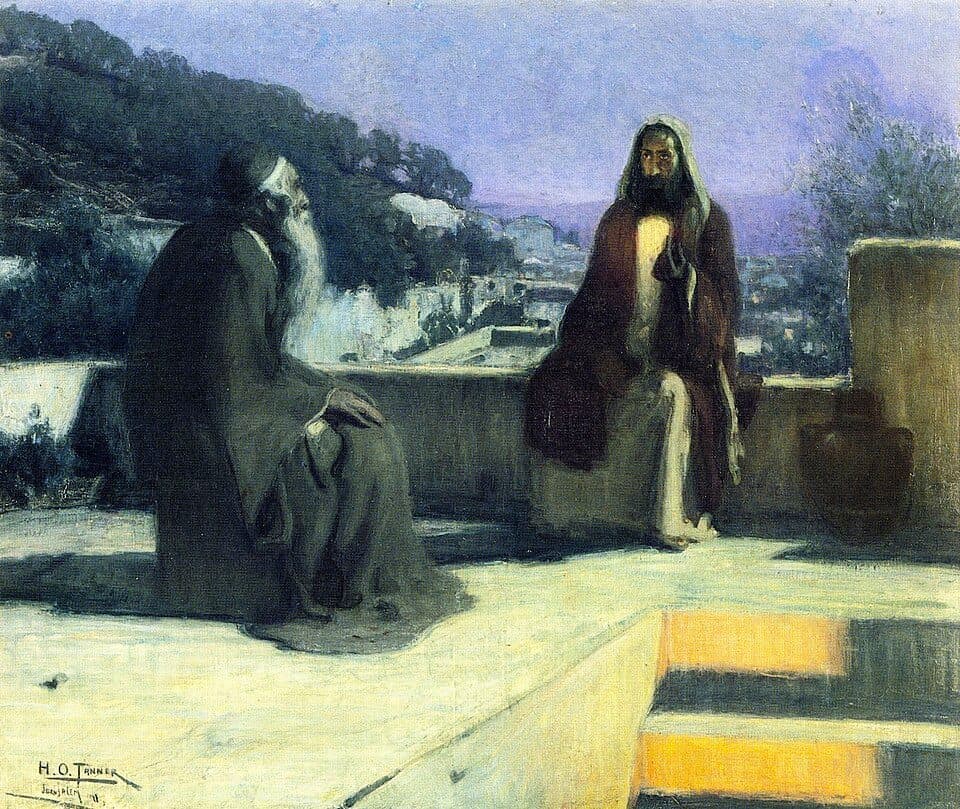
Henry Ossawa Tanner, Nicodemus Visiting Jesus, 1899, Pennsylvania Academy of the Fine Arts. Public domain, via Wikimedia Commons.
THE ARTWORKTanner painted the two men on a rooftop in Jerusalem by moonlight. Nicodemus sits bent forward in shadow, and Jesus sits facing him on the low wall, His robe lit by the warm light of a stairway below.
Summary
The new heart is the inward change of the person, which the New Testament calls the new birth.
- Only two verses of Ezekiel use the Hebrew phrase new heart, and only two name the heart of stone.
- In chapter 36 the sprinkling of clean water comes before the new heart, in the language of the purification rite of Numbers 19.
- Jeremiah promises the same inner change as the law inscribed on the heart.
- Readers divide on who makes the new heart, on the water Jesus names, and on whose heart is promised.
Ezekiel's Three Places
Two promises of the LORD and one command to Israel, in the order Ezekiel gave them.
And I will give them singleness of heart and put a new spirit within them; I will remove their heart of stone and give them a heart of flesh, so that they may follow My statutes, keep My ordinances, and practice them. Then they will be My people, and I will be their God.This promise answers Jerusalem's people, who said the exiles were far from the LORD and the land was theirs.
Therefore, O house of Israel, I will judge you, each according to his ways, declares the Lord GOD. Repent and turn from all your transgressions, so that your iniquity will not become your downfall. Cast away from yourselves all the transgressions you have committed, and fashion for yourselves a new heart and a new spirit. Why should you die, O house of Israel? For I take no pleasure in anyone’s death, declares the Lord GOD. So repent and live!This command makes the new heart a duty Israel must answer for.
I will also sprinkle clean water on you, and you will be clean. I will cleanse you from all your impurities and all your idols. I will give you a new heart and put a new spirit within you; I will remove your heart of stone and give you a heart of flesh. And I will put My Spirit within you and cause you to walk in My statutes and to carefully observe My ordinances.The cleansing answers the defilement of the land by Israel's conduct and idols, told in Ezekiel 36:17 to 18.
The New Heart Through Scripture
Fifteen texts from Deuteronomy to Hebrews, in canon order.
- Kind
- Command
- Who acts
- Israel
- The image
- A circumcised heart
- Kind
- Gift
- Who acts
- The LORD
- The image
- A circumcised heart
- Kind
- Prayer
- Who acts
- God, asked by David
- The image
- A clean heart
- Kind
- Command
- Who acts
- The men of Judah
- The image
- A circumcised heart
- Kind
- Gift
- Who acts
- The LORD
- The image
- A heart to know Him
- Kind
- Gift
- Who acts
- The LORD
- The image
- The law inscribed on the heart
- Kind
- Gift
- Who acts
- The LORD
- The image
- One heart and one way
- Kind
- Gift
- Who acts
- The LORD
- The image
- Flesh for stone
- Kind
- Command
- Who acts
- Israel
- The image
- A new heart and a new spirit
- Kind
- Gift
- Who acts
- The LORD
- The image
- A new heart, and flesh for stone
- Kind
- Gift
- Who acts
- The LORD
- The image
- His Spirit within them
12John 3:5
- Kind
- Requirement
- Who acts
- The Spirit
- The image
- Birth of water and the Spirit
- Kind
- Gift
- Who acts
- The Spirit
- The image
- A letter on tablets of human hearts
- Kind
- Gift
- Who acts
- God
- The image
- The washing of new birth
- Kind
- Gift
- Who acts
- The LORD
- The image
- Jeremiah's law on the heart, quoted
Each link gives its text's kind, who acts and its image of the heart: three are commands, one is a prayer, one is a requirement, and the other ten are gifts.
The Promise of Ezekiel 36, Step by Step
Ezekiel 36:22 to 32 gives the reason for the promise, its order and its end.
Israel had profaned the LORD's name among the nations, and He acts to show the holiness of His name (Ezekiel 36:22 to 23). Verse 32 adds that He acts for His own sake, so the gift rests on His name and on nothing Israel brings.
The gathering from the countries in verse 24 comes before the cleansing, and in verse 28 the people live in the land and are His people.
The Hebrew word for heart, lev, covers the feelings, the will and the mind, so the change God promises reaches the whole inner person.
The clean water and the rite of Numbers 191 passage, 2 paragraphs
For the purification of the unclean person, take some of the ashes of the burnt sin offering, put them in a jar, and pour fresh water over them. Then a man who is ceremonially clean is to take some hyssop, dip it in the water, and sprinkle the tent, all the furnishings, and the people who were there. He is also to sprinkle the one who touched a bone, a grave, or a person who has died or been slain. The man who is ceremonially clean is to sprinkle the unclean person on the third day and on the seventh day. After he purifies the unclean person on the seventh day, the one being cleansed must wash his clothes and bathe in water, and that evening he will be clean.Ezekiel 36:25 widens this sprinkling from each unclean person to the whole nation.
Rashi, the eleventh-century French commentator, reads the clean water of Ezekiel 36:25 as the water of purification, which removes even the uncleanness of contact with a corpse. Jamieson, Fausset and Brown also trace the phrase to the water mixed with the ashes of the burnt sin offering of Numbers 19:17.
The Mishnah, at the close of tractate Yoma, gives Rabbi Akiva's saying on Ezekiel 36:25: Israel's Father in heaven is the one who purifies them.
The breath in the valley of bones1 passage, 1 paragraph
I will put My Spirit in you and you will live, and I will settle you in your own land. Then you will know that I, the LORD, have spoken, and I will do it, declares the LORD.’”The gift of Ezekiel 36:27 returns here, at the end of the vision of the dry bones.
The Hebrew ruach means wind, breath and spirit, and in the valley it carries all three.
What the Text Says and What Is Often Said
Two claims often made of the new heart, each answered by a verse of Ezekiel 36.
SAID: THE PROMISE IS FOR SINGLE SOULS
Every you in Ezekiel 36:24 to 28 is plural, so the LORD speaks to a whole people at once.
SAID: JEREMIAH AND EZEKIEL PROMISE DIFFERENT THINGS
Both end on the covenant bond of a people and their God, in Jeremiah 31:33 and Ezekiel 36:28.
The Exiles Who Heard It
Ezekiel dated his visions by the years of King Jehoiachin's exile.
Ezekiel was a priest, the son of Buzi, living among the exiles by the River Kebar in the land of the Chaldeans. The king of Babylon had taken King Jehoiachin captive in the eighth year of his own reign.
He was called in the fifth year of that exile, and the vision of chapters 8 to 11 came in the sixth, while Jerusalem still stood.
In the twelfth year a fugitive brought the news that the city had been taken. The promise of chapter 36 stands after that report, and it speaks to a people whose temple, king and land were gone.
What the Text Leaves Unsaid
Ezekiel and John 3 leave four matters to the reader.
Ezekiel does not use the words new covenant. He speaks of a covenant of peace and an everlasting covenant, in Ezekiel 37:26.
John 3 does not name Ezekiel.
The text does not say how one person receives the promise.
Ezekiel does not explain how the command of chapter 18 and the gift of chapter 36 fit together. He sets them side by side.
From Ezekiel to the New Birth
Jesus, Paul and Hebrews take up the promise of the heart and the Spirit.
Jesus answered, “Truly, truly, I tell you, no one can enter the kingdom of God unless he is born of water and the Spirit.This verse answers Nicodemus, who asked how a man can be born when he is old.
“You are Israel’s teacher,” said Jesus, “and you do not understand these things?Jesus' rebuke shows He expected Israel's teacher to know the new birth from the Scriptures.
Jesus joins water and Spirit, as Ezekiel 36:25 to 27 joins clean water, a new spirit and God's Spirit.
Paul names the same change in Jeremiah's image of writing, and calls himself a minister of a new covenant of the Spirit.
It is clear that you are a letter from Christ, the result of our ministry, written not with ink but with the Spirit of the living God, not on tablets of stone but on tablets of human hearts.Paul sets stone against the heart, as Ezekiel did.
He saved us, not by the righteous deeds we had done, but according to His mercy, through the washing of new birth and renewal by the Holy Spirit.Paul gives the new birth by God's mercy, apart from any righteous deed the saved had done.
The Spirit poured out3 passages
And I will no longer hide My face from them, for I will pour out My Spirit on the house of Israel, declares the Lord GOD.”Ezekiel's verb for the Spirit's coming, shaphak, is the verb Joel uses.
And afterward, I will pour out My Spirit on all people. Your sons and daughters will prophesy, your old men will dream dreams, your young men will see visions.Peter explained the coming of the Spirit at Pentecost with this verse, in Acts 2:16 to 18.
He was speaking about the Spirit, whom those who believed in Him were later to receive. For the Spirit had not yet been given, because Jesus had not yet been glorified.This verse answers when the promised Spirit would come.
Jeremiah's new covenant beside Ezekiel's new heart1 passage, 1 paragraph
Behold, the days are coming, declares the LORD, when I will make a new covenant with the house of Israel and with the house of Judah. It will not be like the covenant I made with their fathers when I took them by the hand to lead them out of the land of Egypt—a covenant they broke, though I was a husband to them,” declares the LORD. “But this is the covenant I will make with the house of Israel after those days, declares the LORD. I will put My law in their minds and inscribe it on their hearts. And I will be their God, and they will be My people. No longer will each man teach his neighbor or his brother, saying, ‘Know the LORD,’ because they will all know Me, from the least of them to the greatest, declares the LORD. For I will forgive their iniquities and will remember their sins no more.”Jeremiah places the inward change inside a new covenant with the house of Israel and the house of Judah.
Hebrews quotes this promise twice, in chapters 8 and 10, of Christ's priesthood and sacrifice.
Voices Across the Centuries
Four teachers from John Chrysostom to Jamieson, Fausset and Brown, earliest first.
John Chrysostom on water and the SpiritHomily on the Gospel of John 25
“That the need of water is absolute and indispensable, you may learn in this way. On one occasion, when the Spirit had flown down before the water was applied, the Apostle did not stay at this point, but, as though the water were necessary and not superfluous, observe what he says; ‘Can any man forbid water, that these should not be baptized, which have received the Holy Ghost as well as we?’”
John Chrysostom · Homily on the Gospel of John 25 · on John 3:5Patristic
Augustine on the heart of fleshAgainst Faustus, a Manichaean 15:4
“For by the heart of flesh and the fleshy tables is not meant a carnal understanding: but as flesh feels, whereas a stone cannot, the insensibility of stone signifies an unintelligent heart, and the sensibility of flesh signifies an intelligent heart.”
Augustine of Hippo · Against Faustus, a Manichaean 15:4 · on Ezekiel 11:19Patristic
Augustine on grace and the stony heartLetter 217
“God by his grace takes away the stony heart from unbelievers and forestalls merit in people of good will in such a way that their will is prepared by what goes before grace, but that grace is not given through some merit of human will.”
Augustine of Hippo · LETTER 217 · on Ezekiel 36:26Patristic
John Wesley on the new birthExplanatory Notes upon the New Testament, on John 3:5
“Except a man be born of water and of the Spirit - Except he experience that great inward change by the Spirit, and be baptized (wherever baptism can be had) as the outward sign and means of it.”
John Wesley · Explanatory Notes upon the New Testament · on John 3:5Evangelical
John Wesley on the new heart and the Spirit withinExplanatory Notes upon the Old Testament, on Ezekiel 36:26 and 27
“A new heart - A new frame of soul, a mind changed, from sinful to holy, from carnal to spiritual. A heart in which the law of God is written, Jer. xxxi, 33. A sanctified heart, in which the almighty grace of God is victorious, and turns it from all sin to God.”
John Wesley · Explanatory Notes upon the Old Testament · on Ezekiel 36:26Evangelical
“And cause you - Sweetly, powerfully, yet without compulsion; for our spirits, framed by God's spirit to a disposition suitable to his holiness, readily concurs. Ye shall keep - Be willing; and able to keep the judgments, and to walk in the statutes of God, which is, to live in all holiness.”
John Wesley · Explanatory Notes upon the Old Testament · on Ezekiel 36:27Evangelical
Jamieson, Fausset and Brown on the command and the giftCommentary Critical and Explanatory on the Whole Bible, on Ezekiel 36:26
“In Eze 18:31 they are commanded, ‘Make you a new heart, and a new spirit.’ Here God says, ‘A new heart will I give you, and a new spirit will I put within you.’ Thus the responsibility of man, and the sovereign grace of God, are shown to be coexistent.”
Jamieson, Fausset & Brown · Commentary Critical and Explanatory on the Whole Bible · on Ezekiel 36:26Reformed
Who Makes the New Heart, What Is the Water, Whose Heart Is Promised
Three questions and eight positions, each with its holders and the strongest objection.
God gives the new heart, and the command teaches us to askAugustine, On Grace and Free Will; John Calvin, Commentaries on Ezekiel · Augustinian and Reformed
Augustine, in On Grace and Free Will, answered the Pelagians that God commands some things we cannot do, so that we may know what to ask of Him. He read Ezekiel 36:26 to 27 as God making us act.
John Calvin, lecturing on Ezekiel 18:31, held that a command shows what we ought to do and not what we are able to do. On Ezekiel 11:19 he traced the stony heart to Adam's fall.
“But God is not content with that partition, since he is deprived of half his right: for he does not say that he would assist men to renew themselves and to repent; but he attributes the work to himself entirely: I will give you a new heart and a new spirit.”
John Calvin · Commentaries on the Prophet Ezekiel, volume 2, Lecture 58, on Ezekiel 18:31 to 32 · on Ezekiel 18:31Reformed
The strongest objection is the command itself. Ezekiel 18:31 tells Israel to fashion a new heart and asks why they should die. The Pelagians held that God does not command what cannot be done.
God gives it to those who come to Him willinglyOrigen, De Principiis · Alexandrian theology
Origen, in De Principiis, answered those who used Ezekiel 11:19 to deny free will. A teacher promises to remove ignorance from a pupil who gives himself to be taught. In the same way, Origen held, the Word takes away the stony heart from those who come, as the sick came to the Saviour to be healed.
The strongest objection is the order of Ezekiel 36. The cleansing and the new heart come first, and only after them do the people remember their ways and loathe themselves.
God works it, and the renewed will consentsJohn Wesley, Explanatory Notes upon the Old Testament; Jamieson, Fausset and Brown, Commentary Critical and Explanatory · Methodist and evangelical commentary
John Wesley held this reading in his note on Ezekiel 36:27, and Jamieson, Fausset and Brown in their note on Ezekiel 36:26.
The strongest objection comes from both sides. Augustine, in Letter 217, holds that God gives the will itself to believe, and Origen, in De Principiis, holds that the stony heart is taken only from those who choose to receive the word.
The water is the Spirit's cleansingJohn Calvin, Commentary on the Gospel according to John · Reformed
Calvin read water and Spirit in John 3:5 as one thing named twice, the Spirit who cleanses as water does, and doubted that Christ spoke of baptism there.
“Accordingly, he employed the words Spirit and water to mean the same thing, and this ought not to be regarded as a harsh or forced interpretation”
John Calvin · Commentary on the Gospel according to John, volume 1, on John 3:5 · on John 3:5Reformed
The strongest objection is the Gospel's own setting. John 3:22 to 23 shows Jesus and John the Baptist baptizing in the next scene.
The water is baptismJohn Chrysostom, Homilies on the Gospel of John · Greek patristic
John Chrysostom held this reading in his twenty-fifth homily on John.
The strongest objection is Calvin's: the design of the passage is the new life the Spirit gives, and to confine the hope of salvation to the outward sign is absurd.
The water is both the inward change and its signJohn Wesley, Explanatory Notes upon the New Testament · Methodist
John Wesley held this reading in his note on John 3:5.
The strongest objection comes from both sides. Calvin reads the water as the Spirit alone, and Chrysostom reads it as baptism alone.
The heart of stone is Israel's evil inclinationRashi on Ezekiel; Babylonian Talmud, Sukkah · Rabbinic Judaism
Rashi read the new heart as an inclination renewed for the better and the heart of flesh as soft and yielding.
The promise is fulfilled in the church from Christ's comingTheodoret of Cyrus, Commentary on Ezekiel; Augustine, On Grace and Free Will · Patristic
Theodoret of Cyrus held that these things did not happen before the coming of Christ, since prophecy ceased after Haggai, Zechariah and Malachi. Augustine said Ezekiel 11:19 was foretold of the New Testament and pointed to 2 Corinthians 3:3.
The strongest objection is the text's own address. Ezekiel 36:22 addresses the house of Israel, and Ezekiel 36:24 and Ezekiel 36:28 promise its gathering from the nations into the land given to their fathers. A reading that removes Israel from the promise removes the people the chapter names.
Books to Read Next
Four works, each with a free door to its public domain text.
De Principiis
Origen · c. 230
Origen takes up free will in book 3, chapter 1.
Read book 3, chapter 1 at New AdventOn Grace and Free Will
Augustine of Hippo · 426
Augustine reads Ezekiel's promise in chapters 29 to 32.
Read it at New AdventCommentary on the Gospel according to John
John Calvin · 1553
Calvin's note on John 3:5 stands in the first volume.
Read it at the Christian Classics Ethereal LibraryCommentaries on the Prophet Ezekiel
John Calvin · 1565
The lectures cover chapters 1 to 20, and the promise of chapter 36 lies beyond them.
Read it at the Christian Classics Ethereal LibraryThe Heart God Gives
Ezekiel's call and promise reach every reader through Christ.
The call to repent and live stands, and the heart able to answer it is God's gift.
The cleansing and the Spirit that Ezekiel promised are given by Christ.
In the same way, after supper He took the cup, saying, “This cup is the new covenant in My blood, which is poured out for you.With this cup Jesus makes His death the ground of the covenant Jeremiah promised.
Keep studying
Read it4