
Acts 7 to 2 Timothy 4 · Person · Featured Study
Paul
Paul's life from Tarsus to Rome in twenty-one turns, with his family, his places and two disputed questions.
The first believer Acts shows speaking to Saul after the Damascus road greets him as a brother, though Saul had come to the city to arrest believers.
- The name means
- Saul is his Jewish name and Paul his Roman one; Strong's dictionary glosses Paulus as little
- Family
- father: a Pharisee, unnamed; sister: unnamed; nephew: his sister's son, unnamed
- Places
- Jerusalem, Damascus, Antioch, Cyprus, Lystra, Troas, Philippi, Thessalonica, Athens, Corinth, Ephesus, Miletus, Caesarea, Malta, Rome
- First named
- Acts 7:58
- Last named
- 2 Peter 3:15
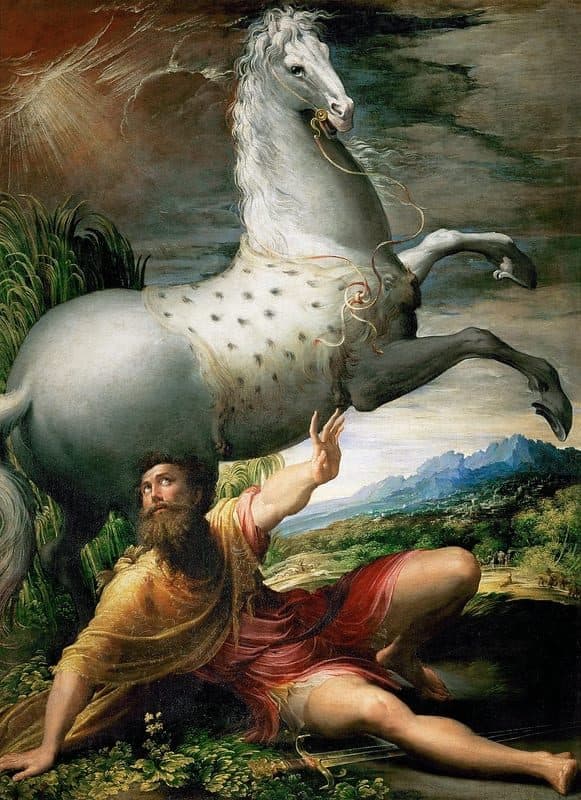
Parmigianino, The Conversion of Paul, about 1527, Kunsthistorisches Museum, Vienna. Public domain, via Wikimedia Commons.
THE ARTWORKParmigianino painted Saul thrown down beneath a rearing horse; the horse is the painter's, since Acts 9:4, Acts 22:7 and Acts 26:14 say only that he fell to the ground.
Summary
Paul, a Pharisee from Tarsus, hunted the followers of Jesus until the risen Jesus met him near Damascus and sent him to the Gentiles.
- He was born a Roman citizen in Tarsus of Cilicia and trained in Jerusalem under Gamaliel.
- With Barnabas and then Silas he planted churches across Cyprus, Galatia, Macedonia, Achaia and Asia.
- Thirteen letters of the New Testament open with his name, from Romans to Philemon.
- Arrested in the temple, he appealed to Caesar and was taken to Rome.
Where Paul Stands in Scripture
From Acts 7 to 2 Peter 3
They dragged him out of the city and began to stone him. Meanwhile the witnesses laid their garments at the feet of a young man named Saul.He is first seen at the death of Stephen.
From chapter 13 to its last verse, Acts follows Paul's journeys.
Consider also that our Lord’s patience brings salvation, just as our beloved brother Paul also wrote you with the wisdom God gave him.Peter counts Paul's letters as wisdom from God.
The Life, Turn by Turn
Twenty-one turns from Stephen's death to Rome, each with its verse
- Approves of Stephen's deathJerusalem, Acts 8:1
- Watched at the city gates by men plotting to kill himDamascus, Acts 9:24
- Sees James, the Lord's brotherJerusalem, Galatians 1:19
- Debates the Hellenistic Jews, who try to kill himJerusalem, Acts 9:29
- Sent home to TarsusCaesarea, Acts 9:30
- Carries the famine gift to the elders with BarnabasJerusalem, Acts 11:30
- Strikes the sorcerer Elymas blindPaphos, Acts 13:11
- Preaches in the synagogue when its leaders invite a wordPisidian Antioch, Acts 13:16
- Called Hermes by the crowd after a lame man walksLystra, Acts 14:12
- Tells the council of the signs God did among the GentilesJerusalem, Acts 15:12
- Kept by the Holy Spirit from speaking the word in AsiaPhrygia and Galatia, Acts 16:6
- Lydia and her household are baptizedPhilippi, Acts 16:15
- Beaten with rods and thrown into prisonPhilippi, Acts 16:23
- Finds the Bereans examining the Scriptures every dayBerea, Acts 17:11
- Speaks before the AreopagusAthens, Acts 17:22
- Shakes out his garments and turns to the GentilesCorinth, Acts 18:6
- Cloths from his body heal the sickEphesus, Acts 19:12
- Bound with two chains by the Roman commanderJerusalem, Acts 21:33
- Speaks to Felix of the judgment to comeCaesarea, Acts 24:25
- Stays three months after the shipwreckMalta, Acts 28:11
- Persuades some of the Jews while others refuseRome, Acts 28:24
The turns stand in the order Acts tells them, and no verse gives a year.
From Tarsus to Rome
Acts 8 to Acts 28, with the letters beside it
Acts tells his life city by city, and the letters add what Acts leaves out, among them the five floggings he received from the Jews and the thorn in the flesh.
The persecutorActs 8; Acts 26
But Saul began to destroy the church. Going from house to house, he dragged off men and women and put them in prison.Luke records the persecution in a single sentence, and it reaches into homes.
And that is what I did in Jerusalem. With authority from the chief priests I put many of the saints in prison, and when they were condemned to death, I cast my vote against them. I frequently had them punished in the synagogues, and I tried to make them blaspheme. In my raging fury against them, I even went to foreign cities to persecute them.Paul's own account before Agrippa adds the votes for death and the attempts to make believers blaspheme.
The Damascus roadActs 9:1 to 22
Meanwhile, Saul was still breathing out murderous threats against the disciples of the Lord. He approached the high priest and requested letters to the synagogues in Damascus, so that if he found any men or women belonging to the Way, he could bring them as prisoners to Jerusalem.Saul asks for the warrants himself, so the journey is the next stage of his campaign.
As Saul drew near to Damascus on his journey, suddenly a light from heaven flashed around him. He fell to the ground and heard a voice say to him, “Saul, Saul, why do you persecute Me?” “Who are You, Lord?” Saul asked. “I am Jesus, whom you are persecuting,” He replied. “Now get up and go into the city, and you will be told what you must do.”Jesus counts the attack on His disciples as an attack on Himself.
Saul got up from the ground, but when he opened his eyes he could not see a thing. So they led him by the hand into Damascus. For three days he was without sight, and he did not eat or drink anything.The man who came to take prisoners from Damascus is led into the city by the hand.
But Ananias answered, “Lord, many people have told me about this man and all the harm he has done to Your saints in Jerusalem. And now he is here with authority from the chief priests to arrest all who call on Your name.” “Go!” said the Lord. “This man is My chosen instrument to carry My name before the Gentiles and their kings, and before the people of Israel. I will show him how much he must suffer for My name.”The Lord answers the objection of Ananias with a commission that already includes Saul's suffering.
So Ananias went to the house, and when he arrived, he placed his hands on Saul. “Brother Saul,” he said, “the Lord Jesus, who appeared to you on the road as you were coming here, has sent me so that you may see again and be filled with the Holy Spirit.” At that instant, something like scales fell from Saul’s eyes, and his sight was restored. He got up and was baptized,The scales fall at the touch of the man who had objected to going.
Saul promptly began to proclaim Jesus in the synagogues, declaring, “He is the Son of God.” All who heard him were astounded and asked, “Isn’t this the man who wreaked havoc in Jerusalem on those who call on this name? And hasn’t he come here to take them as prisoners to the chief priests?” But Saul was empowered all the more, and he confounded the Jews living in Damascus by proving that Jesus is the Christ.Within days Saul preaches in the same synagogues to which his letters were addressed.
Damascus again, the basket and BarnabasGalatians 1; 2 Corinthians 11; Acts 9
Only after three years did I go up to Jerusalem to confer with Cephas, and I stayed with him fifteen days.Paul counts three years before his first visit to Jerusalem, a span Acts 9:23 calls many days.
In Damascus, the governor under King Aretas secured the city of the Damascenes in order to arrest me. But I was lowered in a basket through a window in the wall and escaped his grasp.Paul's letter gives a second witness to the night Luke records in Acts 9:25.
When Saul arrived in Jerusalem, he tried to join the disciples, but they were all afraid of him, not believing that he was a disciple. Then Barnabas brought him to the apostles and described how Saul had seen the Lord, who spoke to him on the road to Damascus, and how Saul had spoken boldly in that city in the name of Jesus.Barnabas is the first man in the church to vouch for Saul when the disciples in Jerusalem were afraid of him.
Antioch and the first journeyActs 11 to 14
The believers scattered after Stephen's death preached to Greeks at Antioch, and the church in Jerusalem sent Barnabas there.
Then Barnabas went to Tarsus to look for Saul, and when he found him, he brought him back to Antioch. So for a full year they met together with the church and taught large numbers of people. The disciples were first called Christians at Antioch.The church that would send Saul out is the church where believers first bore the name Christians.
While they were worshiping the Lord and fasting, the Holy Spirit said, “Set apart for Me Barnabas and Saul for the work to which I have called them.” And after they had fasted and prayed, they laid their hands on them and sent them off.The mission begins with a word of the Holy Spirit to a church at worship.
Then some Jews arrived from Antioch and Iconium and won over the crowds. They stoned Paul and dragged him outside the city, presuming he was dead. But after the disciples had gathered around him, he got up and went back into the city. And the next day he left with Barnabas for Derbe.Paul's courage after the stoning shows the suffering promised at his call coming true.
The council and the right hand of fellowshipActs 15; Galatians 2
Men from Judea taught the Gentile believers at Antioch that they could not be saved unless they were circumcised, and Paul and Barnabas went up to Jerusalem over the question.
It seemed good to the Holy Spirit and to us not to burden you with anything beyond these essential requirements: You must abstain from food sacrificed to idols, from blood, from the meat of strangled animals, and from sexual immorality. You will do well to avoid these things. Farewell.The council's letter names four things for the Gentiles to avoid, and circumcision is not among them.
And recognizing the grace that I had been given, James, Cephas, and John—those reputed to be pillars—gave me and Barnabas the right hand of fellowship, so that we should go to the Gentiles, and they to the circumcised.Paul's own account names two commissions under one grace, his to the Gentiles and theirs to the circumcised.
Barnabas, Mark and SilasActs 15:36 to 41
Barnabas wanted to take John Mark on the second journey, and Paul would not take a man who had left them in Pamphylia.
Their disagreement was so sharp that they parted company. Barnabas took Mark and sailed for Cyprus,Luke records how sharp the disagreement was and assigns the fault to neither man.
Paul chose Silas and set out through Syria and Cilicia, strengthening the churches.
Macedonia and AchaiaActs 16 to 18
During the night, Paul had a vision of a man of Macedonia standing and pleading with him, “Come over to Macedonia and help us.” As soon as Paul had seen the vision, we got ready to leave for Macedonia, concluding that God had called us to preach the gospel to them.The narrator joins the journey at Troas, and the account turns from they to we.
Then he brought them out and asked, “Sirs, what must I do to be saved?” They replied, “Believe in the Lord Jesus and you will be saved, you and your household.”Paul and Silas answer the jailer with faith in the Lord Jesus and nothing added.
Although God overlooked the ignorance of earlier times, He now commands all people everywhere to repent. For He has set a day when He will judge the world with justice by the Man He has appointed. He has given proof of this to everyone by raising Him from the dead.”Paul ends his speech to the Areopagus on the resurrection as God's proof of the coming judgment.
One night the Lord spoke to Paul in a vision: “Do not be afraid; keep on speaking; do not be silent. For I am with you and no one will lay a hand on you, because I have many people in this city.” So Paul stayed for a year and a half, teaching the word of God among the Corinthians.The promise keeps Paul in a city whose synagogue had already turned against him.
At Corinth the Jews of the city brought Paul before Gallio, the proconsul of Achaia, who refused to judge a dispute about their own law.
Ephesus and the farewell at MiletusActs 19 and 20
This continued for two years, so that everyone who lived in the province of Asia, Jews and Greeks alike, heard the word of the Lord.Two years of daily teaching at Ephesus carry the word through the whole province of Asia.
The silversmith Demetrius stirred up a riot in fear for the trade in silver shrines of Artemis, and Paul left for Macedonia.
But I consider my life of no value to me, if only I may finish my course and complete the ministry I have received from the Lord Jesus—the ministry of testifying to the good news of God’s grace.Paul tells the elders of Ephesus that finishing his course matters more to him than his life.
Arrest, Caesarea and the appealActs 21 to 26
Then Paul answered, “Why are you weeping and breaking my heart? I am ready not only to be bound, but also to die in Jerusalem for the name of the Lord Jesus.”Paul goes up to Jerusalem knowing the prophet Agabus has foretold his binding.
But as they stretched him out to strap him down, Paul said to the centurion standing there, “Is it lawful for you to flog a Roman citizen without a trial?”Paul's Roman citizenship stops the flogging before it begins.
Felix kept him two years at Caesarea, hoping for a bribe, and left him in prison when Porcius Festus succeeded him.
If, however, I am guilty of anything worthy of death, I do not refuse to die. But if there is no truth to their accusations against me, no one has the right to hand me over to them. I appeal to Caesar!”The appeal to Caesar is the reason Paul reaches Rome as a prisoner.
The storm, Malta and RomeActs 27 and 28
For just last night an angel of God, whose I am and whom I serve, stood beside me and said, ‘Do not be afraid, Paul; you must stand before Caesar. And look, God has granted you the lives of all who sail with you.’ So take courage, men, for I believe God that it will happen just as He told me.A prisoner gives the crew courage on the strength of a promise from God.
The ship ran aground off Malta, and every person aboard reached land; a viper fastened on Paul's hand at the islanders' fire, and he shook it off unharmed.
When we arrived in Rome, Paul was permitted to stay by himself, with a soldier to guard him.In Rome Paul lives in his own lodging under a soldier's guard, so he can still receive visitors.
What the Text Sets Beside the Retelling
Six details retellings often drop
SAUL, ALSO CALLED PAUL
Luke calls him Saul until Acts 13:9, where he writes "Saul, who was also called Paul", on Cyprus.
A YOUNG MAN RAISED AT TROAS
At Troas Eutychus fell asleep in a window during Paul's long talk and fell from the third story; he was picked up dead, and the people took him home alive.
MORE SHIPWRECKS THAN ACTS TELLS
Paul had already been shipwrecked three times when he wrote 2 Corinthians, before the wreck on Malta.
A CHARGE BUILT ON A GUESS
The crowd that seized Paul in the temple had seen Trophimus the Ephesian with him in the city and assumed he had brought a Greek inside.
MARK RESTORED
In his last letter Paul asks Timothy to bring Mark, the man he once refused to take, because Mark is useful to him in the ministry.
FORGIVENESS AT THE FIRST DEFENSE
When everyone deserted Paul at his first defense, he asked that it not be charged against them.
The World Behind the Story
Tarsus, Gamaliel, the trade of a tentmaker, and the witnesses after Acts
“I am a Jew, born in Tarsus of Cilicia, but raised in this city. I was educated at the feet of Gamaliel in strict conformity to the law of our fathers. I am just as zealous for God as any of you here today.Paul claims his Jerusalem training before a crowd that had just tried to kill him.
Gamaliel and the tentmaker's tradeActs 5, 18 and 20
Acts describes Gamaliel as a Pharisee and a teacher of the law who was honored by all the people. It records his counsel to the Sanhedrin to leave the apostles alone.
His standing in the early churchIrenaeus of Lyons; Tertullian of Carthage
Late in the second century, in Against Heresies, Book 3, Irenaeus of Lyons answered those who did not recognize Paul as an apostle. Anyone who accepts Luke's Gospel, he argued, must accept Luke's report that the Lord spoke to Paul from heaven.
Tertullian of Carthage, in On the Resurrection of the Flesh, notes that before Agrippa Paul claimed to teach nothing beyond what the prophets had announced.
The Family of Paul
Four people in three generations
Generation 1
- His fatherA Pharisee, Acts 23:6
Generation 2
- PaulCircumcised on the eighth day, Philippians 3:5
- His sisterNamed in no verse; her son was in Jerusalem, Acts 23:16
Generation 3
- His sister's sonWarned him of a plot to kill him, Acts 23:16
A family tree drawn from Acts 23 and Philippians 3.
The Places of His Life
Seventeen places, fifteen of them on the map
- Located: the gazetteer fixes one site
- Placed: the point stands for an area, or is rounded
about 500 km (311 miles)
- 1Tarsus, He called it no ordinary city. Acts 21:39
- 2Jerusalem, He spoke to the crowd in Hebrew from the barracks steps. Acts 21:40
- 3Damascus, He lodged in the house of Judas on the street called Straight. Acts 9:11
- 4Arabia, He went there after his conversion. Galatians 1:17
- 5Caesarea, He stayed in the house of Philip the evangelist. Acts 21:8
- 6Antioch, He and Barnabas reported to the church all that God had done through them. Acts 14:27
- 7Cyprus, He spoke in the synagogues at Salamis. Acts 13:5
- 8Lystra, He met Timothy, the son of a believing Jewish woman. Acts 16:1
- 9Troas, He left his cloak there with Carpus. 2 Timothy 4:13
- 10Philippi, He drove a spirit of divination out of a slave girl. Acts 16:18
- 11Thessalonica, He reasoned in the synagogue on three Sabbaths. Acts 17:2
- 12Athens, He was distressed to see the city full of idols. Acts 17:16
- 13Corinth, Crispus, the leader of the synagogue, believed with his household. Acts 18:8
- 14Ephesus, Disciples there were baptized into the name of the Lord Jesus. Acts 19:5
- 15Miletus, He sent for the elders of Ephesus. Acts 20:17
- 16Malta, He healed the father of Publius, the chief official of the island. Acts 28:8
- 17Rome, He called together the leaders of the Jews. Acts 28:17
Not located: Tarsus, Arabia.
The coastline is simplified; each place stands at its place page's coordinates.
The places in the order of his life.
Questions the Life Raises
Four questions, each set beside its verses
Do the three accounts agree on what the companions saw?Acts 9, 22 and 26; Theophylact of Ohrid
The men traveling with Saul stood there speechless. They heard the voice but did not see anyone.Luke's narration says the companions heard the voice and saw no one.
My companions saw the light, but they could not understand the voice of the One speaking to me.Paul's account to the temple crowd says they saw the light and could not understand the voice.
We all fell to the ground, and I heard a voice say to me in Hebrew, ‘Saul, Saul, why do you persecute Me? It is hard for you to kick against the goads.’Paul's account to Agrippa says they all fell, and it alone gives the saying about the goads.
Read together, the companions saw the light and heard a sound without receiving the words spoken to Saul. Theophylact of Ohrid, in his eleventh-century Commentary on Acts, reads it so: the light shone on all of them so that they could bear witness, and it blinded Paul alone.
Why did Paul circumcise Timothy after defending Titus?Galatians 2; Acts 16
Yet not even Titus, who was with me, was compelled to be circumcised, even though he was a Greek.At Jerusalem the question was whether a Greek believer had to be circumcised.
Paul wanted Timothy to accompany him, so he took him and circumcised him on account of the Jews in that area, for they all knew that his father was a Greek.At Lystra the reason given is the Jews of the region, who knew Timothy's father was a Greek.
Did his gospel come from the apostles in Jerusalem?Galatians 1
For I certify to you, brothers, that the gospel I preached was not devised by man. I did not receive it from any man, nor was I taught it; rather, I received it by revelation from Jesus Christ.Paul rests his authority on this claim when the Galatians doubt his gospel.
I assure you before God that what I am writing to you is no lie.Paul puts his account of the early years under oath.
How did Paul die?2 Timothy 4; Clement of Rome; Eusebius; Ignatius of Antioch
For I am already being poured out like a drink offering, and the time of my departure is at hand.Paul writes as a man who expects to die soon.
Clement of Rome wrote to Corinth near the end of the first century. He says Paul was seven times thrown into captivity and preached in the east and the west. He adds that Paul came to the extreme limit of the west and suffered martyrdom under the prefects, without saying how he died.
Eusebius of Caesarea, in his fourth-century Ecclesiastical History, reads 2 Timothy 4 as Paul foreseeing his own martyrdom. Ignatius of Antioch, himself under guard early in the second century, is an earlier witness still.
“I know both who I am, and to whom I write. I am a condemned man, ye have been the objects of mercy; I am subject to danger, ye are established in safety. Ye are the persons through whom those pass that are cut off for the sake of God. Ye are initiated into the mysteries of the Gospel with Paul, the holy, the martyred, the deservedly most happy, at whose feet may I be found, when I shall attain to God; who in all his Epistles makes mention of you in Christ Jesus.”
Ignatius of Antioch · Epistle of Ignatius to the Ephesians · on Acts 9:15Patristic
What the Text Leaves Unsaid
Three silences: Arabia, his face and the end
The Pattern of Mercy
His own account of mercy, with his teaching on Israel and the Spirit
This is a trustworthy saying, worthy of full acceptance: Christ Jesus came into the world to save sinners, of whom I am the worst. But for this very reason I was shown mercy, so that in me, the worst of sinners, Christ Jesus might display His perfect patience as an example to those who would believe in Him for eternal life.The persecutor becomes the pattern for every later believer.
And last of all He appeared to me also, as to one of untimely birth. For I am the least of the apostles and am unworthy to be called an apostle, because I persecuted the church of God. But by the grace of God I am what I am, and His grace to me was not in vain. No, I worked harder than all of them—yet not I, but the grace of God that was with me.Paul ranks himself last among the witnesses of the risen Lord.
The worst of sinners1 Timothy 1:15; John Chrysostom
“It is no humility to think that you are a sinner when you really are a sinner. But whenever one is conscious of having done many great deeds but does not imagine that he is something great in himself, that is true humility. When a man is like Paul and can say, ‘I have nothing on my conscience,’ and then can add, ‘But I am not justified by this,’ and can say again, ‘Christ Jesus came to save sinners of whom I am the chief,’ that is true humility. That man is truly humble who does exalted deeds but, in his own mind, sees himself as lowly.”
John Chrysostom · On the Incomprehensible Nature of God 5.6 · on 1 Timothy 1:15Patristic
Israel in Paul's teachingRomans 11; John Calvin; Cyril of Alexandria
I ask then, did God reject His people? Certainly not! I am an Israelite myself, a descendant of Abraham, from the tribe of Benjamin.Paul answers the question of Israel's rejection with his own descent from Abraham and Benjamin.
For God’s gifts and His call are irrevocable.This verse is the ground of Paul's answer that Israel still has a future.
“This objection is what he anticipates in this passage, and he so modifies what he had previously said respecting the repudiation of the Jews, that no one might think that the covenant formerly made with Abraham is now abrogated, or that God had so forgotten it that the Jews were now so entirely alienated from his kingdom, as the Gentiles were before the coming of Christ.”
John Calvin · Commentaries · on Romans 11:1Reformed
“Although it was rejected, Israel will also be saved eventually, a hope which Paul confirms by quoting this text of Scripture. For indeed, Israel will be saved in its own time and will be called at the end, after the calling of the Gentiles.”
Cyril of Alexandria · Explanation of the Letter to the Romans · on Romans 11:26Patristic
The Spirit in Paul's churchesActs 19; 1 Corinthians 14
And when Paul laid his hands on them, the Holy Spirit came upon them, and they spoke in tongues and prophesied.The Spirit comes on the disciples at Ephesus under Paul's own hands, with tongues and prophecy.
So, my brothers, be eager to prophesy, and do not forbid speaking in tongues.Paul's closing instruction to a church that had misused the gifts is to keep using them in order.
Voices on Paul
Four writers from the fourth century to the eighteenth, in their own words
“The Holy Spirit worked immediately and not only changed Paul's blindness to sight but also imparted the seal to his soul, making him a vessel of election to carry the name of the Lord who had appeared to him before kings and the children of Israel; and he fashioned his former persecutor into a herald and a good servant who ‘from Jerusalem round about as far as Illyricum completed the gospel of Christ.’”
Cyril of Jerusalem · Catechetical Lecture 17.26 · on Acts 9:17Patristic
“Saul's sufferings for Christ shall redound so much to the honour of Christ and the service of the church, shall be so balanced with spiritual comforts and recompensed with eternal glories, that it is no discouragement to him to be told how great things he must suffer for Christ's name's sake. Ananias presently goes on Christ's errand to Saul, and with good effect.”
Matthew Henry · Commentary on the Whole Bible · on Acts 9:16Puritan
“Paul did not labor in order to receive grace, but he received grace so that he might labor.”
Augustine of Hippo · Proceedings of Pelagius 14.36 · on 1 Corinthians 15:10Patristic
“I have felt this thorn in the flesh, 2 Cor. xii. 8, 9, the very mercy of God to me.”
John Bunyan · Grace Abounding to the Chief of Sinners · on 2 Corinthians 12:8 to 9English Puritan
Where Readers Differ
The thorn in the flesh and the rebuke at Antioch, each read two ways
or because of these surpassingly great revelations. So to keep me from becoming conceited, I was given a thorn in my flesh, a messenger of Satan, to torment me. Three times I pleaded with the Lord to take it away from me. But He said to me, “My grace is sufficient for you, for My power is perfected in weakness.” Therefore I will boast all the more gladly in my weaknesses, so that the power of Christ may rest on me.Paul names no illness and no enemy, so the thorn is read two ways.
The thorn as persecutionSeverian of Gabala, Pauline Commentary; Theophylact of Ohrid, Commentary on 2 Corinthians; Adam Clarke, Commentary on the Bible
Theophylact of Ohrid, in his Commentary on 2 Corinthians, holds that Paul's body was not handed over to the devil. Adam Clarke, in his Commentary on the Bible of 1832, refers the thorn to the opposition Paul met at Corinth from a false apostle.
“Many people think this was some kind of headache, but in reality Paul is referring to the persecutions which he suffered, because they came from diabolical powers.”
Severian of Gabala · Pauline Commentary from the Greek Church · on 2 Corinthians 12:7Patristic
The objection: Paul places the thorn in his flesh.
The thorn as a bodily afflictionCyprian of Carthage, On the Mortality; Tertullian, reported in Adam Clarke, Commentary on the Bible
Cyprian of Carthage, in his treatise On the Mortality, reads the thorn beside the many grievous tortures of Paul's flesh and body. Adam Clarke, in his Commentary on the Bible of 1832, reports that Tertullian took it for an earache.
You know that it was because of an illness that I first preached the gospel to you.This reading points to Paul's own mention of an illness in Galatia.
The objection: the thorn is also called a messenger of Satan, a phrase the first reading takes to mean a person.
The rebuke at Antioch as a real disputeAugustine of Hippo, Commentary on Galatians
Augustine of Hippo, in his commentary on Galatians, holds that Paul rebuked Peter because Peter, in fear of men from James, pretended to agree that Gentiles must keep Jewish customs.
When Cephas came to Antioch, however, I opposed him to his face, because he stood to be condemned.Paul's own words for the scene are the ground of the reading that the rebuke was real.
The objection: Peter had already eaten with Gentiles after the vision of Acts 10, so a sudden lapse is hard to credit.
The rebuke at Antioch as a scene with a purposeTheophylact of Ohrid, Commentary on Galatians
Theophylact of Ohrid, in his Commentary on Galatians, explains the scene from what Peter had allowed among the believers at Jerusalem.
“Many think that here Paul accuses Peter of hypocrisy, but this is unjust. For what he seemingly says against Peter was done and spoken with a special purpose. For Peter, being in Jerusalem, permitted circumcision — indeed it was impossible to suddenly draw them away …”
Theophylact of Ohrid · Commentary on Galatians · on Galatians 2:11Patristic
The objection: Paul writes that Peter stood condemned and that even Barnabas was led astray.
I Have Kept the Faith
I have fought the good fight, I have finished the race, I have kept the faith. From now on there is laid up for me the crown of righteousness, which the Lord, the righteous Judge, will award to me on that day—and not only to me, but to all who crave His appearing.His last letter looks past his death to Christ's appearing.
What his life asks of the reader is the faith he kept: to believe in Christ and to run until the end.
Keep studying
Studies16
Places15
Symbols1