
Jonah 1 to 4 · Debate · Featured Study
Jonah: History or Parable?
Two readings of the book of Jonah: an account of a real prophet sent to Nineveh, or a story told to teach Israel about God's mercy.
Jesus set the men of Nineveh beside His own generation at the judgment, and readers still ask whether that city's repentance happened.
- The question
- Does the book of Jonah record events that happened, or is it a story told to teach?
- The texts
- 2 Kings 14:25, Matthew 12:40-41, Jonah 1:17
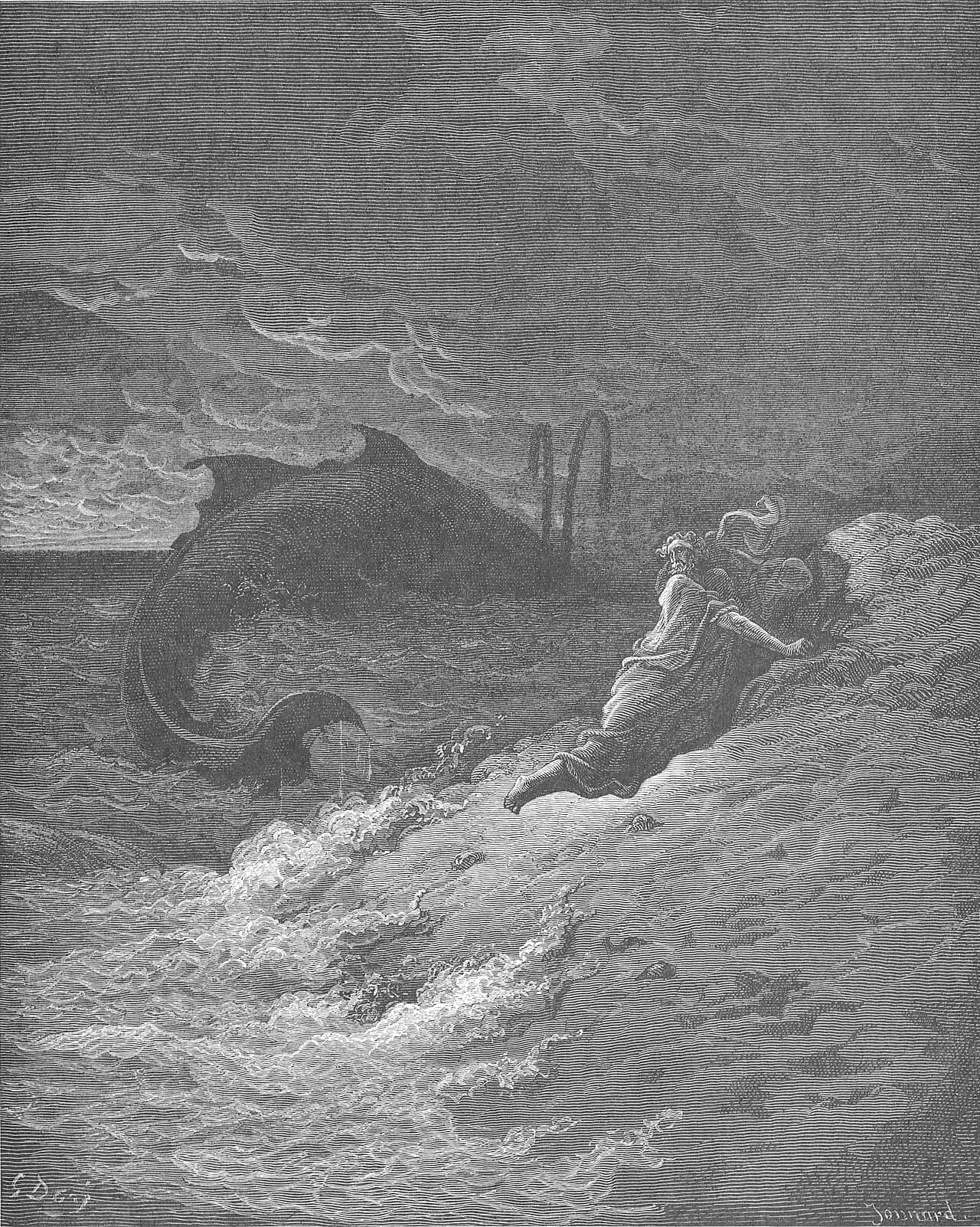
Gustave Doré, Jonah Is Spewed Forth by the Whale, 1866, from Doré's English Bible. Public domain, via Wikimedia Commons.
THE ARTWORKDoré drew the moment the fish gives Jonah back to the land in Jonah 2:10. Jesus names this return from the deep as the sign of Jonah, and both readings of the book must account for it.
Summary
Readers differ on whether the book of Jonah, where a prophet flees God, spends three days in a great fish and sees Nineveh repent at his preaching, reports events or teaches by a story.
- Second Kings names Jonah son of Amittai as a prophet in the days of King Jeroboam II.
- Jesus compares His three days in the earth with Jonah's three days in the fish.
- Leslie C. Allen and other modern scholars read the book as a parable told about a known prophet.
- Jonah prayed from the belly of Sheol. Some say he was alive in the deep, and some say he died and was raised.
- Nineveh stood on the Tigris, and its palaces and library have been dug up.
The Texts Both Readings Read
Second Kings 14, Jonah 1 and 2, and the words of Jesus in Matthew 12 and Luke 11
This Jeroboam restored the boundary of Israel from Lebo-hamath to the Sea of the Arabah, according to the word that the LORD, the God of Israel, had spoken through His servant Jonah son of Amittai, the prophet from Gath-hepher.The book of Kings names Jonah, his father, his town and a word he spoke in the reign of Jeroboam II.
Now the word of the LORD came to Jonah son of Amittai, saying,The book opens with the same name and the same father.
Now the LORD had appointed a great fish to swallow Jonah, and Jonah spent three days and three nights in the belly of the fish.The LORD appoints a great fish, and Jonah is in it three days and three nights.
This time Jonah got up and went to Nineveh, in accordance with the word of the LORD. Now Nineveh was an exceedingly great city, requiring a three-day journey.Each reading must explain the size of this city.
For as Jonah was three days and three nights in the belly of the great fish, so the Son of Man will be three days and three nights in the heart of the earth. The men of Nineveh will stand at the judgment with this generation and condemn it; for they repented at the preaching of Jonah, and now One greater than Jonah is here.Jesus sets Jonah's three days beside His own, and the men of Nineveh beside His generation at the judgment.
For as Jonah was a sign to the Ninevites, so the Son of Man will be a sign to this generation. The Queen of the South will rise at the judgment with the men of this generation and condemn them; for she came from the ends of the earth to hear the wisdom of Solomon, and now One greater than Solomon is here. The men of Nineveh will stand at the judgment with this generation and condemn it; for they repented at the preaching of Jonah, and now One greater than Jonah is here.Luke sets the queen of the South and the men of Nineveh side by side as witnesses at the judgment.
Both readings take these verses as Scripture. They differ over what kind of writing the book of Jonah is.
The Two Readings Side by Side
each question the debate turns on, with the answer each reading gives
| Question | An account of events | A parable or teaching story |
|---|---|---|
| Who was Jonah? | The prophet of Gath-hepher whom Second Kings places in the reign of Jeroboam II. | The story gives its main figure the name of a known prophet. |
| What is the great fish? | A creature the LORD appointed, and a miracle of the same order as the other miracles of Scripture. | A figure in a story, whose meaning lies in the lesson it carries. |
| Did Nineveh repent? | Yes, and Jesus names the men of Nineveh as witnesses at the judgment. | The city's repentance is the story's picture of how far God's mercy reaches. |
| How does it read Jesus' words? | He sets Jonah beside His own death and resurrection as events of the same kind. | He draws on a story His hearers knew, as a teacher cites a well known account. |
| The strongest objection it answers | The book's close design and its humour, which the parable reading takes as signs of a story. | Jesus places the men of Nineveh at the judgment beside the queen of the South, whom Scripture records as a real queen. |
- Question
- Who was Jonah?
- An account of events
- The prophet of Gath-hepher whom Second Kings places in the reign of Jeroboam II.
- A parable or teaching story
- The story gives its main figure the name of a known prophet.
- Question
- What is the great fish?
- An account of events
- A creature the LORD appointed, and a miracle of the same order as the other miracles of Scripture.
- A parable or teaching story
- A figure in a story, whose meaning lies in the lesson it carries.
- Question
- Did Nineveh repent?
- An account of events
- Yes, and Jesus names the men of Nineveh as witnesses at the judgment.
- A parable or teaching story
- The city's repentance is the story's picture of how far God's mercy reaches.
- Question
- How does it read Jesus' words?
- An account of events
- He sets Jonah beside His own death and resurrection as events of the same kind.
- A parable or teaching story
- He draws on a story His hearers knew, as a teacher cites a well known account.
- An account of events
- The book's close design and its humour, which the parable reading takes as signs of a story.
- A parable or teaching story
- Jesus places the men of Nineveh at the judgment beside the queen of the South, whom Scripture records as a real queen.
Each Reading in Its Own Terms
the case for each reading, as its holders state it
An account of events
This reading starts from Second Kings, which names Jonah son of Amittai as a prophet from Gath-hepher who spoke in the reign of Jeroboam II. The book of Jonah opens with the same man. The reading then turns to Jesus, who compares His coming resurrection with Jonah's three days in the fish, and says that the men of Nineveh will stand at the judgment.
J. C. Ryle, writing on Matthew 12, reads the passage as proof that Jesus treated the story of Jonah as fact.
T. Desmond Alexander, in Jonah and Genre (Tyndale Bulletin 36, 1985), adds that the book opens as the historical books open.
The beginning of this passage is one of those places which strikingly illustrate the truth of Old Testament history. Our Lord speaks of the Queen of the South as a real, true person, who had lived and died. He refers to the story of Jonah, and his miraculous preservation in the whale’s belly, as undeniable matters of fact. Let us remember this if we hear men professing to believe the writers of the New Testament, and yet sneering at the things recorded in the Old Testament as if they were fables.
J.C. Ryle · Expository Thoughts on the Gospels: Matthew · on Matthew 12:38-50Reformed Evangelical
The objection this reading answers is the book's craft. Its holders reply that a record of events can be told with design and irony, as the books of Kings are.
A parable or teaching story
Leslie C. Allen, in The Books of Joel, Obadiah, Jonah and Micah (1976), reads the book as a parable told about a historical prophet. He points to the close symmetry of its two halves, the irony of a prophet angry at mercy, and the repentance of a whole city under a king the book does not name. He takes these as the marks of a story told to make a point, hung on the name of a known prophet.
Hans Walter Wolff, in Obadiah and Jonah (1986), reads the book as a later story set around the one prophet of Jeroboam's reign that Second Kings names.
On this reading the book is a story told to Israel, and its lesson is God's mercy to an enemy nation.
The strongest objection comes from the words of Jesus. He sets the men of Nineveh beside the queen of the South, and both rise at the judgment with His generation.
A Great Fish
what Jonah 1:17 says of the creature
The Hebrew text calls the creature a great fish, and the Berean text follows it. The word whale came into the English story from the King James wording of Matthew 12:40, the whale's belly.
The Jamieson, Fausset and Brown commentary makes the same point on this verse.
prepared a great fish--not created specially for this purpose, but appointed in His providence, to which all creatures are subservient. The fish, through a mistranslation of Mt 12:40, was formerly supposed to be a whale; there, as here, the original means "a great fish." The whale's neck is too narrow to receive a man.
Jamieson, Fausset & Brown · Commentary Critical and Explanatory on the Whole Bible · on Jonah 1:17Reformed
Nineveh in the Record
the city on the Tigris and what has been dug from it
Nineveh stood on the east bank of the Tigris, across the river from modern Mosul. Excavations on its mounds at Kuyunjik and Nebi Yunus have uncovered great palaces, a wall circuit of about eight miles, and the library of Ashurbanipal with tens of thousands of tablets.
The book says it took three days to go through Nineveh. Carl Friedrich Keil, in his Biblical Commentary on the Minor Prophets (English 1868), reads that as the whole district, the capital with its ring of neighbouring towns, the cluster that Genesis 10 lists.
From that land he went forth into Assyria, where he built Nineveh, Rehoboth-Ir, Calah, and Resen, which is between Nineveh and the great city of Calah.Nineveh, Rehoboth-Ir, Calah and Resen, named together as one cluster of cities.
Nineveh's excavated buildings confirm the city. Jack M. Sasson, in his Anchor Bible commentary on Jonah (1990), notes that no Assyrian text records a fast at Nineveh or a turning to Israel's God. The repentance of Jonah 3 rests on the text of Scripture alone.
What the Book Leaves Unsaid
the king of Nineveh, left unnamed
The book names no king of Nineveh, and which Assyrian king heard Jonah cannot be said with confidence.
When word reached the king of Nineveh, he got up from his throne, took off his royal robe, covered himself with sackcloth, and sat in ashes.The king of Nineveh, unnamed, gets up from his throne and sits in ashes.
The Question the Book Ends On
God's question to Jonah about Nineveh, which closes the book at 4:10 to 11
The book ends with a question from God. Jonah grieved for a plant that grew up in a night, and God asks whether He should not care for Nineveh, a city of more than 120,000 people and many cattle.
But the LORD said, “You cared about the plant, which you neither tended nor made grow. It sprang up in a night and perished in a night. So should I not care about the great city of Nineveh, which has more than 120,000 people who cannot tell their right hand from their left, and many cattle as well?”God's last word in the book is a question about His mercy to Nineveh.
John Wesley, on 4:11, reads the question as an argument from the lesser to the greater. If Jonah pitied a plant, the LORD will not be less merciful to a great city, its infants and its cattle.
Terence E. Fretheim, in The Message of Jonah (1977), reads the question as put to Israelites who resented God's mercy to their enemies. The book records no answer from Jonah, so the reader is left to answer in his place.
Cyril of Alexandria, in the fifth century, hears in the question the gentleness of God.
O, the incomparable and inconceivable gentleness! What speech would suffice for us for hymnody? Or opening what mouth shall we offer up songs of thanksgiving to the merciful and good One? For he removes our iniquities far from us, and as a father pities his sons, so the Lord has pitied those who fear him, because he himself knew our frame. For see how he shows Jonah to be grieved not at the right time, nor for the things he should have been, although it was necessary to applaud in a holy manner and to praise as the good Master. For if you, he says, were sullen, or rather are even brought to extreme grief, because the gourd plant has withered for you, which grew up in one night, and perished in the same way, how could I myself neglect a populous city, in which there are more than twelve myriads of people?
Cyril of Alexandria · Commentary on the Twelve Minor Prophets: Jonah · on Jonah 4:10Patristic
Three Voices on Jonah
Irenaeus, John Calvin and Matthew Henry on the rescue and the prayer, in their own words, earliest first
Irenaeus, late in the second century, sets Jonah's return from the fish beside Elijah taken up in the flesh, as works done by the command of God.
If, however, any one imagine it impossible that men should survive for such a length of time, and that Elias was not caught up in the flesh, but that his flesh was consumed in the fiery chariot, let him consider that Jonah, when he had been cast into the deep, and swallowed down into the whale's belly, was by the command of God again thrown out safe upon the land.
Irenaeus · Against Heresies Book V · on Jonah 2:5Patristic
John Calvin, in the sixteenth century, reads Jonah's prayer from the deep as an example of faith in despair.
But in this state of despair Jonah even gathered courage, and was able to retake himself directly to God. It was a wonderful and almost incredible example of faith. Let us then learn to weigh well what is here said; for when the Lord heavily afflicts us, it is then a legitimate and seasonable time for prayer.
John Calvin · Commentaries · on Jonah 2:2Reformed
Matthew Henry, in 1710, hears the words of Jesus about the heart of the earth in Jonah's own prayer.
Whatever deeps we are cast into, it is God that casts us into them, and he it is who, after he has killed, has power to cast into hell. He was cast into the midst of the seas--the heart of the seas (so the word is), and thence Christ borrows that Hebrew phrase, when he applies it to his own lying so long in the heart of the earth.
Matthew Henry · Commentary on the Whole Bible · on Jonah 2:3Puritan
Dead in Sheol or Alive in the Fish
two readings of Jonah's prayer from the deep, each with its holders
Jonah prays from inside the fish and says he called from the belly of Sheol. He says the LORD raised his life from the pit. Readers who hold the book as history divide over what those words describe.
From inside the fish, Jonah prayed to the LORD his God, saying: “In my distress I called to the LORD, and He answered me. From the belly of Sheol I called for help, and You heard my voice.From inside the fish Jonah prays, and he says he called for help from the belly of Sheol.
To the roots of the mountains I descended; the earth beneath me barred me in forever! But You raised my life from the pit, O LORD my God!You raised my life from the pit.
Alive in the fish
Adam Clarke reads Sheol here as the bottom of the sea.
Out of the belly of hell - Among the Hebrews שאול sheol means the grave, any deep pit, the place of separate spirits, etc. Here the prophet represents himself as in the bottom of the sea; for so sheol must be understood in this place.
Adam Clarke · Commentary on the Bible · on Jonah 2:2Evangelical
Matthew Henry reads the prayer as spoken inside the fish by a man God kept alive there.
Or, rather, we may suppose it spoken while he was yet in the fish's belly, and then it is the language of his faith: "Thou hast kept me alive here, in the pit, and therefore thou canst, thou wilt, bring up my life from the pit; " and he speaks of it with as much assurance as if it were done already: Thou has brought up my life.
Matthew Henry · Commentary on the Whole Bible · on Jonah 2:6Puritan
John Calvin, in his commentary on Jonah, and Carl Friedrich Keil read the prayer as thanksgiving in the idiom of the Psalms.
The objection: Jonah speaks of Sheol and the pit, the words the Old Testament uses for the realm of the dead.
Dead and raised
Jerome, in his Commentary on Jonah, reads the fish as death itself receiving the prophet. Readers who press the likeness Jesus draws to His own three days in the earth read the prayer the same way.
"Now the LORD had prepared a great fish to swallow up Jonah." LXX: 'and the Lord ordered a great fish to swallow Jonah'. The Lord commanded death and the underworld to receive the prophet. To the eager jaws of death he seemed a prey: she had such joy in swallowing him, and such sadness in spitting him out. Thus happened what is written in Hosea: "I will be your death, O Death! I will be your bite, Hell!" [Hos. 13:14].
Jerome · Commentary on Jonah, Chapter 1 · on Jonah 1:17Patristic
The objection: the prayer is a psalm in the language of Israel's temple songs, where the pit and Sheol can stand for deep distress.
One Greater Than Jonah
What the words of Jesus in Matthew 12:41 ask of every reader of Jonah
Keep studying
Read it4
People2
Doctrines5
Peoples and groups1