
Numbers 26 · Numbers 32 · Numbers 34 · Joshua 18 · Subject · Featured Study
The Tribal Allotments
Numbers 26 to 36 read beside Joshua 13 to 19, with the census counts, Bonne's map of the tribes and the readings of Jewish and Christian commentators.
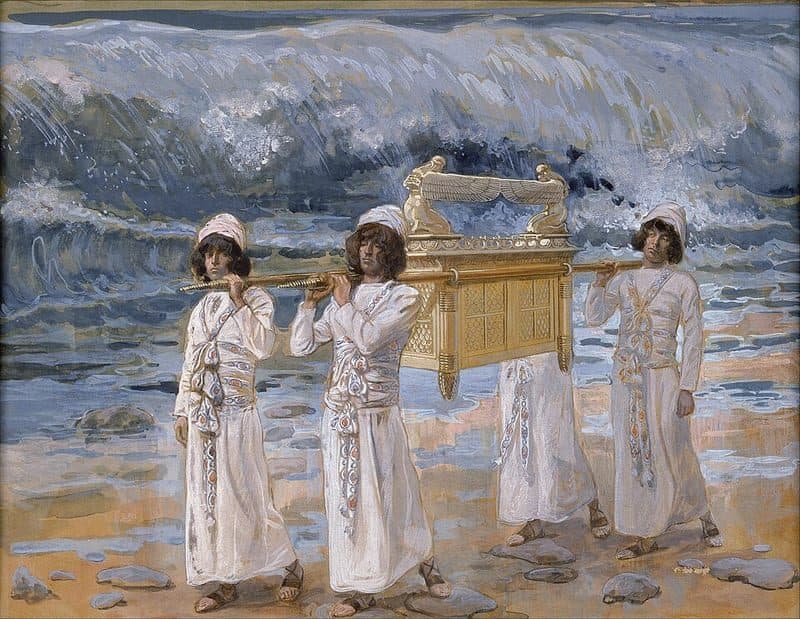
James Tissot, The Ark Passes Over the Jordan, gouache on board, about 1896 to 1902. Public domain by date (the painter died in 1902), via Wikimedia Commons, file James Jacques Joseph Tissot - The Ark Passes Over the Jordan - Google Art Project.jpg.
THE ARTWORKTissot painted the priests carrying the ark into the Jordan, the crossing of Joshua 3 that brought Israel into the land whose division Numbers 26 to 36 had laid down.
The rules for sharing out Canaan among the tribes were given before Israel crossed the Jordan to take it.
Summary
On the plains of Moab, Moses counted the tribes a second time and received from the LORD the laws of the division.
- A larger tribe received a larger inheritance, and every portion was assigned by lot.
- Reuben, Gad and half of Manasseh settled east of the Jordan, after promising to cross armed with the other tribes.
- The daughters of Zelophehad won their father's portion, and a second ruling kept it inside the tribe of Manasseh.
- Levi received towns and pasturelands among the other tribes and no portion of its own.
- Joshua cast the lots for seven tribes at Shiloh, and Joshua 13 to 19 records the borders and towns of every tribe.
The Rule of the Division
Numbers 26, 33 and 34 give the measure, the lot and the share of the nine and a half tribes
The LORD gave the rules of the division directly after the second census, one tied to the count and one to the lot.
“The land is to be divided among the tribes as an inheritance, according to the number of names. Increase the inheritance for a large tribe and decrease it for a small one; each tribe is to receive its inheritance according to the number of those registered.The size of each portion follows the number of names counted in the tribe.
Indeed, the land must be divided by lot; they shall receive their inheritance according to the names of the tribes of their fathers. Each inheritance is to be divided by lot among the larger and smaller tribes.”The lot decides each inheritance, so no leader could choose the land for his own tribe.
And you are to divide the land by lot according to your clans. Give a larger inheritance to a larger clan and a smaller inheritance to a smaller one. Whatever falls to each one by lot will be his. You will receive an inheritance according to the tribes of your fathers.This repetition carries the same rule down from the tribes to the families within them.
So Moses commanded the Israelites, “Apportion this land by lot as an inheritance. The LORD has commanded that it be given to the nine and a half tribes. For the tribes of the Reubenites and Gadites, along with the half-tribe of Manasseh, have already received their inheritance. These two and a half tribes have received their inheritance across the Jordan from Jericho, toward the sunrise.”The east bank is already settled, so the division covers Canaan west of the Jordan alone.
The Tribes on the Map
Numbers 32 and Joshua 12 to 20 on Rigobert Bonne's plate of 1770
Fifteen marks set each tribe at a town or landmark the text gives it, and some marks stand for two or three tribes.
- Located: the site is known
- Identified: the point stands for an area, or is rounded
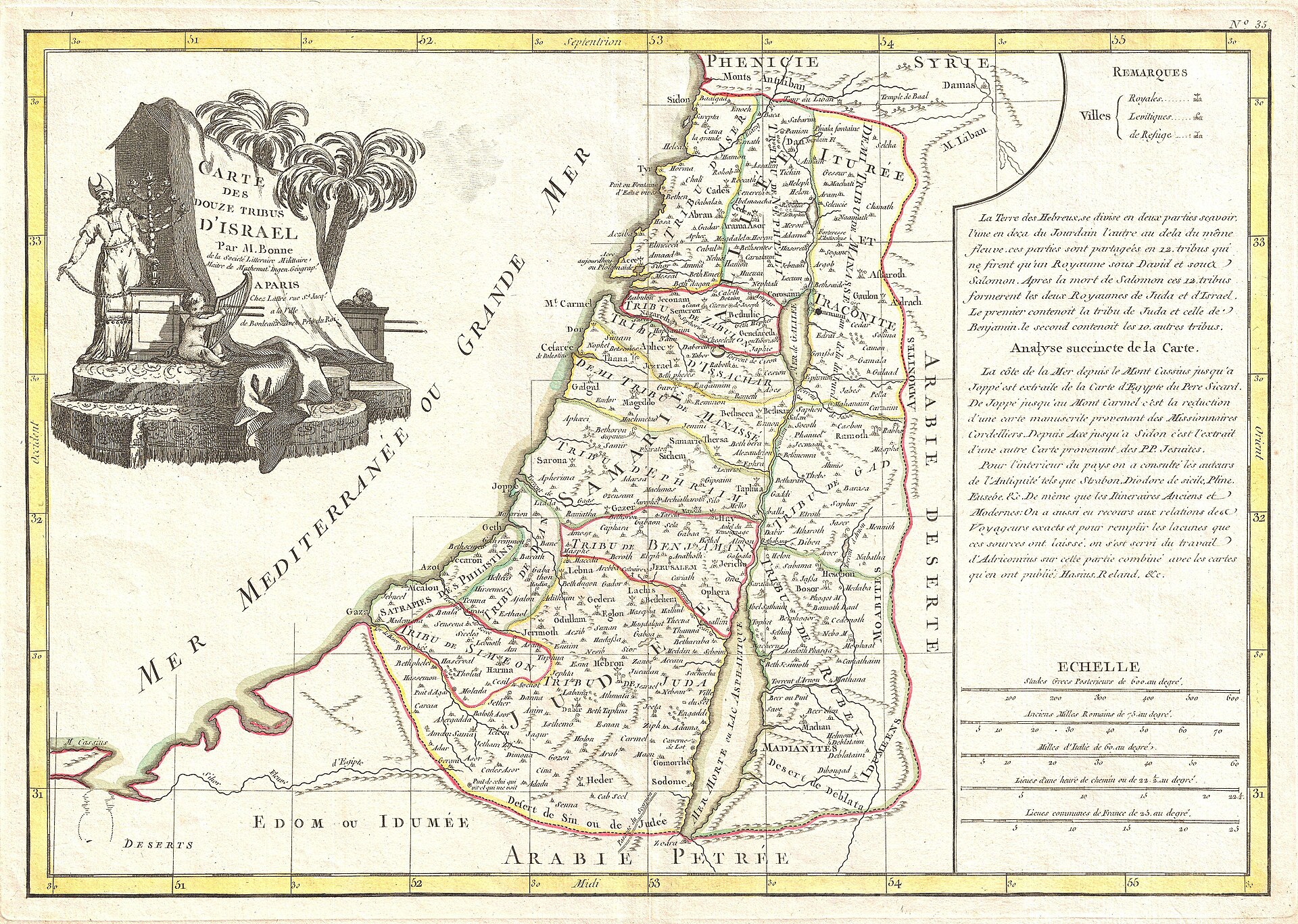
- 1Shiloh, The tent where the land was shared out, Joshua 18:1.
- 2Hebron, Judah: given to Caleb, Joshua 14:13.
- 3Beersheba, Simeon, inside Judah's portion, Joshua 19:2 and 19:9.
- 4Jerusalem, Benjamin: Jebus, Joshua 18:28.
- 5Joppa, Dan: the territory across from Joppa, Joshua 19:46.
- 6Shechem, Ephraim: its hill country, Joshua 20:7; Manasseh west of the Jordan: its border ran near Shechem, Joshua 17:7.
- 7Shunem, Issachar, Joshua 19:18.
- 8Mount Tabor, The borders of Zebulun, Issachar and Naphtali, Joshua 19:12, 19:22 and 19:34.
- 9Mount Carmel, Asher's western border, Joshua 19:26.
- 10Tyre, Asher's border, Joshua 19:29.
- 11Sea of Galilee, Naphtali: its city Chinnereth, Joshua 19:35.
- 12Dan, Dan's later home, once Leshem, Joshua 19:47.
- 13Nebo, Reuben, east of the Jordan, Numbers 32:38.
- 14Ammon, Gad, east of the Jordan, to Aroer near Rabbah, Joshua 13:25.
- 15Mount Hermon, Half of Manasseh, east of the Jordan: the kingdom of Og, Joshua 12:5 and 13:30.
Base map: The Twelve Tribes of Israel, Rigobert Bonne (1770), public domain. Each place stands at its place page's coordinates, set on the plate by Hebron and Dan, as the plate prints them.
Bonne coloured each tribe's portion and printed its name, and the last three marks lie east of the Jordan.
From the Plains of Moab to Shiloh
The census, the daughters of Zelophehad, the east bank, the borders, the Levites and the lots
The division takes seven steps across Numbers 26 to 36 and Joshua 13 to 19.
A new generation is countedNumbers 26:63 to 65
Among all these, however, there was not one who had been numbered by Moses and Aaron the priest when they counted the Israelites in the Wilderness of Sinai. For the LORD had told them that they would surely die in the wilderness. Not one was left except Caleb son of Jephunneh and Joshua son of Nun.No man counted at Sinai was left on the plains of Moab except Caleb and Joshua, so a new generation would inherit the land.
Matthew Henry sees the goodness of God in the size of the new generation.
“The goodness of God to this people, notwithstanding their provocations. Though that murmuring race was cut off, yet God raised up another generation, which was as numerous as they, that, though they perished, yet the name of Israel might not be cut off, lest the inheritance of the promise should be lost for want of heirs.”
Matthew Henry · Commentary on the Whole Bible · on Numbers 26:64 to 65Puritan
The daughters of ZelophehadNumbers 27:1 to 11
“Our father died in the wilderness, but he was not among the followers of Korah who gathered together against the LORD. Instead, he died because of his own sin, and he had no sons. Why should the name of our father disappear from his clan because he had no sons? Give us property among our father’s brothers.”Five sisters ask that their father's name keep its land in the clan, since he had no sons.
“The daughters of Zelophehad speak correctly. You certainly must give them property as an inheritance among their father’s brothers, and transfer their father’s inheritance to them. Furthermore, you shall say to the Israelites, ‘If a man dies and leaves no son, you are to transfer his inheritance to his daughter.The LORD grants their case and makes it a law for every family with daughters and no son.
Albert Barnes explains how a daughter could already carry an estate before this ruling.
“Women in Israel had not, up to the present time, enjoyed any distinct right of inheritance. Yet a father, whether sons had been born to him or not, had the power, either before or at his death, to cause part of his estate to pass to a daughter; in which case her husband married into her family rather than she into his, and the children were regarded as of the family from which the estate had come.”
Albert Barnes · Notes, Explanatory and Practical, on the Old and New Testaments (1832-1869) · on Numbers 27:1Evangelical
Reuben, Gad and half of ManassehNumbers 32:1 to 42
“If we have found favor in your sight,” they said, “let this land be given to your servants as a possession. Do not make us cross the Jordan.”The two tribes with large herds ask for the pastureland east of the river.
Moses replied, “If you will do this—if you will arm yourselves before the LORD for battle, and if every one of your armed men crosses the Jordan before the LORD, until He has driven His enemies out before Him, then when the land is subdued before the LORD, you may return and be free of obligation to the LORD and to Israel. And this land will belong to you as a possession before the LORD.Moses grants the land on one condition, that their armed men cross and fight until the land is subdued.
So Moses gave to the Gadites, to the Reubenites, and to the half-tribe of Manasseh son of Joseph the kingdom of Sihon king of the Amorites and the kingdom of Og king of Bashan—the land including its cities and the territory surrounding them.This grant settles the request of Numbers 32:5 and brings a third group into it.
The borders and the ten leadersNumbers 34:1 to 29
“Command the Israelites and say to them: When you enter the land of Canaan, it will be allotted to you as an inheritance with these boundaries:The LORD defines the land of Canaan before a single tribe receives its share of it.
Henry measures how small the land within these borders was.
“That it lay comparatively in a very little compass: as it is here bounded, it is reckoned to be but about 160 miles in length and about fifty in breadth; perhaps it did not contain more than half as much ground as England, and yet this is the country which was promised to the father of the faithful and was the possession of the seed of Israel.”
Matthew Henry · Commentary on the Whole Bible · on Numbers 34:13Puritan
“These are the names of the men who are to assign the land as an inheritance for you: Eleazar the priest and Joshua son of Nun. Appoint one leader from each tribe to distribute the land.Eleazar and Joshua lead the division, with one leader from each tribe beside them.
Procopius of Gaza, in his Catena on the Octateuch, notes the order of the two names.
“He places the priest before the leader, since the priest comes closer to God.”
Procopius of Gaza · Catena on the Octateuch, on Numbers 34:17 · on Numbers 34:17Patristic
Towns for the LevitesNumbers 35:1 to 8
“Command the Israelites to give, from the inheritance they will possess, cities for the Levites to live in and pasturelands around the cities. The cities will be for them to live in, and the pasturelands will be for their herds, their flocks, and all their other livestock.Levi's share is drawn from every other tribe, so the Levites would live spread across Israel.
To the tribe of Levi, however, Moses had given no inheritance. The LORD, the God of Israel, is their inheritance, just as He had promised them.Joshua gives the reason Levi has no land of its own, since the LORD Himself is its inheritance.
The second ruling for the daughtersNumbers 36:1 to 13
This is what the LORD has commanded concerning the daughters of Zelophehad: They may marry anyone they please, provided they marry within a clan of the tribe of their father. No inheritance in Israel may be transferred from tribe to tribe, because each of the Israelites is to retain the inheritance of the tribe of his fathers.The leaders of Gilead bring a second question about the same five women, and the LORD rules again.
Henry states how narrow the choice of husband became.
“Now the matter is thus accommodated: these heiresses must be obliged to marry, not only within their own tribe of Manasseh, but within the particular family of the Hepherites, to which they did belong. They are not determined to any particular persons; there was choice enough in the family of their father: Let them marry to whom they think best.”
Matthew Henry · Commentary on the Whole Bible · on Numbers 36:5Puritan
Sforno, the sixteenth-century Italian commentator, writes in the English of Eliyahu Munk that the sisters chose their cousins as their closest kin. In his reading no land passed even to another family of the tribe.
They approached Eleazar the priest, Joshua son of Nun, and the leaders, and said, “The LORD commanded Moses to give us an inheritance among our brothers.” So Joshua gave them an inheritance among their father’s brothers, in keeping with the command of the LORD.The sisters claim their land again before Joshua, and he gives it to them as the LORD commanded.
The lots at ShilohJoshua 18:1 to 10 and 19:51
As the men got up to go out, Joshua commanded them to map out the land, saying, “Go and survey the land, map it out, and return to me. Then I will cast lots for you here in Shiloh in the presence of the LORD.” So the men departed and went throughout the land, mapping it city by city into seven portions. Then they returned with the document to Joshua at the camp in Shiloh. And Joshua cast lots for them in the presence of the LORD at Shiloh, where he distributed the land to the Israelites according to their divisions.This is the rule of Numbers 26:55 carried out, with the tabernacle as the place of the decision.
These are the inheritances that Eleazar the priest, Joshua son of Nun, and the heads of the families distributed by lot to the tribes of Israel at Shiloh before the LORD at the entrance to the Tent of Meeting. So they finished dividing up the land.The work ends with Eleazar and Joshua at the tent, the two men Numbers 34:17 named to lead it.
What the Text Says of the Division
Three things often said of the allotments, each tested by a verse
EVERY TRIBE RECEIVED AN EQUAL SHARE
The portions were sized by the tribe, and Judah's share proved larger than Judah needed, so Simeon's towns were taken from it.
LEVI WAS LEFT WITH NOTHING
Levi had no portion of the land, yet the other tribes gave the Levites forty-eight towns with their pasturelands.
REUBEN AND GAD STAYED OUT OF THE WAR
Their armed men crossed the Jordan ahead of Israel, and Joshua sent them home only after the land had rest.
The Second Census
The men of each tribe counted on the plains of Moab, Numbers 26
Moses and Eleazar counted the men twenty years and older in each tribe, and the total came to 601,730, close to the 603,550 of the first census at Sinai.
Judah was the largest tribe at the second census and Simeon the smallest.
- East of the Jordan
- West of the Jordan
- Both banks
The 12 men counted as a table
| Tribe | Men counted | Where the tribe settled | Verse |
|---|---|---|---|
| Reuben | 43,730 | East of the Jordan | Numbers 26:7 |
| Simeon | 22,200 | West of the Jordan | Numbers 26:14 |
| Gad | 40,500 | East of the Jordan | Numbers 26:18 |
| Judah | 76,500 | West of the Jordan | Numbers 26:22 |
| Issachar | 64,300 | West of the Jordan | Numbers 26:25 |
| Zebulun | 60,500 | West of the Jordan | Numbers 26:27 |
| Manasseh | 52,700 | Both banks | Numbers 26:34 |
| Ephraim | 32,500 | West of the Jordan | Numbers 26:37 |
| Benjamin | 45,600 | West of the Jordan | Numbers 26:41 |
| Dan | 64,400 | West of the Jordan | Numbers 26:43 |
| Asher | 53,400 | West of the Jordan | Numbers 26:47 |
| Naphtali | 45,400 | West of the Jordan | Numbers 26:50 |
Twelve bars from zero give the men counted in each tribe in Numbers 26, coloured by the side of the Jordan where the tribe settled.
The two counts side by sideNumbers 1:20 to 46 and Numbers 26:5 to 51
| Tribe | Numbers 1 | Numbers 26 | Change |
|---|---|---|---|
| Reuben | 46,500 | 43,730 | down 2,770 |
| Simeon | 59,300 | 22,200 | down 37,100 |
| Gad | 45,650 | 40,500 | down 5,150 |
| Judah | 74,600 | 76,500 | up 1,900 |
| Issachar | 54,400 | 64,300 | up 9,900 |
| Zebulun | 57,400 | 60,500 | up 3,100 |
| Manasseh | 32,200 | 52,700 | up 20,500 |
| Ephraim | 40,500 | 32,500 | down 8,000 |
| Benjamin | 35,400 | 45,600 | up 10,200 |
| Dan | 62,700 | 64,400 | up 1,700 |
| Asher | 41,500 | 53,400 | up 11,900 |
| Naphtali | 53,400 | 45,400 | down 8,000 |
John Wesley reads the growth of Manasseh as the fruit Jacob promised to Joseph in Genesis 49:22.
The registration of the Levites totaled 23,000, every male a month old or more; they were not numbered among the other Israelites, because no inheritance was given to them among the Israelites.Levi is left out of the bars because its count follows another rule and leads to no portion of land.
What Numbers Leaves Unsaid
Three questions the laws of the division leave open
Numbers commands the lot and never says how it was cast. Jamieson, Fausset and Brown observe that the manner was not recorded, and Adam Clarke reports that some take the Hebrew goral to mean the pebble once used for the purpose.
Numbers draws only the outer borders of Canaan.
Now these are the portions that the Israelites inherited in the land of Canaan, as distributed by Eleazar the priest, Joshua son of Nun, and the heads of the families of the tribes of Israel. Their inheritance was assigned by lot for the nine and a half tribes, as the LORD had commanded through Moses.Joshua 14 begins the record of the portions west of the Jordan, and the borders follow tribe by tribe in Joshua 15 to 19.
The text gives no cause for Simeon's fall from 59,300 men to 22,200. Wesley links the loss to the sin at Peor, because Numbers 25:14 names Zimri, the man slain there, as a leader of a Simeonite family.
An Inheritance Given by Lot
Psalm 16, Origen and the apostle Peter on the inheritance
The words of the allotment passed into Israel's worship.
The LORD is my chosen portion and my cup; You have made my lot secure. The lines of my boundary have fallen in pleasant places; surely my inheritance is delightful.The psalmist takes the vocabulary of Numbers 26 and Joshua 18 and applies it to God Himself.
Origen of Alexandria, in his Homilies on Joshua, sees the lots at Shiloh as a sketch of the inheritance in heaven.
“Therefore we must believe that also here, in imitation of these things, Scripture relates that lots are drawn by Jesus [Joshua], and the inheritance for each of the tribes is determined by divine dispensation; and that in this casting of lots, through the ineffable providence and foreknowledge of God, a model of the future inheritance in heaven is dimly sketched.”
Origen of Alexandria · Homilies on Joshua 23.4 · on Joshua 18:10Patristic
The New Testament carries the inheritance beyond the land of Canaan.
and into an inheritance that is imperishable, undefiled, and unfading, reserved in heaven for you,Numbers 33:56 warns that the land could be lost through disobedience, and Peter calls this inheritance imperishable.
Teachers on the Portions
Matthew Henry, John Calvin and John Wesley
Henry compares the lot to the answer Jesus gave when He was asked for the places at His right and left hand.
“And thus Christ, our Joshua, when he was urged to appoint one of his disciples to his right hand, another to his left in his kingdom, acknowledged the sovereignty of his Father in the disposal: It is not mine to give. Joshua must not dispose of inheritances in Canaan according to his own mind. But it shall be given to those for whom it is prepared of my Father.”
Matthew Henry · Commentary on the Whole Bible · on Numbers 26:55Puritan
Calvin, in his commentary on the last four books of Moses, explains why the law for heiresses came in two rulings.
“What, then, can be the meaning of the objection, that God only half considered what was right? In my opinion, He so arranged His replies, that only when inquired of He assigned to each one his rights. The daughters of Zelophehad come, and demand justice of Moses and the elders, and God complies with their prayers.”
John Calvin · Commentaries · on Numbers 36:1Reformed
Wesley finds the reason for keeping the tribes distinct in the promise of the Messiah.
“And the principal reason why God was solicitous to preserve tribes and families unmixed was, that the tribe and family too, out of which the Messiah was to come, and by which he should be known, might be evident and unquestionable.”
John Wesley · Explanatory Notes upon the Old Testament · on Numbers 36:8Evangelical
What the Lot Decided
Two readings of Numbers 26:54 to 56 and the objection to each
The lot set the place and the census set the sizeJamieson, Fausset and Brown on Numbers 26:55; Wesley on Numbers 26:53
Jamieson, Fausset and Brown hold that the lot fixed the region where each tribe would live, while the quantity of land followed the count. Wesley adds that the dividers weighed the goodness of the land as well as its extent.
The objection: Numbers 33:54 gives the lot the last word over every clan's inheritance.
The LORD directed the lot itselfRashi on Numbers 26:54 and 26:56, after Bava Batra 122a; Barnes on Numbers 26:56
Rashi, the eleventh-century Jewish commentator, teaches that the lot fell by the Holy Spirit. Eleazar the priest wore the Urim and Thummim and named each tribe's territory before its lot came up, so the portion by size and the portion by lot agreed.
Barnes, on Numbers 26:56, also takes the lot as God's own decision for each tribe and compares Proverbs 16:33.
The objection: Joshua 18:9 has men map the land into seven portions in a written survey before any lot was cast.
Books on the Allotments
Two works to read whole, one with a free door
Rashi on Numbers
Rashi, in the English of M. Rosenbaum and A. M. Silbermann · 1929 to 1934
Rashi reads the lot of Numbers 26 through the Talmud and the Midrash and names the source of each reading.
Read Rashi on Numbers 26:54 at SefariaCommentary on the Whole Bible
Matthew Henry · 1706 to 1714
Henry finds in the request of Reuben and Gad a warning against settling short of the heavenly Canaan.
The Lines Have Fallen
Every tribe but Levi received its land from God by lot, and the law kept that land within the tribe.
Not one of all the LORD’s good promises to the house of Israel had failed; everything was fulfilled.The verse closes the page because the land just divided is the land the LORD swore to give the fathers, Joshua 21:43.
Keep studying
Read it4
Studies6
Doctrines4
Peoples and groups3