
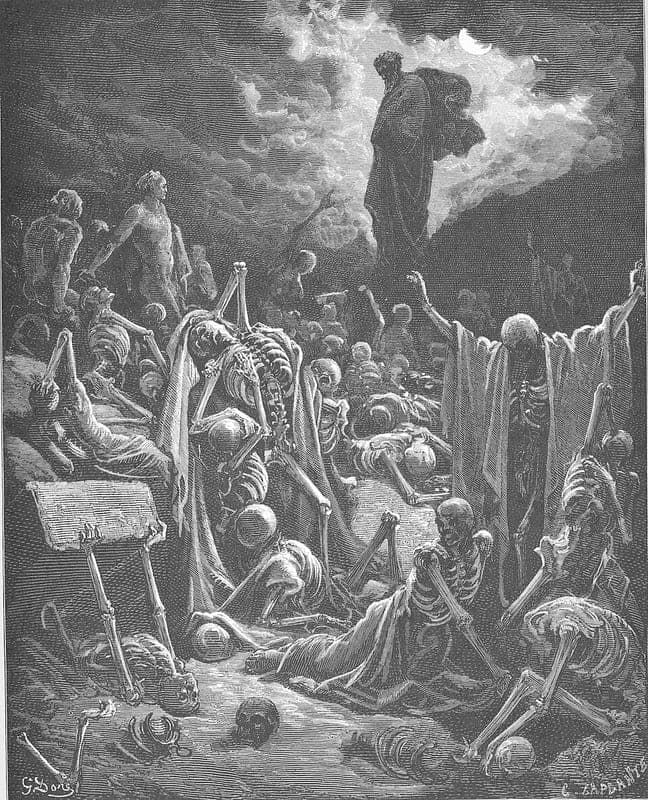
Ezekiel’s Vision of the Valley of Dry Bones, Gustave Doré, 1866. Public domain.
Old Testament · Book 26 of 66
Ezekiel
Ezekiel records the visions of a priest taken captive to Babylon with the exiles of Judah. He sees God's glory leave the temple, dry bones come to life, and a new temple where the LORD is present.
Ezekiel records the visions of a priest taken captive to Babylon with the exiles of Judah. He sees God's glory leave the temple, dry bones come to life, and a new temple where the LORD is present.
What is Ezekiel about?
Ezekiel is a priest carried to Babylon with King Jehoiachin. In the fifth year of that exile he sees the glory of the LORD by the River Kebar and is made a watchman for Israel. For seven years he warns that Jerusalem will fall, acts the siege out in signs, and watches the glory leave the temple. He speaks against seven nations while the city is besieged. When word comes that the city is taken, his message turns to promise: one shepherd, a new heart, dry bones given breath, and a measured temple the glory enters again. The book ends on the city's name, THE LORD IS THERE.
All 48 chapters
Every chapter of the book, in one grid. Each cell opens that chapter.
- The glory and the watchmanEzekiel 1 to 11
- The judgment of JerusalemEzekiel 12 to 24
- The nationsEzekiel 25 to 32
- The restoration and the templeEzekiel 33 to 48
The colour is the movement of the book the chapter stands in, and every cell opens that chapter's Study level.
Who wrote it, where, when, for whom, and why?
The book names its writer: Ezekiel the priest, the son of Buzi (1:3). He speaks in the first person through most of the book, and he is told to write things down: the date the siege began (24:2) and the design of the temple (43:11). No other book of Scripture names him.
the word of the LORD came directly to Ezekiel the priest, the son of Buzi, in the land of the Chaldeans by the River Kebar. And there the LORD’s hand was upon him.
Ezekiel 1:3, Berean Standard Bible.
He lives among the exiles in the land of the Chaldeans, by the River Kebar, at Tel-abib (1:3, 3:15). The elders of Judah sit in his house (8:1). He is carried in visions to Jerusalem and back (8:3, 11:24), and in the twenty-fifth year to a very high mountain in the land of Israel (40:2).
The book opens in a thirtieth year it does not explain (1:1), then counts its years from the exile of King Jehoiachin (1:2). The first dated year is the fifth and the last is the twenty-seventh (29:17). The siege begins in the ninth year (24:1), and the news that the city has been taken arrives in the twelfth (33:21).
He is sent to the house of Israel, a rebellious house, whether they listen or refuse (2:3 to 5). The exiles come to hear him as they would a love song, and do not do what he says (33:31 to 32).
The book gives its purpose in its refrain: the judgment and the restoration are both so that the people and the nations will know that I am the LORD (6:7, 36:23, 39:28). It ends with the reason for all of it, the name of the city: THE LORD IS THERE (48:35).
I will give you a new heart and put a new spirit within you; I will remove your heart of stone and give you a heart of flesh.
Ezekiel 36:26, Berean Standard Bible.
Jerusalem still stands when the book opens, with Zedekiah reigning under oath to the king of Babylon (17:13 to 16). Jeremiah is preaching in the city in the same years (Jeremiah 1:3), and 2 Kings 24 to 25 tells the fall the book looks toward.
Sources. Ezekiel 1:1 to 3, 2:3 to 5, 3:15, 6:7, 8:1, 8:3, 11:24, 17:13 to 16, 24:1 to 2, 29:17, 33:21, 33:31 to 32, 36:23, 36:26, 39:28, 40:2, 43:11, 48:35; Jeremiah 1:3; 2 Kings 24 to 25. Every verse is read in the Berean Standard Bible.
How is Ezekiel arranged, and what is it for?
The four movements the book falls into, then what it teaches and what it was written to do.
- The glory and the watchmanEzekiel 1 to 11, 216 verses, the turn at 10:18
Ezekiel sees the glory by the Kebar, is made a watchman, acts out the siege and watches the glory leave the temple.
- The judgment of JerusalemEzekiel 12 to 24, 403 verses, the turn at 18:4
Signs, parables and charges against a city that says the vision is far off, ending on the day the siege begins.
- The nationsEzekiel 25 to 32, 197 verses, the turn at 28:2
Oracles against seven nations, from Ammon to Egypt, while Jerusalem is under siege.
- The restoration and the templeEzekiel 33 to 48, 457 verses, the turn at 37:5
The city falls, and the prophet promises a shepherd, a new heart, life for dry bones and a measured house the glory enters.
The theme
The book is about the glory of the LORD: seen by the Kebar, leaving a defiled house, and returning to a holy one. Around that line stand the prophet's two offices, the watchman who warns before the fall and the shepherd's messenger who promises after it. Its refrain is that the people and the nations will know that I am the LORD.
The purpose
It was written for exiles who thought Jerusalem could not fall. It takes that hope away before the fall, gives each hearer the call to turn and live, and after the fall gives a better hope: a new heart and a new spirit, one shepherd, and God dwelling among His people again.
The glory's line, with the dates the book gives itself
- By the KebarEzekiel 1:28The glory appears to Ezekiel among the exilesamong the exiles in Babylon
- At the thresholdEzekiel 9:3It rises from the cherubim to the threshold of the templeat the house
- At the east gateEzekiel 10:19It stops at the entrance of the east gate of the houseone step out, the gate
- Over the mountainEzekiel 11:23It stands over the mountain east of the citytwo steps out, beyond the city
- Into the houseEzekiel 43:4It enters the temple through the gate facing eastback in the house
The dated headings, in the book's order (13)
- Year 5month 4, day 51:2the vision by the Kebar
- Year 6month 6, day 58:1the visions of the temple
- Year 7month 5, day 1020:1the elders come to inquire
- Year 9month 10, day 1024:1the siege begins
- Year 12month 11, day 126:1against Tyre
- Year 10month 10, day 1229:1against Pharaohout of order
- Year 27month 1, day 129:17Egypt given for Tyre
- Year 11month 1, day 730:20Pharaoh's arm brokenout of order
- Year 11month 3, day 131:1the cedar
- Year 12month 12, day 132:1the lament for Pharaoh
- Year 12month not given, day 1532:17Egypt in the pit
- Year 12month 10, day 533:21the news that the city is taken
- Year 25month 1, day 1040:1the temple vision
the glory seen the glory leaving the glory returningThe colour is the movement the verse stands in; a dashed heading falls earlier than the one before it.
The glory and the watchman, Ezekiel 1 to 11
What the text says in these 11 chapters, and the pages they open on.
In the fifth year of Jehoiachin's exile the heavens open by the Kebar, and Ezekiel sees the living creatures, the wheels, the throne and the likeness of the glory of the LORD. He eats a scroll, sits seven days among the exiles at Tel-abib, and is made a watchman for the house of Israel. He draws Jerusalem on a brick, lies on his side, eats siege bread and shaves his head. In the sixth year the Spirit carries him in visions to the temple, where he sees the abominations in its courts. The glory rises from the cherubim, stops at the threshold, moves to the east gate and leaves the city.
Then the glory of the LORD moved away from the threshold of the temple and stood above the cherubim.
- Study
Ezekiel 1the living creatures, the wheels and the throne by the KebarShow the summary and 3 pagesShow summary, 3 pagesHide the summary
By the river Chebar among the captives, 'the heavens were opened, and I saw visions of God.' A stormy wind out of the north, a great cloud, fire infolding itself, and four living creatures, each with four faces (man, lion, ox, eagle) and four wings, running and returning like lightning. Beside them wheels within wheels, their rims full of eyes; above them a firmament 'like the terrible crystal,' and over it a throne as of sapphire with the likeness as the appearance of a man, ringed with a bow as in the day of rain. 'This was the appearance of the likeness of the glory of Jehovah. And when I saw it, I fell upon my face.' Revelation 4 gathers these creatures around the throne.
On this chapter (3)
- The throne room
The throne of God seen by the prophets and by John.
- What did Ezekiel see by the Kebar, and how has the vision been read?
Answered under Where do readers disagree, lower on this page, with each reading and who holds it.
- Ezekiel 1:28
The verse on its own page, with the commentators on it by era.
- The throne room
- Study
Ezekiel 2the prophet sent to a rebellious house, whether they listen or notShow the summary and 1 pageShow summary, 1 pageHide the summary
'Son of man … stand up on your feet and I will speak to you'. And the Spirit entered into him and set him upon his feet, the title 'Son of man' that will name him some ninety times. He is sent to a rebellious nation, to children impudent and stiffhearted, with the refrain that governs his whole ministry: 'whether they listen or refuse to listen'. Be not afraid of their words though briers and thorns be with you and you dwell among scorpions. Then a hand holding out a roll of a book, spread before him, written within and without: 'lamentation, mourning, and woe.'
On this chapter (1)
- Ezekiel 2:3
The verse on its own page, with the commentators on it by era.
- Ezekiel 2:3
- Study
Ezekiel 3the scroll eaten, seven days at Tel-abib, the watchman appointedShow the summary and 3 pagesShow summary, 3 pagesHide the summary
'Eat this scroll, then go and speak to the house of Israel', and it was in his mouth as honey for sweetness, the scene John repeats in Revelation 10. He is not sent to a people of strange speech, who would have listened, but to Israel, who will not; so his forehead is made hard as adamant. The Spirit lifts him with the rushing of a great sound to the captives at Tel-abib, where he sits astonished seven days. Then the watchman commission (3:17-21): warn the wicked, or his blood will be required at your hand. Finally he is shut in his house, bound with cords, his tongue made to cleave to the roof of his mouth.
On this chapter (3)
- The watchman
The one set on the wall to warn.
- Was Ezekiel in Babylon or in Jerusalem, and did he travel in the Spirit?
Answered under Where do readers disagree, lower on this page, with each reading and who holds it.
- Ezekiel 3:17
The verse on its own page, with the commentators on it by era.
- The watchman
- Study
Ezekiel 4Jerusalem drawn on a brick, the prophet on his side, the siege breadShow the summary and 1 pageShow summary, 1 pageHide the summary
Prophecy becomes theater. Ezekiel takes a tile, portrays Jerusalem on it, and lays siege to it in miniature (mound, camp, battering rams) with an iron pan set as a wall of iron between himself and the city. Then he lies on his left side three hundred and ninety days for the iniquity of Israel and forty on his right for Judah, 'a day for a year.' His rations are a siege loaf of wheat, barley, beans, lentils, millet and spelt, twenty shekels a day, water by measure, baked over human dung. And when he protests defilement, cow's dung is granted instead. Bread and water consumed in dismay.
On this chapter (1)
- Ezekiel 4:1
The verse on its own page, with the commentators on it by era.
- Ezekiel 4:1
- Study
Ezekiel 5the hair shaved and divided into thirds by fire, sword and windShow the summary and 1 pageShow summary, 1 pageHide the summary
A second sign: a sharp sword used as a barber's razor over head and beard, the hair weighed and divided in three, a third burned in the city, a third smitten with the sword, a third scattered to the wind, with a few bound in the skirts of his robe. 'This is Jerusalem: I have set her in the midst of the nations, and countries are round about her', set at the center and rebelling more than the nations around her. Because she defiled the sanctuary, fathers will eat sons and sons fathers; famine, pestilence and sword will do their work in the sight of every passer-by.
On this chapter (1)
- Ezekiel 5:1
The verse on its own page, with the commentators on it by era.
- Ezekiel 5:1
- Study
Ezekiel 6the mountains of Israel and their high places judgedShow the summary and 1 pageShow summary, 1 pageHide the summary
The word turns to the mountains of Israel, to the hills, the watercourses and the valleys where the high places stand. Altars are laid waste, sun-images broken, and 'I will cast down your slain before your idols.' with bones scattered round about the altars: the shrines defiled by the corpses of their own worshippers. Sword, famine and pestilence divide the land between them. Yet a remnant escapes among the nations, and there they remember Jehovah: 'they will loathe themselves for the evil they have done and for all their abominations.' The chapter's drumbeat is Ezekiel's signature line: 'you will know that I am the LORD.'
On this chapter (1)
- Ezekiel 6:7
The verse on its own page, with the commentators on it by era.
- Ezekiel 6:7
Show chapters 7 to 11 (5 more)
- Study
Ezekiel 7the end has come upon the four corners of the landShow the summary and 1 pageShow summary, 1 pageHide the summary
A dirge of finality: 'An end: the end is come upon the four corners of the land.' The time is come, the day of tumult is near, and Jehovah's eye will not spare. The chapter's most memorable image is the sudden worthlessness of wealth in the day of wrath, silver cast into the streets, gold treated as an unclean thing, unable to satisfy the soul or fill the belly, because it was the stumblingblock of their iniquity. The sword is without, pestilence and famine within; the king mourns, the prince is clothed with desolation. Make the chain: the land is full of bloody crimes and the city full of violence.
On this chapter (1)
- Ezekiel 7:2
The verse on its own page, with the commentators on it by era.
- Ezekiel 7:2
- Study
Ezekiel 8the Spirit carries Ezekiel to the temple and its abominationsShow the summary and 3 pagesShow summary, 3 pagesHide the summary
Fourteen months later, with the elders of Judah sitting before him, the Spirit lifts Ezekiel by a lock of his head and carries him in visions to Jerusalem for a tour of hidden abominations. At the north gate stands the image of jealousy. Told to dig through a wall, he finds a chamber where seventy elders swing censers among every form of creeping thing portrayed round about, each man in his chambers of imagery, saying 'Jehovah seeth us not.' At the temple gate women weep for Tammuz. And between the porch and the altar, twenty-five men with their backs to the temple bow eastward to the sun.
On this chapter (3)
- The glory departed
The glory of the LORD leaves the temple, Ezekiel 8 to 11.
- Was Ezekiel in Babylon or in Jerusalem, and did he travel in the Spirit?
Answered under Where do readers disagree, lower on this page, with each reading and who holds it.
- Ezekiel 8:3
The verse on its own page, with the commentators on it by era.
- The glory departed
- Study
Ezekiel 9the mark on those who groan, and the slaughter from the sanctuaryShow the summary and 1 pageShow summary, 1 pageHide the summary
The vision continues in judgment. Six men come from the upper gate with slaughter weapons, and among them one clothed in linen with a writer's inkhorn: 'Go throughout the city of Jerusalem … and put a mark on the foreheads of the men sighing and groaning over all the abominations committed there.' The rest are struck without pity: 'Now begin at My sanctuary.' So they began at the ancient men before the house. Ezekiel falls on his face with the cry the whole book keeps answering: 'Oh, Lord GOD, when You pour out Your wrath on Jerusalem, will You destroy the entire remnant of Israel?'
On this chapter (1)
- Ezekiel 9:4
The verse on its own page, with the commentators on it by era.
- Ezekiel 9:4
- Study
Ezekiel 10the coals from the wheels, and the glory moves to the east gateShow the summary and 3 pagesShow summary, 3 pagesHide the summary
The glory begins to leave. Coals of fire are taken from between the cherubim and scattered over the city by the man in linen. The wheels beside them, named 'the whirling wheels,' are full of eyes, and the cherubim rise with the sound of their wings like the voice of God Almighty when he speaketh. Then the departure in slow stages: the glory of Jehovah goes up from the cherub to the threshold of the house, the house is filled with the cloud, the court with brightness, and the cherubim lift up and stand at the door of the east gate. 'This is the living creature that I saw by the river Chebar.'
On this chapter (3)
- The glory departed
The glory of the LORD leaves the temple, Ezekiel 8 to 11.
- The throne room
The throne of God seen by the prophets and by John.
- Ezekiel 10:18
The verse on its own page, with the commentators on it by era.
- The glory departed
- Study
Ezekiel 11the leaders judged, the new spirit promised, the glory leaves the cityShow the summary and 2 pagesShow summary, 2 pagesHide the summary
At the east gate stand twenty-five men, Jaazaniah and Pelatiah among them, devising iniquity and saying, 'This city is the caldron, and we are the flesh': safe meat in a strong pot. Ezekiel prophesies against them, and Pelatiah dies as he speaks; the prophet falls on his face crying out for the remnant. Then the counter-promise to the exiles the city despised: though scattered among the countries, 'I will be to them a sanctuary for a little while': a temple without walls. 'I will give them one heart, and I will put a new spirit within you; and I will take the stony heart out of their flesh.' Then the glory departs the city and stands on the mountain to the east.
On this chapter (2)
- The glory departed
The glory of the LORD leaves the temple, Ezekiel 8 to 11.
- Ezekiel 11:23
The verse on its own page, with the commentators on it by era.
- The glory departed
The vision by the Kebar, part by part, as the text describes it
- A figure like a manon the throne high above, with brilliant light around Him1:26 to 28
- The thronethe likeness of a throne with the appearance of sapphire1:26
- The expansespread out above their heads, gleaming like crystal1:22
- The wheelsa wheel on the ground beside each creature, a wheel within a wheel1:15 to 16
- The four facesa man, a lion on the right, an ox on the left, an eagle1:10
- Four living creaturesa human form, four faces and four wings each1:5 to 6
Above, highest in the vision; below, on the ground. The drawing and the rows run in the same order.
Characters (3)
Who the text names. A name with a page carries its door.
- Ezekiel
The priest, son of Buzi, who sees visions of God among the exiles (1:3).
- Jehoiachin
The exiled king by whose captivity the book counts its years (1:2).
- The watchman
The office the LORD gives Ezekiel for the house of Israel (3:17).
Places (3)
Where the chapters stand.
- The Kebar canal
The river in the land of the Chaldeans where the heavens open (1:1, 1:3).
- Tel-abib
Where the exiles live, and Ezekiel sits among them seven days (3:15).
- The temple
Where the Spirit carries him in visions to see the abominations (8:3).
Themes (2)
What these chapters raise, each on its own page where one stands.
- The glory of the LORD
Seen by the Kebar and seen leaving the house (1:28, 10:18).
- The watchman
The one who warns, and answers for the warning not given (3:17 to 21).
Where the New Testament uses these chapters (1)each marked as a quotation or an allusion, with the evidence
- Probable allusionEzekiel 1:26 to 28 at Revelation 4:2 to 3. A throne in heaven with One seated on it and a rainbow around it, the picture of Ezekiel 1:26 to 28, with the four living creatures of Ezekiel 1 at Revelation 4:6 to 7.
The judgment of Jerusalem, Ezekiel 12 to 24
What the text says in these 13 chapters, and the pages they open on.
Ezekiel packs an exile's bags in daylight and digs through the wall at dusk. He answers the proverbs of the people, names the prophets who say peace when there is none, and tells the city's history as a useless vine, a foundling bride, two eagles and two sisters. He answers the proverb of the sour grapes: each soul answers for its own sin, and the one who turns will live. On the day the king of Babylon lays siege to Jerusalem he is told to write down the date, to set a pot on the fire, and not to mourn when his wife dies.
Behold, every soul belongs to Me; both father and son are Mine. The soul who sins is the one who will die.
- Study
Ezekiel 12the baggage of exile carried out through the wallShow the summary and 2 pagesShow summary, 2 pagesHide the summary
The prophet packs an exile's baggage and carries it out in the sight of the people, digging through the wall at evening with his face covered, the exact fate of Zedekiah, who will be brought to Babylon yet never see it, since his eyes are put out on the way. 'I will spread my net upon him, and he shall be taken in my snare.' Then Ezekiel eats his bread with quaking and drinks his water with trembling. Two proverbs of delay are answered: 'The days are prolonged, and every vision faileth' is replaced with 'the days are at hand, and the fulfilment of every vision.' No word of Jehovah shall be deferred any more.
On this chapter (2)
- The exile and the return
Seventy years in Babylon and the way home.
- Ezekiel 12:3
The verse on its own page, with the commentators on it by era.
- The exile and the return
- Study
Ezekiel 13the prophets who say peace and whitewash the wallShow the summary and 1 pageShow summary, 1 pageHide the summary
Against the prophets who prophesy out of their own heart and have seen nothing: they are like foxes in the waste places, and 'You did not go up to the gaps or restore the wall around the house of Israel so that it would stand in the battle on the Day of the LORD.' Their word is untempered mortar smeared on a wall that will fall in an overflowing shower, great hailstones and a stormy wind. And men will ask where the daubing is. They say 'Peace,' and there is no peace. The chapter also indicts the women who sew bands upon the elbows and make kerchiefs for the head to hunt souls, profaning God among his people 'for handfuls of barley and scraps of bread.'
On this chapter (1)
- Ezekiel 13:10
The verse on its own page, with the commentators on it by era.
- Ezekiel 13:10
- Study
Ezekiel 14idols in the heart, and Noah, Daniel and JobShow the summary and 1 pageShow summary, 1 pageHide the summary
Elders sit before Ezekiel to inquire of Jehovah, but 'these men have set up idols in their hearts', the answer they get will match the idols they brought, so that God may take the house of Israel in their own heart. The chapter then names the four sore judgments (sword, famine, evil beasts, pestilence) and delivers its famous verdict on borrowed righteousness: though Noah, Daniel, and Job stood in the land, 'their righteousness could deliver only themselves,' not son nor daughter. Yet even so a remnant is brought out, and seeing their way and their doings, 'you will be comforted regarding the disaster I have brought upon Jerusalem'.
On this chapter (1)
- Ezekiel 14:14
The verse on its own page, with the commentators on it by era.
- Ezekiel 14:14
- Study
Ezekiel 15the vine wood good for nothing but the fireShow the summary and 1 pageShow summary, 1 pageHide the summary
The shortest of the parables and among the sharpest. What is the wood of the vine more than any tree of the forest? It cannot be made into any work; men will not even take a pin of it to hang a vessel on. Cast into the fire for fuel, with both ends burned and the middle scorched, it is fit for less than it was before. 'As the wood of the vine among the trees of the forest, which I have given to the fire for fuel, so will I give the inhabitants of Jerusalem.' Israel's whole worth was fruit-bearing; barren, the vine has no second use.
On this chapter (1)
- Ezekiel 15:6
The verse on its own page, with the commentators on it by era.
- Ezekiel 15:6
- Study
Ezekiel 16Jerusalem the foundling, clothed, and unfaithfulShow the summary and 1 pageShow summary, 1 pageHide the summary
Jerusalem as a foundling: born of Amorite and Hittite stock, cast out in the open field on the day she was born, unwashed and unpitied, and God passing by said, 'Live!' Grown, she is washed, anointed, clothed in broidered work and fine linen, decked with jewels and a crown, and her renown goes forth among the nations for her beauty. Then she spends the gifts on her lovers, builds high places of her garments, and passes her children through the fire, a harlot who pays hire instead of taking it. Her sisters are Samaria and Sodom, whose iniquity was 'arrogant, overfed, and complacent'. Yet the chapter ends in covenant: 'I will establish an everlasting covenant with you.'
On this chapter (1)
- Ezekiel 16:6
The verse on its own page, with the commentators on it by era.
- Ezekiel 16:6
- Study
Ezekiel 17the two eagles and the sprig the LORD will plantShow the summary and 1 pageShow summary, 1 pageHide the summary
A riddle and a parable. A great eagle comes to Lebanon, crops the topmost twig of the cedar and carries it to a city of merchants, then plants seed of the land by great waters, where it becomes a spreading vine of low stature. But the vine bends its roots toward a second great eagle (Zedekiah's turn to Egypt) and the question comes: shall it prosper? He despised the oath and broke the covenant, and he shall die in Babylon. Then God plants for himself: 'I will also take of the lofty top of the cedar… and will plant it upon a high and lofty mountain,' a goodly cedar where every bird finds shelter.
On this chapter (1)
- Ezekiel 17:22
The verse on its own page, with the commentators on it by era.
- Ezekiel 17:22
Show chapters 18 to 24 (7 more)
- Study
Ezekiel 18the sour grapes answered, and the call to turn and liveShow the summary and 3 pagesShow summary, 3 pagesHide the summary
The proverb 'The fathers have eaten sour grapes, and the teeth of the children are set on edge' is abolished: 'every soul belongs to Me … The soul who sins is the one who will die.' Three generations make the case (a righteous man, his violent son, his righteous grandson) and each stands or falls on his own doing. Righteousness is spelled out in deeds: no oppression, the pledge restored, bread to the hungry, no usury. The wicked who turns from all his sins shall surely live; the righteous who turns away shall die. 'Do I take any pleasure in the death of the wicked? … Wouldn’t I prefer that he turn from his ways and live?' Make you a new heart and a new spirit: why will you die?
On this chapter (3)
- Repentance
Turning back to God, the call of the prophets.
- Does 18:20 contradict Exodus 20:5?
Answered under Where do readers disagree, lower on this page, with each reading and who holds it.
- Ezekiel 18:4
The verse on its own page, with the commentators on it by era.
- Repentance
- Study
Ezekiel 19a lament for the princes of Israel, the lion cubs and the vineShow the summary and 1 pageShow summary, 1 pageHide the summary
A funeral song for the princes of Israel. The mother is a lioness among lions; she rears one whelp that learns to catch prey and is taken with hooks to Egypt, then another brought in a cage to the king of Babylon: Jehoahaz and Jehoiachin, the crown carried off twice. The image shifts to a vine planted by the waters, full of branches, with strong rods for the sceptres of them that bear rule; but she is plucked up in fury, dried by the east wind, and fire goes out of the rod of her branches. Now planted in a dry land, she has 'no strong rod to be a sceptre to rule. This is a lamentation, and shall be for a lamentation.'
On this chapter (1)
- Ezekiel 19:1
The verse on its own page, with the commentators on it by era.
- Ezekiel 19:1
- Study
Ezekiel 20Israel's rebellion told from Egypt to the exileShow the summary and 1 pageShow summary, 1 pageHide the summary
Elders come again to inquire, and are refused: 'As surely as I live, I will not be consulted by you, declares the Lord GOD.' Instead Ezekiel gives a history of rebellion in cycles, in Egypt, where they would not cast away her idols; in the wilderness with the first generation and with their children; and in the land, on every high hill. Each cycle turns on the same restraint: 'I acted for the sake of My name, that it should not be profaned'. The sabbaths given as a sign were profaned too. Judgment comes as a second exodus: brought into the wilderness of the peoples, pleaded with face to face, made to pass under the rod and into the bond of the covenant.
On this chapter (1)
- Ezekiel 20:25
The verse on its own page, with the commentators on it by era.
- Ezekiel 20:25
- Study
Ezekiel 21the sword of the king of Babylon at the fork in the roadShow the summary and 1 pageShow summary, 1 pageHide the summary
The song of the sword. Jehovah draws his sword out of its sheath against the righteous and the wicked alike, from the south to the north, and the prophet is told to sigh with the breaking of his loins. The sword is sharpened and furbished, given into the hand of the slayer. Then a startling scene: the king of Babylon halts at the parting of the ways to divine (shaking arrows, consulting teraphim, looking at the liver) and the lot falls on Jerusalem. The crown is taken off: 'A ruin, a ruin, I will make it a ruin! And it will not be restored until the arrival of Him to whom it belongs' (21:27). Then the sword against Ammon.
On this chapter (1)
- Ezekiel 21:21
The verse on its own page, with the commentators on it by era.
- Ezekiel 21:21
- Study
Ezekiel 22the charges against the city of bloodshedShow the summary and 1 pageShow summary, 1 pageHide the summary
Three indictments of 'the bloody city.' First a catalog of her crimes, blood shed, fathers and mothers set light by, sojourners oppressed, the fatherless and widow wronged, sabbaths profaned, usury and extortion taken. Second, the furnace: Israel has become dross (brass, tin, iron and lead), gathered into the fire to be melted in the heat of Jehovah's wrath. Third, an audit of every class: prophets daubing with untempered mortar, priests who hide their eyes from the sabbaths, princes like wolves ravening the prey, and the people using oppression. Then the verse behind a thousand sermons on intercession: 'I searched for a man among them to repair the wall and stand in the gap before Me on behalf of the land … But I found no one' (22:30).
On this chapter (1)
- Ezekiel 22:30
The verse on its own page, with the commentators on it by era.
- Ezekiel 22:30
- Study
Ezekiel 23the two sisters, Samaria and JerusalemShow the summary and 1 pageShow summary, 1 pageHide the summary
Two sisters, Oholah and Oholibah (Samaria and Jerusalem) who played the harlot in Egypt in their youth and never left the habit. Oholah doted on the Assyrians, her neighbors clothed in blue, and was given into their hand. Oholibah was more corrupt than her sister: she doted on Assyria too, then on the Chaldeans she saw portrayed in vermilion upon the wall, and sent messengers to Babylon. And when they came, her soul was alienated from them. So her lovers become her judges. The sisters' cup passes from one to the other, 'a cup of astonishment and desolation,' deep and large, to be drunk and then broken and gnawed at its shards.
On this chapter (1)
- Ezekiel 23:4
The verse on its own page, with the commentators on it by era.
- Ezekiel 23:4
- Study
Ezekiel 24the siege begins, the pot on the fire, the prophet's wife diesShow the summary and 1 pageShow summary, 1 pageHide the summary
On the very day Nebuchadnezzar set himself against Jerusalem, Ezekiel is given the parable of the boiling caldron: set it on, fill it with the choice bones and the good pieces, heap on the wood, and then leave it empty on the coals till its brass burns and its rust is consumed, for the rust will not go out any other way. Then the hardest sign of his life: 'behold, I am about to take away the desire of your eyes with a fatal blow.' He preaches in the morning, his wife dies at evening, and he does not mourn, as they will not mourn when the sanctuary, the desire of their eyes, falls. When the fugitive comes, his mouth will be opened.
On this chapter (1)
- Ezekiel 24:16
The verse on its own page, with the commentators on it by era.
- Ezekiel 24:16
The signs the prophet acts out, in the text's order
- Sign 1The brickJerusalem drawn on a brick with siege works around it4:1
- Sign 2Lying on his side390 days on the left side for Israel, then 40 on the right for Judah4:4
- Sign 3The siege breadsix grains in one container, eaten by weight4:9
- Sign 4The hairhead and beard shaved, the hair weighed and divided in three5:1
- Sign 5The baggagean exile's bags carried out in daylight, through the wall at dusk12:3
- Sign 6The pota pot set on the fire on the day the siege begins24:3
- Sign 7His wife's deaththe desire of his eyes taken, and no mourning24:16
Characters (3)
Who the text names. A name with a page carries its door.
- Zedekiah
The prince in Jerusalem who breaks his oath to Babylon (12:12, 17:15 to 16).
- Nebuchadnezzar
The king of Babylon who takes the cedar's top and lays siege to the city (17:12, 24:2).
- Ezekiel's wife
The desire of his eyes, who dies the evening he preaches (24:16, 24:18).
Places (2)
Where the chapters stand.
Themes (2)
What these chapters raise, each on its own page where one stands.
- Personal responsibility
The soul who sins is the one who will die, and the one who turns will live (18:4, 18:32).
- Repentance
Turn and live (18:32).
Where the New Testament uses these chapters (0). No New Testament passage quotes or names these chapters, Ezekiel 12 to 24.
The nations, Ezekiel 25 to 32
What the text says in these 8 chapters, and the pages they open on.
While the siege goes on the book turns to the neighbours. Ammon, Moab, Edom and Philistia are judged for what they did to Judah in its fall. Tyre takes three chapters: the city that cheered at Jerusalem's ruin, the great merchant ship that sinks, and its ruler who said he was a god. Sidon follows, then four chapters on Pharaoh and Egypt, the great monster of the Nile and the cedar cut down, ending with Egypt sent down to the pit among the nations already there.
“Son of man, tell the ruler of Tyre that this is what the Lord GOD says: Your heart is proud, and you have said, ‘I am a god; I sit in the seat of gods in the heart of the sea.’ Yet you are a man and not a god, though you have regarded your heart as that of a god.
- Study
Ezekiel 25Ammon, Moab, Edom and Philistia judgedShow the summary and 1 pageShow summary, 1 pageHide the summary
The oracles against the nations begin, four in one chapter, each answering a sin of the tongue or the heart against Judah's fall. Ammon said 'Aha' against the sanctuary when it was profaned, and is given to the children of the east for a possession. Moab said 'the house of Judah is like all the other nations,' flattening Israel's election, and loses her frontier cities. Edom dealt vengefully against the house of Judah: 'I will take My vengeance on Edom by the hand of My people Israel, and they will deal with Edom according to My anger and wrath.' And the Philistines took vengeance with despite of soul to destroy with perpetual enmity, so the Cherethites are cut off. Each closes: they shall know that I am Jehovah.
On this chapter (1)
- Ezekiel 25:3
The verse on its own page, with the commentators on it by era.
- Ezekiel 25:3
- Study
Ezekiel 26Tyre to be scraped bare as a rock for drying netsShow the summary and 1 pageShow summary, 1 pageHide the summary
Against Tyre, who said of Jerusalem, 'Aha! The gate to the nations is broken', glad to inherit the trade of a ruined rival. Jehovah brings up many nations against her as the sea causes its waves to come up, beginning with Nebuchadnezzar king of kings from the north with horses and chariots. Her walls are broken, her towers taken down, her very dust scraped away: 'I will make you a bare rock, and you will become a place to spread the fishing nets.' The princes of the sea come down from their thrones and clothe themselves with trembling. 'You will be sought, but will never be found'.
On this chapter (1)
- Ezekiel 26:3
The verse on its own page, with the commentators on it by era.
- Ezekiel 26:3
- Study
Ezekiel 27the lament over Tyre as a great merchant shipShow the summary and 1 pageShow summary, 1 pageHide the summary
A lamentation shaped as a shipwreck. Tyre is built like a magnificent vessel: planks of fir from Senir, a cedar mast from Lebanon, oars of the oaks of Bashan, a sail of embroidered fine linen from Egypt, rowers from Sidon and Arvad, caulkers and pilots from her own wise men. Then comes the trade manifest, the ancient world's shipping register: Tarshish with silver, iron, tin and lead; Javan, Tubal and Meshech; Judah with wheat and honey and oil; Dedan, Sheba and Raamah with spices and precious stones. 'Your oarsmen have brought you onto the high seas, but the east wind will shatter you in the heart of the sea.' Mariners cry on the shore and cast dust on their heads. Revelation 18 mourns Babylon in these very cadences.
On this chapter (1)
- Ezekiel 27:3
The verse on its own page, with the commentators on it by era.
- Ezekiel 27:3
- Study
Ezekiel 28the ruler who said I am a god, and the word against SidonShow the summary and 2 pagesShow summary, 2 pagesHide the summary
Two oracles over Tyre. To the prince: 'Your heart is proud, and you have said … I am a god; I sit in the seat of gods in the heart of the sea. … Yet you are a man and not a god', wisdom turned to trade, trade turned to pride. Then the lamentation over the king, in language no merchant ever fit: 'You were in Eden, the garden of God', covered with every precious stone, 'anointed as a guardian cherub,' walking among the stones of fire: 'From the day you were created you were blameless in your ways … until wickedness was found in you', long read toward the fall of Satan behind the human throne. Then Sidon, and Israel gathered to dwell securely.
On this chapter (2)
- Who is the prince of Tyre in 28:12 to 19, a king or Satan?
Answered under Where do readers disagree, lower on this page, with each reading and who holds it.
- Ezekiel 28:2
The verse on its own page, with the commentators on it by era.
- Who is the prince of Tyre in 28:12 to 19, a king or Satan?
- Study
Ezekiel 29Pharaoh the great monster of the Nile, and Egypt given to BabylonShow the summary and 1 pageShow summary, 1 pageHide the summary
Egypt's turn, in seven oracles beginning here. Pharaoh is 'great monster who lies among his rivers, who says … The Nile is mine; I made it myself': the Nile claimed as self-made, the essence of the sin. Hooks go into his jaws and he is flung into the wilderness with the fish of his rivers. Egypt was a staff of reed to Israel: leaned on, it broke and tore the shoulder. So the land lies desolate forty years and its people are scattered, then gathered again to be 'the lowliest of kingdoms', never again lifting itself above the nations. Last, Egypt is given to Nebuchadnezzar as wages for his labor against Tyre.
On this chapter (1)
- Ezekiel 29:3
The verse on its own page, with the commentators on it by era.
- Ezekiel 29:3
- Study
Ezekiel 30the day of the LORD on Egypt, and Pharaoh's arm brokenShow the summary and 1 pageShow summary, 1 pageHide the summary
'Wail … Alas for that day! … For the day is near, the Day of the LORD is near', a day of clouds and a time of the nations. Egypt's allies fall with her: Ethiopia, Put, Lud, Arabia, Cub. The oracle then walks the map of Egyptian cities, each with its own doom (No and Sin and Noph, Tehaphnehes and On and Pi-beseth), idols destroyed, fire set, multitudes cut off. The controlling image is a broken arm: 'I have broken the arm of Pharaoh king of Egypt', unbound and unsplinted so it cannot hold a sword, then both arms broken, while the arms of the king of Babylon are strengthened and God's own sword is put into his hand.
On this chapter (1)
- Ezekiel 30:3
The verse on its own page, with the commentators on it by era.
- Ezekiel 30:3
Show chapters 31 to 32 (2 more)
- Study
Ezekiel 31Pharaoh as a cedar of Lebanon cut downShow the summary and 1 pageShow summary, 1 pageHide the summary
A tree taller than empire. Assyria was a cedar in Lebanon with fair branches and a shadowing shroud, exalted by the deep waters that nourished it; the birds of the heavens nested in its boughs, the beasts brought forth under it, and great nations dwelt in its shade, so that the trees of Eden envied it. But because it lifted itself up in stature and set its top among the thick boughs, it was delivered to the mighty one of the nations, cut down and left on the mountains for the beasts. The nations shake at the sound of its fall, and it goes down to Sheol. 'This is Pharaoh and all his multitude.'
On this chapter (1)
- Ezekiel 31:3
The verse on its own page, with the commentators on it by era.
- Ezekiel 31:3
- Study
Ezekiel 32the lament for Pharaoh, and Egypt among the slain in the pitShow the summary and 1 pageShow summary, 1 pageHide the summary
The final Egyptian dirge and the strangest scene in the oracles. Pharaoh thought himself a lion among the nations but is a monster in the seas, fouling the waters with his feet; God spreads a net over him and casts him on the open field for the birds. Then cosmic mourning: the heavens covered, the stars darkened, the sun veiled with a cloud, the moon withholding her light. The chapter closes in the underworld, where Egypt is laid among the uncircumcised beside the fallen empires already there (Asshur, Elam, Meshech and Tubal, Edom, the princes of the north, the Sidonians), warriors gone down with their weapons of war, their swords laid under their heads.
On this chapter (1)
- Ezekiel 32:2
The verse on its own page, with the commentators on it by era.
- Ezekiel 32:2
Seven nations, in the text's order, each drawn to its length
- 1 of 7Ammon25:1 to 7said Aha over the sanctuary7 verses
- 2 of 7Moab25:8 to 11said Judah is like all the nations4 verses
- 3 of 7Edom25:12 to 14took vengeance on Judah3 verses
- 4 of 7Philistia25:15 to 17acted with ancient hostility3 verses
- 5 of 7Tyre26:1 to 28:19cheered at Jerusalem's ruin76 verses
- 6 of 7Sidon28:20 to 26a thorn to the house of Israel7 verses
- 7 of 7Egypt29:1 to 32:32said the Nile is mine97 verses
Characters (3)
Who the text names. A name with a page carries its door.
- The ruler of Tyre
Who says I am a god, though he is a man (28:2).
- Pharaoh
The great monster lying in the Nile, who says the river is his (29:3).
- Nebuchadnezzar
Given Egypt as wages for his labour against Tyre (29:18 to 20).
Places (2)
Where the chapters stand.
Themes (2)
What these chapters raise, each on its own page where one stands.
- Pride
The heart lifted up that says I am a god (28:2, 31:10).
- They will know that I am the LORD
The refrain the oracles against the nations close on (25:5, 25:11, 28:22).
Where the New Testament uses these chapters (0). No New Testament passage quotes or names these chapters, Ezekiel 25 to 32.
The restoration and the temple, Ezekiel 33 to 48
What the text says in these 16 chapters, and the pages they open on.
The watchman's charge is given again, and a fugitive arrives to say the city has been taken. From that day the message changes. God will judge the shepherds and set one shepherd, His servant David, over the flock. He will give a new heart and a new spirit, breathe life into a valley of dry bones and join the two sticks of Judah and Joseph into one. Gog comes against the land and falls on its mountains. In the twenty-fifth year of the exile a man with a measuring rod shows Ezekiel a temple, the glory enters it by the east gate, a river flows from its threshold, the land is divided among the tribes, and the city is named THE LORD IS THERE.
This is what the Lord GOD says to these bones: I will cause breath to enter you, and you will come to life.
- Study
Ezekiel 33the watchman again, and the news that the city has been takenShow the summary and 3 pagesShow summary, 3 pagesHide the summary
The hinge of the book. The watchman charge is renewed with the parable behind it: if the watchman sees the sword and blows not the trumpet, the blood is required at his hand. Then the heart of Ezekiel's God: 'As surely as I live … I take no pleasure in the death of the wicked, but rather that the wicked should turn from their ways and live. Turn! Turn from your evil ways!' (33:11). Past righteousness saves no one who turns away; past wickedness damns no one who repents. Then the fugitive arrives ('The city has been taken!') and the prophet's mouth is opened. His hearers treat him as a lovely song: they hear his words and do them not.
On this chapter (3)
- The watchman
The one set on the wall to warn.
- Repentance
Turning back to God, the call of the prophets.
- Ezekiel 33:21
The verse on its own page, with the commentators on it by era.
- The watchman
- Study
Ezekiel 34the shepherds judged and one shepherd, My servant DavidShow the summary and 3 pagesShow summary, 3 pagesHide the summary
The shepherds of Israel fed themselves and not the flock, eating the fat, clothing themselves with the wool, killing the fatlings, while the sick were not healed, the broken not bound up, and the lost not sought. So the sheep were scattered and became meat to every beast. Against them stands the divine reversal: 'Behold, I myself, even I, will search for my sheep, and will seek them out… I will feed them in a good pasture.' Fat sheep that shove the lean with shoulder and horn are judged. Then the promise underneath John 10: 'I will set up one shepherd over them, and he shall feed them, even my servant David,' with a covenant of peace and showers of blessing.
On this chapter (3)
- The good shepherd
The shepherd who lays down His life for the sheep.
- The Davidic covenant
The promise of a king from David's line.
- Ezekiel 34:23
The verse on its own page, with the commentators on it by era.
- The good shepherd
- Study
Ezekiel 35Mount Seir made desolateShow the summary and 1 pageShow summary, 1 pageHide the summary
A short oracle against Mount Seir, set deliberately opposite the mountains of Israel in the next chapter. Edom is charged with perpetual enmity: giving over the children of Israel to the power of the sword in the time of their calamity, in the time of the iniquity of the end. And with the greed that said of Israel and Judah, 'These two nations and these two countries shall be mine, and we will possess it.' The answer names what Edom forgot: 'whereas Jehovah was there.' Blood shall pursue the one who hated not blood; the mountain that rejoiced over another's desolation is made desolate itself.
On this chapter (1)
- Ezekiel 35:3
The verse on its own page, with the commentators on it by era.
- Ezekiel 35:3
- Study
Ezekiel 36the mountains of Israel, and a new heart and a new spiritShow the summary and 2 pagesShow summary, 2 pagesHide the summary
The mountains of Israel are addressed directly, because the enemy claimed the ancient high places for his own. They will shoot forth branches and yield fruit to a people at hand to come; cities inhabited, waste places built, and God doing better for them than at their beginnings. But the reason is stripped of flattery: they had profaned his holy name among the nations: 'It is not for your sake that I will act, O house of Israel, but for My holy name, which you profaned among the nations to which you went.' Then the new covenant in its clearest Old Testament form: 'I will also sprinkle clean water on you … I will give you a new heart and put a new spirit within you' (36:25-27), the passage behind Jesus' 'You must be born again' (John 3:7).
On this chapter (2)
- The new covenant
The law written on the heart and a new spirit within.
- Ezekiel 36:26
The verse on its own page, with the commentators on it by era.
- The new covenant
- Study
Ezekiel 37the valley of dry bones and the two sticks made oneShow the summary and 3 pagesShow summary, 3 pagesHide the summary
Set down in the midst of a valley full of very dry bones and asked, 'Son of man, can these bones come to life?' the prophet answers, 'O Lord GOD … only You know.' He prophesies, and there is a noise and a shaking, bone joining to bone, sinews and flesh and skin. But no breath, until he prophesies to the four winds and they stand up an exceeding great army. The interpretation is national resurrection: 'I will open your graves … I will bring you back to the land of Israel.' Then two sticks, Judah and Joseph, become one in his hand: one nation, one king, with David as their prince, a covenant of peace, and this promise: 'My dwelling place will be with them'. Revelation 21 takes up this line.
On this chapter (3)
- The valley of dry bones
Ezekiel 37, the bones given breath.
- The Davidic covenant
The promise of a king from David's line.
- Ezekiel 37:5
The verse on its own page, with the commentators on it by era.
- The valley of dry bones
- Study
Ezekiel 38Gog of the land of Magog comes against the landShow the summary and 3 pagesShow summary, 3 pagesHide the summary
Gog, of the land of Magog, prince of Rosh, Meshech and Tubal, is brought out with hooks in his jaws at the head of a great confederacy: Persia, Cush and Put, Gomer and the house of Togarmah from the uttermost parts of the north. The timing is explicit and future: 'In the latter years you will enter a land that has recovered from war,' whose people are gathered out of many peoples and dwell securely in unwalled villages. Gog thinks an evil thought (to take a spoil) while Sheba, Dedan and the merchants of Tarshish look on. Then the fury: a great shaking, every man's sword against his brother, pestilence, overflowing rain, great hailstones, fire and brimstone.
On this chapter (3)
- Gog and Magog
The enemy of Ezekiel 38 and 39 and of Revelation 20.
- Who is Gog, and when is the battle?
Answered under Where do readers disagree, lower on this page, with each reading and who holds it.
- Ezekiel 38:2
The verse on its own page, with the commentators on it by era.
- Gog and Magog
Show chapters 39 to 48 (10 more)
- Study
Ezekiel 39Gog falls on the mountains of Israel, and the Spirit poured outShow the summary and 3 pagesShow summary, 3 pagesHide the summary
Gog's end on the mountains of Israel: the bow struck from his left hand, the arrows from his right, and the multitude given to the ravenous birds and the beasts of the field, with fire sent on Magog and on the isles. The clean-up is measured in years, seven years burning the weapons for fuel, seven months burying the dead in the valley of Hamon-gog. The birds are summoned to a sacrifice to eat the flesh of the mighty and drink the blood of princes, the scene Revelation 19 calls the great supper of God. Then the turn homeward: the captivity of Jacob brought back, the face no longer hidden, 'for I have poured out my Spirit upon the house of Israel.'
On this chapter (3)
- Gog and Magog
The enemy of Ezekiel 38 and 39 and of Revelation 20.
- Who is Gog, and when is the battle?
Answered under Where do readers disagree, lower on this page, with each reading and who holds it.
- Ezekiel 39:29
The verse on its own page, with the commentators on it by era.
- Gog and Magog
- Study
Ezekiel 40the man with the measuring rod, the gates and the courtsShow the summary and 3 pagesShow summary, 3 pagesHide the summary
In the twenty-fifth year of the captivity, fourteen years after the city fell, Ezekiel is brought in visions of God to the land and set upon a very high mountain, where a man whose appearance was like brass stands with a line of flax and a measuring reed. The last nine chapters are the tour that follows. Here the outer court is measured: the east gate with its lodges and jambs and porch, the north and south gates matching it, the pavement and the thirty chambers, then the inner court, the tables for slaughtering the burnt-offering, the chambers for the singers and the priests, and finally the porch of the temple itself. The house reads this temple as millennial.
On this chapter (3)
- Ezekiel's temple
The house measured in Ezekiel 40 to 48.
- What is the temple of chapters 40 to 48?
Answered under Where do readers disagree, lower on this page, with each reading and who holds it.
- Ezekiel 40:3
The verse on its own page, with the commentators on it by era.
- Ezekiel's temple
- Study
Ezekiel 41the sanctuary and the Most Holy Place measuredShow the summary and 1 pageShow summary, 1 pageHide the summary
The measuring goes inside. The man measures the jambs and the doorway, then the nave, and passing within measures the inner room and says, 'This is the most holy place.' Around the house run side-chambers in three stories, each thirty to a story, resting on rebatements in the wall so that they take no hold on the house itself. Westward stands the separate place and its building. Then the decoration, given with unusual care: the walls carved throughout with cherubim and palm-trees alternating, every cherub with two faces, a man's face toward the palm tree on one side and a young lion's face on the other. A wooden altar stands before the sanctuary, 'This is the table that is before Jehovah.'
On this chapter (1)
- Ezekiel 41:4
The verse on its own page, with the commentators on it by era.
- Ezekiel 41:4
- Study
Ezekiel 42the chambers of the priests and the wall around the wholeShow the summary and 1 pageShow summary, 1 pageHide the summary
The priests' chambers are measured, in blocks north and south of the separate place, three stories high with galleries and a walk before them. Their purpose is holiness, not architecture: 'the priests who approach the LORD will eat the most holy offerings' (the meal-offering, the sin-offering and the trespass-offering) and there they shall lay the garments in which they minister, and put on others before going out to the people. Then the man measures the whole precinct on all four sides, five hundred reeds each way, a perfect square with a wall around it, 'to separate the holy from the common.'
On this chapter (1)
- Ezekiel 42:20
The verse on its own page, with the commentators on it by era.
- Ezekiel 42:20
- Study
Ezekiel 43the glory enters by the east gate, and the altarShow the summary and 3 pagesShow summary, 3 pagesHide the summary
The vision's climax answers chapters 10 and 11. 'Behold, the glory of the God of Israel came from the way of the east: and his voice was like the sound of many waters; and the earth shined with his glory.' It was as the vision by the Chebar, and Ezekiel fell upon his face. The glory enters by the east gate, the Spirit lifts him into the inner court, and the house is filled. Then the promise: 'this is the place of my throne, and the place of the soles of my feet, where I will dwell in the midst of the children of Israel for ever.' Let them be ashamed, and measure the pattern. The altar is then described and consecrated seven days.
On this chapter (3)
- Ezekiel's temple
The house measured in Ezekiel 40 to 48.
- The glory departed
The glory of the LORD leaves the temple, Ezekiel 8 to 11.
- Ezekiel 43:4
The verse on its own page, with the commentators on it by era.
- Ezekiel's temple
- Study
Ezekiel 44the east gate shut, and the priests of ZadokShow the summary and 1 pageShow summary, 1 pageHide the summary
The outer east gate is shut and stays shut, 'because the LORD, the God of Israel, has entered through it': only the prince may sit in it to eat bread before Jehovah. Then a reform of the priesthood. Foreigners uncircumcised in heart and flesh had been brought into the sanctuary; that ends. The Levites who went astray after idols will bear their iniquity and serve at the gates but not come near as priests. The sons of Zadok, who kept the charge when Israel went astray, come near to minister. Rules follow: linen garments and no wool, no wine in the inner court, marriage limits, teaching the difference between the holy and the common. And no inheritance, for 'I am their inheritance.'
On this chapter (1)
- Ezekiel 44:2
The verse on its own page, with the commentators on it by era.
- Ezekiel 44:2
- Study
Ezekiel 45the holy portion of the land and the prince's shareShow the summary and 1 pageShow summary, 1 pageHide the summary
The land is divided before it is farmed. A holy oblation is set apart, a portion for the sanctuary and the priests, a portion for the Levites, a strip for the city, and land on both sides for the prince, so that his princes shall no more oppress the people. The commercial law is stated with the same weight as the ritual law: 'You must use honest scales, a just ephah, and a just bath', with the homer, the shekel and the gerah fixed by decree. The people bring their oblation to the prince, and the prince provides the offerings at the feasts, the new moons and the sabbaths, to make atonement for the house of Israel.
On this chapter (1)
- Ezekiel 45:1
The verse on its own page, with the commentators on it by era.
- Ezekiel 45:1
- Study
Ezekiel 46the prince at the gate, and the offerings of the sabbathsShow the summary and 1 pageShow summary, 1 pageHide the summary
The liturgical calendar of the new temple. The east gate of the inner court stays shut the six working days and is opened on the sabbath and the new moon; the prince enters by the porch and worships at its threshold while the people worship at its door. Offerings are prescribed for sabbath, new moon and freewill gifts. Traffic is ordered so that no one turns back: whoever comes in by the north gate goes out by the south. The prince may give inheritance to his sons, but a gift to a servant returns in the year of liberty, and he shall not take the people's inheritance by oppression. Boiling and baking places stand in the corners of the court.
On this chapter (1)
- Ezekiel 46:1
The verse on its own page, with the commentators on it by era.
- Ezekiel 46:1
- Study
Ezekiel 47the river from the threshold, and the borders of the landShow the summary and 2 pagesShow summary, 2 pagesHide the summary
Waters issue from under the threshold of the house eastward, on the south side of the altar, and the man with the line measures them a thousand cubits at a time, to the ankles, to the knees, to the loins, and then 'waters to swim in, a river that could not be passed through.' A river that deepens with no tributary. Trees line both banks; the stream runs down the Arabah into the sea and the waters are healed, so that fish abound and nets are spread from En-gedi to En-eglaim. The trees bear new fruit every month, 'and the leaf thereof for healing': Revelation 22 takes both river and leaves. Then the land's borders, with sojourners who beget children counted 'as the home-born.'
On this chapter (2)
- Ezekiel's temple
The house measured in Ezekiel 40 to 48.
- Ezekiel 47:9
The verse on its own page, with the commentators on it by era.
- Ezekiel's temple
- Study
Ezekiel 48the tribes' portions, and the city named THE LORD IS THEREShow the summary and 1 pageShow summary, 1 pageHide the summary
The tribes receive parallel strips running east to west, seven to the north (Dan, Asher, Naphtali, Manasseh, Ephraim, Reuben and Judah) then the great oblation in the center with the sanctuary, the priests, the Levites, the city and the prince's land, and five to the south: Benjamin, Simeon, Issachar, Zebulun and Gad. The city is a square of four thousand five hundred each way, with twelve gates named for the twelve tribes, three to a side: the plan Revelation 21 gives the New Jerusalem. The book that opened with a departing glory ends with a name: 'And the name of the city from that day shall be, Jehovah is there.'
On this chapter (1)
- Ezekiel 48:35
The verse on its own page, with the commentators on it by era.
- Ezekiel 48:35
The temple from above, and the river from its threshold
- The outer wall:
- five hundred cubits each way, to separate the holy from the common (42:20)
- Each gateway:
- fifty cubits from the entrance to the inner portico (40:15)
- The outer court:
- a hundred cubits from the lower gateway to the inner court (40:19)
- The inner court:
- square, a hundred cubits each way, with the altar before the temple (40:47)
- The temple:
- a hundred cubits long (41:13)
- The outer sanctuary:
- forty cubits by twenty (41:2)
- The Most Holy Place:
- twenty cubits by twenty (41:4)
Characters (3)
Who the text names. A name with a page carries its door.
- The shepherds
Israel's rulers, who fed themselves and not the flock (34:2).
- My servant David
The one shepherd God will set over the flock (34:23, 37:24).
- Gog
Of the land of Magog, chief prince of Meshech and Tubal (38:2).
Places (3)
Where the chapters stand.
- The valley of bones
The valley full of very dry bones (37:1 to 2).
- The mountains of Israel
Promised fruit and people again (36:8), where Gog falls (39:4).
- The city
Whose name from that day is THE LORD IS THERE (48:35).
Themes (3)
What these chapters raise, each on its own page where one stands.
- The new heart
A heart of flesh and a new spirit within (36:26 to 27).
- The one shepherd
One shepherd and one king over one people (34:23, 37:22).
- The temple
The house measured and the glory returned (40:3, 43:4).
Where the New Testament uses these chapters (5)each marked as a quotation or an allusion, with the evidence
- Probable allusionEzekiel 34 at John 10:11 to 16. Jesus calls Himself the good shepherd against hirelings who leave the flock, and speaks of one flock and one shepherd (John 10:16, Ezekiel 34:23).
- Later Christian readingEzekiel 36:25 to 27 at John 3:5. Born of water and the Spirit is read beside the clean water and the new spirit of Ezekiel 36:25 to 27, a reading made by D. A. Carson, The Gospel According to John, Pillar New Testament Commentary (1991), on 3:5; John does not cite the verse.
- Probable allusionEzekiel 37:5, 37:10 at Revelation 11:11. The breath of life from God enters the two witnesses and they stand on their feet, the words of Ezekiel 37:10.
- Probable allusionEzekiel 38 to 39 at Revelation 20:8. Gog and Magog are named as the nations gathered for battle, the names of Ezekiel 38:2.
- Probable allusionEzekiel 40 to 48 at Revelation 21 to 22. A city measured with a rod, gates named for the tribes, and a river of the water of life flowing from the throne with trees for healing (Revelation 21:12 to 17, 22:1 to 2; Ezekiel 40:3, 47:1 to 12, 48:31).
- Author
- Ezekiel, son of Buzi the priest (1:3)
- Date
- Dated oracles 593 BC (1:1, fifth year of Jehoiachin's exile) to 571 BC (29:17)
- Audience
- Judean exiles in Babylon along the Chebar canal
Where do readers disagree?
One list: the readings with their holders, and what the evidence does not settle.
What did Ezekiel see by the Kebar, and how has the vision been read?
The Throne Room→- The glory of God, not bound to the temple. Held by Moshe Greenberg, Ezekiel 1 to 20, Anchor Bible (1983).
- The throne-chariot, a text to be guarded. Held by the Mishnah, tractate Hagigah 2:1, and traced by Gershom Scholem, Major Trends in Jewish Mysticism (1941).
- The four living creatures as the four Gospels. Held by Irenaeus in Against Heresies 3.11.8, and by Jerome in his Commentary on Matthew, preface.
What the evidence does not settle: The text says what the vision looked like, each part a likeness (1:26 to 28), and does not say whether the figures carry a meaning beyond the glory itself.
The argument in full
The glory of God, not bound to the temple. The vision is told in likenesses and appearances (1:26, 1:28), and it comes to exiles in Babylon, so the God of the temple is shown present and mobile outside the land.
The throne-chariot, a text to be guarded. The chariot of chapter 1 became the centre of a tradition of visionary ascent, and the rabbis limited its teaching to one qualified hearer at a time.
The four living creatures as the four Gospels. The four faces of the creatures (1:10), seen again around the throne in Revelation 4:7, are read as the four Gospels, and the figure like a man on the throne as the Son.
Who is the prince of Tyre in 28:12 to 19, a king or Satan?
- The adversary behind the king. Held by Tertullian, Against Marcion 2.10, and Origen, On First Principles 1.5.4.
- The human king in the language of Eden. Held by Moshe Greenberg, Ezekiel 21 to 37, Anchor Bible (1997).
What the evidence does not settle: The oracle is addressed to the king of Tyre (28:12) and speaks of Eden and a cherub, and the text gives no line saying which of the two it means.
The argument in full
The adversary behind the king. Eden, the anointed cherub, the holy mountain of God and a being blameless from the day he was created (28:13 to 15) do not fit a Phoenician ruler, so the lament is read as the fall of the one who stood behind his pride.
The human king in the language of Eden. Chapter 31 applies a cedar in the garden of God to Pharaoh (31:8 to 9), and chapter 28 is read the same way, the pride of a king told as a fall from Eden.
What is the temple of chapters 40 to 48?
Ezekiel's Temple→- A house still to be built, in the age to come. Held by Maimonides, Mishneh Torah (1180), Laws of the Chosen House 1:4, and by Rashi, Commentary on Ezekiel (eleventh century), on chapters 40 to 48.
- A vision of God dwelling with His people, fulfilled in Christ and the church. Held by Jerome, Commentary on Ezekiel (AD 410 to 414), and Patrick Fairbairn, Ezekiel and the Book of His Prophecy (1851).
- The temple of the millennial kingdom. Held by Charles Lee Feinberg, The Prophecy of Ezekiel (1969), and Ralph Alexander, Ezekiel, Expositor's Bible Commentary (1986).
What the evidence does not settle: The text tells Ezekiel to write the design down so that the people may keep it (43:11), and it does not say when or whether the house is built.
The argument in full
A house still to be built, in the age to come. The measurements are given to be kept and carried out (43:11), and the house they describe has not yet stood.
A vision of God dwelling with His people, fulfilled in Christ and the church. The point of every measure is to separate the holy from the common (42:20), and the book ends on a name, THE LORD IS THERE (48:35), which Revelation takes up for the city of God (Revelation 21:3).
The temple of the millennial kingdom. The measures are read as measures of a house that will stand in the land during the thousand years, its offerings as memorials of a finished sacrifice.
The offerings of 45:17 to 25 are the place where the readings part most sharply, since Hebrews 10:12 to 18 says Christ offered one sacrifice for sins for all time.
Who is Gog, and when is the battle?
Gog and Magog→- A future enemy of Israel at the end of the age. Held by Charles Lee Feinberg, The Prophecy of Ezekiel (1969).
- The nations of the whole world against the church. Held by Augustine in The City of God 20.11.
- A figure drawn from a known name, set in an end-time frame. Held by Daniel I. Block, The Book of Ezekiel: Chapters 25 to 48, New International Commentary on the Old Testament (1998).
What the evidence does not settle: The text names Gog and his lands (38:2 to 6) and sets the attack after the return (38:8) with no date; Revelation 20:8 puts Gog and Magog after the thousand years.
The argument in full
A future enemy of Israel at the end of the age. The attack comes in the latter years on a people brought back and living in safety (38:8), and Gog falls on the mountains of Israel (39:4).
The nations of the whole world against the church. Revelation 20:8 names Gog and Magog as the nations in the four corners of the earth, so they are read as no single people but the persecutors of the church at the end.
A figure drawn from a known name, set in an end-time frame. The name is read as Gyges of Lydia, a king remembered in the region, used for a leader of distant northern peoples in a battle the text sets after the return.
Does 18:20 contradict Exodus 20:5?
- Two texts on two matters, and both stand. Held by C. F. Keil, Biblical Commentary on the Prophecies of Ezekiel (1876), on 18:1 to 4.
- A word to one generation that blamed its fathers. Held by Paul M. Joyce, Divine Initiative and Human Response in Ezekiel (1989).
What the evidence does not settle: Both texts stand in the Berean text as written, and the chapter does not name Exodus 20:5.
The argument in full
Two texts on two matters, and both stand. Exodus 20:5 speaks of those who hate God, whose children follow them, and Ezekiel 18 is a court case in which each man is judged by his own ways; Deuteronomy 24:16 already forbids putting children to death for fathers.
A word to one generation that blamed its fathers. The chapter answers a proverb (18:2) and calls the exiles to turn and live (18:31 to 32), so it is read as a call to the present generation, not a new doctrine of the individual.
Was Ezekiel in Babylon or in Jerusalem, and did he travel in the Spirit?
- In Babylon, and carried to Jerusalem in visions. Held by Daniel I. Block, The Book of Ezekiel: Chapters 1 to 24, New International Commentary on the Old Testament (1997).
- A ministry in Jerusalem, set later in a Babylonian frame. Held by C. C. Torrey, Pseudo-Ezekiel and the Original Prophecy (1930), and Volkmar Herntrich, Ezechielprobleme (1932).
What the evidence does not settle: The book places him by the Kebar (1:1, 3:15) and says he was in Jerusalem in visions (8:3, 40:2); it does not say how the visions carried him.
The argument in full
In Babylon, and carried to Jerusalem in visions. The Spirit lifts him up and carries him in visions of God to Jerusalem (8:3), and the vision leaves him among the exiles in Chaldea (11:24).
A ministry in Jerusalem, set later in a Babylonian frame. The Jerusalem scenes of chapters 8 to 11 are read as too close to be seen from far away, so the exile setting is read as an editor's frame.
The pages Ezekiel opens on
Studies84
Show the next 6 titles
- The New Covenant
- The Good Shepherd
- The Davidic Covenant
- The Exile and the Return
- The Millennium
- Repentance
Show the next 6 titles
- The Major Prophets
- Daniel the Prophet
- Generational Curses
- Satan
- The Glory That Filled the House
- The Vine & the Vineyard
Show the next 6 titles
- Revelation: the Canon's Closing Scroll
- Taw: The Mark of God
- The Tabernacle
- Creation to New Creation
- Jeremiah: the Study Guide
- Covenants of Scripture
Show the next 6 titles
Show the next 6 titles
- The New Heart and the New Spirit
- The Intercession of Moses
- Job's Integrity
- Molech and Topheth
- Sodom and Gomorrah
- The Covenant of Salt
Show the next 6 titles
- The Harlot
- The Ordeal of the Suspected Wife
- Providence
- When God relents, and the gracious and compassionate formula
- The Qinah, the Rhythm of the Hebrew Lament
- The Holiness Code
Show the next 6 titles
- Unequally Yoked
- Ammon
- Shiloh and the Scepter: Genesis 49:10
- The teraphim
- Abraham's Intercession for Sodom
- The Philistines
Show the next 6 titles
- Haran
- Eden
- God Dwelling with His People, from Eden to the New Jerusalem
- The Origin of Evil
- The Gap Reading at Genesis 1:2
- Pharaoh
Show the next 6 titles
People and groups4
Books beside it5
Sources for this page
The painting in the band is Ezekiel’s Vision of the Valley of Dry Bones, Gustave Doré, 1866. Public domain. The movements, the chapter entries, the figures and the Context are read off the text of Ezekiel, and every count on the page is computed from the Berean Standard Bible text in the store. The works behind the readings under Where do readers disagree are the Mishnah, tractate Hagigah; Irenaeus, Against Heresies; Tertullian, Against Marcion; Origen, On First Principles; Augustine, The City of God; Jerome, Commentary on Ezekiel and Commentary on Matthew; Rashi, Commentary on Ezekiel; Maimonides, Mishneh Torah; Patrick Fairbairn, Ezekiel and the Book of His Prophecy (1851); C. F. Keil, Biblical Commentary on the Prophecies of Ezekiel (1876); C. C. Torrey, Pseudo-Ezekiel and the Original Prophecy (1930); Volkmar Herntrich, Ezechielprobleme (1932); Gershom Scholem, Major Trends in Jewish Mysticism (1941); Charles Lee Feinberg, The Prophecy of Ezekiel (1969); Moshe Greenberg, Ezekiel, Anchor Bible (1983 and 1997); Ralph Alexander, Ezekiel, Expositor's Bible Commentary (1986); Paul M. Joyce, Divine Initiative and Human Response in Ezekiel (1989); D. A. Carson, The Gospel According to John (1991); and Daniel I. Block, The Book of Ezekiel, New International Commentary on the Old Testament (1997 and 1998). Every verse quoted on this page is the Berean Standard Bible, read from the store.