

Genesis 21:21 · Place · Featured Study
Paran
Ishmael the archer, Israel's camp and an Edomite prince on his way to Egypt all passed through this wilderness.
Scripture names Paran in eleven verses, and in two of them God Himself comes from it.
- Region
- Between the Wilderness of Sinai and the south of Canaan
- First named
- Genesis 14:6 “…Mount Seir, as far as El-paran, which is…”
- Last named
- Habakkuk 3:3 “…the Holy One from Mount Paran. Selah His…”
Giovanni Lanfranco, Moses and the Messengers from Canaan, 1621 to 1624. Public domain.
Summary
Paran is the wilderness north of Sinai and south of Canaan, where Ishmael settled and where Israel camped before the spies went up.
- Ishmael grew up in the Wilderness of Paran, and his mother took a wife for him from Egypt.
- The cloud settled in Paran when Israel left Sinai in the second year after the exodus.
- Moses sent the twelve spies from Paran, and they came back after forty days to the camp at Kadesh.
The Wilderness of Paran
Genesis and Numbers each send someone out into Paran, Ishmael in one book and Israel in the other.
And while he was dwelling in the Wilderness of Paran, his mother got a wife for him from the land of Egypt.Ishmael's home after Hagar was sent away lay in this wilderness.
and the Israelites set out from the Wilderness of Sinai, traveling from place to place until the cloud settled in the Wilderness of Paran.The cloud chose where the camp would stop, as Numbers 9:17 had laid down.
The Hebrew dictionary of James Strong's concordance of 1890 glosses Paran as a desert of Arabia. Adam Clarke, on Genesis 21:21, places it in Arabia Petraea near Mount Sinai, and Albert Barnes, on Deuteronomy 33:2, takes Mount Paran as the range that bounds the desert of Sinai on the north. Genesis 14:6 names El-paran, near the desert, where the eastern kings turned back toward Kadesh.
Paran on Fuller's Plate
Thomas Fuller's plate prints the Desert of Paran north of Sinai and numbers Israel's camps across it.
Fuller drew the Kadesh of the spies and the Kadesh of the fortieth year as two places, one north of the other.
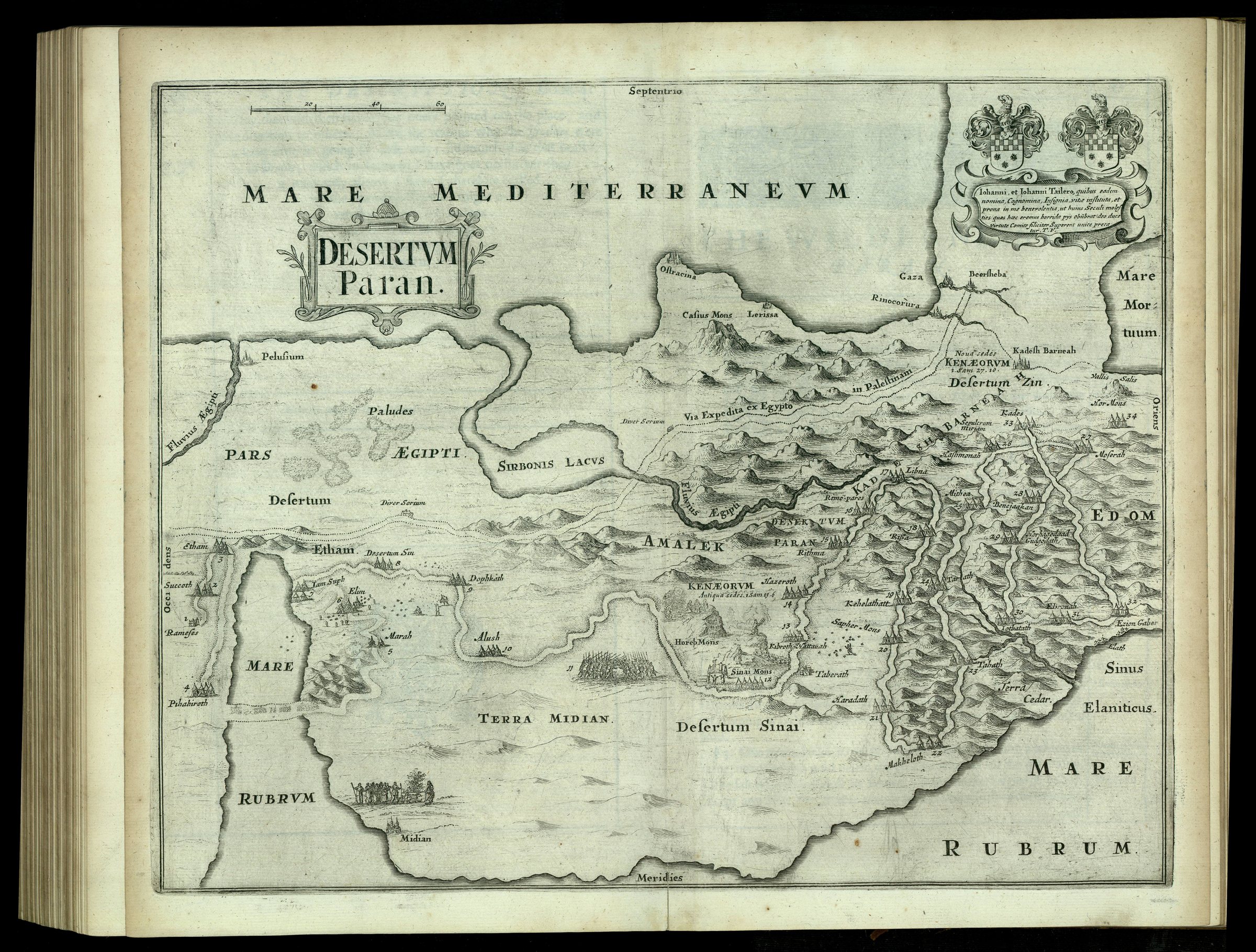
- Desert of ParanFuller prints the wilderness across the uplands between Sinai and the south of Canaan.Numbers 10:12
- Mount SinaiThe march to Paran started from the mountain of the LORD.
- Kibroth-hattaavahFuller numbers this camp 13, the first after Sinai.
- HazerothMiriam and Aaron criticized Moses at this last camp before Paran.Numbers 12:1
- RithmahFuller draws this camp of Numbers 33 inside the Desert of Paran.Numbers 33:18
- Kadesh-barneaFuller draws here the camp from which the spies were sent.Numbers 32:8
- KadesFuller numbers this camp 33 and draws the tomb of Miriam beside it.Numbers 33:36
- Mount HorIsrael went on from Kadesh to the mountain where Aaron died.Numbers 20:22
- BeershebaHagar wandered in the wilderness of Beersheba before Ishmael settled in Paran.Genesis 21:14
- EdomMoses names the mountain land of Seir beside Paran.
Thomas Fuller, Desertum Paran, A Pisgah-Sight of Palestine, 1650. Public domain; Wikimedia Commons, File:Thomas_Fuller,_Desertum_Paran_(FL199985330_2368553).jpg.
Ten places are numbered where the plate prints them, from Sinai in the south to Beersheba in the north.
From Sinai to Kadesh
Numbers 10 to 14 takes Israel from Sinai into Paran and back out again.
Israel reached Paran in the second year after the exodus, and turned back from it after the spies' report.
- The second year, second monthThe cloud lifts from the tabernacle at SinaiNumbers 10:11
- Three days outThe ark goes ahead to find a resting placeNumbers 10:33
- TaberahFire from the LORD burns among the complainersNumbers 11:3
- Kibroth-hattaavahThe people who craved other food are buriedNumbers 11:34
- HazerothMiriam waits seven days outside the campNumbers 12:15
- Into ParanThe camp moves from Hazeroth into the wildernessNumbers 12:16
- The spies sentTwelve leaders go up from ParanNumbers 13:3
- Forty days laterThe spies return from the landNumbers 13:25
- At KadeshThey show the congregation the fruit of the landNumbers 13:26
- The sentenceForty years for the forty daysNumbers 14:34
- HormahThe Amalekites and Canaanites rout the people who went up against the LORD's wordNumbers 14:45
Each row gives the step and the verse that tells it.
The spies sent, Forty days later, At Kadesh, The sentence, Hormah
Eleven days from HorebDeuteronomy 1:2; John Gill
It is an eleven-day journey from Horeb to Kadesh-barnea by way of Mount Seir.Moses measures the road the people took so long to travel.
John Gill, on Deuteronomy 1:2, reckons that Israel stayed a whole month at Kibroth-hattaavah and seven days at Hazeroth, so the eleven days give the distance and not the time Israel took.
The Holy One from Mount Paran
Deuteronomy 33 and Habakkuk 3 name Paran beside Seir and Teman.
He said: “The LORD came from Sinai and dawned upon us from Seir; He shone forth from Mount Paran and came with myriads of holy ones, with flaming fire at His right hand.Moses opens his blessing of the tribes with the LORD's coming at the giving of the law.
God came from Teman, and the Holy One from Mount Paran. Selah His glory covered the heavens, and His praise filled the earth.Habakkuk prays for God to act again as He did in the wilderness.
Jamieson, Fausset and Brown, on Habakkuk 3:3, take Teman as the country south of Judea near Edom and, following Henderson, place the mountain in Edom. John Gill, on the same verse, reads the prophet as recalling the giving of the law of Deuteronomy 33:2, and cites the Targum, the Aramaic paraphrase, to the same effect.
Paran After the Wilderness
First Samuel and First Kings both name Paran in stories of David's day.
After Samuel's death, the Berean text of 1 Samuel 25:1 sends David down to the Wilderness of Paran, still a fugitive from Saul.
Albert Barnes, on 1 Samuel 25:1, notes that the Septuagint, the ancient Greek translation, reads Maon for Paran here. He thinks it the more probable reading, since the next verse sets the story in the neighbourhood of Maon.
Hadad and his men set out from Midian and went to Paran. They took men from Paran with them and went to Egypt, to Pharaoh king of Egypt, who gave Hadad a house and land and provided him with food.This is the last verse that names Paran as a place people went to.
Adam Clarke, on 1 Kings 11:18, places this Paran in the south of Idumea, the country of Edom.
What Scripture Leaves Unsaid
Scripture leaves two things about Paran untold.
Scripture draws no border for the Wilderness of Paran, and the only camp it places inside it by name is Kadesh, in Numbers 13:26.
Genesis does not say where in Paran Ishmael lived, and Genesis 25:18 places his descendants from Havilah to Shur instead.
The Rest Refused at Paran
Hebrews reads the turn back from Paran as a warning to those who have heard the gospel.
And with whom was God angry for forty years? Was it not with those who sinned, whose bodies fell in the wilderness?The writer asks who fell in the wilderness, and the answer is the generation that heard the spies.
So we see that it was because of their unbelief that they were unable to enter.The verse names unbelief as the cause, which is the verdict of Numbers 14 on the camp at Kadesh.
Hebrews 4:1 turns the warning on its own readers, telling them that the promise of entering His rest still stands and that none of them should be deemed to have fallen short of it.
The Voices on Paran
Clement of Alexandria, John Calvin and Matthew Henry wrote on the spies Moses sent from Paran.
died 215 · Clement of Alexandria
Clement of Alexandria reads the great cluster of grapes as a sign of the Word crushed for His people.
“Later on, a sacred vine put forth a cluster of grapes that was prophetic. To those who had been led by the Educator to a place of rest after their wanderings it was a sign, for the great cluster of grapes is the Word crushed on our account. The Word desired that the ‘blood of the grape’ be mixed with water as a symbol that his own blood is an integral element in salvation.”
Clement of Alexandria · The Instructor Book 2 · on Numbers 13:24Patristic
1509 to 1564 · John Calvin
John Calvin explains why Numbers lists the spies by name.
“Their names are enumerated, in perpetual remembrance of their ignominy, except in the case of two, Joshua and Caleb; for it was just that their crime should be handed down to all ages, and that the infamy of their perfidiousness should never be blotted out, since they endeavored, as far as in them lay, to bring to naught the promise and the grace of God.”
John Calvin · Commentaries · on Numbers 13:2Reformed
1662 to 1714 · Matthew Henry
Matthew Henry turns Caleb's answer into a rule for every believer facing a hard task.
“Difficulties that lie in the way of salvation dwindle and vanish before a lively active faith in the power and promise of God. All things are possible, if they be but promised, to him that believes.”
Matthew Henry · Commentary on the Whole Bible · on Numbers 13:30Puritan
One Kadesh or Two?
Numbers 13:26 puts the spies' camp at Kadesh in Paran, and Numbers 20:1 puts the fortieth-year camp at Kadesh in Zin.
In the first month, the whole congregation of Israel entered the Wilderness of Zin and stayed in Kadesh. There Miriam died and was buried.The first month here falls in the fortieth year, since Aaron dies at Mount Hor later the same year (Numbers 33:38).
One Kadesh, reached twiceJamieson, Fausset and Brown; Albert Barnes
Jamieson, Fausset and Brown, on Numbers 20:1, call the arrival at Kadesh Israel's second, after thirty-eight years, and identify the place with Ain-el-Weibeh. Albert Barnes, on Numbers 13:26, gives the same identification for the spies' Kadesh, and on Numbers 13:21 he calls the Wilderness of Zin the north-eastern part of the Wilderness of Paran.
The objection: Numbers 33 lists the camps in order and names Kadesh only after Ezion-geber, in the fortieth-year stretch of the march.
Kadesh-barnea and a second KadeshJohn Wesley; Thomas Fuller
John Wesley, on Numbers 13:26, warns against confusing Kadesh-barnea with the Kadesh of the Wilderness of Zin, which Israel reached only in the fortieth year. Thomas Fuller takes the same view on his plate.
The objection: Joshua 15:3 runs Judah's border on to Zin and south of Kadesh-barnea, so the Kadesh of the spies already lay at Zin.
Out of the Wilderness
At Paran Israel heard a good report and a bad one about the land, and believed the bad. Christ answered the tempter in the wilderness with the words of Deuteronomy, the book Moses spoke after Paran. The text asks the reader to trust God's word about the land ahead, as Caleb did.
But because My servant Caleb has a different spirit and has followed Me wholeheartedly, I will bring him into the land he has entered, and his descendants will inherit it.The LORD sets Caleb apart from the camp that turned back at Paran.
Sources
Scripture is the Berean Standard Bible.
- James Strong, Exhaustive Concordance of the Bible (1890), Hebrew dictionary, entry 6290.
- Adam Clarke, Commentary on the Bible (1832), on Genesis 21:21.
- Adam Clarke, Commentary on the Bible (1832), on 1 Kings 11:18.
- Albert Barnes, Notes, Explanatory and Practical, on the Old and New Testaments, on Deuteronomy 33:2.
- Albert Barnes, Notes, Explanatory and Practical, on the Old and New Testaments, on 1 Samuel 25:1.
- Albert Barnes, Notes, Explanatory and Practical, on the Old and New Testaments, on Numbers 13:21 and 13:26.
- Jamieson, Fausset and Brown, Commentary Critical and Explanatory on the Whole Bible (1871), on Habakkuk 3:3.
- Jamieson, Fausset and Brown, Commentary Critical and Explanatory on the Whole Bible (1871), on Numbers 20:1.
- John Gill, Exposition of the Old Testament, on Habakkuk 3:3.
- John Gill, Exposition of the Old Testament, on Deuteronomy 1:2.
- John Wesley, Explanatory Notes upon the Old Testament (1765), on Numbers 13:26.
- Clement of Alexandria, The Instructor, Book 2, on Numbers 13:24.
- John Calvin, Commentaries, on Numbers 13:2.
- Matthew Henry, Commentary on the Whole Bible (1710), on Numbers 13:30.
Keep Studying
Read it4
Studies5
People and groups6
Places8