
Exodus 16 · Exodus 20 · Exodus 31 · Subject · Featured Study
The Sabbath in Jewish Practice
The weekly day of rest in the Torah, the prophets and the Mishnah, and how it was kept in the home, the synagogue and the gates of Jerusalem.
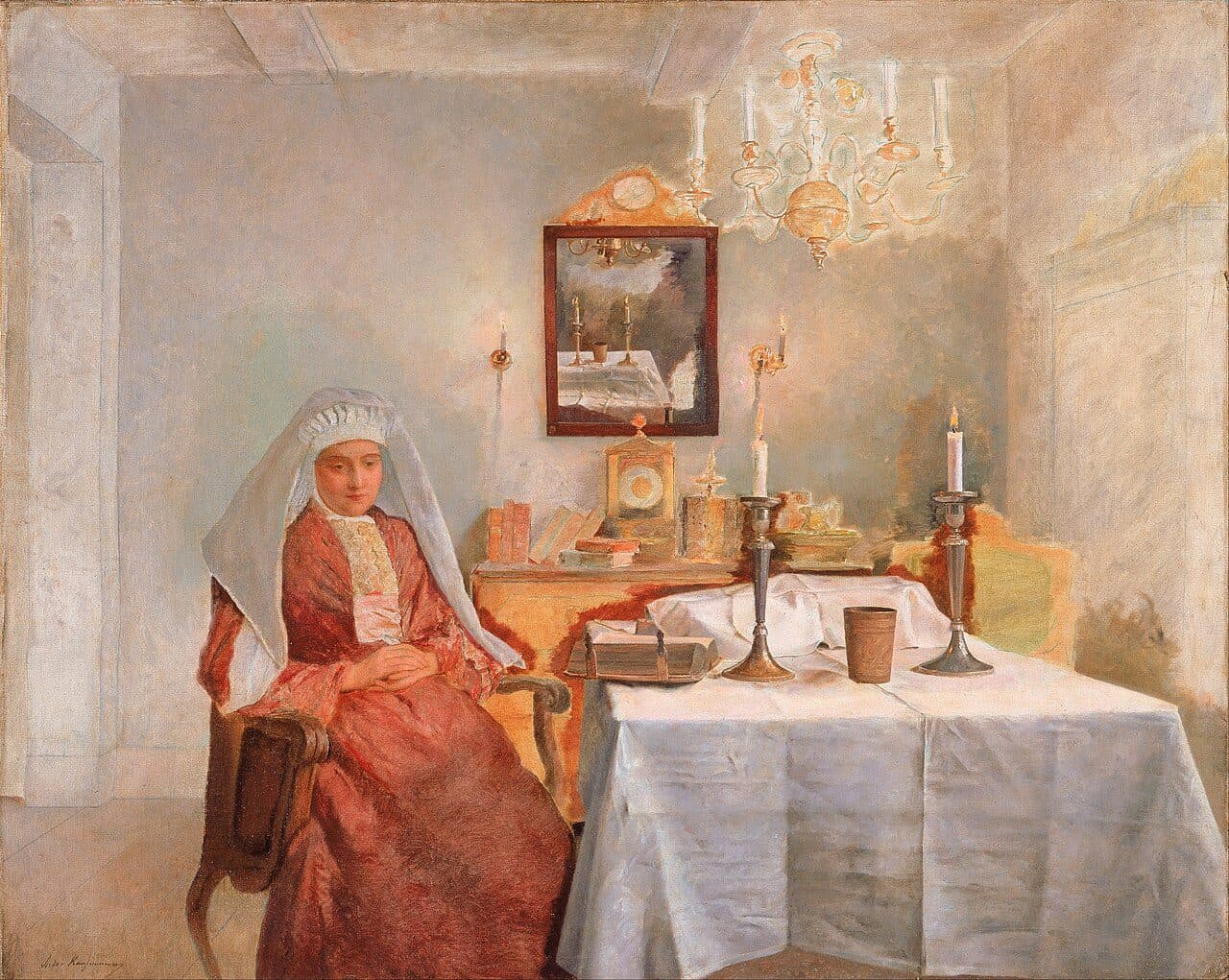
Isidor Kaufmann, Friday Evening, about 1920, oil on canvas, The Jewish Museum. Public domain by date (the painter died in 1921), via Wikimedia Commons.
THE ARTWORKKaufmann painted a woman seated beside the table laid for the Sabbath, with the two candles already burning.
On the sixth day in the wilderness the people gathered bread for two days, and on the seventh no manna fell.
Summary
The Sabbath is the seventh day, which the LORD set apart as a day of complete rest from work, and Jewish practice keeps it from evening to evening.
- Exodus gives the day with the manna before Sinai, again in the fourth word at Sinai, and again as a sign between the LORD and Israel.
- The Mishnah counts thirty-nine classes of work, and the rabbis drew them from the building of the tabernacle.
- Nehemiah shut the gates of Jerusalem against the traders, and Isaiah called the day a delight.
- Jesus called Himself Lord of the Sabbath, and the churches still differ on whether the day binds them.
Eight Passages on the Sabbath
The law in Exodus, Leviticus and Deuteronomy, then Nehemiah at the gates and the call of Isaiah
Four of the eight passages come from Exodus, and the first of them comes before the people reach Sinai.
He told them, “This is what the LORD has said: ‘Tomorrow is to be a day of complete rest, a holy Sabbath to the LORD. So bake what you want to bake, and boil what you want to boil. Then set aside whatever remains and keep it until morning.’”Moses names the day a holy Sabbath here, in the second month after Egypt.
Remember the Sabbath day by keeping it holy. Six days you shall labor and do all your work, but the seventh day is a Sabbath to the LORD your God, on which you must not do any work—neither you, nor your son or daughter, nor your manservant or maidservant or livestock, nor the foreigner within your gates. For in six days the LORD made the heavens and the earth and the sea and all that is in them, but on the seventh day He rested. Therefore the LORD blessed the Sabbath day and set it apart as holy.The fourth word grounds the day in the six days of creation.
The Israelites must keep the Sabbath, celebrating it as a permanent covenant for the generations to come. It is a sign between Me and the Israelites forever; for in six days the LORD made the heavens and the earth, but on the seventh day He rested and was refreshed.’”The seventh-day reading among the positions below rests on these verses.
For six days work may be done, but the seventh day shall be your holy day, a Sabbath of complete rest to the LORD. Whoever does any work on that day must be put to death. Do not light a fire in any of your dwellings on the Sabbath day.”These verses add the law of fire to the Sabbath law.
For six days work may be done, but the seventh day is a Sabbath of complete rest, a day of sacred assembly. You must not do any work; wherever you live, it is a Sabbath to the LORD.The Sabbath heads the list of the LORD's appointed feasts.
but the seventh day is a Sabbath to the LORD your God, on which you must not do any work—neither you, nor your son or daughter, nor your manservant or maidservant, nor your ox or donkey or any of your livestock, nor the foreigner within your gates, so that your manservant and maidservant may rest as you do. Remember that you were a slave in the land of Egypt, and that the LORD your God brought you out of there with a mighty hand and an outstretched arm. That is why the LORD your God has commanded you to keep the Sabbath day.Moses repeats the fourth word in the fortieth year, and here the rest of the servant is written into it.
When the evening shadows began to fall on the gates of Jerusalem, just before the Sabbath, I ordered that the gates be shut and not opened until after the Sabbath. I posted some of my servants at the gates so that no load could enter on the Sabbath day.This verse shows the day beginning at evening, as Jewish practice keeps it.
If you turn your foot from breaking the Sabbath, from doing as you please on My holy day, if you call the Sabbath a delight, and the LORD’s holy day honorable, if you honor it by not going your own way or seeking your own pleasure or speaking idle words,The prophet carries the rest from the keeper's work to his speech and his pleasure.
The Thirty-Nine Classes of Work
The principal classes of work forbidden on the Sabbath, as Mishnah Shabbat 7:2 names them
| Stage | The classes of work | Number |
|---|---|---|
| From the field to bread | Sowing, plowing, reaping, binding sheaves, threshing, winnowing, sorting, grinding, sifting, kneading, baking | 11 |
| From the fleece to cloth | Shearing wool, whitening it, combing it, dyeing it, spinning, setting up the warp, making two loops, weaving two threads, separating two threads, tying, untying, sewing two stitches, tearing in order to sew two stitches | 13 |
| From the hunt to leather | Hunting a deer, slaughtering it, skinning it, salting it, curing its hide, scraping it, cutting it | 7 |
| Writing | Writing two letters, erasing in order to write two letters | 2 |
| Building | Building, demolishing | 2 |
| Fire | Extinguishing a flame, lighting a flame | 2 |
| The finishing blow | Striking with a hammer | 1 |
| Carrying | Carrying from one domain to another | 1 |
- Stage
- From the field to bread
- The classes of work
- Sowing, plowing, reaping, binding sheaves, threshing, winnowing, sorting, grinding, sifting, kneading, baking
- Number
- 11
- Stage
- From the fleece to cloth
- The classes of work
- Shearing wool, whitening it, combing it, dyeing it, spinning, setting up the warp, making two loops, weaving two threads, separating two threads, tying, untying, sewing two stitches, tearing in order to sew two stitches
- Number
- 13
- Stage
- From the hunt to leather
- The classes of work
- Hunting a deer, slaughtering it, skinning it, salting it, curing its hide, scraping it, cutting it
- Number
- 7
- Stage
- Writing
- The classes of work
- Writing two letters, erasing in order to write two letters
- Number
- 2
- Stage
- Building
- The classes of work
- Building, demolishing
- Number
- 2
- Stage
- Fire
- The classes of work
- Extinguishing a flame, lighting a flame
- Number
- 2
- Stage
- The finishing blow
- The classes of work
- Striking with a hammer
- Number
- 1
- Stage
- Carrying
- The classes of work
- Carrying from one domain to another
- Number
- 1
From the Manna to the Gates of Jerusalem
The manna, the two forms of the fourth word, the tabernacle, the wood gatherer, the load and the traders at the gates
The manna and the first SabbathExodus 16
Yet on the seventh day some of the people went out to gather, but they did not find anything. Then the LORD said to Moses, “How long will you refuse to keep My commandments and instructions?The first breach of the day ends in a rebuke, and the chapter records no punishment.
Remember and observeExodus 20, Deuteronomy 5
Exodus 20:8 opens the fourth word with remember, and Deuteronomy 5:12 opens it with observe. Rashi, on Exodus 20:8, holds that the two words were spoken in one utterance.
The sign and the tabernacleExodus 31 and 35
Exodus sets the Sabbath law beside the tabernacle work twice, once at the end of the instructions and once at the start of the building. Rashi, on Exodus 31:13 and Exodus 35:2, reads the order as a rule that the building of the tabernacle does not set the Sabbath aside.
Jamieson, Fausset & Brown read the order of Exodus 31 the same way.
“They might suppose that the erection of the tabernacle was a sacred work, and that it would be a high merit, an acceptable tribute, to prosecute the undertaking without the interruption of a day's repose; and therefore the caution here given, at the commencement of the undertaking, was a seasonable admonition.”
Jamieson, Fausset & Brown · Commentary Critical and Explanatory on the Whole Bible · on Exodus 31:12 to 17Reformed
A teaching quoted in the Talmud, at Shabbat 49b, holds a man liable only for a kind of work that was done for the tabernacle. Bartenura, on Mishnah Shabbat 7:2, ties each class in the list to work done for the sanctuary.
The wood and the loadNumbers 15, Jeremiah 17
While the Israelites were in the wilderness, a man was found gathering wood on the Sabbath day. Those who found the man gathering wood brought him to Moses, Aaron, and the whole congregation, and because it had not been declared what should be done to him, they placed him in custody. And the LORD said to Moses, “The man must surely be put to death. The whole congregation is to stone him outside the camp.” So the whole congregation took the man outside the camp and stoned him to death, as the LORD had commanded Moses.The law of Exodus 31:14 is carried out here on a man found gathering wood.
This is what the LORD says: Take heed for yourselves; do not carry a load or bring it through the gates of Jerusalem on the Sabbath day. You must not carry a load out of your houses or do any work on the Sabbath day, but you must keep the Sabbath day holy, just as I commanded your forefathers.Jeremiah forbids carrying a load out of a house or through a gate, which is the last class of work in the Mishnah's list.
Nehemiah and the tradersNehemiah 13
In those days I saw people in Judah treading winepresses on the Sabbath and bringing in grain and loading it on donkeys, along with wine, grapes, and figs. All kinds of goods were being brought into Jerusalem on the Sabbath day. So I warned them against selling food on that day. Additionally, men of Tyre who lived there were importing fish and all kinds of merchandise and selling them on the Sabbath to the people of Judah in Jerusalem. Then I rebuked the nobles of Judah and asked, “What is this evil you are doing—profaning the Sabbath day? Did not your forefathers do the same things, so that our God brought all this disaster on us and on this city? And now you are rekindling His wrath against Israel by profaning the Sabbath!”Nehemiah ties the trade on the Sabbath to the disaster that fell on the city before.
Once or twice, the merchants and those who sell all kinds of goods camped outside Jerusalem, but I warned them, “Why are you camping in front of the wall? If you do it again, I will lay hands on you.” From that time on, they did not return on the Sabbath. Then I instructed the Levites to purify themselves and guard the gates in order to keep the Sabbath day holy. Remember me for this as well, O my God, and show me mercy according to Your abundant loving devotion.Nehemiah's last measures make the closing of the city lasting.
What the Text Says and What the Sages Added
The Sabbath limit, the lamp and the saving of life, each set beside a verse
THE TWO THOUSAND CUBITS
Rashi takes this verse as the support the Sages found for a limit of two thousand cubits. He says the limit is a rule of the scribes, and that the verse itself spoke of the people gathering manna.
THE LIMIT IN ACTS
Acts measures the walk from the Mount of Olives to Jerusalem by the same limit.
THE FLAME BEFORE NIGHTFALL
The verse forbids lighting a fire on the day. In the Mishnah's rule no flame is kindled once it is uncertain whether night has fallen.
THE SAVING OF LIFE
The Mishnah, in Yoma 8:6, rules that whatever threatens to endanger life supersedes the Sabbath. Jesus argues from a sheep that falls into a pit and is lifted out on that day.
The Day in the Home and the Synagogue
The evening start, the three things said on the eve and the reading in the synagogue
It will be a Sabbath of complete rest for you, and you shall humble yourselves. From the evening of the ninth day of the month until the following evening you are to keep your Sabbath.”The rule of evening to evening is stated here for the Day of Atonement, which the verse calls a Sabbath.
“The Jews are supposed to begin every day, and consequently their sabbaths, at the evening, in remembrance of the creation, as Christians generally begin their days and sabbaths with the morning in memory of Christ's resurrection.”
John Wesley · Explanatory Notes upon the Old Testament · on Leviticus 23:32Evangelical
The three things said on the eveMishnah Shabbat 2:7
On the eve of the Sabbath, says the Mishnah in Shabbat 2:7, the householder asks at dusk whether the tithe is separated and the eruv prepared. Then he tells the household to light the lamps.
The reading in the synagogueActs 15, Luke 4
For Moses has been proclaimed in every city from ancient times and is read in the synagogues on every Sabbath.”The weekly reading of the Torah was already called ancient in the apostles' day.
Then Jesus came to Nazareth, where He had been brought up. As was His custom, He entered the synagogue on the Sabbath. And when He stood up to read,This verse shows the synagogue reading kept on the Sabbath in Galilee in the time of Jesus.
The Words of the Sabbath
Five words from the lexicon, each in a verse where it stands
SHABBAT, SABBATH (HEBREW, H7676)
The lexicon gives intermission, and specifically the Sabbath, and counts 110 uses. Here the word stands joined to the word for day.
SHAVAT, TO REST (HEBREW, H7673)
The lexicon gives to repose or desist from exertion, the verb used when the people rested on the seventh day.
SHABBATON, COMPLETE REST (HEBREW, H7677)
The lexicon gives a sabbatism or special holiday. In this verse it follows shabbat, and the Berean text renders the pair a Sabbath of complete rest.
OT, SIGN (HEBREW, H226)
The lexicon gives a signal, as a flag, a monument or evidence, and here it names the Sabbath as the sign between the LORD and Israel.
MELAKHAH, WORK (HEBREW, H4399)
The lexicon gives employment or work. The same word names the workmanship of the tabernacle in Exodus 31:3 and the work forbidden on the Sabbath in this verse.
What the Torah Leaves Unsaid
Three questions the verses leave open
Which kinds of work are forbiddenExodus 34:21
The Torah forbids work on the Sabbath and names only a few kinds of it, among them gathering the manna, plowing and harvest, lighting a fire and gathering wood.
Six days you shall labor, but on the seventh day you shall rest; even in the seasons of plowing and harvesting, you must rest.The law holds even in the busiest seasons of the farmer's year.
Who kept the day before the mannaGenesis 2:2 to 3
Genesis 2 records that God rested on the seventh day and blessed it, and Genesis names no one who kept the day before the manna fell in Exodus 16.
And by the seventh day God had finished the work He had been doing; so on that day He rested from all His work. Then God blessed the seventh day and sanctified it, because on that day He rested from all the work of creation that He had accomplished.The fourth word points back to this rest in Exodus 20:11.
What the sacred assembly didLeviticus 23:3, Numbers 28:9 to 10
Leviticus 23:3 calls the day a sacred assembly and does not say what the assembly did.
On the Sabbath day, present two unblemished year-old male lambs, accompanied by a grain offering of two-tenths of an ephah of fine flour mixed with oil, as well as a drink offering. This is the burnt offering for every Sabbath, in addition to the regular burnt offering and its drink offering.The priests' work at the tabernacle went on through the day of rest.
The Son of Man and the Sabbath
Mark 2 and Colossians 2
Then Jesus declared, “The Sabbath was made for man, not man for the Sabbath. Therefore, the Son of Man is Lord even of the Sabbath.”Jesus gives this answer when the Pharisees fault His disciples for picking heads of grain on the Sabbath.
Therefore let no one judge you by what you eat or drink, or with regard to a feast, a New Moon, or a Sabbath. These are a shadow of the things to come, but the body that casts it belongs to Christ.The three Christian readings below turn on how this verse is read.
Two Teachers on the Sabbath
Two readers of Exodus 16, one of the third century and one of the eighteenth
Origen asks whether the command to stay in one's place can be kept to the letter.
“Moreover in regard to the celebrated sabbath, a careful reader will see that the command, ‘You shall sit each one in your dwellings; let none of you go out from his place on the sabbath day,’ is an impossible one to observe literally, for no living creature could sit for a whole day and not move from his seat.”
Origen of Alexandria · On First Principles 4.3.2 · on Exodus 16:29Patristic
Wesley answers when the Sabbath was first kept.
“Here is a plain intimation of the observing a seventh day sabbath, not only before the giving of the law upon Mount Sinai, but before the bringing of Israel out of Egypt and therefore from the beginning.”
John Wesley · Explanatory Notes upon the Old Testament · on Exodus 16:23Evangelical
Whether the Sabbath Binds the Church
The Westminster Confession, John Calvin and Joseph Bates on the fourth word
The first day as the Christian SabbathThe Westminster Confession of Faith, chapter 21, sections 7 and 8
The Westminster Confession holds that one day in seven is appointed by a moral and perpetual commandment. It says the day was the last of the week until the resurrection of Christ and the first day of the week from then on, the Lord's day, kept as the Christian Sabbath.
Its proof texts for the keeping of the day include Exodus 16 and 31, Isaiah 58:13 and Nehemiah 13:15 to 22.
The objection is that the New Testament never calls the first day a Sabbath.
On the Lord’s day I was in the Spirit, and I heard behind me a loud voice like a trumpet,The confession takes the name of the Lord's day from this verse.
The Sabbath fulfilled in ChristJohn Calvin, Institutes of the Christian Religion, book 2, chapter 8, sections 28 to 34
Calvin holds that the ceremonial part of the commandment was abolished at the coming of Christ, whose resurrection is the end and accomplishment of the rest the old Sabbath typified. He keeps stated days for hearing the Word, the breaking of bread and public prayer, and rest for servants and labourers.
The objection is that Exodus 31:17 calls the Sabbath a sign forever, and Genesis 2:3 blesses the seventh day before there was an Israel.
The seventh day kept stillJoseph Bates, The Seventh Day Sabbath, a Perpetual Sign, 1846
Bates holds that the Bible records no abrogation of the Sabbath, and he reads Exodus 31:16 to 17 as a perpetual covenant. He counts the seventh day among the things to be restored before the second coming of Christ.
The objection, which Bates sets out and answers himself, comes from Colossians 2 and Romans 14.
One person regards a certain day above the others, while someone else considers every day alike. Each one should be fully convinced in his own mind.Paul leaves the regard of one day above another to each believer's own mind.
Books on the Sabbath
The Mishnah, Rashi, Calvin and Bates, each free to read online
The Mishnah, tractate Shabbat
The rabbis of the Mishnah · about 200
Tractate Shabbat sets out the rules of the day as the rabbis taught them.
Read it on SefariaCommentary on the Torah
Rashi · eleventh century
Rashi gives a rabbinic reading of the Sabbath verses of Exodus, often with its source in the Mekhilta.
Read it on SefariaInstitutes of the Christian Religion
John Calvin · 1559
Book 2, chapter 8 treats the fourth commandment and the Lord's day.
Read it on CCELThe Seventh Day Sabbath, a Perpetual Sign
Joseph Bates · 1846
Bates argues from both Testaments for keeping the seventh day.
Read it on Project GutenbergA Sabbath Rest Remains
In Exodus 16:29 the LORD says He has given Israel the Sabbath. The reader is asked to come to Christ for the rest the seventh day pointed to.
There remains, then, a Sabbath rest for the people of God. For whoever enters God’s rest also rests from his own work, just as God did from His.The letter reads the rest of the seventh day as the rest of all who enter God's rest.
Come to Me, all you who are weary and burdened, and I will give you rest.Hebrews names the rest, and this verse names the One who gives it.
Keep studying
Read it5
Studies6
Doctrines7
Peoples and groups1