
Numbers 9 · 2 Chronicles 30 · Subject · Featured Study
The Second Passover
Numbers 9 read beside Exodus 12, Numbers 19 and the Passover of King Hezekiah, with the readings of Jewish and Christian commentators.
A man made unclean by a dead body could not eat the Passover lamb, so the LORD gave him the same meal one month later.
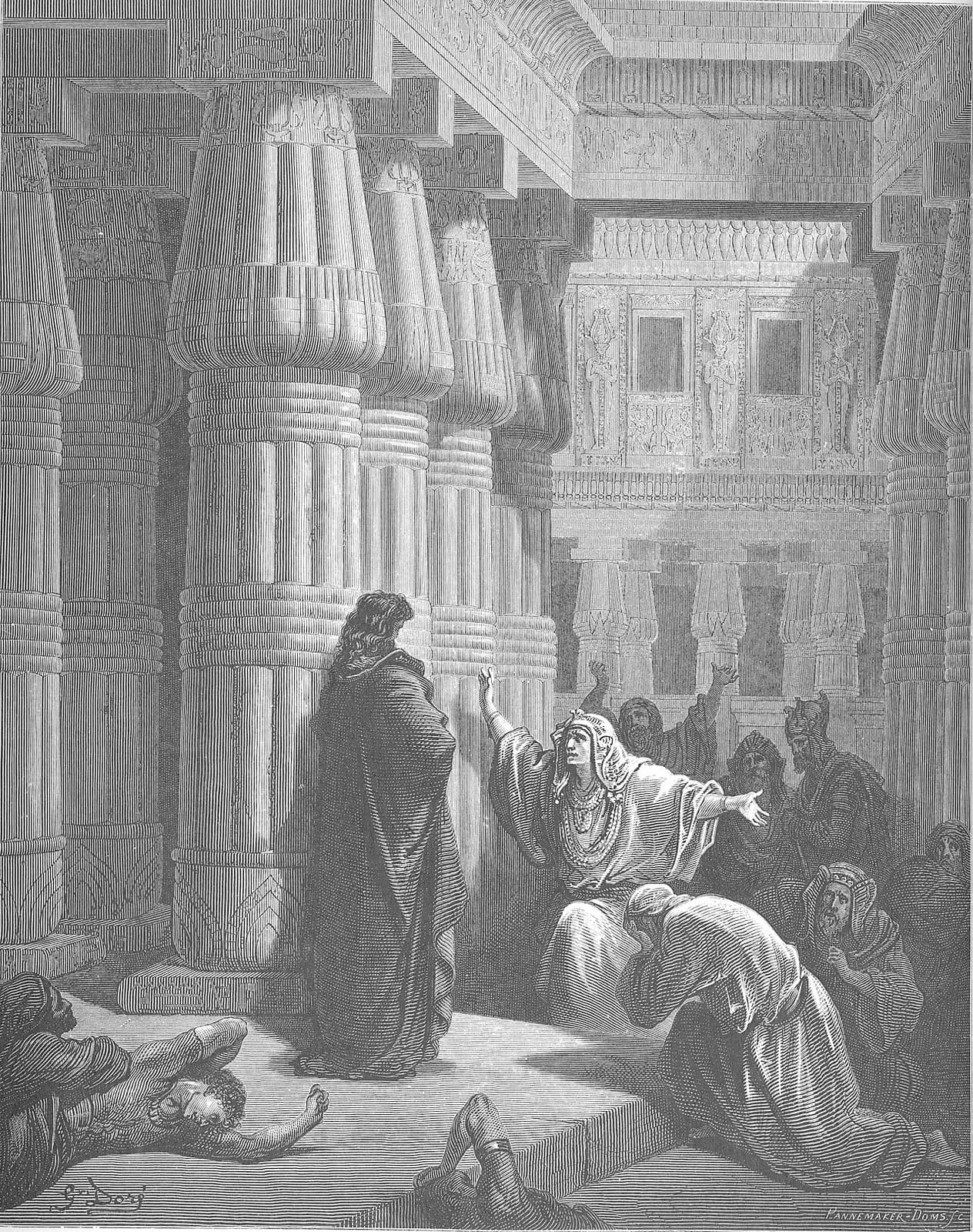
Gustave Doré, The Egyptians Ask Moses to Depart, wood engraving, 1866, from the English edition of La Grande Bible de Tours. Public domain by date (Doré died in 1883).
THE ARTWORKDoré engraved the night of the first Passover, when Pharaoh summoned Moses and Aaron and told them to leave Egypt, as Exodus 12:31 to 33 tells it. Numbers 9 sets the yearly memorial of that night and makes room for those who could not keep it on its date.
Summary
The second Passover is the law of Numbers 9 for an Israelite who was unclean or away from home on the fourteenth day of the first month.
- Men defiled by a corpse asked Moses at Sinai why they should be shut out, and the LORD answered them with a law for every generation.
- The later Passover kept every statute of the first, and a clean man at home who neglected the first date was cut off.
- King Hezekiah kept the Passover in the second month because the priests were not ready and the people were not gathered at the regular time.
- Many from the northern tribes ate it unclean, and Hezekiah prayed for them, and the LORD healed the people.
The Law of the Second Month
Three passages of Numbers 9, from the Passover at Sinai to the law for the unclean and the traveller
Numbers 9 opens one year after the night in Egypt, with Israel still camped in the Wilderness of Sinai.
“The Israelites are to observe the Passover at its appointed time. You are to observe it at the appointed time, at twilight on the fourteenth day of this month, in accordance with its statutes and ordinances.”The LORD holds the Passover to the day and hour Exodus 12:6 had fixed, before any exception is given.
But there were some men who were unclean due to a dead body, so they could not observe the Passover on that day. And they came before Moses and Aaron that same day and said to Moses, “We are unclean because of a dead body, but why should we be excluded from presenting the LORD’s offering with the other Israelites at the appointed time?”Moses had no ruling for their case and told them to wait while he asked the LORD, as Numbers 9:8 records.
“Tell the Israelites: ‘When any one of you or your descendants is unclean because of a dead body, or is away on a journey, he may still observe the Passover to the LORD. Such people are to observe it at twilight on the fourteenth day of the second month. They are to eat the lamb, together with unleavened bread and bitter herbs;These two verses are the whole law of the second Passover, and they bind Israel's descendants as well as the men at Sinai.
The Two Dates and the Couriers
The days of Numbers 9 and 2 Chronicles 29 to 30 in the order of the religious year, and the places of Hezekiah's call to all Israel
Numbers 9 gives the hindered a second date one month after the first, and Hezekiah kept his Passover on that later date.
- Hezekiah's priests consecrate the templeThe work ran from the first to the sixteenth day of the first month, two days past the regular Passover date.2 Chronicles 29:17
- The Passover at SinaiIsrael kept it at twilight on the fourteenth day of the first month of the second year.Numbers 9:5
- The unclean men come to MosesOn that same fourteenth day they asked why they should be excluded.Numbers 9:7
- The second Passover in the lawThe unclean and the traveller keep it at twilight on the fourteenth day of the second month.Numbers 9:11
- Hezekiah's PassoverThe lambs were slaughtered in Jerusalem on the fourteenth of the second month.2 Chronicles 30:15
- The Feast of Unleavened BreadThe feast ran seven days from the fifteenth of the month, the day Leviticus 23:6 sets, and was kept with great joy.2 Chronicles 30:21
- Seven more daysThe whole assembly agreed to keep a second week after the seven days of the feast.2 Chronicles 30:23
Seven numbered stops in the order of the days of the religious year, from Numbers 9 and 2 Chronicles 29 to 30, each with its verse.
Hezekiah's letters went out from Jerusalem to all Israel from Beersheba to Dan, and men of five northern tribes came to keep the Passover.
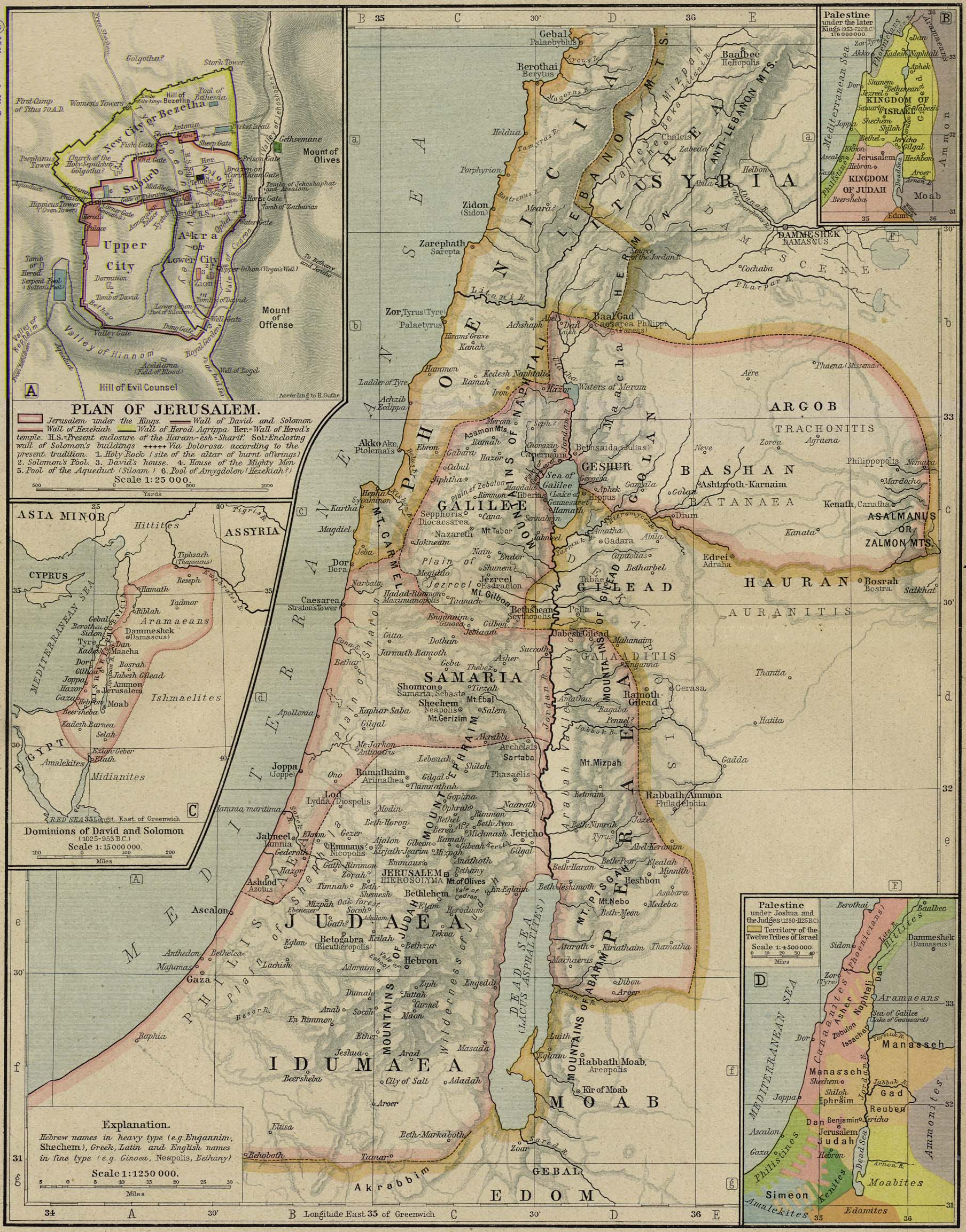
- 1Jerusalem, The king's letters went out from here, and a very great assembly kept the feast here in the second month. Jerusalem held the house of the LORD, where the Passover had to be kept. 2 Chronicles 30:13
- 2Beersheba, The proclamation was to start from this town at the far south of the land. The pair of names marks the whole land from south to north, as in Judges 20:1. 2 Chronicles 30:5
- 3Dan, The proclamation was to reach this town at the far north of the land. Rashi on this verse reads the two names as the bounds of the ten northern tribes. 2 Chronicles 30:5
- 4Shechem, for Ephraim and Manasseh, The couriers went from city to city through Ephraim and Manasseh and were mocked, and some from Manasseh came. Joshua 20:7 sets Shechem in the hill country of Ephraim, and Joshua 17:7 runs the border of Manasseh near Shechem. 2 Chronicles 30:10
- 5Mount Tabor, for Zebulun, The couriers went as far as Zebulun, and some from Zebulun came. Joshua 19:12 runs the border of Zebulun along Chisloth-tabor. 2 Chronicles 30:11
- 6Shunem, for Issachar, Many from Issachar ate the Passover without purifying themselves. Joshua 19:18 names Shunem in the territory of Issachar. 2 Chronicles 30:18
- 7Tyre, for Asher, Some from Asher humbled themselves and came to Jerusalem. Joshua 19:29 turns the border of Asher toward the fortified city of Tyre. 2 Chronicles 30:11
Base map: Reference map of ancient Palestine, Rand McNally reference map (1926), public domain. Each place stands at its place page's coordinates, set on the plate by Jerusalem and Damascus, as the plate prints them.
Seven numbered places on an atlas plate of the land. Each northern tribe is marked by one place that the book of Joshua sets in its land or on its border.
Hezekiah's Passover
2 Chronicles 30 in five scenes, from the letters to the fourteen days of joy
Hezekiah opened the doors of the temple in the first month of his reign, and the Passover he called followed the cleansing of the house.
The letters to Ephraim and Manasseh2 Chronicles 30:1 to 9
So the couriers went throughout Israel and Judah with letters from the king and his officials, which read: “Children of Israel, return to the LORD, the God of Abraham, Isaac, and Israel, so that He may return to those of you who remain, who have escaped the grasp of the kings of Assyria.The invitation is a call to repentance, with a promise of mercy for kin held captive in 2 Chronicles 30:9.
Henry hears in the invitation a king who set aside the quarrel between the two kingdoms for the sake of the worship of God.
“‘Let them take whom they will for their king,’ says Hezekiah, ‘so they will but take him for their God.’ The matters in difference between Judah and Israel, either upon a civil or sacred account, shall not hinder but that if the people of Israel will sincerely return to the Lord their God Hezekiah will bid them as welcome to the passover as any of his own subjects.”
Matthew Henry · Commentary on the Whole Bible · on 2 Chronicles 30:1Puritan
The couriers mocked and the few who came2 Chronicles 30:10 to 12
And the couriers traveled from city to city through the land of Ephraim and Manasseh as far as Zebulun; but the people scorned and mocked them. Nevertheless, some from Asher, Manasseh, and Zebulun humbled themselves and came to Jerusalem.These verses answer who came from far off to a Passover kept on the date Numbers 9 gave the traveller.
Wesley notes that about six years after this refusal the ten tribes were carried away captive. Rashi on 2 Chronicles 30:1 places the letters in the first year of Hezekiah, before the northern kingdom fell.
And at the end of three years, the Assyrians captured it. So Samaria was captured in the sixth year of Hezekiah, which was the ninth year of Hoshea king of Israel.This verse dates the fall of Samaria by the years of Hezekiah's reign.
The altars thrown into the Kidron2 Chronicles 30:13 to 16
They proceeded to remove the altars in Jerusalem and to take away the incense altars and throw them into the Kidron Valley. And on the fourteenth day of the second month they slaughtered the Passover lamb. The priests and Levites were ashamed, and they consecrated themselves and brought burnt offerings to the house of the LORD.The city was cleansed before the feast, and the priests' shame shows that the people had gone ahead of them.
Henry takes the clearing of the altars as the pattern for the gospel passover, which is prepared for by casting away spiritual idolatries.
The Levites slaughter for the unclean2 Chronicles 30:17
Since there were many in the assembly who had not consecrated themselves, the Levites were in charge of slaughtering the Passover lambs for every unclean person to consecrate the lambs to the LORD.Here the Levites stood in for worshippers who could not offer their own lambs.
Seven more days of joy2 Chronicles 30:21 to 27
So there was great rejoicing in Jerusalem, for nothing like this had happened there since the days of Solomon son of David king of Israel.The Chronicler measures the feast against the days of Solomon, when Israel last worshipped at one temple as one kingdom.
Barnes calls the added week a voluntary addition to the requirements of the Law.
What the Text Says of the Second Passover
Three things often said of the later date, each tested by a verse
ANY ISRAELITE COULD CHOOSE THE LATER DATE
The law cuts off the man who is clean and at home and still fails to keep the Passover at its appointed time.
THE LATER DATE WAS FOR THE UNCLEAN ALONE
The LORD names the man who is away on the road beside the man defiled by a dead body.
THE LATER PASSOVER WAS A LIGHTER RITE
Numbers requires the lamb, the unleavened bread and the bitter herbs, with no bone broken and nothing left until morning.
The Calendar and the Uncleanness
The first month, the uncleanness of the dead, and the Mishnah's rules for the second Passover
The law of Numbers 9 rests on the calendar of Exodus 12 and on the law of uncleanness in Numbers 19.
The head of the yearExodus 12:2
“This month is the beginning of months for you; it shall be the first month of your year.Both dates of Numbers 9 are counted from the month this verse makes first.
Henry explains why the later Passover kept the same day of its month.
“This secondary passover was to be kept on the same day of the month with the first, because the ordinance was a memorial of their deliverance on that day of the month.”
Matthew Henry · Commentary on the Whole Bible · on Numbers 9:10 to 11Puritan
The uncleanness of the deadNumbers 19:11 to 12
The men at Sinai were stopped by the uncleanness that Numbers 19 removes with water mixed with the ashes of the red heifer. The same uncleanness cancels the days a Nazirite has already kept, by Numbers 6:9 to 12.
Whoever touches any dead body will be unclean for seven days. He must purify himself with the water on the third day and on the seventh day; then he will be clean. But if he does not purify himself on the third and seventh days, he will not be clean.These two verses set the week of cleansing that stood between the men of Numbers 9:6 and the lamb.
The Mishnah's rules for the later dateMishnah Pesachim 9:1 to 3
The Mishnah, compiled about AD 200, extends the second Passover to one who forgot or was prevented. It holds that only the impure and the far off escape being cut off if they miss the second date as well. Rabbi Akiva counts as far off anyone beyond the town of Modiin, and Rabbi Eliezer anyone beyond the threshold of the temple court. At the second Passover leaven may stay in the house and no Hallel is sung while the lamb is eaten.
Rashi on Numbers 9:10 notes the dot written over the last letter of the Hebrew word for distant, read by the rabbis to mean that the road need not be long.
Barnes reports the later Jewish name for the feast and the time it gave.
“The later Jews speak of this as the ‘little Passover.’ Coming, as it did, a month after the proper Passover, it afforded ample time for a man to purify himself from legal defilement, as also to return from any but a very distant journey. Compare Hezekiah’s act 2Ch 30:1-3.”
Albert Barnes · Notes, Explanatory and Practical, on the Old and New Testaments (1832-1869) · on Numbers 9:11Evangelical
What the Text Leaves Unsaid
Two questions Numbers 9 leaves open
Numbers 9 does not name the unclean men, and it records no Passover kept on the second date before the camp moved on.
Who the unclean men wereSukkah 25a to 25b
In the Talmud Rabbi Yosei the Galilean names them as the bearers of Joseph's coffin, and Rabbi Akiva as Mishael and Elzaphan, who carried out the bodies of Nadab and Abihu. Rabbi Yitzhak answers that either group would have been clean again by the fourteenth day, and holds that they were men whose seventh day after a burial fell on the Passover itself.
Barnes calls Mishael and Elzaphan the probable men, and Clarke says only that the defilement probably came from a burial.
Moses summoned Mishael and Elzaphan, sons of Aaron’s uncle Uzziel, and said to them, “Come here; carry the bodies of your cousins outside the camp, away from the front of the sanctuary.” So they came forward and carried them, still in their tunics, outside the camp, as Moses had directed.These verses are the burial Rabbi Akiva and Barnes point to.
Whether the later date was kept that yearNumbers 10:11
Rashi, after Sifrei Bamidbar, says the generation in the wilderness offered only this one Passover in forty years.
On the twentieth day of the second month of the second year, the cloud was lifted from above the tabernacle of the Testimony,The march began six days after the second Passover date, so any keeping of that date fell while the camp was still at Sinai.
Atonement for Everyone Who Seeks God
Hezekiah's prayer for the unclean, and the Passover in John 18
Hezekiah's assembly met a case the law of Numbers 9 had not foreseen.
A large number of the people—many from Ephraim, Manasseh, Issachar, and Zebulun—had not purified themselves, yet they ate the Passover, contrary to what was written. But Hezekiah interceded for them, saying, “May the LORD, who is good, provide atonement for everyone who sets his heart on seeking God—the LORD, the God of his fathers—even if he is not cleansed according to the purification rules of the sanctuary.” And the LORD heard Hezekiah and healed the people.Hezekiah's prayer and the LORD's healing are the Chronicler's answer to that case.
Rashi reads the words contrary to what was written as eating in uncleanness against the law. Henry calls it a defect in the purification of the sanctuary that needed pardoning grace, and Clarke holds the men excusable because they came from lands wholly given to idolatry. Wesley sets the inward purity of a heart prepared to seek God against the outward purification the men lacked, and Gill, after Kimchi, takes the healing to mean that the LORD forgave them.
John 18 shows the same care for cleanness before the Passover on the morning of the crucifixion.
Then they led Jesus away from Caiaphas into the Praetorium. By now it was early morning, and the Jews did not enter the Praetorium, to avoid being defiled and unable to eat the Passover.The men who handed Jesus over guarded their fitness to eat the Passover while the true Passover lamb was led to His death.
Two Teachers on the Law of Numbers 9
John Calvin and Matthew Henry
Calvin names the bind the men were in, between two commands of God.
“Hence arose a kind of discrepancy; because, whilst the unclean were not permitted to approach the sacred feast, it was sinful to neglect this exercise of religion. Even Moses confessed that he was perplexed as to this matter, since he sought for time to inquire of God.”
John Calvin · Commentaries · on Numbers 9:6Reformed
Henry reads the stranger's share in the Passover as a sign of the gospel for every nation.
“As then there was one law, so in the days of the Messiah there should be one gospel, for the stranger and for him that was born in the land; for in every nation he that fears God and works righteousness is accepted of him, and this was a truth before Peter perceived it, Acts x.”
Matthew Henry · Commentary on the Whole Bible · on Numbers 9:14Puritan
Why Hezekiah Kept the Second Month
Three readings of 2 Chronicles 30:2 to 3 and the objection to each
He applied the law of Numbers 9 to the whole peopleAlbert Barnes, Notes, on 2 Chronicles 30:2; Rabbi Shimon ben Yehuda in Sanhedrin 12b
Barnes holds that Hezekiah and his counsellors extended the permission of the law to the whole nation, because the cleansing of the temple ran past the fourteenth day of the first month. In the Talmud Rabbi Shimon ben Yehuda, in the name of Rabbi Shimon, says that Hezekiah moved the people to keep the second Passover.
The objection: in the Talmud Rav Ashi holds that the feast is not moved to the second month when most of the people are impure (Sanhedrin 12b).
For the king and his officials and the whole assembly in Jerusalem had decided to keep the Passover in the second month, since they had been unable to observe it at the regular time, because not enough priests had consecrated themselves and the people had not been gathered in Jerusalem.These verses give the decision of the king and the assembly and the cause of the delay.
Need set the appointed time asideMatthew Henry, John Wesley and Adam Clarke, on 2 Chronicles 30:2 to 3
Wesley calls the second month against the common rule, and Clarke holds that the only other course was to wait a whole year and lose the zeal of the reform.
“Whereupon they resolved to keep the passover in the second month. Let the circumstance give way to the substance, and let not the thing itself be lost upon a nicety about the time. It is good striking while the iron is hot, and taking people when they are in a good mind.”
Matthew Henry · Commentary on the Whole Bible · on 2 Chronicles 30:3Puritan
The objection: Barnes answers that the Chronicler's two reasons, priests not yet consecrated and a people not yet gathered, fall under the permission Numbers 9 gives.
He added a month to the yearRabbi Yehuda in Sanhedrin 12a; the baraita of Berakhot 10b
Rabbi Yehuda says that Hezekiah made the year a leap year because of uncleanness and then prayed for mercy. The baraita in Berakhot 10b says he added a second Nisan in Nisan itself, after the time to add a month had passed, and that the Sages of his day did not agree with him.
The objection: 2 Chronicles 30:2 and 30:15 call the month the second month, and Gill, after the Targum, names it Ijar.
Books on the Second Passover
Two works to read whole
Rashi on Numbers
Rashi, in the English of M. Rosenbaum and A. M. Silbermann · 1929 to 1934
Rashi explains the words of Numbers 9 and names the midrash each reading comes from.
Read Rashi on Numbers 9 at SefariaMishnah Pesachim
The Mishnah, in the William Davidson English edition · about AD 200
Chapter 9 of the tractate sets out who keeps the second Passover and how it differs from the first.
Read Mishnah Pesachim 9 at SefariaChrist Our Passover
Numbers 9 held the feast open for those whom death or distance had kept away. The text asks every reader to come to Christ, the lamb that feast pointed to.
Get rid of the old leaven, that you may be a new unleavened batch, as you really are. For Christ, our Passover lamb, has been sacrificed. Therefore let us keep the feast, not with the old bread, leavened with malice and wickedness, but with the unleavened bread of sincerity and of truth.Paul applies the feast to the church at Corinth.
Keep studying
Places2
Doctrines9
Peoples and groups2