
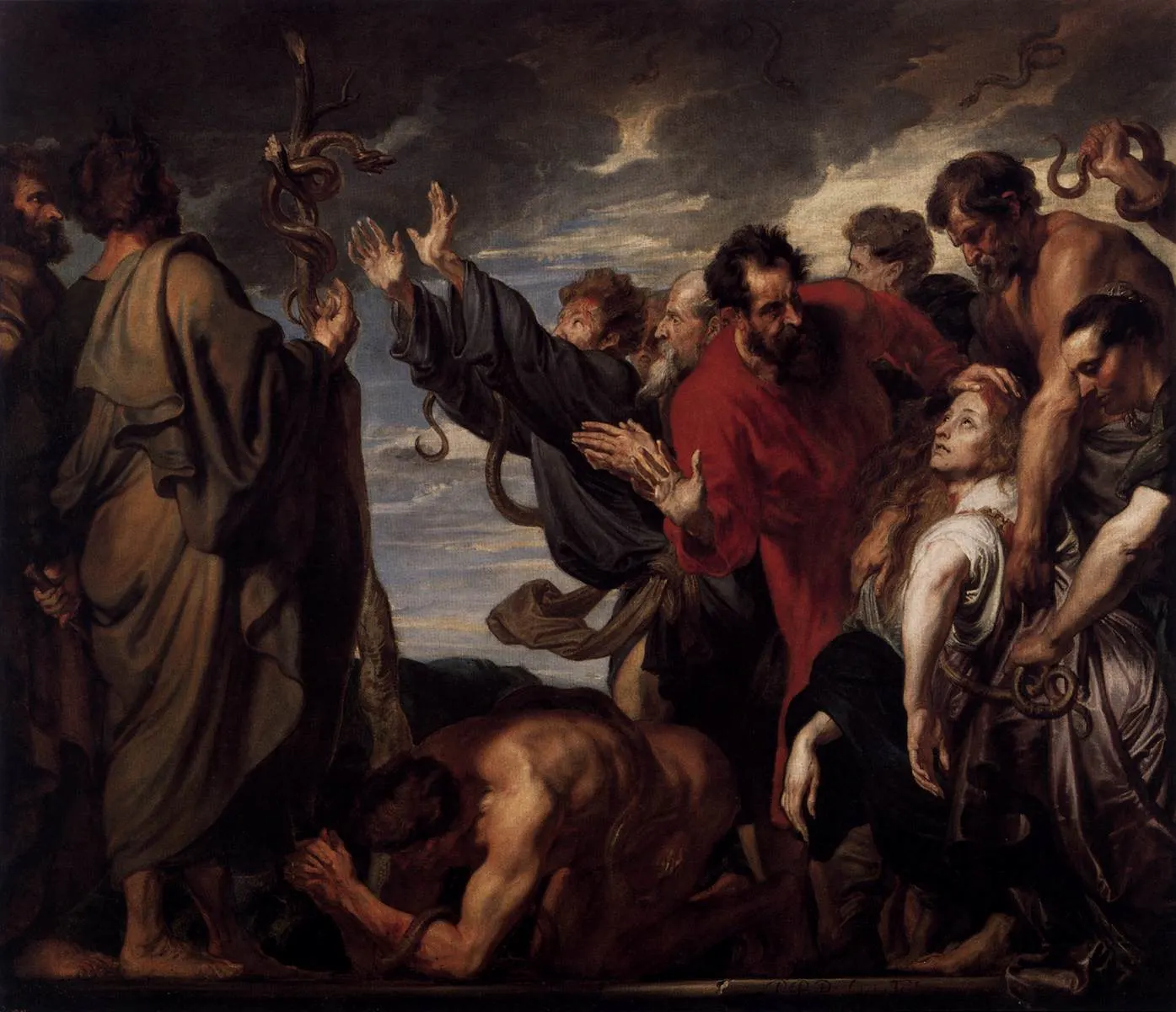
The Brazen Serpent, Anthony van Dyck, 1618 to 1620. Public domain.
Old Testament · Book 4 of 66
Numbers
Numbers records Israel's forty years in the wilderness, from Sinai to the plains of Moab. The people are counted twice, in chapters 1 and 26, and the generation that refused to enter Canaan dies in the desert.
Numbers records Israel's forty years in the wilderness, from Sinai to the plains of Moab. The people are counted twice, in chapters 1 and 26, and the generation that refused to enter Canaan dies in the desert.
What is Numbers about?
Numbers opens at Sinai in the second year after Egypt, where the LORD has the fighting men counted and the tribes camped around the tent (1:1; 2:2). The camp sets out for the land, but at Kadesh the people refuse to go in, and the LORD asks how long they will refuse to believe in him (14:11). He sentences that generation to forty years in the wilderness, until the last of them has died (14:33). Miriam and Aaron die on the road. The book ends with the next generation counted and waiting on the plains of Moab, across the Jordan from Jericho (36:13).
All 36 chapters
Every chapter of the book, in one grid. Each cell opens that chapter.
- CampNumbers 1 to 10
- MarchNumbers 11 to 12
- KadeshNumbers 13 to 19
- Fortieth yearNumbers 20 to 25
- Plains of MoabNumbers 26 to 36
Two classes: the four slate steps are the first generation, from the camp at Sinai to the fortieth year, and green is the second generation on the plains of Moab. Every cell opens that chapter's Study level.
Who wrote it, where, when, for whom, and why?
Numbers says that at the LORD's command Moses recorded the stages of Israel's journey (33:2). The book opens with the LORD speaking to Moses in the Tent of Meeting in the Wilderness of Sinai (1:1) and closes with the commandments the LORD gave the Israelites through Moses on the plains of Moab (36:13).
At the LORD’s command, Moses recorded the stages of their journey. These are the stages listed by their starting points:
Numbers 33:2, Berean Standard Bible.
The rest of Scripture remembers these years. Deuteronomy opens in the fortieth year (Deuteronomy 1:3) and counts thirty-eight years from Kadesh to the Brook of Zered, until that whole generation of fighting men had died (Deuteronomy 2:14). Caleb says the LORD kept him alive forty-five years while Israel wandered in the wilderness (Joshua 14:10). The psalm says God was angry with that generation for forty years (Psalm 95:10). Paul writes that these things happened as examples and were written down as warnings for us (1 Corinthians 10:6 and 10:11), and Hebrews asks with whom God was angry for forty years (Hebrews 3:17).
The book opens in the Wilderness of Sinai (1:1). The cloud lifts and settles in the Wilderness of Paran (10:12), the spies return to Kadesh (13:26), and the congregation is at Kadesh again in the first month when Miriam dies (20:1). From there Israel goes around Edom and camps on the plains of Moab by the Jordan, across from Jericho (22:1), where the book ends (36:13).
The text keeps its own dates. The first count is taken on the first day of the second month of the second year after Egypt (1:1), and Aaron dies on the first day of the fifth month of the fortieth year (33:38).
The book is written for the congregation the LORD had counted, the men of twenty and older by the houses of their fathers (26:2), and for the children who would inherit the land their fathers refused.
The book gives its own reasons. The LORD brought Israel out of Egypt to be their God (15:41). He asks how long the people will refuse to believe in him despite all his signs (14:11), and Balaam must say that God is not a man, that he should lie or change his mind (23:19). Paul reads the book the same way: these things were written down as warnings for us (1 Corinthians 10:11).
Numbers stands in the wilderness between Egypt and Canaan, among peoples with kings and gods of their own. Edom refuses Israel passage (20:21), the Canaanite king of Arad attacks (21:1), and Sihon of the Amorites and Og of Bashan come out to fight (21:23 and 21:33). Balak king of Moab sends to Pethor by the Euphrates for a diviner to curse Israel (22:5 and 22:7), and at Peor the people join in the worship of Baal (25:3).
Sources. Numbers 1:1, 10:12, 13:26, 14:11, 15:41, 20:1, 20:21, 21:1, 21:23, 21:33, 22:1, 22:5, 22:7, 23:19, 25:3, 26:2, 33:2, 33:38 and 36:13; Deuteronomy 1:3 and 2:14; Joshua 14:10; Psalm 95:10; 1 Corinthians 10:6 and 10:11; Hebrews 3:17. Every verse is read in the Berean Standard Bible.
How is Numbers arranged, and what is it for?
Two counts, five movements and the forty years between them, then what the book teaches and why it was written.
- CampNumbers 1 to 10, 420 verses, the first generation
Israel is counted, camped around the tent by tribes and made ready to move.
- MarchNumbers 11 to 12, 51 verses, the first generation
On the road the people complain, and Miriam and Aaron speak against Moses.
- KadeshNumbers 13 to 19, 236 verses, the first generation
The people refuse to enter the land, and the LORD sentences that generation to die in the wilderness.
- Fortieth yearNumbers 20 to 25, 178 verses, the first generation
Miriam and Aaron die, the bronze snake is raised, and Balaam blesses the people he was hired to curse.
- Plains of MoabNumbers 26 to 36, 403 verses, the second generation
A new generation is counted, given its leader and its laws, and waits across the Jordan from Jericho.
The outline
The book is framed by two counts of the men of Israel, the first at Sinai (1:46) and the second on the plains of Moab (26:51). Chapters 1 to 25 follow the first generation from the camp at Sinai to its death in the wilderness, and chapters 26 to 36 follow the second generation to the edge of the land. The sentence at Kadesh stands between them (14:34).
The theme
The LORD keeps his promise through a people who will not trust him. The generation he brought out of Egypt refuses the land and dies in the wilderness, and he brings their children to its border. Along the way he guards his presence in the camp, answers each rebellion with judgment and with mercy, and turns a hired curse into blessing.
The purpose
Numbers was written so that the second generation would know why their parents died in the wilderness and would not repeat the refusal. It gives them the order of the camp, the laws for the land and the borders of their inheritance. The New Testament reads it as a warning written for the church (1 Corinthians 10:11).
The forty-year line: the book gives its words to the two ends
- The first generation
- The second generation
The second year
- Month 1. The tabernacle set up and the Passover kept at Sinai (7:1; 9:1).
- Month 2, day 1. The first census (1:1).
- Month 2, day 20. The cloud lifts and the camp leaves Sinai (10:11).
- Year 2, inferred. The refusal at Kadesh (13:26).Inferred. Numbers gives no date. Deuteronomy counts thirty-eight years from Kadesh to the Brook of Zered, which places the refusal in the second year.
Years 3 to 39
Thirty-eight years, from Kadesh to the Brook of Zered, until that whole generation of fighting men had died. The stages of these years stand as names in the list of chapter 33.
The fortieth year
- Month 1, year inferred. Miriam dies at Kadesh (20:1).Inferred. Numbers 20:1 gives the month and not the year. Aaron dies later on the same road in the fortieth year (33:38), which places this first month in the fortieth year.
- Month 5, day 1. Aaron dies on Mount Hor (33:38).
- After the plague at Peor. The second census on the plains of Moab (26:2).
- Month 11, day 1. Moses speaks to Israel, where Deuteronomy begins.
The camp ordered at Sinai, Numbers 1 to 10
10 chapters and 420 verses, turning at 10:11: The cloud lifts from the tabernacle and the camp sets out from Sinai.
In the second year after leaving Egypt, Israel is still camped at Sinai. The LORD tells Moses to count every man of twenty or older who can serve in the army, and the twelve tribes are set in four camps around the Tent of Meeting, each under its standard. The Levites are counted apart to carry and guard the tabernacle. The LORD gives the vow of the Nazirite and the blessing the priests are to speak, the leaders bring their gifts, the Levites are set apart and the Passover is kept. On the twentieth day of the second month the cloud lifts, the silver trumpets sound, and the camp sets out.
“The Israelites are to camp around the Tent of Meeting at a distance from it, each man under his standard, with the banners of his family.
- Study
Numbers 1The first count, 603,550 menShow the summary and 2 pagesShow summary, 2 pagesHide the summary
In the second month of the second year the LORD tells Moses to count every man of twenty or older who can serve in the army. The twelve tribes are counted by clan and the total is 603,550.
- A leader from each tribe stands with Moses and Aaron for the count.
- The Levites are not counted with the army.
- They camp around the tabernacle and carry it.
On this chapter (2)
- How large were the counts of Numbers?
Answered under Where do readers disagree, lower on this page, with each reading and who holds it.
- Numbers 1:46
The verse on its own page, with the commentators on it by era.
- Study
Numbers 2Four camps of three around the tentShow the summary and 1 pageShow summary, 1 pageHide the summary
The tribes are set in four camps of three around the Tent of Meeting, each under its standard. Judah camps on the east, Reuben on the south, Ephraim on the west and Dan on the north.
- Each camp's count is given and totalled.
- Judah's camp sets out first.
- The Levites march in the middle with the tent.
On this chapter (1)
- Numbers 2:2
The verse on its own page, with the commentators on it by era.
- Study
Numbers 3The Levites countedShow the summary and 2 pagesShow summary, 2 pagesHide the summary
The Levites numbered. Aaron's sons Nadab, Abihu, Eleazar, and Ithamar. The first two dead; Eleazar and Ithamar minister. Levites given to Aaron for the service of the tabernacle; the LORD takes the Levites in place of all the firstborn of Israel (since the night of the tenth plague). Three clans. Gershon (7,500), Kohath (8,600), Merari (6,200). Total 22,000 Levites; 22,273 firstborn. A surplus of 273 firstborn redeemed at five shekels apiece. Clans assigned positions: Gershon westward, Kohath southward, Merari northward, Moses and Aaron and priests eastward at the entrance of the tabernacle.
On this chapter (2)
- The priest
The priest who stands between God and the people.
- Numbers 3:12
The verse on its own page, with the commentators on it by era.
- The priest
- Study
Numbers 4The Levites' dutiesShow the summary and 2 pagesShow summary, 2 pagesHide the summary
The Levite service assignments. Kohath bears the ark, the table, the lampstand, the altars, and the vessels. But only after Aaron and his sons have covered them; they must not touch nor look upon the holy things lest they die. Gershon bears the curtains, coverings, and hangings. Merari bears the boards, bars, pillars, sockets, and cords. Each clan numbered from thirty to fifty years. The working age. Kohath 2,750; Gershon 2,630; Merari 3,200. Total 8,580. ‘Every one according to his service and according to his burden.’ The care of holy things is as exacting as the care of the army.
On this chapter (2)
- The priest
The priest who stands between God and the people.
- Numbers 4:15
The verse on its own page, with the commentators on it by era.
- The priest
- Study
Numbers 5The camp cleansedShow the summary and 1 pageShow summary, 1 pageHide the summary
Uncleanness put out of the camp. Lepers, any issue, the defiled by the dead: ‘put out … that they defile not their camps, in the midst whereof I dwell’. Trespass confessed and restored with the fifth added; if no kinsman to pay, it goes to the priest. Then the law of jealousy. A husband suspicious of his wife brings her to the priest with a jealousy offering; the water of bitterness; her oath; the priest writes the curses, blots them into the water; if guilty, her thigh rots; if innocent, she bears seed. The ordeal is severe by modern ears; its ancient setting is the protection of covenant honour and the public discovery of truth.
On this chapter (1)
- Numbers 5:7
The verse on its own page, with the commentators on it by era.
- Numbers 5:7
- Study
Numbers 6The Nazirite vow and the priestly blessingShow the summary and 2 pagesShow summary, 2 pagesHide the summary
A man or woman may take the vow of a Nazirite and be set apart to the LORD for a time. The chapter ends with the blessing Aaron and his sons are to speak over Israel.
- The Nazirite drinks no wine, leaves the hair uncut and touches no dead body.
- At the end of the vow the hair is shaved and burned.
- The blessing puts the LORD's name on the people (6:27).
On this chapter (2)
- The priest
The priest who stands between God and the people.
- Numbers 6:24
The verse on its own page, with the commentators on it by era.
- Study
Numbers 7The leaders' giftsShow the summary and 2 pagesShow summary, 2 pagesHide the summary
The tabernacle dedicated. The twelve tribal princes bring six covered wagons and twelve oxen for the Levitical transport. Given to Gershon and Merari; none to Kohath, who bears the holy things on shoulders. Then twelve days of tribal offerings, each prince bringing the same set: a silver charger, a silver bowl, a gold spoon of incense, a bullock, a ram, a lamb, a kid for sin offering, two oxen, five rams, five he-goats, five lambs for peace offerings. The chapter repeats the list twelve times. The longest repetition in Scripture. The weight of each identical tribute is a theological point: no tribe's gift is summarised or abbreviated.
On this chapter (2)
- Why are chapters 7 and 9 dated before chapter 1?
Answered under Where do readers disagree, lower on this page, with each reading and who holds it.
- Numbers 7:89
The verse on its own page, with the commentators on it by era.
- Why are chapters 7 and 9 dated before chapter 1?
- Study
Numbers 8Lamps and LevitesShow the summary and 2 pagesShow summary, 2 pagesHide the summary
The lamps lit and the Levites consecrated. Aaron lights the seven lamps of the candlestick so that they shine over against it. The Levites cleansed by the water of purifying, shaving all their flesh, washing their clothes; a bullock for sin offering, another for burnt offering. The people lay hands on the Levites. A corporate transfer. And Aaron offers them as a wave offering. Their service: from twenty-five until fifty years. The chapter gives both a visible picture of worship (the lamps before the face of God) and a procedural picture (the Levites received on behalf of all the firstborn of Israel).
On this chapter (2)
- The priest
The priest who stands between God and the people.
- Numbers 8:14
The verse on its own page, with the commentators on it by era.
- The priest
- Study
Numbers 9The Passover at Sinai, and the cloudShow the summary and 3 pagesShow summary, 3 pagesHide the summary
Israel keeps the Passover at Sinai in the first month of the second year. When the tabernacle is set up the cloud covers it, and the camp moves and halts as the cloud lifts and settles.
- A man unclean from a dead body keeps the Passover a month later.
- No bone of the lamb is to be broken (9:12).
- The camp moves at the LORD's command.
On this chapter (3)
- Passover
The feast, the lamb and the night Israel left Egypt.
- Why are chapters 7 and 9 dated before chapter 1?
Answered under Where do readers disagree, lower on this page, with each reading and who holds it.
- Numbers 9:15
The verse on its own page, with the commentators on it by era.
- Study
Numbers 10The silver trumpets and the cloud liftedShow the summary and 2 pagesShow summary, 2 pagesHide the summary
Moses makes two silver trumpets to call the congregation and to set the camps moving. On the twentieth day of the second month the cloud lifts and Israel leaves Sinai for the Wilderness of Paran.
- The trumpets also sound in battle and at the feasts.
- The tribes march in the order of chapter 2.
- Moses asks Hobab to guide them.
On this chapter (2)
- The wilderness
The wilderness in Scripture, from Sinai to the temptation of Jesus.
- Numbers 10:11
The verse on its own page, with the commentators on it by era.
Characters (4)
Who the text follows. A name with a page carries its door.
- Moses
Counts the congregation with Aaron in the Wilderness of Sinai, as the LORD commanded (1:17 to 19).
- Eleazar and Ithamar
Aaron's sons, who serve as priests and oversee the Levites (3:4 and 3:32).
- The twelve leaders
One leader of each tribe, who stand with Moses for the count and bring the gifts of chapter 7.
- Hobab
The Midianite kinsman Moses asks to be the camp's eyes in the wilderness (10:29 to 31).
Places (3)
Where the chapters stand.
- The Wilderness of Sinai
Where the book opens and the first count is taken (1:1).
- The Tent of Meeting
The tabernacle at the centre of the camp, where the LORD speaks from above the mercy seat (7:89).
- The Wilderness of Paran
Where the cloud settles after the camp leaves Sinai (10:12).
Themes (3)
What these chapters raise, each on its own page.
- The priest
The priests at the tent's entrance and the blessing they speak.
- Passover
Kept at Sinai in the second year, with a second date for the unclean.
- The wilderness
The land Israel is counted in and sets out into.
Where the New Testament uses these chapters (1)each marked as a quotation or an allusion, with the evidence
- Explicit quotationNumbers 9:12 at John 19:36. John says that the soldiers did not break Jesus' legs so that the Scripture would be fulfilled, not one of his bones will be broken. The same rule stands at Exodus 12:46, so John may be quoting either book, and Psalm 34:20 carries a close wording.
The camp plan: the tent at the centre, the Levites around it, the tribes outside
The western and eastern camps stand below the plan, west first, so the plan keeps its width on a phone. A solid border is a tribe's camp, a dashed border a Levite clan or the priests, and the double border the tent.
The march and the complaints, Numbers 11 to 12
2 chapters and 51 verses, turning at 11:1: The people complain on the road, and fire from the LORD burns the edge of the camp.
Three days out from Sinai the people complain, and fire from the LORD burns the edge of the camp until Moses prays. Then the rabble craves meat and the people weep for the fish and the melons of Egypt. Moses tells the LORD the people are too heavy for him, and the LORD places the Spirit that is on Moses on seventy elders. A wind brings quail, and a plague falls while the meat is still in their teeth. Then Miriam and Aaron speak against Moses, and the LORD answers that he speaks with Moses face to face.
Soon the people began to complain about their hardship in the hearing of the LORD, and when He heard them, His anger was kindled, and fire from the LORD blazed among them and consumed the outskirts of the camp.
- Study
Numbers 11The fire at Taberah and the quailShow the summary and 3 pagesShow summary, 3 pagesHide the summary
The people complain, and fire from the LORD burns the edge of the camp at Taberah. They crave meat, the LORD sends quail, and a plague strikes them at Kibroth-hattaavah.
- Moses tells the LORD the people are too heavy for him to carry.
- The Spirit on Moses is placed on seventy elders, who prophesy.
- The quail come in on a wind from the sea.
On this chapter (3)
- Manna
The bread from heaven the people grew tired of at 11:6.
- The wilderness generation
The generation that refused at Kadesh, and the warning the New Testament draws from it.
- Numbers 11:1
The verse on its own page, with the commentators on it by era.
- Study
Numbers 12Miriam and Aaron against MosesShow the summary and 2 pagesShow summary, 2 pagesHide the summary
Miriam and Aaron speak against Moses because of his Cushite wife and claim the LORD speaks through them too. The LORD answers that he speaks with Moses face to face, and Miriam is struck with leprosy.
- Moses is called faithful in all the LORD's house (12:7).
- Moses prays for her healing.
- The camp waits seven days until Miriam is brought back in.
On this chapter (2)
- Miriam, the prophetess
Moses' sister from the riverbank to her death at Kadesh.
- Numbers 12:7
The verse on its own page, with the commentators on it by era.
Characters (5)
Who the text follows. A name with a page carries its door.
- Moses
Tells the LORD he cannot carry the people alone (11:14), and is called the most humble man on earth (12:3).
- Miriam
Criticizes Moses with Aaron, becomes leprous, and is shut outside the camp seven days (12:1, 12:10 and 12:15).
- Aaron
Criticizes Moses with Miriam, then asks him not to hold the sin against them (12:1 and 12:11).
- The seventy elders
The elders who receive a share of the Spirit on Moses and prophesy (11:25).
Show the next 1
- Eldad and Medad
Two of the seventy who prophesy in the camp, and Moses wishes all the LORD's people were prophets (11:29).
Places (3)
Where the chapters stand.
- Taberah
Named for the fire of the LORD that burned among the people (11:3).
- Kibroth-hattaavah
The graves of craving, where those who craved meat were buried (11:34).
- Hazeroth
Where the camp stays while Miriam is shut outside for seven days (11:35 and 12:15).
Themes (2)
What these chapters raise, each on its own page.
- Manna
The bread the people grow tired of (11:6 to 9).
- Miriam, the prophetess
Her challenge to Moses and her healing.
Where the New Testament uses these chapters (1)each marked as a quotation or an allusion, with the evidence
- Probable allusionNumbers 12:7 at Hebrews 3:5. Hebrews says Moses was faithful as a servant in all God's house, and sets Christ over the house as a son. The words faithful in all my house are the LORD's words about Moses at 12:7; Hebrews gives no formula of citation.
Kadesh, the refusal and the sentence, Numbers 13 to 19
7 chapters and 236 verses, turning at 14:29: Everyone counted at twenty years or older will die in the wilderness.
From the Wilderness of Paran twelve men spy out Canaan for forty days. Ten report that the cities are fortified and the people too strong, and only Caleb and Joshua say the land can be taken. The congregation weeps all night and talks of going back to Egypt. The LORD sentences everyone counted at twenty or older to die in the wilderness, a year for each day of the spying, and the ten spies die by a plague. Korah and his company rise against Moses and Aaron and are swallowed up, Aaron's staff buds to settle who may come near, and the laws of the priests' portion and the red heifer follow.
In keeping with the forty days you spied out the land, you shall bear your guilt forty years—a year for each day—and you will experience My alienation.
- Study
Numbers 13The twelve spies and the bad reportShow the summary and 4 pagesShow summary, 4 pagesHide the summary
Twelve men, one from each tribe, spy out Canaan for forty days and bring back fruit from the Valley of Eshcol. Ten say the people there are too strong, and only Caleb says Israel can take the land.
- Moses renames Hoshea son of Nun as Joshua.
- The spies see the descendants of Anak at Hebron.
- The ten spread a bad report through the camp.
On this chapter (4)
- Caleb and the twelve spies
The forty days in the land and the two who trusted.
- The Watchers and the Nephilim
Where the Nephilim of 13:33 come from, and the readings of them.
- Who were the Nephilim the spies saw?
Answered under Where do readers disagree, lower on this page, with each reading and who holds it.
- Numbers 13:30
The verse on its own page, with the commentators on it by era.
- Study
Numbers 14The refusal and the sentenceShow the summary and 3 pagesShow summary, 3 pagesHide the summary
The people weep all night and want to choose a leader and go back to Egypt. The LORD sentences everyone counted at twenty or older to die in the wilderness over forty years, a year for each day of the spying.
- Moses prays and the LORD pardons, but the sentence stands.
- The ten spies die by a plague, and Joshua and Caleb live.
- The people attack the next day against the command and are beaten at Hormah.
On this chapter (3)
- The wilderness generation
The generation that refused at Kadesh, and the warning the New Testament draws from it.
- Caleb and the twelve spies
The forty days in the land and the two who trusted.
- Numbers 14:34
The verse on its own page, with the commentators on it by era.
- Study
Numbers 15Offerings and tasselsShow the summary and 1 pageShow summary, 1 pageHide the summary
Offering laws, the Sabbath-breaker, and fringes. Meat and drink offerings in proportion to burnt and peace offerings. A lamb with three-tenths flour and one-third hin of wine; a ram with more; a bullock more still. The one law for native and stranger. Sin unwittingly committed by the congregation. A bullock; by an individual. A female kid. Sin with a high hand. That soul is cut off. A man found gathering sticks on the Sabbath is stoned by the congregation outside the camp. Then fringes with a blue ribband on the borders of every Israelite's garment, ‘for you to look at, so that you may remember all the commandments of the LORD’.
On this chapter (1)
- Numbers 15:41
The verse on its own page, with the commentators on it by era.
- Numbers 15:41
- Study
Numbers 16Korah, Dathan and AbiramShow the summary and 3 pagesShow summary, 3 pagesHide the summary
Korah, a Levite, with Dathan and Abiram of Reuben and 250 leaders, rises against Moses and Aaron. The earth swallows Korah's men and fire consumes the 250 who offered incense.
- Moses sets a test of censers before the LORD (16:5).
- The next day the congregation grumbles and a plague breaks out.
- Aaron stands between the living and the dead and the plague stops.
On this chapter (3)
- Korah's rebellion
The Levite who rose against Moses and Aaron, and the ground that opened.
- The priest
The priest who stands between God and the people.
- Numbers 16:5
The verse on its own page, with the commentators on it by era.
- Study
Numbers 17Aaron's staff budsShow the summary and 3 pagesShow summary, 3 pagesHide the summary
The leader of each tribe brings a staff with his name on it, and the twelve are laid before the Testimony. In the morning Aaron's staff has budded, blossomed and produced almonds.
- The sign ends the grumbling against Aaron's priesthood.
- The staff is kept before the Testimony.
- The people fear to come near the tabernacle.
On this chapter (3)
- The priest
The priest who stands between God and the people.
- Korah's rebellion
The Levite who rose against Moses and Aaron, and the ground that opened.
- Numbers 17:8
The verse on its own page, with the commentators on it by era.
- Study
Numbers 18The priests' portionShow the summary and 2 pagesShow summary, 2 pagesHide the summary
The priests' and Levites' portion. Aaron and his sons bear the iniquity of the sanctuary; their brethren the Levites are joined to them. All the heave offerings of holy things, the best of the oil, the best of the wine and wheat, the firstfruits. Given to Aaron and his sons as a portion. The firstborn of man redeemed at five shekels; the firstborn of the unclean beast redeemed. ‘I am your portion and your inheritance among the Israelites’. The priesthood holds no land because it holds the LORD. All the tithe of Israel goes to the Levites; the Levites tithe the tithe to the priests. Economic fabric of a holy people.
On this chapter (2)
- The priest
The priest who stands between God and the people.
- Numbers 18:20
The verse on its own page, with the commentators on it by era.
- The priest
- Study
Numbers 19The red heifer and the water of purificationShow the summary and 2 pagesShow summary, 2 pagesHide the summary
A red heifer without defect is burned outside the camp, and its ashes are kept for the water of purification. Anyone who touches a dead body is cleansed with that water on the third and seventh days.
- Cedar, hyssop and scarlet are thrown into the fire.
- The one who prepares the water becomes unclean himself.
- A tent where someone dies makes all inside it unclean.
On this chapter (2)
- The red heifer
The ashes, the water of purification and Hebrews 9:13.
- Numbers 19:9
The verse on its own page, with the commentators on it by era.
Characters (5)
Who the text follows. A name with a page carries its door.
- Caleb
The spy from Judah with a different spirit, who follows the LORD wholeheartedly (14:24).
- Joshua
Hoshea son of Nun, renamed by Moses, who with Caleb tells the people not to rebel or fear (13:16; 14:6 to 9).
- Aaron
Stands with the censer between the living and the dead until the plague stops, and his staff buds (16:47 to 48; 17:8).
- Korah, Dathan and Abiram
A Levite and two Reubenites who lead 250 leaders against Moses and Aaron (16:1 to 2).
Show the next 1
- The ten spies
The men who bring the bad report and die by a plague before the LORD (14:37).
Places (4)
Where the chapters stand.
- Kadesh
The camp in the Wilderness of Paran where the spies report and the people refuse (13:26).
- The Valley of Eshcol
Where the spies cut the cluster of grapes carried on a pole (13:23).
- Hebron
Where the spies see the descendants of Anak (13:22).
- Hormah
Where the people are beaten when they attack against the command (14:45).
Themes (4)
What these chapters raise, each on its own page.
- The wilderness generation
The refusal and the warning drawn from it in Hebrews 3 and 4.
- Korah's rebellion
Who may come near, and the ground that opened.
- The red heifer
The ashes and the water of purification.
- The Watchers and the Nephilim
The Nephilim the spies said they saw (13:33).
Where the New Testament uses these chapters (3)each marked as a quotation or an allusion, with the evidence
- Probable allusionNumbers 14:29 at Hebrews 3:17. Hebrews asks with whom God was angry for forty years, and answers, with those who sinned, whose bodies fell in the wilderness. The words bodies fell in the wilderness follow 14:29, and the forty years follow 14:34; Hebrews 3:7 to 11 quotes Psalm 95 on the same generation.
- Probable allusionNumbers 16:5 at 2 Timothy 2:19. Paul writes that God's firm foundation bears the seal, the Lord knows those who are his. Moses says at 16:5 that the LORD will show who belongs to him; Paul's words follow the Greek of that verse closely without naming it.
- Probable allusionNumbers 16 at Jude 1:11. Jude says the false teachers have perished in Korah's rebellion. Jude names Korah and his rebellion outright and quotes no words of the chapter.
Forty days, forty years: a year for each day the land was spied out
- ShammuaReubenDied
- ShaphatSimeonDied
- CalebJudahLived
- IgalIssacharDied
- JoshuaEphraimLived
- PaltiBenjaminDied
- GaddielZebulunDied
- GaddiManassehDied
- AmmielDanDied
- SethurAsherDied
- NahbiNaphtaliDied
- GeuelGadDied
The fortieth year on the road to Moab, Numbers 20 to 25
6 chapters and 178 verses, turning at 20:12: Moses and Aaron are told they will not bring the assembly into the land.
In the first month the congregation comes back to Kadesh, and Miriam dies there. With no water, Moses strikes the rock twice instead of speaking to it, and the LORD tells Moses and Aaron they will not bring the assembly into the land. Edom refuses passage, and Aaron dies on Mount Hor. When the people speak against God, fiery serpents bite them, and Moses raises a bronze snake that anyone bitten may look at and live. Israel defeats Sihon and Og, and camps on the plains of Moab. Balak hires Balaam to curse Israel, and Balaam blesses them four times. At Peor the men of Israel join the worship of Baal, and a plague falls on the camp until Phinehas stops it.
Then the LORD said to Moses, “Make a fiery serpent and mount it on a pole. When anyone who is bitten looks at it, he will live.”
- Study
Numbers 20The rock at Meribah and Aaron's deathShow the summary and 4 pagesShow summary, 4 pagesHide the summary
Miriam dies at Kadesh, and when there is no water Moses strikes the rock instead of speaking to it. The LORD bars Moses and Aaron from bringing the people into the land, and Aaron dies on Mount Hor.
- Water gushes out for the congregation and its livestock.
- Edom refuses Israel passage through its land.
- Aaron's garments are put on his son Eleazar.
On this chapter (4)
- Moses strikes the rock
The water at Horeb and the second rock at Meribah.
- The rock in the wilderness
The rock that gave water, and Paul's reading of it.
- Why was Moses barred from the land?
Answered under Where do readers disagree, lower on this page, with each reading and who holds it.
- Numbers 20:12
The verse on its own page, with the commentators on it by era.
- Study
Numbers 21The bronze snake, Sihon and OgShow the summary and 3 pagesShow summary, 3 pagesHide the summary
The people speak against God and Moses on the road around Edom, and the LORD sends fiery serpents among them. Moses makes a bronze snake on a pole, and anyone bitten who looks at it lives.
- Israel defeats the Canaanites at Hormah.
- Israel sings at the well the leaders dug.
- Sihon of the Amorites and Og of Bashan are defeated.
On this chapter (3)
- The rock in the wilderness
The rock that gave water, and Paul's reading of it.
- Was the bronze snake a figure of Christ?
Answered under Where do readers disagree, lower on this page, with each reading and who holds it.
- Numbers 21:9
The verse on its own page, with the commentators on it by era.
- Study
Numbers 22Balak, Balaam and the donkeyShow the summary and 3 pagesShow summary, 3 pagesHide the summary
Balak king of Moab sends for Balaam son of Beor to curse Israel. On the road the angel of the LORD blocks the way, the donkey sees him, and the LORD opens her mouth.
- God first tells Balaam not to go.
- Balaam is told to speak only what God tells him.
- Balak takes Balaam up to Bamoth-baal to see the camp.
On this chapter (3)
- Balaam's donkey
The donkey that saw the angel, and the prophet hired to curse.
- Was Balaam a prophet or a diviner?
Answered under Where do readers disagree, lower on this page, with each reading and who holds it.
- Numbers 22:28
The verse on its own page, with the commentators on it by era.
- Study
Numbers 23Two oraclesShow the summary and 2 pagesShow summary, 2 pagesHide the summary
Balaam's first two oracles. Seven altars, seven bullocks, seven rams on each of Bamoth-baal, Zophim, and the top of Pisgah. ‘How can I curse what God has not cursed? How can I denounce what the LORD has not denounced? … Let me die the death of the righteous; let my end be like theirs!’ (23:8-10). Balak moves him to another vantage; a second oracle: ‘God is not a man, that He should lie … Does He speak and not act?’ (23:19). Israel seen from a fresh hill; the verdict is the same. Balak is in turmoil: ‘Then neither curse them at all nor bless them at all’.
On this chapter (2)
- Balaam's donkey
The donkey that saw the angel, and the prophet hired to curse.
- Numbers 23:19
The verse on its own page, with the commentators on it by era.
- Balaam's donkey
- Study
Numbers 24The third and fourth oracles, the starShow the summary and 3 pagesShow summary, 3 pagesHide the summary
Balaam sees that blessing Israel pleases the LORD and does not resort to sorcery as before. The Spirit of God comes on him, he blesses Israel a third time, and in a fourth oracle he sees a star come out of Jacob.
- Balak's anger burns and he sends Balaam home without the reward he promised.
- The fourth oracle names Moab, Edom, Amalek and the Kenites.
- Balaam goes home and Balak goes his way.
On this chapter (3)
- Balaam's donkey
The donkey that saw the angel, and the prophet hired to curse.
- The wise men and the star
The magi and the star they followed to Bethlehem.
- Numbers 24:17
The verse on its own page, with the commentators on it by era.
- Study
Numbers 25Peor, the plague and PhinehasShow the summary and 3 pagesShow summary, 3 pagesHide the summary
At Shittim the men of Israel join the women of Moab in the worship of Baal of Peor. A plague kills 24,000 until Phinehas kills an Israelite man and a Midianite woman.
- The LORD gives Phinehas his covenant of peace (25:12).
- The priesthood is promised to his line.
- Midian is named as the enemy for its schemes at Peor.
On this chapter (3)
- The covenant of Phinehas
The zeal at Peor and the covenant of peace.
- Why does Paul count 23,000 where Numbers counts 24,000?
Answered under Where do readers disagree, lower on this page, with each reading and who holds it.
- Numbers 25:12
The verse on its own page, with the commentators on it by era.
Characters (6)
Who the text follows. A name with a page carries its door.
- Aaron
Is barred from the land with Moses (20:12), and dies on the mountain; Israel mourns him thirty days (20:28 to 29).
- Miriam
Dies at Kadesh in the first month and is buried there (20:1).
- Eleazar
Aaron's son, who is given his father's priestly garments (20:26 to 28).
- Balaam son of Beor
The diviner Balak sends for, who can speak only what God puts in his mouth (22:38).
Show the next 2
- Balak
The king of Moab who hires Balaam to curse Israel (22:4 to 6).
- Phinehas
Aaron's grandson, whose zeal at Peor stops the plague (25:11).
Places (5)
Where the chapters stand.
- Meribah
The waters where the Israelites quarrelled with the LORD (20:13).
- Mount Hor
On the border of Edom, where Aaron dies (20:22 to 28).
- Edom
The land that refuses Israel passage (20:21).
- The plains of Moab
The camp by the Jordan across from Jericho (22:1).
Show the next 1
- Peor
The height Balaam blesses from, and the Baal the people join (23:28 and 25:3).
Themes (5)
What these chapters raise, each on its own page.
- Moses strikes the rock
The rock at Horeb and the rock at Meribah.
- The rock in the wilderness
The rock Paul says was Christ (1 Corinthians 10:4).
- Balaam's donkey
The donkey that saw the angel.
- The covenant of Phinehas
The covenant of peace and of permanent priesthood (25:12 to 13).
Show the next 1
- The wise men and the star
The star read with the star out of Jacob.
Where the New Testament uses these chapters (6)each marked as a quotation or an allusion, with the evidence
- Probable allusionNumbers 20:11 at 1 Corinthians 10:4. Paul says Israel drank from the spiritual rock that accompanied them, and that rock was Christ. Water from a rock is given at Exodus 17:6 and again at Numbers 20:11, and Paul reads the two as one provision.
- Probable allusionNumbers 21:9 at John 3:14. Jesus says that just as Moses lifted up the snake in the wilderness, so the Son of Man must be lifted up. Jesus names the event of 21:8 to 9 himself and draws the comparison; he does not quote the verse's words.
- Probable allusionNumbers 25:9 at 1 Corinthians 10:8. Paul warns against sexual immorality, as some of them did, and in one day twenty-three thousand of them died. Numbers 25:9 counts 24,000 dead; the difference is taken up under Where do readers disagree.
- Probable allusionNumbers 22 to 24 at 2 Peter 2:15. Peter says the false teachers follow the way of Balaam son of Beor, who loved the wages of wickedness. Peter names Balaam and his father, and 2:16 recalls the donkey that spoke.
- Probable allusionNumbers 25:1 to 2 and 31:16 at Revelation 2:14. The risen Christ rebukes those in Pergamum who hold to the teaching of Balaam, who taught Balak to put a stumbling block before Israel. Numbers 31:16 traces the sin at Peor to the counsel of Balaam, and Revelation names that counsel.
- Later Christian readingNumbers 24:17 at Matthew 2:2. The star Balaam sees coming out of Jacob is read with the star the magi followed to the King of the Jews. Matthew does not cite Numbers. The link is made by Justin Martyr, Dialogue with Trypho 106, and by Origen, Against Celsus 1.59 to 60.
The four oracles as one sequence, from three heights
- Height 1Bamoth-baalReached at 22:41, seven altars at 23:1
- 23:7. The first oracle. Balaam cannot curse those God has not cursed, a people who live apart.
- Height 2Pisgah, the field of ZophimReached at 23:14, seven altars at 23:14
- 23:18. The second oracle. God does not lie or change his mind, and he has blessed.
- Height 3PeorReached at 23:28, seven altars at 23:29
The second generation on the plains of Moab, Numbers 26 to 36
11 chapters and 403 verses, turning at 26:64: Not one man of the first count is left in the second.
After the plague the LORD orders a second count on the plains of Moab, and not one man of the first count is left except Caleb and Joshua. The daughters of Zelophehad ask for their father's land and receive it. Moses sees the land from the mountains of Abarim, and Joshua is commissioned before Eleazar and the congregation. The LORD gives the offerings for the year and the law of vows, and Israel takes vengeance on Midian. Reuben and Gad settle east of the Jordan on the promise to cross and fight. Moses records the stages of the journey, the borders of the land are drawn, and the Levites receive forty-eight cities, six of them cities of refuge.
For the LORD had told them that they would surely die in the wilderness. Not one was left except Caleb son of Jephunneh and Joshua son of Nun.
- Study
Numbers 26The second count, 601,730 menShow the summary and 3 pagesShow summary, 3 pagesHide the summary
After the plague the LORD orders a second count of the men of twenty or older, on the plains of Moab. The total is 601,730, and not one man of the first count is left except Caleb and Joshua.
- The land is to be divided by the size of each tribe.
- The Levites are counted apart, 23,000 males.
- The daughters of Zelophehad are named in the count.
On this chapter (3)
- The wilderness generation
The generation that refused at Kadesh, and the warning the New Testament draws from it.
- How large were the counts of Numbers?
Answered under Where do readers disagree, lower on this page, with each reading and who holds it.
- Numbers 26:65
The verse on its own page, with the commentators on it by era.
- Study
Numbers 27Zelophehad's daughters and JoshuaShow the summary and 2 pagesShow summary, 2 pagesHide the summary
The five daughters of Zelophehad ask for their father's inheritance, and the LORD says they speak correctly. Moses sees the land from the mountains of Abarim, and Joshua is commissioned to lead after him.
- A law of inheritance follows for a man with no son.
- Moses asks the LORD for a shepherd for the congregation.
- Moses lays his hands on Joshua before Eleazar.
On this chapter (2)
- Joshua
The servant of Moses who leads Israel into the land.
- Numbers 27:18
The verse on its own page, with the commentators on it by era.
- Study
Numbers 28The daily offeringsShow the summary and 1 pageShow summary, 1 pageHide the summary
Daily and festival offerings re-summarised for the new generation. The continual burnt offering. A lamb in the morning, a lamb at even, with meat and drink offering. The Sabbath offering doubled. The new moon: two bullocks, a ram, seven lambs, a kid for sin offering. The Passover; the Feast of Unleavened Bread; the Day of Firstfruits (Pentecost) each with their prescribed offerings. The chapter collects the calendar's liturgy for the people about to enter the land where these feasts will shape the national year. No innovation. The same calendar Leviticus 23 gave. Obedience now, with a cleared horizon ahead.
On this chapter (1)
- Numbers 28:2
The verse on its own page, with the commentators on it by era.
- Numbers 28:2
- Study
Numbers 29The seventh monthShow the summary and 1 pageShow summary, 1 pageHide the summary
The feasts of the seventh month. First day. Trumpets: one bullock, one ram, seven lambs, a kid for sin. Tenth day. Day of Atonement: same plus afflict your souls. Fifteenth day. Tabernacles, seven days, each day's offering decreasing by one bullock (thirteen, twelve, eleven, ten, nine, eight, seven bullocks). Eighth-day holy convocation: one bullock, one ram, seven lambs. The chapter's numeric descent across Tabernacles is distinctive. Seventy bullocks total, often read in later Jewish tradition as offered for the nations of Genesis 10. The liturgical year culminates in the feast of the dwelling of God with his people.
On this chapter (1)
- Numbers 29:1
The verse on its own page, with the commentators on it by era.
- Numbers 29:1
- Study
Numbers 30VowsShow the summary and 1 pageShow summary, 1 pageHide the summary
Laws of vows. A man's vow binds him; he shall not break his word. A woman's vow in her father's house. If her father holds his peace it stands; if he disallows on the day he hears, it is void. A wife's vow. The husband may confirm or disallow on the day he hears. A widow's or divorcée's vow stands of itself. The husband who, hearing a vow, holds his peace and then afterward makes it void shall bear her iniquity. The chapter sets a family-structural rule around religious speech. The free utterance guarded by the head of household, binding only when heard and not disallowed.
On this chapter (1)
- Numbers 30:2
The verse on its own page, with the commentators on it by era.
- Numbers 30:2
- Study
Numbers 31War on MidianShow the summary and 2 pagesShow summary, 2 pagesHide the summary
War with Midian, at the LORD's command. Vengeance for Baal-peor. A thousand from every tribe, twelve thousand armed for war. The five kings of Midian slain; the cities burnt. Balaam son of Beor is killed with the sword. Moses is angry that the women. The very cause of the plague at Peor. Have been kept alive; he commands their death (the female children innocent) and the purification of soldiers and spoil. Spoil divided: half to the warriors, half to the congregation; a levy to the LORD. The officers bring a heave offering of jewels, confessing that not one of their thousand-man bands was missing. A heave offering of gratitude.
On this chapter (2)
- The covenant of Phinehas
The zeal at Peor and the covenant of peace.
- Numbers 31:16
The verse on its own page, with the commentators on it by era.
- The covenant of Phinehas
- Study
Numbers 32The eastern tribesShow the summary and 1 pageShow summary, 1 pageHide the summary
Reuben and Gad east of Jordan. Their cattle are very great; they see the land of Jazer and Gilead and ask Moses for their inheritance east of Jordan rather than crossing. Moses suspects a replay of the spies and charges them sharply. They answer: ‘we will arm ourselves and be ready to go ahead of the Israelites until we have brought them into their place. … We will not return to our homes until every Israelite has taken possession of his inheritance’. Moses accepts the terms. Half the tribe of Manasseh joins them. Ten and a half tribes will go over; two and a half will settle first and fight second.
On this chapter (1)
- Numbers 32:23
The verse on its own page, with the commentators on it by era.
- Numbers 32:23
- Study
Numbers 33The stages of the journeyShow the summary and 2 pagesShow summary, 2 pagesHide the summary
At the LORD's command Moses records the stages of Israel's journey from Egypt to the plains of Moab. The list runs from Rameses to the Jordan across from Jericho.
- Aaron dies on Mount Hor in the fifth month of the fortieth year (33:38).
- He was 123 years old.
- Israel is told to drive out the land's people and destroy their idols.
On this chapter (2)
- The wilderness
The wilderness in Scripture, from Sinai to the temptation of Jesus.
- Numbers 33:2
The verse on its own page, with the commentators on it by era.
- Study
Numbers 34The bordersShow the summary and 1 pageShow summary, 1 pageHide the summary
The boundaries of Canaan and the men who will divide it. The south border from the wilderness of Zin along Edom; the western border the great sea; the northern border from Mount Hor to the entering of Hamath, Zedad, Ziphron, Hazar-enan; the east border from Hazar-enan to Shepham, Riblah, the Sea of Chinnereth, the Jordan, and the Salt Sea. Eleazar and Joshua and a prince of every tribe will divide it. The chapter is a geography map drawn before the people cross. The land bounded and bordered before a single spear has been thrown. Gill: faith sees the fence before the field.
On this chapter (1)
- Numbers 34:2
The verse on its own page, with the commentators on it by era.
- Numbers 34:2
- Study
Numbers 35The Levites' cities and the cities of refugeShow the summary and 2 pagesShow summary, 2 pagesHide the summary
The Levites are given forty-eight cities with pasturelands, six of them cities of refuge. A person who kills someone unintentionally may flee there and live until the death of the high priest.
- Three cities stand east of the Jordan and three in Canaan.
- A murderer is not protected by the city.
- A death sentence needs more than one witness.
On this chapter (2)
- Cities of refuge
The six cities where a manslayer could flee, and what they picture.
- Numbers 35:11
The verse on its own page, with the commentators on it by era.
- Study
Numbers 36Marriage within tribeShow the summary and 1 pageShow summary, 1 pageHide the summary
The daughters of Zelophehad's follow-up. The families of Manasseh come before Moses: if the daughters marry into another tribe, the inheritance will move with them. Moses again inquires and rules: they may marry whom they think best, but only within the family of the tribe of their father. The inheritance is not to move from tribe to tribe. Zelophehad's daughters marry within Manasseh. The book closes as it began. With the careful ordering of inheritance and tribal structure. ‘These are the commandments and ordinances that the LORD gave the Israelites through Moses on the plains of Moab by the Jordan across from Jericho.’
On this chapter (1)
- Numbers 36:7
The verse on its own page, with the commentators on it by era.
- Numbers 36:7
Characters (3)
Who the text follows. A name with a page carries its door.
- Joshua
A man with the Spirit in him, commissioned by Moses before Eleazar and the congregation (27:18 to 23).
- The daughters of Zelophehad
Mahlah, Noah, Hoglah, Milcah and Tirzah, whose case sets the law of inheritance (26:33 and 27:7).
- Reuben and Gad
The tribes that ask for the land east of the Jordan, with half of Manasseh (32:33).
Places (4)
Where the chapters stand.
- The plains of Moab
Where the second count is taken, by the Jordan across from Jericho (26:3).
- The mountains of Abarim
Where Moses is told to see the land he will not enter (27:12).
- Gilead
The land east of the Jordan given to Reuben, Gad and half of Manasseh (32:29).
- The cities of refuge
Six cities, three east of the Jordan and three in Canaan (35:14).
Themes (1)
What these chapters raise, each on its own page.
- Cities of refuge
Refuge until the death of the high priest (35:25).
The two counts, tribe by tribe
- The first generation
- The second generation
| Tribe | At Sinai | On the plains of Moab | Change |
|---|---|---|---|
| Reuben | 46,500 | 43,730 | down 2,770 |
| Simeon | 59,300 | 22,200 | down 37,100 |
| Gad | 45,650 | 40,500 | down 5,150 |
| Judah | 74,600 | 76,500 | up 1,900 |
| Issachar | 54,400 | 64,300 | up 9,900 |
| Zebulun | 57,400 | 60,500 | up 3,100 |
| Ephraim | 40,500 | 32,500 | down 8,000 |
| Manasseh | 32,200 | 52,700 | up 20,500 |
| Benjamin | 35,400 | 45,600 | up 10,200 |
| Dan | 62,700 | 64,400 | up 1,700 |
| Asher | 41,500 | 53,400 | up 11,900 |
| Naphtali | 53,400 | 45,400 | down 8,000 |
| All Israel | 603,550 (1:46) | 601,730 (26:51) | down 1,820 |
- Author
- Moses, the wilderness narrator; ‘Moses wrote their goings out according to their journeys’ (33:2)
- Date
- The wilderness years, c. 15th–13th century BC
- Audience
- The children of the wilderness generation, about to enter the land
Where do readers disagree?
One list: the readings with their holders, and what the evidence does not settle.
Who wrote Numbers, and when?
- Moses wrote it in the wilderness years. Held in the Babylonian Talmud, Bava Batra 14b, which names Moses as the writer of his book, and by C. F. Keil and F. Delitzsch, The Pentateuch.
- It was compiled from earlier sources. Held by Julius Wellhausen and the documentary hypothesis after him.
What the evidence does not settle: How much of the present book 33:2 covers, since it names the list of stages and does not claim the whole book.
The argument in full
Moses wrote it in the wilderness years. The book says Moses recorded the stages of the journey at the LORD's command (33:2), and it presents its laws as given through Moses from Sinai to the plains of Moab (1:1; 36:13).
It was compiled from earlier sources. The turns between narrative, census list and ritual law are read as seams between an older narrative source and later priestly material, with the book taking its final shape long after the events.
The witnesses to the text, 2
4QNumb (4Q27) (c. late 1st century BC). A Numbers scroll from Qumran notable for a text type that in places agrees with the Samaritan Pentateuch's expanded readings against the Masoretic Text, evidence that more than one textual tradition of Numbers circulated before the Masoretic tradition became standard. The Masoretic Text (Leningrad Codex) (c. AD 1008). The standard Hebrew text behind English translations of Numbers.
The finds, 1
The Ketef Hinnom Silver Amulets (excavated 1979; inscriptions dated c. late 7th to early 6th century BC). Two small silver scrolls found in a burial cave in Jerusalem, inscribed with a version of the Aaronic Blessing of Numbers 6:24-26, the oldest artifact yet found quoting a biblical text, centuries older than the Dead Sea Scrolls.
How large were the counts of Numbers?
- The totals are counts of men. Held by C. F. Keil and F. Delitzsch, The Pentateuch, who take the numbers at their plain sense.
- The word eleph counts clans or units. Held by George Mendenhall (Journal of Biblical Literature 77, 1958) and J. W. Wenham (Tyndale Bulletin 18, 1967).
What the evidence does not settle: Which sense eleph carries in these lists: the word has both senses in the Hebrew Bible, and the totals of 1:46 and 26:51 are summed as thousands in the text as it stands.
The argument in full
The totals are counts of men. The first count totals 603,550 (1:46) and the second 601,730 (26:51), which with women and children is read as a people of two million or more.
The word eleph counts clans or units. The Hebrew eleph means thousand and also a clan or a unit of troops (Judges 6:15), so each tribe's figure is read as so many units and so many men, a far smaller total.
The word stands on its own page at eleph, thousand or clan. Neither reading questions that the counts were taken; the question is how the figures are read.
Why are chapters 7 and 9 dated before chapter 1?
- The book orders these chapters by subject. Held by C. F. Keil and F. Delitzsch, The Pentateuch.
- An editor placed them with the priestly material. Held by Martin Noth, Numbers: A Commentary (1968).
What the evidence does not settle: Who put the chapters in their present order and when; both readings agree that the order is by subject and not by date.
The argument in full
The book orders these chapters by subject. Chapter 7 opens on the day the tabernacle was set up and chapter 9 in the first month, a month before 1:1, and they are placed after the camp is ordered because they belong with the service of the tent.
An editor placed them with the priestly material. The chapters are read as later additions set into the book where their subject fitted rather than where their date falls.
Why was Moses barred from the land?
- His anger and his words. Held by Moses Maimonides in his Eight Chapters, chapter 4.
- He struck when he was told to speak. Held by Rashi in his Commentary on the Torah, on Numbers 20:11.
What the evidence does not settle: Which failure 20:12 names; the verse gives unbelief as the charge and does not say which act showed it.
The argument in full
His anger and his words. Moses called the people rebels and asked must we bring you water out of this rock (20:10), so the sin lay in his anger and in speaking as if the water were his to give.
He struck when he was told to speak. At Horeb Moses was told to strike the rock (Exodus 17:6); here he was told to speak to it (20:8) and struck it twice, and the LORD says he did not trust him to show his holiness (20:12).
Was Balaam a prophet or a diviner?
- A prophet among the nations. Held by Tertullian in Against Marcion, book 4, chapter 28, who calls him the prophet Balaam filled with the Spirit, and in the midrash Sifre on Deuteronomy, section 357, which sets him beside Moses.
- A diviner God held in check. Held by Matthew Henry in his Commentary on the Whole Bible, who calls him a false prophet (on 22:29), with Joshua 13:22, which calls him the diviner, and 2 Peter 2:15, which says he loved the wages of wickedness.
What the evidence does not settle: How the true oracles and the hired trade belong to one man; the text gives both and does not reconcile them.
The argument in full
A prophet among the nations. God speaks to Balaam (22:9 and 22:20), the Spirit of God comes on him (24:2), and his oracles are true words he cannot change (22:38).
A diviner God held in check. He is paid with the fee for divination (22:7), had resorted to sorcery on the earlier occasions (24:1), and counsels the sin at Peor (31:16).
The Deir 'Alla Plaster Inscription, Transjordan (Ammonite or Aramaic sphere), c. 8th century BC. Names 'Balaam son of Beor' as a seer who receives a night vision from the gods and delivers an oracle, matching the biblical prophet's name, patronymic, and role centuries after the events of Numbers 22-24. Independent, extrabiblical evidence that a seer named Balaam son of Beor was remembered in Transjordanian tradition outside the Bible's own reporting. The inscription's own oracle is not the biblical one, but the name and role match.
Why does Paul count 23,000 where Numbers counts 24,000?
- Both are round numbers. Held by John Calvin, Commentary on 1 Corinthians (1546), on 10:8.
- Paul counts one day. Held by Matthew Henry in his Commentary on the Whole Bible, on 1 Corinthians 10:8.
What the evidence does not settle: Which explanation is right; the two figures stand in the texts as they are, 24,000 at Numbers 25:9 and 23,000 at 1 Corinthians 10:8.
The argument in full
Both are round numbers. Neither writer means to count to the last man, and the true figure lay between the two.
Paul counts one day. Paul says twenty-three thousand died in one day, and Numbers counts everyone who died in the plague (25:9), and Henry counts with them those the judges were ordered to kill (25:5).
Who were the Nephilim the spies saw?
The Watchers and the Nephilim→- Giants descended from the Nephilim of Genesis 6. Held by Rashi in his Commentary on the Torah, on Numbers 13:33, who reads them as the Anakim descended from the fallen ones.
- The words of a frightened report. Held by C. F. Keil and F. Delitzsch in The Pentateuch.
What the evidence does not settle: Whether the name reports what the spies saw or how they described it; the Nephilim of Genesis 6 are argued on their own page.
The argument in full
Giants descended from the Nephilim of Genesis 6. The word is used only here and at Genesis 6:4, and the spies name the sons of Anak as their descendants.
The words of a frightened report. The text calls the report bad (13:32) and has Caleb answer it (13:30), so the name is read as the spies' exaggeration and not as the narrator's claim.
Was the bronze snake a figure of Christ?
- A figure of Christ lifted up. Held by John Wesley in his Explanatory Notes upon the Old Testament, on Numbers 21:8.
- A contrast to Christ. Held by Gregory of Nazianzus in his “Oration 45”, section 22.
What the evidence does not settle: What the snake itself stands for: Jesus compares his lifting up to it (John 3:14) and says no more, and 2 Kings 18:4 records that Israel later burned incense to it until Hezekiah broke it in pieces.
The argument in full
A figure of Christ lifted up. Jesus names the event at John 3:14, and Wesley reads the snake as Christ in the likeness of sinful flesh, the pole as the cross, and the look as faith in him.
A contrast to Christ. The snake was hung up as a remedy for the biting snakes, and Gregory reads it as a picture of the power that was killed, not of the one who suffered.
The pages Numbers opens on
Studies153
- The Wilderness Generation
- The Wilderness
- Caleb and the Twelve Spies
- Korah's Rebellion
- The Red Heifer
- Moses Strikes the Rock
Show the next 6 titles
- The Rock in the Wilderness
- Balaam's Donkey
- The Covenant of Phinehas
- Cities of Refuge
- The Watchers and the Nephilim
- The Wise Men and the Star
Show the next 6 titles
Show the next 6 titles
- Cush in Scripture
- Grumbling, the Opposite of Thanks
- Moses, the Most Humble Man
- Joshua son of Nun
- Jude, the Study Guide
- The Mark of the Beast and 666
Show the next 6 titles
- Mouth to Mouth: How God Spoke with Moses
- The Nephilim and the Giants
- Restitution and the Added Fifth
- The Large Numbers of the Old Testament
- The Levitical Towns
- The Nazirite Vow
Show the next 6 titles
- The Ordeal of the Suspected Wife
- The Priestly Blessing
- The Quail at Kibroth-hattaavah
- The Route out of Egypt
- The Second Passover
- The Tribal Allotments
Show the next 6 titles
- The Wilderness Itinerary
- The Twelve Tribes
- Who Wrote the Pentateuch
- The Haftarah
- Vows in Israel
- The Tabernacle
Show the next 6 titles
- Taw: The Mark of God
- The Golden Calf: Covenant Made, Broken, Remade
- Trees: Eden, Cross, New Jerusalem
- Types of Christ: the Bronze Serpent
- Bright Morning Star
- The Half Shekel and the Temple Tax
Show the next 6 titles
- The Mixed Multitude and the Foreigner
- The Tent of Meeting Outside the Camp
- Creation to New Creation
- Nadab and Abihu: the unauthorized fire
- The Birthright
- The Firstborn
Show the next 6 titles
- The Levites
- The Ark of the Covenant
- Outside the Camp
- The Sin Offering and the Guilt Offering
- Tsara'at: the affliction of Leviticus 13 and 14
- Archaeology and the Bible
Show the next 6 titles
- John the Baptist
- The Face
- David Danced Before the Ark
- The Lampstand
- Cut Off from Among His People
- The Passover and the First Month
Show the next 6 titles
- The Pillar of Cloud and Fire
- Paran
- The Ark and Dagon: 1 Samuel 4-6
- The Hebrew Calendar
- The Trumpet & the Shofar
- The Feast of Trumpets
Show the next 6 titles
- Egypt
- Elders and Deacons
- The Elders of Israel
- The seventy elders and the Spirit given to them
- The Spirit in the Old Testament
- Who the Holy Spirit Is
Show the next 6 titles
- Aaron
- Dreams in Scripture and in Egypt
- The Words Emunah and Pistos
- The Fruit of the Spirit
- The Hebrew and Greek Words for Humility
- Moses
Show the next 6 titles
- The prophet like Moses
- The Song of the Sea
- The Giants of 1 Enoch
- Amalek and the Standing War
- Caleb
- David and Goliath
Show the next 6 titles
- Hebron
- Types of Christ: Joseph and Joshua
- Sihon and Og
- The Canaanite Conquest
- The Words Nasa, Salach and Aphiemi
- The Intercession of Moses
Show the next 6 titles
- When God relents, and the gracious and compassionate formula
- Blue, Purple and Scarlet
- The Death Penalty in the Law of Moses
- The Sabbath in Jewish Practice
- The Tassels and the Blue Cord
- Fire
Show the next 6 titles
- Incense and the Censers
- The Sons of Korah
- Salt and Light
- The Branch and the King: the Four Plantings of Tsemach
- The Covenant of Salt
- The devoted thing (herem)
Show the next 6 titles
- The Tithe
- Mourning and Burial in Israel
- The Scarlet Thread
- The New Heart and the New Spirit
- Edom, the nation of Esau
- The High-Priestly Line
Show the next 6 titles
- The death of Moses
- Ammon
- Angelology
- Nicodemus at Night. John 3
- The Register of the Thirty-One Kings
- The Serpent
Show the next 6 titles
Show the next 6 titles
Books beside it4
Sources for this page
The painting in the band is The Brazen Serpent, Anthony van Dyck, 1618 to 1620. Public domain. The movements, the chapter entries, the figures and the Context are read off the text of Numbers. The works behind the readings under Where do readers disagree are Julius Wellhausen, Prolegomena to the History of Israel (1878); George E. Mendenhall, The Census Lists of Numbers 1 and 26, Journal of Biblical Literature 77 (1958); J. W. Wenham, Large Numbers in the Old Testament, Tyndale Bulletin 18 (1967); C. F. Keil and F. Delitzsch, Biblical Commentary on the Old Testament: The Pentateuch; Martin Noth, Numbers: A Commentary (1968); Moses Maimonides, Eight Chapters; Rashi, Commentary on the Torah; Sifre on Deuteronomy; the Babylonian Talmud, Bava Batra 14b; John Calvin, Commentary on the First Epistle to the Corinthians (1546); Matthew Henry, Commentary on the Whole Bible (1706 to 1714); Tertullian, Against Marcion; John Wesley, Explanatory Notes upon the Old Testament; and Gregory of Nazianzus, Oration 45. The later reading of Numbers 24:17 is Justin Martyr, Dialogue with Trypho 106, and Origen, Against Celsus 1.59 to 60. Every verse quoted on this page is the Berean Standard Bible, read from the store.