
Exodus 32 to 34 · Psalm 106 · Romans 9 · Subject · Featured Study
The Intercession of Moses
A study of the prayers of Exodus 32 to 34 for a people under judgment, read beside Psalm 106:23 and Romans 9:3.
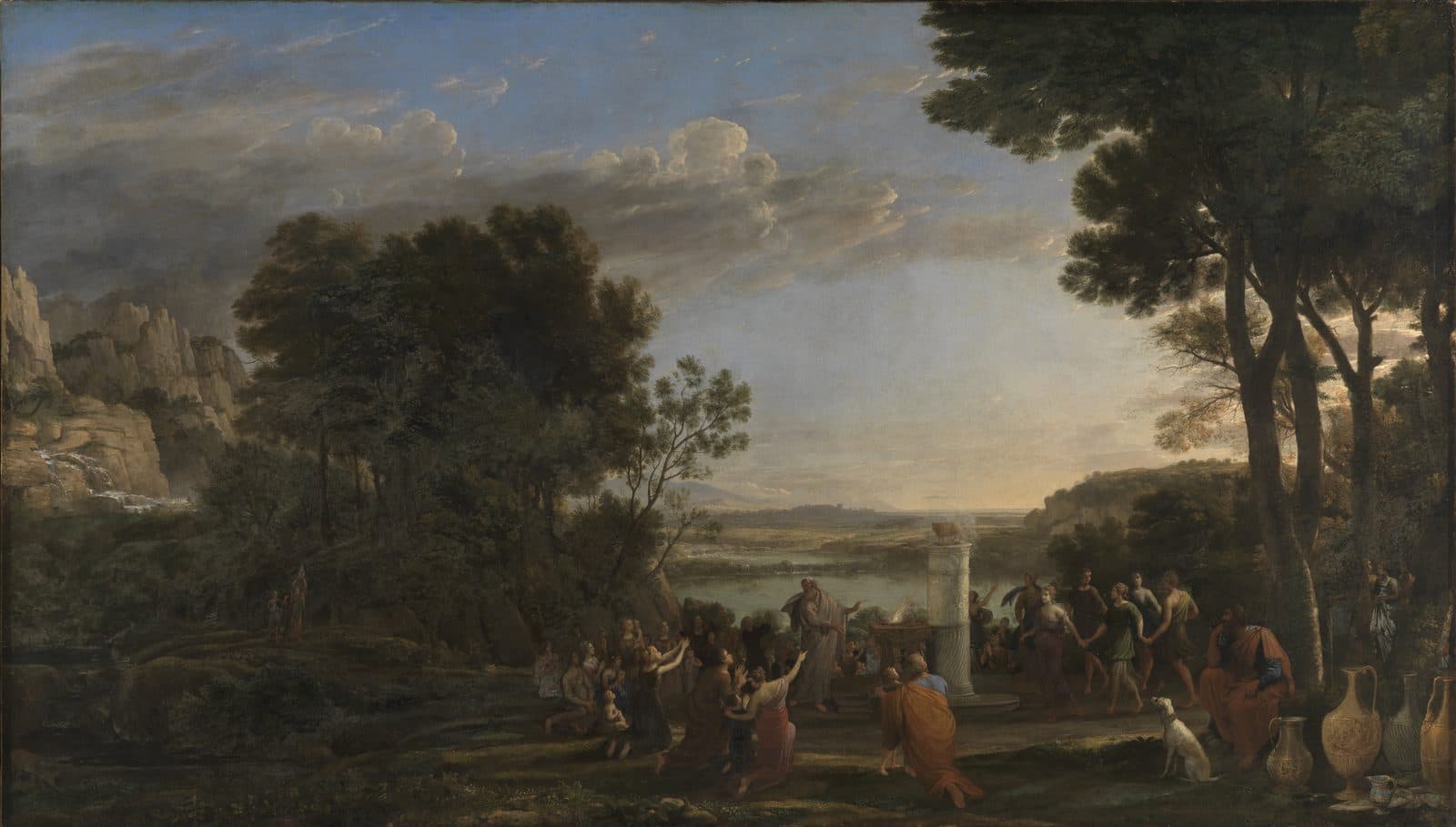
Claude Lorrain, The Worship of the Golden Calf, 1653, Staatliche Kunsthalle Karlsruhe. Public domain by date, published before 1930, via Wikimedia Commons.
THE ARTWORKClaude painted the camp at the calf small among woods and water. At the left he set two small figures coming down from the rocky heights, where Exodus 32:15 to 17 brings Moses and Joshua down from the mountain after the first plea.
Offered a great nation of his own at Sinai, Moses asked instead that the LORD spare the people who had made the calf.
Summary
Moses pleaded with the LORD four times for Israel between the golden calf and the renewal of the covenant, and the text gives an answer to each plea.
- The first plea rests on what Egypt would say and on the oath to Abraham, Isaac and Israel.
- In the second, Moses asks to be blotted out of the LORD's book if the people's sin is not forgiven.
- In the third and fourth he asks that the LORD go with the people Himself and pardon them.
- Calvin set Paul's wish at Romans 9:3 beside the offer, and Hebrews 7:25 names Christ as the one who always lives to intercede.
Four Pleas after the Calf
The four pleas of Exodus 32 to 34, in the order the book gives them
The four pleas fall within three chapters, and each comes after a word or an act of judgment.
But Moses sought the favor of the LORD his God, saying, “O LORD, why does Your anger burn against Your people, whom You brought out of the land of Egypt with great power and a mighty hand? Why should the Egyptians declare, ‘He brought them out with evil intent, to kill them in the mountains and wipe them from the face of the earth’? Turn from Your fierce anger and relent from doing harm to Your people. Remember Your servants Abraham, Isaac, and Israel, to whom You swore by Your very self when You declared, ‘I will make your descendants as numerous as the stars in the sky, and I will give your descendants all this land that I have promised, and it shall be their inheritance forever.’”Moses makes this plea on the mountain, while the people are still at the calf below.
So Moses returned to the LORD and said, “Oh, what a great sin these people have committed! They have made gods of gold for themselves. Yet now, if You would only forgive their sin.... But if not, please blot me out of the book that You have written.”Moses goes back up the day after the Levites' judgment, and he confesses the sin before he asks anything.
“If Your Presence does not go with us,” Moses replied, “do not lead us up from here. For how then can it be known that Your people and I have found favor in Your sight, unless You go with us? How else will we be distinguished from all the other people on the face of the earth?”This plea follows the LORD's word in Exodus 33:2 to 3 that an angel would go ahead and He Himself would stay away.
“O Lord,” he said, “if I have indeed found favor in Your sight, my Lord, please go with us. Although this is a stiff-necked people, forgive our iniquity and sin, and take us as Your inheritance.”Moses makes this plea after bowing down to worship, as Exodus 34:8 records.
Whether the LORD changed His mind at Exodus 32:14 is set out with its holders on the page When God Relents.
Request, Ground and Answer
Each plea of Exodus 32 to 34 in one row
| Plea | What Moses asks | The ground he gives | The LORD's answer | Verses |
|---|---|---|---|---|
| First | That the LORD relent from doing harm to His people | They are His people; Egypt will say He meant them harm; He swore to Abraham, Isaac and Israel | He relents from the harm He had threatened (Exodus 32:14) | Exodus 32:11 to 14 |
| Second | That the LORD forgive their sin, or else blot Moses out of His book | No ground is given, and Moses offers himself | Only those who sinned will be blotted out, and their sin will be punished (Exodus 32:33 to 34) | Exodus 32:30 to 34 |
| Third | That the LORD's Presence go with the people | Only His Presence will show that they have found favor and set them apart | His Presence will go with Moses, and He will do what Moses asked (Exodus 33:14 and 33:17) | Exodus 33:12 to 17 |
| Fourth | That the Lord go with them, forgive them and take them as His inheritance | The favor Moses has found in the LORD's sight, though the people are stiff-necked | He makes a covenant and promises wonders before the people (Exodus 34:10) | Exodus 34:9 to 10 |
Where Scripture Returns to the Pleas
Psalm 106, Numbers 14, Deuteronomy 9, Psalm 99 and Jeremiah 15
Psalm 106 confesses Israel's sins, and the calf made at Horeb is one of them.
So He said He would destroy them— had not Moses His chosen one stood before Him in the breach to divert His wrath from destroying them.A plea at KadeshNumbers 14:13 to 20
When the people refused to enter the land, Moses pleaded again with the ground of what the Egyptians would hear.
So now I pray, may the power of my Lord be magnified, just as You have declared: ‘The LORD is slow to anger and abounding in loving devotion, forgiving iniquity and transgression. Yet He will by no means leave the guilty unpunished; He will visit the iniquity of the fathers upon their children to the third and fourth generation.’ Pardon, I pray, the iniquity of this people, in keeping with the greatness of Your loving devotion, just as You have forgiven them ever since they left Egypt.”Moses holds the LORD to the words He proclaimed at Sinai in Exodus 34:6 to 7.
“I have pardoned them as you requested,” the LORD replied.The answer at Kadesh is given in one line.
Moses looks back in DeuteronomyDeuteronomy 9:18 to 29
In his last words to Israel Moses tells the pleas from his own side.
Then I fell down before the LORD for forty days and forty nights, as I had done the first time. I did not eat bread or drink water because of all the sin you had committed in doing what was evil in the sight of the LORD and provoking Him to anger. For I was afraid of the anger and wrath that the LORD had directed against you, enough to destroy you. But the LORD listened to me this time as well. The LORD was angry enough with Aaron to destroy him, but at that time I also prayed for Aaron.Exodus does not record the prayer for Aaron, and this passage does.
So I fell down before the LORD for forty days and forty nights, because the LORD had said He would destroy you. And I prayed to the LORD and said, “O Lord GOD, do not destroy Your people, Your inheritance, whom You redeemed through Your greatness and brought out of Egypt with a mighty hand. Remember Your servants Abraham, Isaac, and Jacob. Overlook the stubbornness of this people and the wickedness of their sin. Otherwise, those in the land from which You brought us out will say, ‘Because the LORD was not able to bring them into the land He had promised them, and because He hated them, He has brought them out to kill them in the wilderness.’ But they are Your people, Your inheritance, whom You brought out by Your great power and outstretched arm.”The grounds of this prayer are the grounds of Exodus 32:11 to 13, with Jacob named where Exodus has Israel.
Moses and SamuelPsalm 99:6 and Jeremiah 15:1
Moses and Aaron were among His priests; Samuel was among those who called on His name. They called to the LORD and He answered.Here Moses and Samuel stand together as men who called and were answered.
Then the LORD said to me: “Even if Moses and Samuel should stand before Me, My heart would not go out to this people. Send them from My presence, and let them go.The LORD names the two pleaders to say that even their pleas would not turn Him from judging Judah.
What the Text Says of the Pleas
Two points of the scene, each with the verse that settles it
THE WORDS 'LEAVE ME ALONE'
Moses had said nothing yet, and he pleads at once after these words.
THE PLAGUE AFTER THE RELENTING
The LORD relented at Exodus 32:14, and the plague still fell on the people for the calf.
The Forty Days on the Mountain
The time Exodus gives, from the arrival at Sinai to the second stay on the mountain
Israel reached Sinai in the third month after leaving Egypt, and Moses stayed on the mountain twice for forty days and forty nights.
Between the two stays the LORD spoke with Moses at the tent of meeting, and the third plea follows that account.
The first stayExodus 24:18
Moses entered the cloud as he went up on the mountain, and he remained on the mountain forty days and forty nights.This is the first stay, during which the people made the calf.
The second stayExodus 34:28
So Moses was there with the LORD forty days and forty nights without eating bread or drinking water. He wrote on the tablets the words of the covenant—the Ten Commandments.This is the second stay, when the words of the covenant were written on the tablets again.
The Words of the Pleas
Seven Hebrew words from the lexicon, each in the verse where it stands
CHALAH, TO ENTREAT (HEBREW, H2470)
The lexicon gives to be rubbed or worn, hence to entreat, and here Moses entreats the face of the LORD.
KAPHAR, TO ATONE (HEBREW, H3722)
The lexicon gives to cover, and figuratively to expiate or placate.
NASA, TO LIFT (HEBREW, H5375)
The lexicon counts 656 uses of this verb of lifting and carrying, and here it is rendered forgive.
MACHAH, TO WIPE OUT (HEBREW, H4229)
The lexicon gives to rub and so to erase, the verb of blotting out.
SALACH, TO FORGIVE (HEBREW, H5545)
The lexicon gives the one sense to forgive, and Moses asks it in the fourth plea.
NACHAL, TO TAKE AS A POSSESSION (HEBREW, H5157)
The lexicon gives to inherit or to occupy, the verb of the last request of the fourth plea.
PERETS, A BREACH (HEBREW, H6556)
The lexicon gives a break, rendered breach or gap, and Psalm 106 uses it for the place where Moses stood.
What the Text Leaves Unsaid
Four things the pleas leave unstated
Moses says he will go up and perhaps make atonement, and the text names no offering and no rite that he meant.
Exodus never says what book Moses meant at Exodus 32:32.
Exodus does not say whether Moses made the third plea at the tent or on the mountain.
Exodus 34:28 names no prayer in the second forty days, and Deuteronomy 9 supplies it.
The atonement Moses hoped to makeExodus 32:30
The next day Moses said to the people, “You have committed a great sin. Now I will go up to the LORD; perhaps I can make atonement for your sin.”A book in a psalm of DavidPsalm 69:28
May they be blotted out of the Book of Life and not listed with the righteous.David's psalm also speaks of names blotted out of a book, and it calls the book the Book of Life.
Moses, Paul and the One Mediator
Romans 9:3 and Hebrews 3:5 to 6 read beside Exodus 32
Paul makes a like wish for his own people at Romans 9:3, and Wesley asked how far he meant it.
For I could wish that I myself were cursed and cut off from Christ for the sake of my brothers, my own flesh and blood,Paul's word for cursed is anathema, which the lexicon gives as a religious ban.
“As if he had said, I could wish to suffer in their stead; yea, to be an anathema from Christ in their place. In how high a sense he wished this, who can tell, unless himself had been asked and had resolved the question? Certainly he did not then consider himself at all, but only others and the glory of God.”
John Wesley · Explanatory Notes upon the New Testament · on Romans 9:3Evangelical
Hebrews weighs Moses against Christ.
Now Moses was faithful as a servant in all God’s house, testifying to what would be spoken later. But Christ is faithful as the Son over God’s house. And we are His house, if we hold firmly to our confidence and the hope of which we boast.Four Teachers on the Pleas
Ambrose, Matthew Henry, John Wesley and Albert Barnes, each with the work named
Ambrose holds up the offer as the pattern of a leader wronged by his own people.
“What reproaches Moses had to bear from his people! But when the Lord would have avenged him on those who reviled him, he often used to offer himself for the people that he might save them from the divine anger. What gentle words he used to address the people, even after he was wronged! He comforted them in their labors, consoled them by his prophetic declarations of the future and encouraged them by his works. And though he often spoke with God, yet he was inclined to address men gently and pleasantly.”
Ambrose of Milan · On the Duties of the Clergy 2.7.31 · on Exodus 32:32Patristic
Henry reads the first plea through Psalm 106.
“Now Moses is standing in the gap to turn away the wrath of God, Ps. cvi. He wisely took the hint which God gave him when he said, Let me alone, which, though it seemed to forbid his interceding, did really encourage it, by showing what power the prayer of faith has with God.”
Matthew Henry · Commentary on the Whole Bible · on Exodus 32:11 to 13Puritan
Wesley sees a type of Christ in the third plea.
“Moses now returned to the door of the tabernacle, as an important supplicant for two favours, and prevails for both: herein he was a type of Christ the great intercessor, whom the Father heareth always. He is earnest with God for a grant of his presence with Israel in the rest of their march to Canaan.”
John Wesley · Explanatory Notes upon the Old Testament · on Exodus 33:12Evangelical
Barnes reads the grammar of the plea at Kadesh for what it shows of Moses.
“The syntax of these verses is singularly broken. As did Paul when deeply moved, so Moses presses his arguments one on the other without pausing to ascertain the grammatical finish of his expressions. He speaks here as if in momentary apprehension of an outbreak of God’s wrath, unless he could perhaps arrest it by crowding in every topic of deprecation and intercession that he could mention on the instant.”
Albert Barnes · Notes, Explanatory and Practical, on the Old and New Testaments (1832-1869) · on Numbers 14:13Evangelical
The Book of Exodus 32:32
Three readings of the book Moses asked to be blotted out of, each with its holder and the objection to it
The register of the livingMatthew Henry, Commentary on the Whole Bible, 1710
Henry reads the request as a wish to die with the people rather than see them destroyed, and he explains it from Ezekiel 13:9.
The objection: Paul's like wish at Romans 9:3 is to be cut off from Christ, which is more than the death of the body.
My hand will be against the prophets who see false visions and speak lying divinations. They will not belong to the council of My people or be recorded in the register of the house of Israel, nor will they enter the land of Israel. Then you will know that I am the Lord GOD.The false prophets of this verse are left out of the record of God's people, which is the sense Henry gives the book.
The book of lifeJohn Calvin, Harmony of the Law, 1563
Calvin takes the book as God's decree of the elect. He reads the request as Moses offering his own salvation in a vehemence of love that did not weigh its words, and he sets Paul's wish beside it.
The objection: the punishment the LORD names in His answer at Exodus 32:34 falls in this life.
Now go, lead the people to the place I described. Behold, My angel shall go before you. But on the day I settle accounts, I will punish them for their sin.”The book of the TorahRashi, Commentary on the Torah, eleventh century
Rashi, the eleventh-century French commentator, reads the book as the whole Torah. Moses asks to be left out of it so that no one would say he was not worthy to pray for the people.
The objection: the reply in the next verse treats the book as a list of persons, and the Torah is a book of words.
The LORD replied to Moses, “Whoever has sinned against Me, I will blot out of My book.The reading of the book must fit this answer as well as the request.
Books on the Pleas
Three commentaries to read whole, earliest first, two of them free to read online
Commentaries on the Four Last Books of Moses Arranged in the Form of a Harmony
John Calvin · 1563
Calvin argues that the word of Exodus 33:1 came before the prayer of Exodus 32:32 in time.
Read volume 3 at the Christian Classics Ethereal LibraryCommentary on the Whole Bible
Matthew Henry · 1710
Henry gives his notes on Exodus 32:30 to 35 the heading The Intercession of Moses.
Read Henry on Exodus 32 at the Christian Classics Ethereal LibraryExplanatory Notes upon the Old Testament
John Wesley · 1765
Wesley wrote short notes on the third and fourth pleas.
He Always Lives to Intercede
Moses pleaded for a people who broke the covenant while he was still on the mountain, and he was ready to be blotted out with them. Christ Jesus died, was raised to life and is now at the right hand of God interceding for His people, as Romans 8:34 says. The text asks the reader to come to God through Christ and, as Paul urges in 1 Timothy 2:1, to pray for others.
Therefore He is able to save completely those who draw near to God through Him, since He always lives to intercede for them.Keep studying
Read it4
Studies4
Doctrines13