
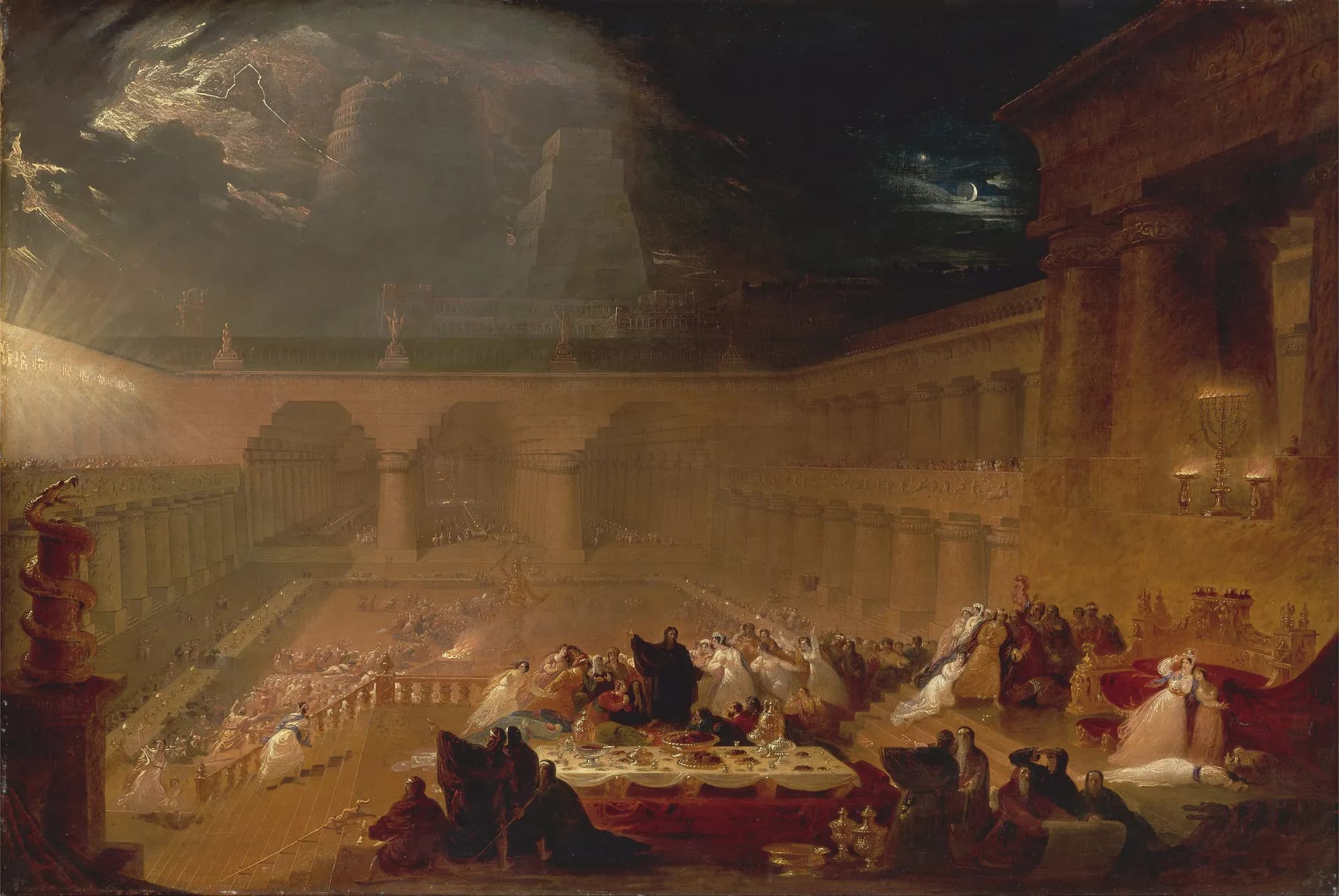
Belshazzar's Feast, John Martin, 1820. Public domain.
Old Testament · Book 35 of 66
Habakkuk
Habakkuk records the prophet's complaints to God about injustice in Judah and God's answers. God says the righteous will live by faith, and the book closes with Habakkuk's prayer of trust.
Habakkuk records the prophet's complaints to God about injustice in Judah and God's answers. God says the righteous will live by faith, and the book closes with Habakkuk's prayer of trust.
What is Habakkuk about?
Habakkuk is the book of a prophet of Judah who speaks to God before he speaks for him. He asks how long violence will go unanswered, and the LORD says he is raising up the Chaldeans. The prophet asks again how a holy God can use a nation worse than Judah, and he waits on the ramparts. The second answer is a vision to write down and wait for, and a line to live by: “the righteous will live by faith” (2:4). Five woes then fall on the proud one, and the book ends in a prayer of joy in the LORD though the fig tree does not bud.
All 3 chapters
Every chapter of the book, in one grid. Each cell opens that chapter.
- The two complaints1:1 to 2:5
- The five woes2:6 to 20
- The prayerChapter 3
The colour is the movement of the book the chapter stands in, and every cell opens that chapter's Study level. The two complaints run on to 2:5, so the first five verses of chapter 2 belong to them.
Who wrote it, where, when, for whom, and why?
The book names its writer twice: the burden that Habakkuk the prophet received in a vision (1:1), and a prayer of Habakkuk the prophet, according to Shigionoth (3:1). It gives no father, no town and no king's name. The book speaks in his own voice, as I will stand at my guard post (2:1) and I heard and trembled within (3:16). Paul quotes 1:5 as what was spoken by the prophets (Acts 13:40 to 41).
This is the burden that Habakkuk the prophet received in a vision:
Habakkuk 1:1, Berean Standard Bible.
The prophet speaks from Judah, where the law is paralysed and the wicked hem in the righteous (1:4). He looks out to the Chaldeans, who march through the breadth of the earth (1:6), and in his prayer he sees God come from the south, past the tents of Cushan and Midian (3:3 and 7). He speaks of the LORD in His holy temple (2:20).
The book names no king. Its one mark of time is the LORD's word that he is raising up the Chaldeans, a work the prophet's hearers would not believe in their own days (1:5 to 6). The Chaldeans are the rulers of Babylon, who took Jerusalem in the days of Jehoiakim, Jehoiachin and Zedekiah (2 Kings 24:1 to 25:10), so the book is usually placed in the last years of Judah before the exile, between about 609 and 598 BC. The date is inferred from 1:6 and is not stated.
The first two chapters are a conversation between the prophet and the LORD, and the vision is written plainly on tablets so that a herald may run with it (2:2), which gives it to Judah. Chapter 3 is set for the choirmaster with stringed instruments (3:19), so the prayer was given to Judah's worship.
The book gives its reason in the prophet's question and the LORD's answers. The prophet asks how long violence will go unanswered (1:2), and why the LORD is silent while the wicked swallow up the more righteous (1:13). The LORD answers that the vision will surely come at its appointed time (2:3), that the righteous will live by faith (2:4), and that the earth will be filled with the knowledge of his glory (2:14).
The book names a nation of horsemen swifter than leopards who scoff at kings and build siege ramps against every fortress (1:8 to 10), who catch the nations like fish in a dragnet and burn incense to the net (1:15 to 16). It names houses built by unjust gain, towns built with bloodshed, the cutting of Lebanon and idols of wood and stone overlaid with gold and silver (2:9 to 19). Its last verses name the fig, the vine, the olive, the fields, the sheepfold and the stalls a family of Judah lived by (3:17).
Sources. Habakkuk 1:1, 1:2, 1:4 to 6, 1:8 to 10, 1:13, 1:15 to 16, 2:1 to 4, 2:9 to 20, 3:1, 3:3, 3:7, 3:16, 3:17 and 3:19; 2 Kings 24:1 to 25:10; Acts 13:40 to 41. Every verse is read in the Berean Standard Bible.
How is Habakkuk arranged, and what is it for?
The three movements the book falls into, then what it teaches and what it was written to do.
- The two complaints1:1 to 2:5, 22 verses, the turn at 2:4
The prophet asks how long, the LORD raises the Chaldeans, the prophet asks again and waits on the rampart for the vision.
- The five woes2:6 to 20, 15 verses, the turn at 2:14
Five woes on the plunderer, the house of unjust gain, the city of blood, the neighbour made drunk and the idol, and the LORD in His temple.
- The prayerChapter 3, 19 verses, the turn at 3:17 to 18
God comes from the south, the nations and the waters shake, and the prophet rejoices in the LORD with no harvest.
The theme
Habakkuk asks why God lets the wicked go on, and the LORD answers twice. The first answer makes the question harder, because the Chaldeans he raises are worse than the wrong they punish. The second answer gives the prophet a vision to write down and wait for, and a line to live by: the proud one will fall, and the righteous will live by faith (2:4). The five woes show the proud one's end, and the prayer shows the prophet trusting the LORD before any of it has come.
The purpose
The book sets down a prophet's questions to God and God's answers, so that people who see violence go unpunished know what the LORD said to it. It tells them to wait for the appointed time, it names the end of the empire that plunders, and it gives them a prayer to pray while the fields are empty.
Two complaints and two answers
- 1The prophetThe first complaintHabakkuk 1:2 to 4, 3 verses
“How long, O LORD, must I call for help but You do not hear” (1:2)
Violence fills Judah and the law is paralysed.
- 2The LORDThe first answerHabakkuk 1:5 to 11, 7 verses
“I am doing a work in your days that you would never believe” (1:5)
The LORD is raising up the Chaldeans.
- 3The prophetThe second complaintHabakkuk 1:12 to 2:1, 7 verses
“Why are You silent while the wicked swallow up those more righteous than themselves?” (1:13)
How can a holy God use a nation more wicked than Judah? The prophet waits on the ramparts.
- 4The LORDThe second answerHabakkuk 2:2 to 5, 4 verses
“Though it lingers, wait for it, since it will surely come and will not delay” (2:3)
Write the vision on tablets; it awaits its appointed time.
The two complaints, Habakkuk 1:1 to 2:5
What the text says in these 22 verses, and the pages they open on.
The book opens as the burden Habakkuk the prophet received in a vision (1:1), and the first words are his, spoken to God. He asks how long he must cry out while violence goes unanswered, and he says the law is paralysed and justice perverted, because the wicked hem in the righteous (1:2 to 4). The LORD answers that he is doing a work the prophet would not believe: he is raising up the Chaldeans, a ruthless nation swifter than leopards, whose own strength is their god (1:5 to 11). Habakkuk asks again. The LORD's eyes are too pure to look on evil, so why is he silent while the wicked swallow up those more righteous than themselves, and will the foe go on emptying his net (1:12 to 17)? The prophet takes his stand on the ramparts to watch for the reply (2:1). The LORD tells him to write the vision plainly on tablets, because it awaits its appointed time and will surely come (2:2 to 3). The proud one is not upright, but the righteous will live by faith (2:4).
Look at the proud one; his soul is not upright—but the righteous will live by faith—
- Study
Habakkuk 1how long, the Chaldeans raised, and the second complaintShow the summary and 3 pagesShow summary, 3 pagesHide the summary
Not a sermon but a dialogue, the prophet questions God twice. First complaint: 'How long, O LORD, must I call for help but You do not hear'? Judah is full of violence, and 'the law is paralyzed, and justice never goes forth.' God's answer is worse than the silence: 'I am doing a work in your days that you would never believe even if someone told you. … For behold, I am raising up the Chaldeans … that ruthless and impetuous nation', swifter than leopards, fiercer than evening wolves, guilty men 'their own strength is their god.' Paul quotes that warning at Antioch (Acts 13:41). Hence the second question: you who are of purer eyes than to behold evil, why use a worse man to punish a better?
- Habakkuk asks how long he must cry out while violence goes on and the law is paralysed (1:2 to 4).
- The LORD answers that he is raising up the Chaldeans (1:5 to 11).
- Habakkuk asks why a holy God is silent while the wicked swallow up the more righteous (1:12 to 17).
On this chapter (3)
- The question of suffering
Why the wicked prosper, and what the prophets said to it.
- When did Habakkuk write, before or after Carchemish, and who are the Chaldeans of 1:6?
Answered under Where do readers disagree, lower on this page, with each reading and who holds it.
- Habakkuk 1:5
The verse on its own page, with the commentators on it by era.
The second answer, 2:1 to 5, opens chapter 2, and that chapter's entry stands under The five woes. The four exchanges are drawn as the dialogue in two columns, under The book as a whole.
One line and the three places it is quoted
Look at the proud one; his soul is not upright—but the righteous will live by faith—
For the gospel reveals the righteousness of God that comes by faith from start to finish, just as it is written: “The righteous will live by faith.”
Now it is clear that no one is justified before God by the law, because, “The righteous will live by faith.”
But My righteous one will live by faith; and if he shrinks back, I will take no pleasure in him.”
Characters (4)
Who the text names. A name with a page carries its door.
- Habakkuk
The prophet who received the burden in a vision and speaks to God first (1:1 to 2).
- The Chaldeans
The ruthless nation the LORD says he is raising up (1:6).
- The wicked and the righteous
The wicked hem in the righteous (1:4) and swallow up those more righteous (1:13).
- The proud one
Not upright, set beside the righteous who lives by faith (2:4 to 5).
Places (3)
Where the chapters stand.
- Judah
Where the law is paralysed and justice perverted (1:4).
- Chaldea and Babylon
The land of the Chaldeans, whose horses are swifter than leopards (1:6 to 8).
- The ramparts
Where the prophet stands to watch for the answer (2:1).
Themes (4)
What these chapters raise, each on its own page where one stands.
- The righteous shall live by faith
The line of 2:4 and its three New Testament uses.
- Why the wicked prosper
The question of both complaints (1:2 to 4, 1:13).
- Waiting for the vision
It awaits an appointed time and will surely come (2:3).
- Justification by faith
The doctrine Paul builds on 2:4 in Romans and Galatians.
Where the New Testament uses these chapters (3)each marked as a quotation or an allusion, with the evidence
- Explicit quotation1:5 at Acts 13:41. Paul closes his sermon at Pisidian Antioch with the LORD's first answer, a work in your days you would never believe, as what was spoken by the prophets. Held by Paul, as Luke records him (Acts 13:40). He adds you scoffers and wonder and perish, which follow the Greek form of the verse.
- Explicit quotation2:4 at Romans 1:17 and Galatians 3:11. Paul states that the gospel reveals the righteousness of God that comes by faith, just as it is written, and argues in Galatians that no one is justified before God by the law, because the righteous will live by faith. Held by Paul, who marks the first with just as it is written and sets the second against Leviticus 18:5. Both leave out the pronoun that the Hebrew and the Greek each carry, and the two stand word for word.
- Explicit quotation2:3 to 4 at Hebrews 10:37 to 38. The writer tells believers under trial that he who is coming will come and will not delay, and that My righteous one will live by faith. Held by the writer to the Hebrews. He follows a Greek form that reads My righteous one and gives the coming vision a person who is coming; the difference stands under Where do readers disagree.
The five woes, Habakkuk 2:6 to 20
What the text says in these 15 verses, and the pages they open on.
The proud one who gathers the nations to himself (2:5) now hears the nations take up a taunt against him, in five woes (2:6). Woe to him who heaps up what is not his: those he plundered will plunder him (2:6 to 8). Woe to him who builds his house by unjust gain: the stones will cry out from the wall (2:9 to 11). Woe to him who builds a city with bloodshed: the labour of the peoples only feeds the fire, for the earth will be filled with the knowledge of the glory of the LORD as the waters cover the sea (2:12 to 14). Woe to him who makes his neighbours drunk to see their nakedness: the cup in the LORD's right hand will come round to him (2:15 to 17). Woe to him who tells wood to awake and silent stone to arise, an idol with no breath in it (2:18 to 19). The section ends in the LORD in His holy temple, and all the earth silent before him (2:20).
For the earth will be filled with the knowledge of the glory of the LORD as the waters cover the sea.
- Study
Habakkuk 2the watchpost, the vision on tablets, and the five woesShow the summary and 4 pagesShow summary, 4 pagesHide the summary
'I will stand upon my watch, and set me upon the tower': the prophet takes his post and waits, and the answer comes with instructions: 'Write the vision, and make it plain upon tablets, that he may run that readeth it… though it tarry, wait for it; because it will surely come.' Then the line that carried the Reformation: 'the righteous will live by faith' (2:4), the text Paul builds on in Romans 1 and Galatians 3. Five woes follow against the plunderer: the debt-collector, the nest set on high while 'the stone shall cry out of the wall,' the city built with blood, the neighbor made drunk, the gilded idol with 'no breath at all in the midst of it.'
- Habakkuk stands at his post, and the LORD tells him to write the vision on tablets (2:1 to 3).
- The proud one is set beside the righteous one who lives by faith (2:4 to 5).
- Five woes fall on the proud one, and the LORD is in His holy temple (2:6 to 20).
On this chapter (4)
- The just shall live by faith
The line of 2:4 and its three New Testament uses.
- Justification by faith
The doctrine Paul builds on 2:4.
- What does 2:4 say in the Hebrew, in the Greek and in its three New Testament uses, and whose faith is it?
Answered under Where do readers disagree, lower on this page, with each reading and who holds it.
- Habakkuk 2:14
The verse on its own page, with the commentators on it by era.
5 woes on the proud one
- 1The plunderer2:6 to 8
- The charge
- “Woe to him who amasses what is not his” (2:6)
- The sentence
- “the remnant of the people will plunder you” (2:8)
- 2The house of unjust gain2:9 to 11
- The charge
- “Woe to him who builds his house by unjust gain” (2:9)
- The sentence
- “the stones will cry out from the wall” (2:11)
- 3The city of blood2:12 to 14
- The charge
- “Woe to him who builds a city with bloodshed” (2:12)
- The sentence
- “the labor of the people only feeds the fire” (2:13)
- 4The shamed neighbour2:15 to 17
- The charge
- “Woe to him who gives drink to his neighbors” (2:15)
- The sentence
- “You will be filled with shame instead of glory” (2:16)
- 5The idol2:18 to 20
- The charge
- “Woe to him who says to wood” (2:19)
- The sentence
- “there is no breath in it at all” (2:19)
Characters (3)
Who the text names. A name with a page carries its door.
- The plunderer
Heaps up what is not his and is plundered in turn (2:6 to 8).
- The builder of the city of blood
Builds a city with bloodshed, and the labour feeds the fire (2:12 to 13).
- The idol maker
Trusts in what he made, an idol that cannot speak (2:18).
Places (3)
Where the chapters stand.
- Lebanon
The violence done to Lebanon will overwhelm the one who did it (2:17).
- The city built with blood
The town established by iniquity (2:12).
- The LORD's holy temple
Where the LORD is, and all the earth is silent (2:20).
Themes (3)
What these chapters raise, each on its own page where one stands.
- The woes of empire
The taunt the nations take up against the one who plundered them (2:6).
- The glory of the LORD filling the earth
As the waters cover the sea (2:14).
- Idols that cannot speak
Wood told to awake and stone to arise (2:18 to 19).
Where the New Testament uses these chapters (1)each marked as a quotation or an allusion, with the evidence
- Probable allusion2:14 at Isaiah 11:9. Habakkuk's earth filled with the knowledge of the glory of the LORD as the waters cover the sea stands close to Isaiah's earth full of the knowledge of the LORD as the sea is full of water. Held by John Gill, Exposition of the Old Testament, on 2:14, who sets the two verses side by side. This is a use inside the prophets, carried here because the design block names it; no New Testament passage quotes 2:14.
The prayer, Habakkuk 3
What the text says in these 19 verses, and the pages they open on.
Chapter 3 is a prayer of Habakkuk the prophet, according to Shigionoth (3:1). He has heard of the LORD's deeds and stands in awe, and he asks God to revive them in these years and in wrath to remember mercy (3:2). Then he sees God come from Teman and the Holy One from Mount Paran, his glory covering the heavens (3:3). Plague goes before him, the ancient mountains crumble, and the tents of Cushan and the curtains of Midian tremble (3:5 to 7). The prophet asks whether the LORD was angry at the rivers and the sea, and he sees the deep roar, the sun and moon stand still, and the LORD go out to save his people and his anointed (3:8 to 15). Habakkuk trembles and waits for the day of distress (3:16). Though the fig tree does not bud, the fields yield no food and the stalls stand empty, he will exult in the LORD, who makes his feet like those of a deer (3:17 to 19). The last line is a direction for the choirmaster, with stringed instruments (3:19).
Though the fig tree does not bud and no fruit is on the vines, though the olive crop fails and the fields produce no food, though the sheep are cut off from the fold and no cattle are in the stalls, yet I will exult in the LORD; I will rejoice in the God of my salvation!
- Study
Habakkuk 3the LORD comes from Teman, and joy without harvestShow the summary and 4 pagesShow summary, 4 pagesHide the summary
A prayer set to music, with Selah and a note for the chief musician, the prophet's questions resolved into worship. 'O LORD, I have heard the report of You; I stand in awe … In Your wrath, remember mercy!' Then a theophany out of Sinai and the conquest: God came from Teman, his glory covering the heavens, rays coming forth from his hand, 'where His power is hidden'; mountains scattered, the deep lifting up its hands, God marching forth for the salvation of his people and of his anointed. And the ending holds without a single circumstance improving: though fig-tree, vine, olive, field, flock, and herd all fail, 'yet I will exult in the LORD' (3:18).
- Habakkuk prays that the LORD will remember mercy in wrath (3:2).
- God comes from Teman and Mount Paran, and the nations, the rivers and the sea shake (3:3 to 15).
- The prophet trembles, waits, and rejoices in the LORD though the harvest fails (3:16 to 19).
On this chapter (4)
- Faith under fire
Trust held while the day of distress comes on.
- Is chapter 3 original to the book, since the Qumran commentary ends with chapter 2?
Answered under Where do readers disagree, lower on this page, with each reading and who holds it.
- What are Shigionoth, Selah and the choirmaster's line, and what do they show of how chapter 3 was used?
Answered under Where do readers disagree, lower on this page, with each reading and who holds it.
- Habakkuk 3:18
The verse on its own page, with the commentators on it by era.
The LORD comes from the south
The stations (6)
- 1TemanHabakkuk 3:3probableGod came from Teman, in the south, the land of Edom.
- 2Mount ParanHabakkuk 3:3probableThe Holy One came from the wilderness south of Judah.
- 3CushanHabakkuk 3:7not locatedIts tents are in distress; no place of this name has been located.
- 4MidianHabakkuk 3:7probableIts curtains tremble, east of the Gulf of Aqaba.
- 5The riversHabakkuk 3:8 to 10the watersWas the LORD angry at the rivers? He splits the earth with rivers.
- 6The seaHabakkuk 3:8 and 15the watersHe tramples the sea with his horses, churning the great waters.
- Probable: a region, drawn as a hollow ring.
- Not located: no place of this name has been found, drawn as a dashed ring.
- The waters of the prayer, drawn as a wave, not a place on a map.
Characters (3)
Who the text names. A name with a page carries its door.
- Habakkuk at prayer
Asks the LORD to remember mercy in wrath (3:2).
- The LORD's anointed
The one the LORD goes out to save (3:13).
- The choirmaster
The last line gives the prayer to him, with stringed instruments (3:19).
Places (4)
Where the chapters stand.
- Teman
God came from Teman (3:3).
- Mount Paran
Where the Holy One came from (3:3).
- Cushan
Its tents are in distress (3:7); the place is not located.
- Midian
Its curtains tremble (3:7).
Themes (4)
What these chapters raise, each on its own page where one stands.
- Joy without harvest
Rejoicing in the LORD when the fig tree does not bud (3:17 to 18).
- Faith under fire
Trust held while the day of distress comes on (3:16).
- Mercy in wrath
The prayer's first request (3:2).
- The day of the LORD
The LORD going out in fury to judge and to save (3:12 to 13).
No New Testament passage quotes or names these chapters.
- Author
- Habakkuk the prophet (1:1)
- Date
- Late 7th c. BC, shortly before the Babylonian rise to dominance
- Audience
- Judah on the eve of the exile
Where do readers disagree?
One list: the readings with their holders, and what the evidence does not settle.
When did Habakkuk write, before or after Carchemish, and who are the Chaldeans of 1:6?
- Before Carchemish, in the reign of Jehoiakim. Held by J. J. M. Roberts, Nahum, Habakkuk, and Zephaniah, Old Testament Library (1991), and by O. Palmer Robertson, The Books of Nahum, Habakkuk, and Zephaniah (1990).
- In the days of Manasseh. Held by Rabbi Yose ben Halafta in Seder Olam Rabbah, the rabbinic chronicle ascribed to him, which names Habakkuk among the prophets of Manasseh's reign.
- The Kittim, the Greeks of Alexander. Held by Bernhard Duhm, Das Buch Habakuk (1906).
What the evidence does not settle: The book names no king and no year, so every date rests on how 1:5 to 6 is read; the Chaldeans are named in every Hebrew copy of 1:6.
The argument in full
Before Carchemish, in the reign of Jehoiakim. The LORD calls the rise of the Chaldeans a work Judah would not believe (1:5), which fits the years before Babylon broke Egypt at Carchemish in 605 BC, when its power in the west was still to come.
In the days of Manasseh. The violence and the paralysed law of 1:2 to 4 answer to the sins 2 Kings 21:16 lays on Manasseh, who filled Jerusalem with innocent blood.
The Kittim, the Greeks of Alexander. Duhm reads Kittim in place of Chaldeans at 1:6 and dates the book to Alexander's campaigns in the 330s BC; no Hebrew copy of 1:6 reads Kittim.
What does 2:4 say in the Hebrew, in the Greek and in its three New Testament uses, and whose faith is it?
The Just Shall Live by Faith→- His faith, the trust of the righteous one. Held by John Calvin, Commentaries on the Twelve Minor Prophets, on 2:4, and by Martin Luther, Preface to the Latin Writings (1545).
- His faithfulness, steady loyalty. Held by J. J. M. Roberts, Nahum, Habakkuk, and Zephaniah (1991), with the Jewish Publication Society's Tanakh (1985), which renders it his fidelity, and the Qumran Commentary on Habakkuk (1QpHab), column 8.
- My faithfulness, God's own, in the Greek. Held by F. F. Bruce, The Epistle to the Hebrews (1964), on 10:38, reading the Septuagint, whose Greek has by my faith, and the form My righteous one that Hebrews follows.
- The Righteous One is Christ. Held by Richard B. Hays, The Faith of Jesus Christ (1983).
What the evidence does not settle: Which pronoun stood in the verse Paul and the writer to the Hebrews knew, since the Hebrew reads his, the Greek copies read my, and Paul reads neither.
The argument in full
His faith, the trust of the righteous one. The Hebrew reads by his emunah, and the righteous one lives by trusting the promise of the vision the verse before has told him to wait for (2:3), which is the sense Paul takes up.
His faithfulness, steady loyalty. The Hebrew noun names firmness, and the Qumran commentary applies the verse to those who keep the Law in the house of Judah and stay loyal to the Teacher of Righteousness.
My faithfulness, God's own, in the Greek. The Greek puts the pronoun on God or on the righteous one as God's own, and Hebrews joins the verse to the one who is coming (Hebrews 10:37).
The Righteous One is Christ. Paul leaves out the pronoun, and Hays reads the righteous one in Romans as Christ, whose faithfulness reveals God's righteousness.
Is chapter 3 original to the book, since the Qumran commentary ends with chapter 2?
- A psalm added to the book later. Held by Julius Wellhausen, Die kleinen Propheten (1892).
- The prophet's own prayer, drawing on older hymns. Held by William Foxwell Albright, 'The Psalm of Habakkuk', in Studies in Old Testament Prophecy (1950), and by Theodore Hiebert, God of My Victory: The Ancient Hymn in Habakkuk 3 (1986).
- Chapter 3 answers chapters 1 and 2. Held by O. Palmer Robertson, The Books of Nahum, Habakkuk, and Zephaniah (1990).
What the evidence does not settle: Why the Qumran commentary stops at 2:20, whether its writers did not have chapter 3 or did not comment on it; the Greek Septuagint and the Hebrew scroll of the Twelve from Wadi Murabba'at both carry chapter 3.
The argument in full
A psalm added to the book later. Chapter 3 has its own heading (3:1), its own Selah marks and its own direction to the choirmaster (3:19), which belong to a psalm, and the Qumran commentary stops at 2:20.
The prophet's own prayer, drawing on older hymns. The poetry of 3:3 to 15 is old in its language, and the prayer's close in 3:16 to 19 answers the waiting the vision asked for in 2:3.
Chapter 3 answers chapters 1 and 2. The prophet who asked how long (1:2) ends by waiting patiently for the day of distress (3:16), so the book needs its prayer to finish its argument.
What are Shigionoth, Selah and the choirmaster's line, and what do they show of how chapter 3 was used?
- Shigionoth, a song of strong feeling. Held by Wilhelm Gesenius, in Gesenius's Hebrew and Chaldee Lexicon, under shiggayon.
- Selah, a pause in the singing. Held by Charles Haddon Spurgeon, The Treasury of David, on Psalm 3:2.
- A prayer set for the temple singers. Held by Theodore Hiebert, God of My Victory: The Ancient Hymn in Habakkuk 3 (1986).
What the evidence does not settle: What Shigionoth meant to the singers, since the word stands only here and at Psalm 7; the synagogue later read Habakkuk 3 on the feast of Weeks (Babylonian Talmud, Megillah 31a).
The argument in full
Shigionoth, a song of strong feeling. The word stands at 3:1 and in the singular at the head of Psalm 7, and Gesenius links it to a verb for reeling, a song sung with passion.
Selah, a pause in the singing. Selah stands three times in the prayer (3:3, 3:9, 3:13) and seventy-one times in the Psalms, and the Septuagint renders it diapsalma, an interlude.
A prayer set for the temple singers. The heading and the direction for the choirmaster with stringed instruments (3:19) show the prayer copied for use in worship, as the Psalms were.
Does the book answer the question of evil, or does it answer the prophet?
The Question of Suffering→- It answers the prophet with the character of God. Held by D. Martyn Lloyd-Jones, From Fear to Faith (1953).
- It answers the question in history. Held by Donald E. Gowan, The Triumph of Faith in Habakkuk (1976).
- It answers with a vision to wait for. Held by Matthew Henry, Commentary on the Whole Bible (1710), on 2:3.
What the evidence does not settle: Whether the woes of 2:6 to 20 fell on Babylon within the prophet's generation or look further, since the book names no city in them.
The argument in full
It answers the prophet with the character of God. The LORD gives no reason for the Chaldeans; the prophet turns from his questions to who God is, from everlasting and too pure to look on evil (1:12 to 13), and rests there.
It answers the question in history. The five woes show the proud one falling by his own deeds (2:6 to 17), so the book does answer the question: the empire that plunders is plundered in time.
It answers with a vision to wait for. The answer is a promise with a time appointed (2:3), so the prophet is given no explanation now but a word that will surely come.
The pages Habakkuk opens on
Studies19
People and groups5
Words7
Sources for this page
The movements, the chapter entries, the figures and the Context are read off the text of Habakkuk. The works behind the readings under Where do readers disagree are Seder Olam Rabbah; the Qumran Commentary on Habakkuk (1QpHab); the Babylonian Talmud, Megillah; Matthew Henry, Commentary on the Whole Bible (1710); John Gill, Exposition of the Old Testament (1748 to 1763); John Calvin, Commentaries on the Twelve Minor Prophets; Martin Luther, Preface to the Latin Writings (1545); Wilhelm Gesenius, Hebrew and Chaldee Lexicon; Charles Haddon Spurgeon, The Treasury of David; Julius Wellhausen, Die kleinen Propheten (1892); Bernhard Duhm, Das Buch Habakuk (1906); William Foxwell Albright, The Psalm of Habakkuk (1950); D. Martyn Lloyd-Jones, From Fear to Faith (1953); F. F. Bruce, The Epistle to the Hebrews (1964); Donald E. Gowan, The Triumph of Faith in Habakkuk (1976); Richard B. Hays, The Faith of Jesus Christ (1983); the Jewish Publication Society, Tanakh (1985); Theodore Hiebert, God of My Victory (1986); O. Palmer Robertson, The Books of Nahum, Habakkuk, and Zephaniah (1990); and J. J. M. Roberts, Nahum, Habakkuk, and Zephaniah (1991). Every verse quoted on this page is the Berean Standard Bible, read from the store.