
John 13 to 21 · 2 and 3 John · Person · Featured Study
The Beloved Disciple and the elder
Five scenes in John, the letters 2 and 3 John, and what the church at Ephesus said of their writer.
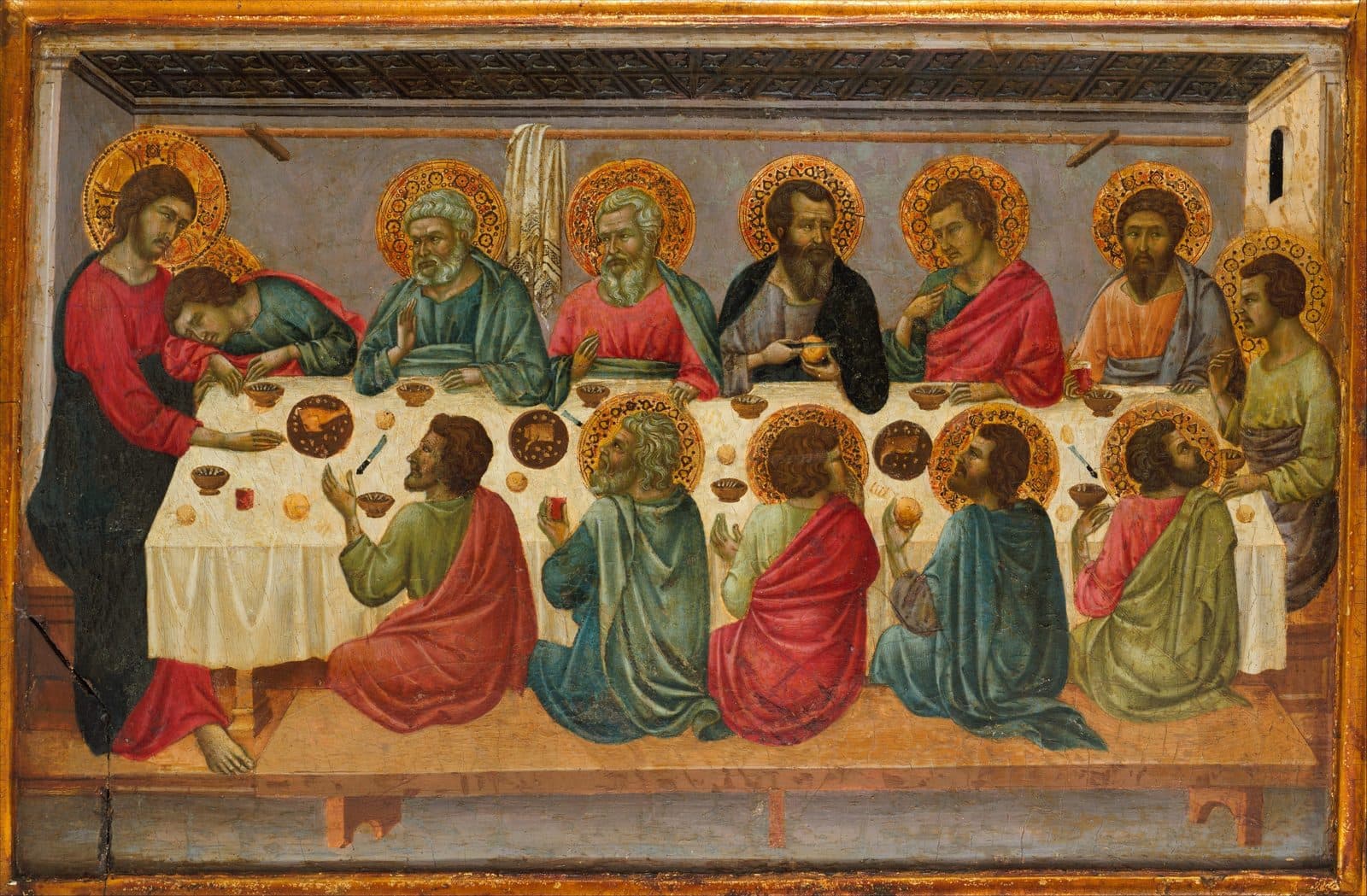
Ugolino di Nerio, The Last Supper, about 1325 to 1330, Metropolitan Museum of Art, New York. Public domain, via Wikimedia Commons.
THE ARTWORKUgolino painted the supper of John 13 with one young disciple resting against Jesus, the place John gives to the disciple whom Jesus loved.
The Gospel of John rests on the eyewitness account of the disciple whom Jesus loved.
Summary
Two short letters after the Gospel are signed by the elder, and readers since the second century have asked whether he and the beloved disciple are one man.
- The title stands five times, from the supper in John 13 to the shore of the Sea of Tiberias.
- Irenaeus names him John and places him at Ephesus until the reign of Trajan.
- Papias names a second John, the presbyter, and Eusebius read him as another man.
- Irenaeus and John Gill read the disciple and the elder as one man, John son of Zebedee.
Where the Disciple and the Elder Stand
The first scene, the Gospel's last word, and the two letters
One of His disciples, the one whom Jesus loved, was reclining at His side. So Simon Peter motioned to him to ask Jesus which one He was talking about. Leaning back against Jesus, he asked, “Lord, who is it?”Irenaeus and Polycrates point to this scene when they name John as the disciple who leaned on the Lord's breast.
This is the disciple who testifies to these things and who has written them down. And we know that his testimony is true.Every reading of the Gospel's authorship starts from this verse.
The elder, To the chosen lady and her children, whom I love in the truth—and not I alone, but also all who know the truth—The writer calls himself the elder here, and the question of one John or two turns on that title.
The elder, To the beloved Gaius, whom I love in the truth:Its opening matches 2 John's, title and greeting alike.
The Disciple, Scene by Scene
What he does in each, and where
- Reclines at Jesus' side and asks who the betrayer isThe supper, John 13:23 to 25
- Stands by the cross with Jesus' motherGolgotha, John 19:26 to 27
- Outruns Peter to the tomb, then sees and believesThe tomb in the garden, John 20:2 to 8
- Knows the risen Lord from the boatThe Sea of Tiberias, John 21:7
- Follows Jesus, and the rumor about his death is correctedThe shore, John 21:20 to 23
Five scenes, in the order John tells them.
Unnamed Disciples Beyond the Title
Three places where John leaves a witness unnamed
Two unnamed disciples earlier in the GospelJohn 1:35 to 40; John 18:15 to 16
John names Andrew as one of the two disciples of John the Baptist who first followed Jesus, and he leaves the other unnamed.
In the high priest's courtyard another disciple, known to the high priest, speaks to the doorkeeper and brings Peter in.
Westcott counted the unnamed man in both scenes as the beloved disciple; the Gospel names neither, so the link is a reading of the text.
The unnamed eyewitness at the crossJohn 19:35
The verse follows the spear thrust of John 19:34, when blood and water flowed from His side.
The one who saw it has testified to this, and his testimony is true. He knows that he is telling the truth, so that you also may believe.What the Text Says of Him
Five points from the text and its readers that bear on the disciple and the elder
ONE MENTION OF ZEBEDEE
The Gospel never names John son of Zebedee, and it mentions the sons of Zebedee only once, in its last chapter.
TWO VERBS OF LOVE
Four of the five places use the Greek verb agapao for Jesus' love; the tomb scene uses phileo.
A LOVE GIVEN TO ALL
John says Jesus loved His own to the very end. Calvin reads the peculiar love for one disciple as a love that took nothing from brotherly love for the rest.
PETER'S WORD FOR HIMSELF
Peter, an apostle, calls himself a fellow elder, so the title on the two letters fits an apostle.
A LADY OR A CHURCH
Strong's dictionary reads Kyria as a Christian woman's name. Jamieson, Fausset and Brown, in their Commentary of 1871, read the chosen lady as a church.
Ephesus and the First Witnesses
What the second-century church said of John
Irenaeus, bishop of Lyons, wrote in Against Heresies that John, the disciple of the Lord who leaned on His breast, published his Gospel while living at Ephesus in Asia.
He adds that John remained with the church at Ephesus until the reign of Trajan.
In a letter to Florinus he recalls hearing Polycarp of Smyrna describe his time with John and the others who had seen the Lord.
John and Cerinthus at the bath-houseIrenaeus, Against Heresies 3.3.4
Irenaeus tells, on Polycarp's word, that John once went to bathe at Ephesus and rushed out without bathing when he learned that Cerinthus was inside.
Irenaeus also quotes 2 John 1:7, on the deceivers who refuse to confess the coming of Jesus Christ in the flesh, as the words of John, the disciple of the Lord.
Polycrates and the priest's plateEusebius, Church History 5.24
Polycrates, who led the bishops of Asia, wrote to Victor of Rome that John, who reclined on the bosom of the Lord, fell asleep at Ephesus.
Polycrates adds that John was a witness and a teacher and, being a priest, wore the priest's plate.
His letter gives no source for the detail.
The Disciple's Household
Four ties, each with its verse
A MOTHER GIVEN AT THE CROSS
Jesus names Mary the disciple's mother, and from that hour he takes her into his home.
THE SONS OF ZEBEDEE
On the traditional reading his father is Zebedee and his brother is James, called with him from their boat.
HIS CHILDREN IN THE FAITH
The elder has no greater joy than to hear that his children are walking in the truth.
THE CHOSEN LADY'S HOUSEHOLD
He was overjoyed to find some of the lady's children walking in the truth, and he sends her greetings from the children of her elect sister.
The Places of the Witness
Two places in the Gospel and one in the early witnesses
- Located: the gazetteer fixes one site
- Placed: the point stands for an area, or is rounded
about 250 km (155 miles)
- 1Jerusalem, Jesus was crucified at Golgotha, the Place of the Skull, near the city, and the tomb was close by. John 19:17 to 42
- 2Sea of Galilee, John calls it the Sea of Tiberias. John 21:1
- 3Ephesus, Irenaeus places John here, in the chief city of the province of Asia. Irenaeus, Against Heresies 3.3.4
The coastline is simplified; each place stands at its place page's coordinates.
Each name opens its place page.
Questions the Witness Raises
Four questions answered from their verses and their readers
Why does the Gospel keep back his name?Augustine; Calvin
Augustine, in his Tractates on John, holds that the writers of Scripture told of themselves as of another man when the story reached them, as Matthew and Moses did.
Calvin reads John 21:24 as the place where John, after speaking of himself in the third person, declares that the disciple is himself.
Who are the we at the Gospel's close?Jamieson, Fausset and Brown; John Wesley; Adam Clarke
John 21:24 moves from he to we. Jamieson, Fausset and Brown, in their Commentary of 1871, read the verse as naming the author of the book.
John Wesley, in his Explanatory Notes upon the New Testament of 1755, held that the church added the closing words on the truth of his testimony, as Tertius added his own greeting in Romans 16:22.
Adam Clarke, in his Commentary on the Bible of 1832, judged it likely that believers of John's day added the two closing verses as a testimony to the narrative. He thought it unlikely that John meant himself by we.
Did Jesus say he would not die?John 21:22 to 23
Jesus answered, “If I want him to remain until I return, what is that to you? You follow Me!” Because of this, the rumor spread among the brothers that this disciple would not die. However, Jesus did not say that he would not die, but only, “If I want him to remain until I return, what is that to you?”Whom else does John say Jesus loved?John 11:5; John 13:23; John 21:2
John 11:5 says that Jesus loved Martha, her sister and Lazarus, two chapters before the title first appears.
The beloved disciple is then placed at the supper and in the boat among the disciples, where Lazarus is never named.
What the Text Leaves Unsaid
Four silences about the two men
The Gospel never names the disciple whom Jesus loved.
No verse says that the beloved disciple wrote the letters or that he was the youngest of the Twelve.
John 21:23 leaves the time and place of the disciple's death unrecorded, and no verse places it at Ephesus.
The letters never say what the title elder means, and the Greek word presbyteros names an older man or a church leader.
Why the Witness Matters
What the Gospel and the first letter say they were written for
Jesus performed many other signs in the presence of His disciples, which are not written in this book. But these are written so that you may believe that Jesus is the Christ, the Son of God, and that by believing you may have life in His name.That which was from the beginning, which we have heard, which we have seen with our own eyes, which we have gazed upon and touched with our own hands—this is the Word of life. And this is the life that was revealed; we have seen it and testified to it, and we proclaim to you the eternal life that was with the Father and was revealed to us. We proclaim to you what we have seen and heard, so that you also may have fellowship with us. And this fellowship of ours is with the Father and with His Son, Jesus Christ.Voices on the Beloved Disciple
Cyril of Alexandria in the fifth century, John Gill in the eighteenth and Charles Spurgeon in the nineteenth
Cyril of Alexandria, in his Commentary on the Gospel of John, held that the Lord loved John because he was remarkable for virtue and equipped for every good work.
John Gill, in his Exposition of the New Testament, reads the elder of 3 John 1:1 as the Apostle John, so titled for his age and his office.
Charles Spurgeon preached in 1880 that John was favored to dwell in an innermost place within the circle of the Lord's love.
One John or Two?
Two readings of the early evidence, each with its holders
The question turns on one sentence of Papias, bishop of Hierapolis, which Eusebius quotes in his Church History.
Papias asks what Andrew, Peter, John and the other disciples of the Lord had said, and then what Aristion and the presbyter John say.
The apostle is the disciple and the elderIrenaeus; B. F. Westcott, 1892
This reading rests on the witnesses at Ephesus set out above, from Polycarp to Irenaeus.
Westcott argued that the disciple is one of the seven at the sea in John 21:2 and, since he is always found beside Peter as John is in Acts, one of the sons of Zebedee. James was killed too early to write, which leaves John.
The objection: Irenaeus heard Polycarp as a boy, and Papias, the earlier witness, can be read the other way.
The elder is John the presbyterEusebius; Jerome
Eusebius reads the sentence as naming two men: the first John among the apostles, and the second after Aristion and outside their number.
He adds that two tombs at Ephesus were each called John's, and he lists 2 and 3 John among the disputed books, whether by the evangelist or by another man of the same name.
Dionysius of Alexandria had noted that the two letters carry no name and open with the elder.
Jerome reports that the two short letters were said to be the work of John the presbyter, whose tomb was shown at Ephesus.
The objection: in the same sentence Papias gives the apostles that title, and the sentence says nothing of who wrote any book.
Books to Read Next
Five works, from the second century to the nineteenth
Against Heresies, Book 3
Irenaeus of Lyons · second century
The third book sets out the succession of the bishops in the churches and the witness of the four Gospels.
READ IT FREE AT NEW ADVENT →Church History, Book 3
Eusebius of Caesarea · fourth century
The third book gathers what the early writers said of the apostles, their churches and their books.
READ IT FREE AT NEW ADVENT →On Illustrious Men
Jerome · fourth century
Jerome gives a short account of each Christian writer from the Lord's passion to his own time.
READ IT FREE AT NEW ADVENT →Commentary on the Gospel According to John
John Calvin · sixteenth century
The second volume explains the last ten chapters of John, the supper and the shore among them.
READ IT FREE AT CCEL →The Gospel according to St. John
B. F. Westcott · 1892 edition
The notes follow the Authorised Version verse by verse, after a long introduction on the Gospel's author.
READ IT FREE AT ARCHIVE.ORG →His Testimony Is True
Whether the Gospel and the letters had one writer or two, they point past their writers to Jesus.
The elder's letters ask every reader to walk in the truth and to love one another, the commandment that, in the words of 2 John 1:5, "we have had from the beginning."
Keep studying
Read it4
Studies8