
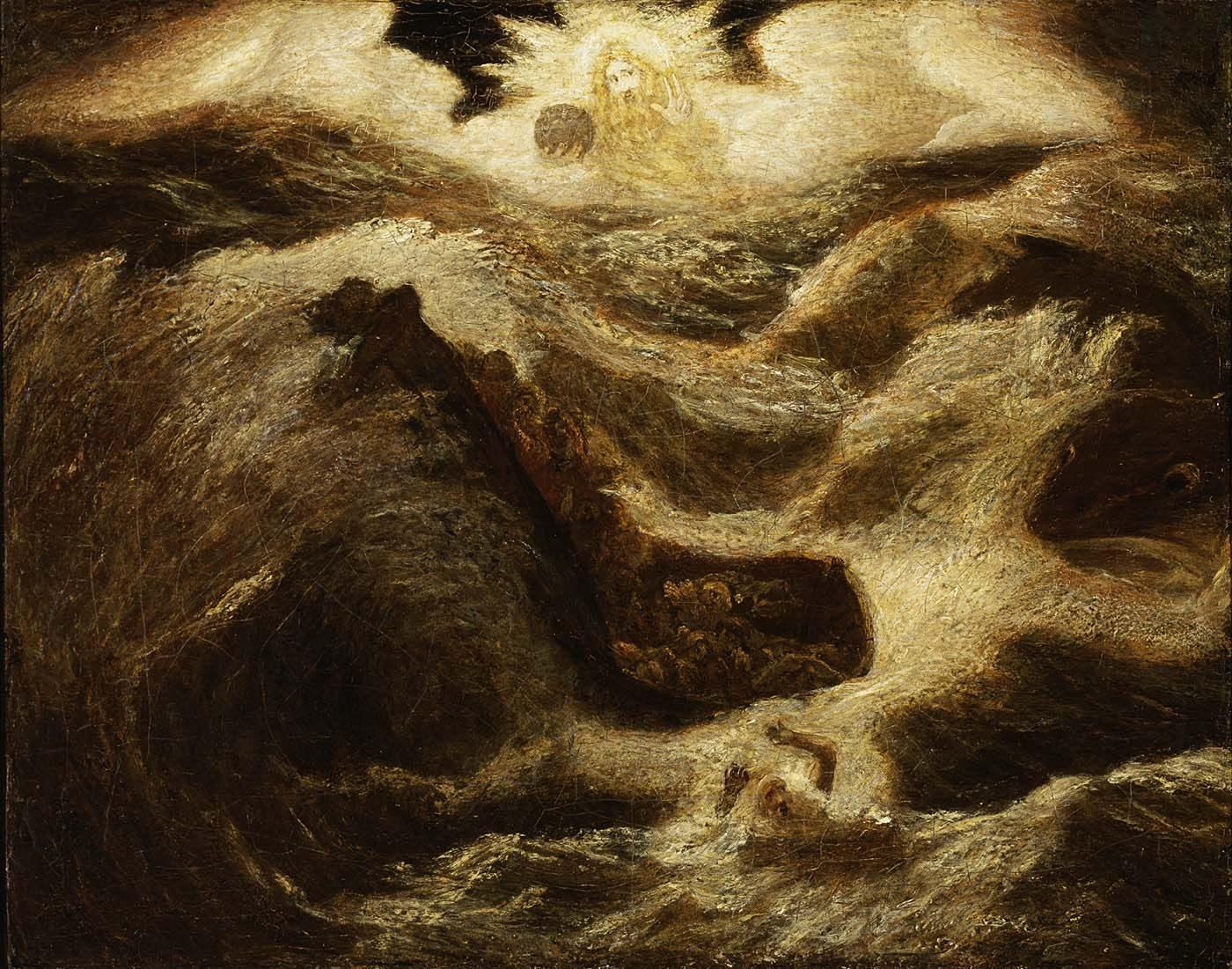
Albert Pinkham Ryder, Jonah, 1885 to 1895. Public domain.
2 Kings 14:25 and Jonah 1 to 4 · Person · Featured Study
Jonah
Jonah was a prophet from Gath-hepher who carried the LORD's word in Israel and to Nineveh.
So should I not care about the great city of Nineveh, which has more than 120,000 people who cannot tell their right hand from their left, and many cattle as well?”
- The name means
- dove
- Family
- father: Amittai
- Places
- Joppa, Nineveh
- First named
- 2 Kings 14:25 “…had spoken through His servant Jonah son of…”
- Last named
- Luke 11:32 “…repented at the preaching of Jonah, and now…”
Jonah is never called a prophet in his own book.
Summary
God told Jonah to go to Nineveh and warn it, and he took a ship the other way. A storm came, and the sailors threw him into the sea. A great fish swallowed him and later put him on dry land. Then he went to Nineveh and gave God's warning. The city was spared, and he was angry.
- Jamieson, Fausset and Brown called him the only prophet who kept back a message he was given.
- His father's name, Amittai, is the Hebrew for truth.
- His home town lay a short way from Nazareth, by Albert Barnes's reckoning.
Where Jonah Stands in Scripture
His story begins in the history of Israel's kings, before his own book.
This Jeroboam restored the boundary of Israel from Lebo-hamath to the Sea of the Arabah, according to the word that the LORD, the God of Israel, had spoken through His servant Jonah son of Amittai, the prophet from Gath-hepher.This verse gives his father, his town and the only prophecy of his recorded outside his book.
The four chapters of his own book tell the rest of his story.
Cyril of Alexandria, in the fifth century, wrote on Jonah's place among the prophets of Israel.
“The Divinely inspired Jonah was the son of Amittai, and came from Gath-hepher, a little city or town of the land of the Jews, so the story goes. You could find Jonah uttering a great number of oracles to the Jewish people, transmitting the words from God on high and clearly foretelling the future. Though no other prophetic text from him is extant than this one, though, the divinely inspired Scripture confirms that he continued predicting to the Jewish masses what would happen in the future times.”
Cyril of Alexandria · Commentary on the Twelve Minor Prophets, Jonah · on Jonah 1:1Patristic
His Life, Turn by Turn
Scripture records the turns of his life in Second Kings and in his own book.
Most of the turns of his life happen at sea or at Nineveh.
- Speaks the word that Israel's border will be restoredIsrael, in the reign of Jeroboam son of Jehoash2 Kings 14:25
- Is told to preach against Ninevehnot stated in the textJonah 1:2
- Pays the fare on a ship bound for TarshishJoppaJonah 1:3
- Lies asleep in the lowest part of the shipat seaJonah 1:5
- Admits to the crew that he is running from the LORDat seaJonah 1:10
- Tells the crew to throw him overboardat seaJonah 1:12
- Is swallowed by a great fishthe seaJonah 1:17
- Prays to the LORD from inside the fishthe seaJonah 2:1
- Is thrown up onto dry landdry landJonah 2:10
- Announces that Nineveh will be overturned in forty daysNinevehJonah 3:4
- Asks the LORD to take his lifeNinevehJonah 4:3
- Builds a shelter and waits to see the city's endeast of NinevehJonah 4:5
Only the first turn stands outside the book of Jonah.
Is swallowed by a great fish, Prays to the LORD from inside the fish, Is thrown up onto dry land, Announces that Nineveh will be overturned in forty days, Asks the LORD to take his life, Builds a shelter and waits to see the city's end
Five Scenes of His Life
His life falls into five scenes, from Jeroboam's Israel to the shelter east of Nineveh.
A prophet in Jeroboam's Israel2 Kings 14:23 to 25
The flightJonah 1:1 to 16
Jonah, however, got up to flee to Tarshish, away from the presence of the LORD. He went down to Joppa and found a ship bound for Tarshish. So he paid the fare and went aboard to sail for Tarshish, away from the presence of the LORD.The verse names his goal three times.
Charles Spurgeon, in his sermon Runaway Jonah and the Convenient Ship (1890), held that Jonah did not think he could get away from God. He wanted to get away from serving God as a prophet.
Inside the fishJonah 1:17 to 2:10
From inside the fish, Jonah prayed to the LORD his God,It is his only prayer in the first three chapters.
At NinevehJonah 3:1 to 10
“Get up! Go to the great city of Nineveh and proclaim to it the message that I give you.”The second call opens with the same words as the first.
East of the cityJonah 4:1 to 11
Then Jonah left the city and sat down east of it, where he made himself a shelter and sat in its shade to see what would happen to the city.His shelter east of the city is the last place the book puts him.
The Circle of Jonah
Six people and groups stand around him in the text.
His circle ran from his father to strangers on a ship and in a foreign city.
Generation 1
- AmittaiHis father
Generation 2
- Jeroboam son of JehoashThe king whose border he foretold
- The ship's captainCame to him in the storm
- The sailorsCast the lots that fell on him
- The king of NinevehHeard of his warning by report
- The people of NinevehHeard his warning in their streets
The captain and the king of Nineveh are named only by their office.
The Places of His Life
Four places are named in his story, from Zebulun's border to the capital of Assyria.
He sailed from Joppa for Tarshish and ended outside Nineveh.
| Place | What Scripture tells of it | When |
|---|---|---|
| Gath-hepher | His home town, on the border of Zebulun's land (Joshua 19:13). | In the reign of Jeroboam (2 Kings 14:25) |
| Joppa | The port where he found a ship. | At his flight (Jonah 1:3) |
| Tarshish | The port he set out for and never reached. | At his flight (Jonah 1:3) |
| Nineveh | The city he warned, and the place east of it where he waited. | At the second call (Jonah 3:3) |
Was Jonah the Widow's Son?
Kings tells of a widow's son raised by Elijah, and a Jewish tradition gives that son a name.
The Jewish traditionPirke de Rabbi Eliezer 33, a midrash edited about the eighth or ninth century
Pirke de Rabbi Eliezer is a Jewish midrash that retells the biblical story. It is traditionally ascribed to Rabbi Eliezer ben Hyrcanus of the second century and was likely edited in the eighth or ninth century.
It says that the widow of Zarephath who took Elijah in was the mother of Jonah. In its telling, Jonah was the boy who died in her house and was given back to her alive.
Gerald Friedlander published an English translation of the work in 1916.
What Kings records1 Kings 17:17 to 24
And the LORD listened to the voice of Elijah, and the child’s life returned to him, and he lived.Kings never gives the boy's name.
The book of Jonah names his father, Amittai, and never his mother, so the tradition cannot be tested from the text.
What the Text Leaves Unsaid
Scripture tells little of his life beyond the two calls.
It records neither his birth nor his death.
It names no wife and no child of his.
It does not say where the fish left him or whether he ever went home.
How Jesus Spoke of Him
Outside his book, the Berean text names Jonah in one verse of Kings and seven verses of the Gospels.
The seven Gospel verses fall in three sayings of Jesus, two in Matthew and one in Luke. A different man, Simon son of Jonah, is named at Matthew 16:17.
Jesus replied, “A wicked and adulterous generation demands a sign, but none will be given it except the sign of the prophet Jonah.Matthew gives this saying a second time at Matthew 16:4.
Voices on Jonah
John Calvin and Augustine of Hippo wrote on the prophet's last chapter.
Augustine of Hippo (died 430)
LETTER 102:6
Augustine, in his Letter 102, read Jonah in his shelter as a picture of Israel, sad that the Gentiles were spared.
“But when Jonah made himself a booth and sat down opposite the city of Nineveh, waiting to see what would befall it, the prophet played a part of different significance. He was a type of the carnal people of Israel, for he was sad over the preservation of the Ninevites! He was frustrated over the redemption and salvation of the Gentiles! This is why Christ came to call ‘not the just but sinners to repentance.’ But the shadow of the vine over his head was the promise of the Old Testament. Its law manifested, as the apostle says, ‘a shadow of things to come.’ God was offering shade from the heat of temporal evils in the land of promise.”
on Jonah 4:5 to 6Patristic
John Calvin (1509 to 1564)
Commentaries
Calvin read Jonah's own words in chapter 4 as a confession that his grief went too far.
“Though the beginning may not have been wrong, yet excess was sinful. But he confesses that there was excess, and want of moderation in his grief: since then he accuses himself in plain words what good is it, by false and invented pretenses, to cover what we clearly see cannot be excused?”
on Jonah 4:1Reformed
Where Was Jonah Buried?
A village in Galilee and a shrine in Mosul have each been shown as his grave.
At Gath-hepher, his home townAlbert Barnes, Notes on Joshua 19:13
Albert Barnes placed Gath-hepher at the village of El-Meshhad, on the road to Tiberias. He wrote that the prophet's tomb was still shown there in his day.
The objection: Barnes calls the site probable, and Scripture gives Gath-hepher as Jonah's home without saying he died there.
At Nineveh, in MosulThe Nebi Yunus shrine at Mosul
The Nebi Yunus shrine in Mosul held what Muslims and Christians believed to be Jonah's tomb, and it stood over a palace built for the Assyrian king Sennacherib.
Islamic State militants blew up the shrine in July 2014, and satellite images taken on 19 and 30 July 2014 confirm its destruction.
The objection: Scripture leaves Jonah outside Nineveh at the end of his book and records no death or burial there.
I Am a Hebrew
“I am a Hebrew,” replied Jonah. “I worship the LORD, the God of the heavens, who made the sea and the dry land.”In the storm he named his people and his God.
Sources
Scripture is the Berean Standard Bible.
- The site's Hebrew lexicon rows h3124 (Yonah, the man), h3123 (yonah, a dove) and h573 (Amittai)
- Pirke de Rabbi Eliezer, chapter 33, translated by Gerald Friedlander (London, 1916), public domain; with Sefaria's description of the work.
- Josie Ensor, Previously untouched 600BC palace discovered under shrine demolished by Isil in Mosul, The Telegraph, 28 February 2017; Dana Ford and Mohammed Tawfeeq, Extremists destroy Jonah's tomb, officials say, CNN, 24 July 2014; American Association for the Advancement of Science, Mosul, Iraq: Destruction of Nebi Yunis (Tomb of the Prophet Jonah)
- Cyril of Alexandria, Commentary on the Twelve Minor Prophets, on Jonah 1:1; Charles Spurgeon, sermon 2171, Runaway Jonah and the Convenient Ship; John Calvin's commentary on Jonah 4:1; Augustine of Hippo, Letter 102, section 6; Jamieson, Fausset and Brown, Commentary Critical and Explanatory on the Whole Bible (1871), on Jonah 1:1 and 1:3; Albert Barnes, Notes, Explanatory and Practical, on Joshua 19:13.
Keep Studying
Read it6
Studies6
People and groups5
Doctrines4
Go further6
Values2