
Exodus 20 · Deuteronomy 5 · Subject · Featured Study
The Numbering of the Ten Commandments
The three ways Jewish, Orthodox, Reformed, Catholic and Lutheran readers count the ten words of Exodus 20 and Deuteronomy 5, and how they divide them between the two tablets.
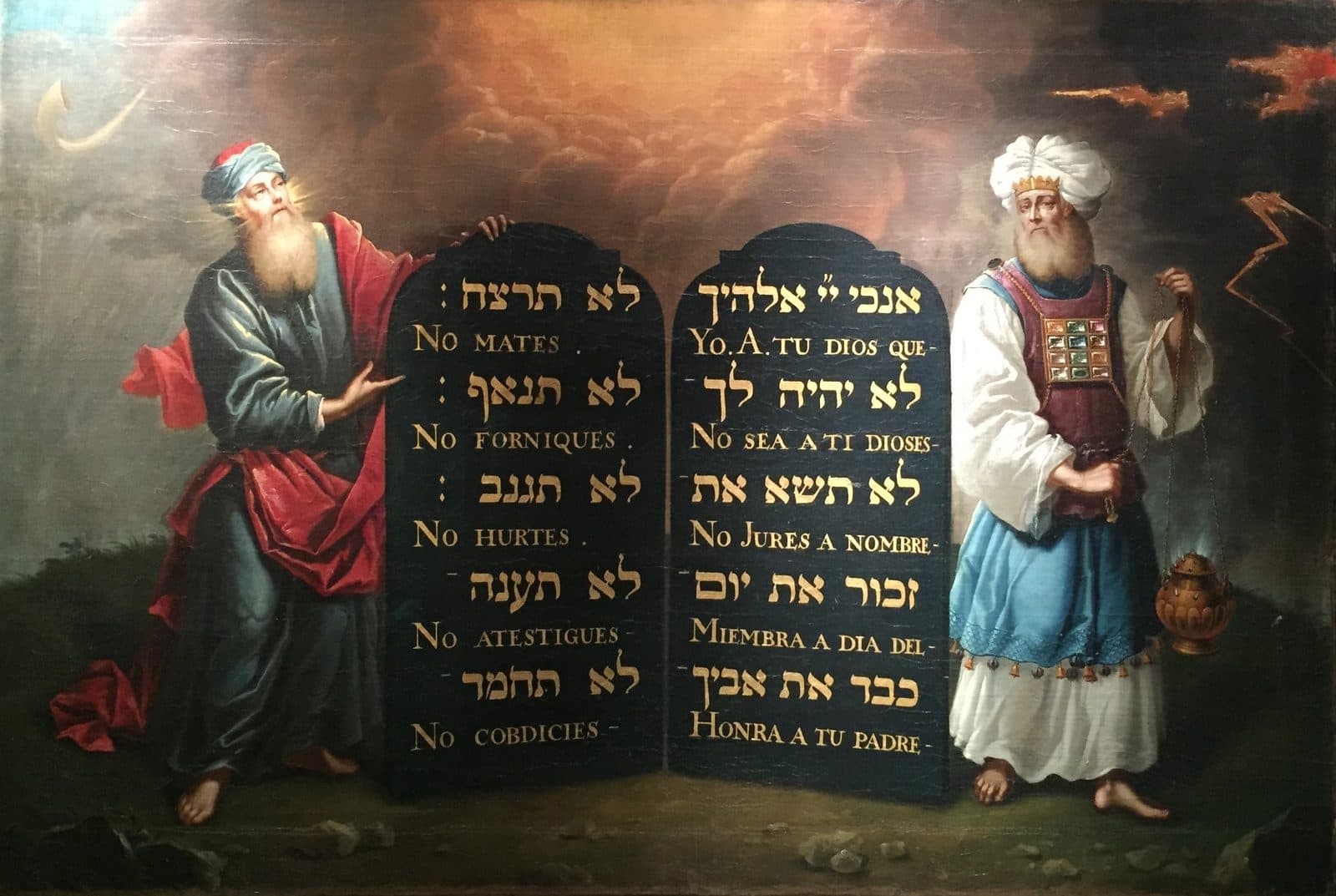
Aron de Chavez, Moses and Aaron with the 10 Commandments, 1674 to 1675, held by the Sephardi community in London. Public domain by date, via Wikimedia Commons.
THE ARTWORKAron de Chavez painted the two tablets with five words on each, in Hebrew with Spanish beneath. The right-hand tablet opens with the Hebrew of “I am the LORD your God,” the words Jewish practice counts as the first of the ten.
Jews, Catholics and Protestants have the same ten words from Sinai, and they number them in three different ways.
Summary
Scripture calls the commandments ten words and never numbers them one by one, so each tradition has made its own count.
- Jewish practice counts the LORD's opening words, where He names His rescue of Israel from Egypt, as the first word.
- Philo, Josephus, the Orthodox and the Reformed count the ban on idols as a word of its own.
- Augustine, the Catholic Church and Luther join the ban on idols to the first word and count the coveting as two.
- The Hebrew text itself sets the commandments in ten paragraphs, and Exodus and Deuteronomy order the last two differently.
Where Scripture Counts the Ten
Four passages in Exodus and Deuteronomy give the number ten or close the list
Scripture gives the number ten three times, and each time it ties the ten to the tablets of stone.
So Moses was there with the LORD forty days and forty nights without eating bread or drinking water. He wrote on the tablets the words of the covenant—the Ten Commandments.Exodus calls the writing on the second tablets the words of the covenant and gives their number as ten.
The LORD spoke these commandments in a loud voice to your whole assembly out of the fire, the cloud, and the deep darkness on the mountain; He added nothing more. And He wrote them on two tablets of stone and gave them to me.Moses says the LORD added nothing more to these words, so the list is closed at ten.
The count in Moses' address beyond the JordanDeuteronomy 4:13
He declared to you His covenant, which He commanded you to follow—the Ten Commandments that He wrote on two tablets of stone.Moses repeats the count to the generation about to cross the Jordan.
The count on the second tabletsDeuteronomy 10:4
And the LORD wrote on the tablets what had been written previously, the Ten Commandments that He had spoken to you on the mountain out of the fire on the day of the assembly. The LORD gave them to me,The second tablets carry the same ten that God had spoken from the fire.
The Ten Words Numbered Three Ways
The coveting of verse 17 takes three lines, since the counts divide it differently
| The words | Jewish | Philo, Orthodox and Reformed | Augustine, Catholic and Lutheran |
|---|---|---|---|
| I am the LORD your God, who brought you out of Egypt | 1 | not counted alone | not counted alone |
| No other gods before Me | 2 | 1 | 1 |
| No idol, and no bowing down to one | 2 | 2 | within 1; not listed by Luther |
| The name of the LORD never taken in vain | 3 | 3 | 2 |
| Remember the Sabbath day | 4 | 4 | 3 |
| Honor your father and mother | 5 | 5 | 4 |
| No murder | 6 | 6 | 5 |
| No adultery | 7 | 7 | 6 |
| No stealing | 8 | 8 | 7 |
| No false witness | 9 | 9 | 8 |
| No coveting of your neighbor's house | 10 | 10 | Catholic 10; Lutheran 9 |
| No coveting of your neighbor's wife | 10 | 10 | Catholic 9; Lutheran 10 |
| No coveting of his servants, ox, donkey or anything that is his | 10 | 10 | 10 |
- Jewish
- 1
- Philo, Orthodox and Reformed
- not counted alone
- Augustine, Catholic and Lutheran
- not counted alone
- The words
- No other gods before Me
- Jewish
- 2
- Philo, Orthodox and Reformed
- 1
- Augustine, Catholic and Lutheran
- 1
- The words
- No idol, and no bowing down to one
- Jewish
- 2
- Philo, Orthodox and Reformed
- 2
- Augustine, Catholic and Lutheran
- within 1; not listed by Luther
- Jewish
- 3
- Philo, Orthodox and Reformed
- 3
- Augustine, Catholic and Lutheran
- 2
- The words
- Remember the Sabbath day
- Jewish
- 4
- Philo, Orthodox and Reformed
- 4
- Augustine, Catholic and Lutheran
- 3
- The words
- Honor your father and mother
- Jewish
- 5
- Philo, Orthodox and Reformed
- 5
- Augustine, Catholic and Lutheran
- 4
- The words
- No murder
- Jewish
- 6
- Philo, Orthodox and Reformed
- 6
- Augustine, Catholic and Lutheran
- 5
- The words
- No adultery
- Jewish
- 7
- Philo, Orthodox and Reformed
- 7
- Augustine, Catholic and Lutheran
- 6
- The words
- No stealing
- Jewish
- 8
- Philo, Orthodox and Reformed
- 8
- Augustine, Catholic and Lutheran
- 7
- The words
- No false witness
- Jewish
- 9
- Philo, Orthodox and Reformed
- 9
- Augustine, Catholic and Lutheran
- 8
- The words
- No coveting of your neighbor's house
- Jewish
- 10
- Philo, Orthodox and Reformed
- 10
- Augustine, Catholic and Lutheran
- Catholic 10; Lutheran 9
- The words
- No coveting of your neighbor's wife
- Jewish
- 10
- Philo, Orthodox and Reformed
- 10
- Augustine, Catholic and Lutheran
- Catholic 9; Lutheran 10
- Jewish
- 10
- Philo, Orthodox and Reformed
- 10
- Augustine, Catholic and Lutheran
- 10
How the Words Are Divided Between the Tablets
Three divisions of the ten between two tablets, each with the readers who hold it
Readers who count four words toward God end the first tablet with the Sabbath, and readers who count five end it with the honor of parents.
Five and fivePhilo, On the Decalogue; Josephus, Antiquities 3
Philo divides the ten into two tables of five. He sets the honor of parents at the end of the first, since he holds that parents stand on the border between the immortal and the mortal. He begins the second table with adultery, before murder. Josephus also writes that the tablets carried five commandments each.
The objection: Calvin answers in his Institutes that Jesus places the honor of parents among the commands toward the neighbor.
“Which ones?” the man asked. Jesus answered, “‘Do not murder, do not commit adultery, do not steal, do not bear false witness, honor your father and mother, and love your neighbor as yourself.’”Jesus gives this answer to the young man who asked which commandments he must keep to enter life.
Four and sixWestminster Confession 19.2; the Orthodox Longer Catechism
The Westminster Confession puts four commandments in the first table, containing our duty toward God, and six in the second, containing our duty to man. The Longer Catechism of the Orthodox Church, published in Moscow in 1830, teaches the duties toward God in the first four and the duties toward the neighbor in the last six. Jamieson, Fausset and Brown give the same four and six in their note on Exodus 20:8.
The objection: this division needs the ban on idols counted as a word of its own, and Augustine read that ban as the first commandment itself, the worship of God by no likeness.
Three and sevenAugustine, Letter 55
Augustine counts three commandments toward God and seven toward the neighbor, and he ties the two groups to the two commandments of love on which the whole law hangs.
The objection: Calvin writes that this division was unknown in the earlier church.
What the Text Says of the Count
Three things the verses state, each with its verse
TEN WORDS BY SCRIPTURE'S OWN NAME
The Hebrew of this verse calls them the ten words, and the Greek deka, ten, and logos, word, give the name Decalogue.
THE OPENING WORDS OF THE TEN
The LORD names Himself and His rescue of Israel from the house of slavery, and the verse gives no command of its own.
DEUTERONOMY NAMES THE WIFE FIRST
Deuteronomy 5:21 names the neighbor's wife before his house and adds his field, where Exodus 20:17 names the house first.
The Paragraphs and Verses of the Hebrew Text
The Masoretic text sets the ten in paragraphs and numbers its verses differently from English Bibles
The Masoretic text, the Hebrew text handed down by the Jewish scribes, marks paragraph breaks within the ten, and in both Exodus and Deuteronomy the breaks give ten paragraphs.
The ten paragraphs of Exodus 20 and Deuteronomy 5the Masoretic text on Sefaria
| Paragraph | Its words | Exodus 20 | Deuteronomy 5 |
|---|---|---|---|
| 1 | I am the LORD, no other gods, no idol | verses 2 to 6 | verses 6 to 10 |
| 2 | The name of the LORD | verse 7 | verse 11 |
| 3 | The Sabbath day | verses 8 to 11 | verses 12 to 15 |
| 4 | Honor your father and mother | verse 12 | verse 16 |
| 5 | No murder | verse 13 | verse 17 |
| 6 | No adultery | verse 14 | verse 18 |
| 7 | No stealing | verse 15 | verse 19 |
| 8 | No false witness | verse 16 | verse 20 |
| 9 | The first clause on coveting | your neighbor's house, verse 17 | your neighbor's wife, verse 21 |
| 10 | The second clause on coveting | his wife and all he has, verse 17 | his house, his field and all he has, verse 21 |
- Paragraph
- 1
- Its words
- I am the LORD, no other gods, no idol
- Exodus 20
- verses 2 to 6
- Deuteronomy 5
- verses 6 to 10
- Paragraph
- 2
- Its words
- The name of the LORD
- Exodus 20
- verse 7
- Deuteronomy 5
- verse 11
- Paragraph
- 3
- Its words
- The Sabbath day
- Exodus 20
- verses 8 to 11
- Deuteronomy 5
- verses 12 to 15
- Paragraph
- 4
- Its words
- Honor your father and mother
- Exodus 20
- verse 12
- Deuteronomy 5
- verse 16
- Paragraph
- 5
- Its words
- No murder
- Exodus 20
- verse 13
- Deuteronomy 5
- verse 17
- Paragraph
- 6
- Its words
- No adultery
- Exodus 20
- verse 14
- Deuteronomy 5
- verse 18
- Paragraph
- 7
- Its words
- No stealing
- Exodus 20
- verse 15
- Deuteronomy 5
- verse 19
- Paragraph
- 8
- Its words
- No false witness
- Exodus 20
- verse 16
- Deuteronomy 5
- verse 20
- Paragraph
- 9
- Its words
- The first clause on coveting
- Exodus 20
- your neighbor's house, verse 17
- Deuteronomy 5
- your neighbor's wife, verse 21
- Paragraph
- 10
- Its words
- The second clause on coveting
- Exodus 20
- his wife and all he has, verse 17
- Deuteronomy 5
- his house, his field and all he has, verse 21
The verse numbers of the Hebrew textExodus 20:13 to 17
The Hebrew text sets the commands against murder, adultery, theft and false witness in one verse, numbered 13, and the coveting in verse 14. After verse 12 its numbers for Exodus 20 therefore run three behind the English. Rashi's notes follow the Hebrew numbers, and on Deuteronomy 5 he sends the reader back to Exodus 20:1 to 14 for the whole of the ten.
What the Text Leaves Unsaid
Three questions the verses leave open
No verse numbers the ten one by one, and no verse says whether the opening words of verse 2 are a word to be counted or the words that come before the first command.
And God spoke all these words:The ten open with this one line of narrative, which names the speaker and nothing more.
No verse says how many words stood on each tablet.
Then Moses turned and went down the mountain with the two tablets of the Testimony in his hands. They were inscribed on both sides, front and back. The tablets were the work of God, and the writing was the writing of God, engraved on the tablets.The writing on both sides is the one detail of the layout that Exodus gives.
Two Teachers on the Ten Words
John Calvin and Matthew Henry, each with the work named
Calvin explains why the LORD names Himself before He gives a command.
“And surely it was necessary that, first of all, the right of the legislator should be established, lest what He chose to command should be despised, or contemptuously received. In these words, then, God seeks to procure reverence to Himself, before He prescribes the rule of a holy and righteous life.”
John Calvin · Commentaries · on Exodus 20:2Reformed
Henry gives two reasons the law was written in stone.
“The law was written in tables of stone, to denote the perpetual duration of it (what can be supposed to last longer than that which is written in stone, and laid up?), to denote likewise the hardness of our hearts; one might more easily write in stone than write any thing that is good in our corrupt and sinful hearts.”
Matthew Henry · Commentary on the Whole Bible · on Exodus 31:18Puritan
The Reasons Behind Each Count
Each count with the reason its holders give and the strongest objection
Calvin held the count of Philo and Josephus, and he still wrote that every reader should have full freedom of judgment on the division and that difference of opinion should not lead to contention.
The rescue from Egypt as the first wordRashi on Exodus 20:1 and 20:2
Rashi, citing the Mekhilta, teaches that God spoke all the words in one utterance and then spoke the first two again, each by itself. He reads the rescue from Egypt as reason enough for Israel to subject itself to the LORD.
The objection: the Westminster Shorter Catechism calls Exodus 20:2 the preface to the ten and begins the count at verse 3.
The ban on idols as the second wordPhilo; Josephus; the Westminster Shorter Catechism; the Orthodox Longer Catechism
The Westminster Shorter Catechism reads the second commandment as forbidding the worship of God by images or any other way not appointed in His word. The Orthodox Longer Catechism reads it as forbidding any bowing down to graven images as to supposed deities. On this reading the first commandment names the God to be worshiped and the second the way He is worshiped.
The objection: the Catholic Encyclopedia of 1908 notes that this count must take Exodus 20:17 as a single commandment to keep the number at ten.
The coveting as two wordsAugustine; the Catholic Encyclopedia (1908); Luther's Small Catechism (1529)
Augustine refers the first commandment to the Father, the second to the Son and the third to the Holy Spirit. The Catholic Encyclopedia states that the Catholic Church follows the division Augustine set out in his Questions on Exodus, and Luther's Small Catechism keeps the same count.
The objection: Calvin argues in his Institutes that the Lord set down the commandment on images as a separate one, and he calls the splitting of the tenth into two absurd.
Books on the Ten Words
Seven older works that set out a count, each free to read
On the Decalogue
Philo of Alexandria, translated by C. D. Yonge · first century
Philo comments on each of the ten in turn, beginning with the one God.
READ IT FREE AT CCEL →Antiquities of the Jews
Flavius Josephus, translated by William Whiston · 1737
Book 3 gives the ten in order, from the one God to coveting.
READ IT FREE AT PROJECT GUTENBERG →Letter 55, to Januarius
Augustine of Hippo · 400
Augustine answers questions on the date of Easter, and chapters 11 and 12 of the letter treat the ten.
READ IT FREE AT NEW ADVENT →Small Catechism
Martin Luther · 1529
The catechism gives each commandment with its verse and its meaning for a household.
READ IT FREE AT CCEL →Institutes of the Christian Religion
John Calvin, translated by Henry Beveridge · 1845
Book 2, chapter 8 weighs the divisions of the ten before Calvin expounds each commandment.
READ IT FREE AT CCEL →The Westminster Shorter Catechism
The Westminster Assembly · 1647
The catechism takes the preface and each of the ten in turn, in questions 41 to 81.
READ IT FREE AT CCEL →The Creeds of Christendom, volume 2
Philip Schaff · 1877
The volume gives the Orthodox Longer Catechism of 1830 in English.
READ IT FREE AT CCEL →Love Is the Fulfillment of the Law
Whatever count a church keeps, Christ teaches the ten as love for God first and love for the neighbor second, and Paul follows Him.
Jesus declared, “‘Love the Lord your God with all your heart and with all your soul and with all your mind.’ This is the first and greatest commandment. And the second is like it: ‘Love your neighbor as yourself.’ All the Law and the Prophets hang on these two commandments.”Where the churches number the ten by position, this answer ranks the law's commands by weight.
The commandments “Do not commit adultery,” “Do not murder,” “Do not steal,” “Do not covet,” and any other commandments, are summed up in this one decree: “Love your neighbor as yourself.” Love does no wrong to its neighbor. Therefore love is the fulfillment of the law.Paul cites four of the ten by their words and gives none of them a number.
Keep studying
Studies6
Symbols1
Doctrines7
Peoples and groups1