
Genesis 3 · The Fall · Featured Study
The Fall & the Protoevangelium
One command, one transgression, and the whole creation fractures into enmity, pain, thorns, exile, and death. Yet before the sentence is even spoken over the man and the woman, God turns to the serpent and promises a Deliverer: the seed of the woman who will crush the serpent's head. This is the protoevangelium: the first gospel.
Summary
This page walks the five steps of the temptation, the three curses spoken over the serpent, the woman, and the man, and how three commentators across history have read the promise folded into Genesis 3:15.
- Traces five stages from the serpent's question to the hiding in the garden
- Lays out the curses to the serpent, the woman, and the man side by side, each with a promise folded in
- Shows God clothing Adam and Eve in animal skins, a first picture of a covering that costs a life
- Gathers readings from John Calvin, Matthew Henry, and Chuck Missler on the promised seed
The Garden Before the Wound
the painting Genesis 3 is set in

Two painters, one canvas: Brueghel filled Eden with the crowded abundance of the animal kingdom (lions beside lambs, birds thick in the branches) and Rubens set Adam and Eve at the one tree in the middle of it, the moment before the fracture described below. The peace of the whole garden is the thing the next five verses undo.
The Anatomy of the Fall
how sin entered
- 1The questionGen 3:1
“Yea, hath God said…?”, the serpent turns God's generous word into a stingy prohibition.
- 2The lieGen 3:4–5
“Ye shall not surely die… ye shall be as God, knowing good and evil.”, the first denial of God's word and character.
- 3The lookGen 3:6
She saw it was good for food, pleasant to the eyes, and desirable to make wise, the pattern of 1 John 2:16.
- 4The actGen 3:6–7
She took, ate, and gave, and the eyes that were promised opening saw only shame.
- 5The hidingGen 3:8
They sew fig-leaves and hide from the God who walks in the garden, sin's first instinct.
The Curses & the Promise
3:14–24
To the serpent, 3:15
“I will put enmity… he shall bruise thy head.” The first gospel: the seed of the woman against the serpent, fulfilled in Christ (Rom 16:20; Gal 3:16).
To the woman, 3:16
Pain in childbearing; the strain in marriage, yet through her seed comes salvation.
To the man, 3:17–19
Thorns, sweat, and a return to dust, the ground cursed for his sake; death enters the world.
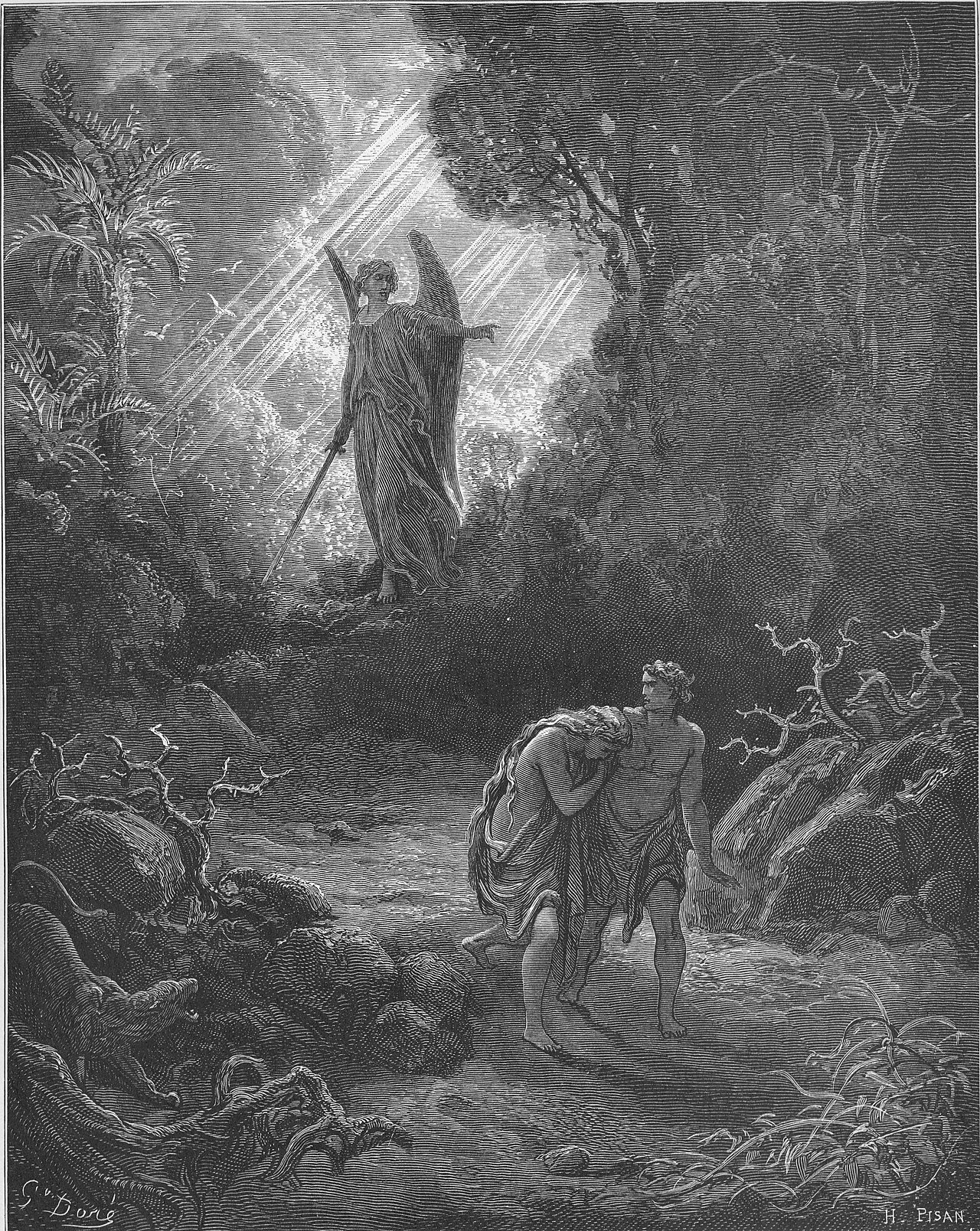
Then God clothes them in coats of skin (3:21), human fig-leaves replaced by a covering that costs a life, the first shadow of “Behold the Lamb of God” (John 1:29).
Where the Tradition Has Stood
the protoevangelium in the commentators
- John Calvin (public domain): his commentary on Genesis reads 3:15 as the first announcement of Christ's victory, the whole gospel already folded into one sentence spoken to the serpent.
- Matthew Henry (public domain): his Commentary on the Whole Bible traces the chapter's own mixture of judgment and mercy, each of the three curses carrying a promise folded inside the sentence.
- Chuck Missler (modern; cited): taught the seed of the woman as the opening move of a lineage the rest of the Old Testament keeps under attack, a thread he traced forward toward the virgin birth.
Keep studying
Read it1
By subject
Creation7 pages
Angels17 pages
On this page
Places1
Words1
Go further2